For most of the last decade, “flagship” meant a predictable checklist: the best camera system, the fastest chip, the brightest slab of glass.
That definition is quietly breaking.
The next wave of new flagship phones won’t win because they post the highest benchmark score. They’ll win because they reduce friction in the moments you actually care about: switching between work and life, handling sensitive conversations, making decisions while traveling, and getting answers that don’t require handing your context to ten different apps.
Foldables and on-device AI didn’t arrive at the same time by accident. Together, they change what a phone is: less a device you operate, more a system you command.
Why new flagship phones are being redefined
The flagship category is still premium, but the value story is shifting.
From specs to workflows. A phone that helps you move from intent to outcome (message drafted, meeting summarized, itinerary adjusted) starts to feel “flagship” even if it isn’t the loudest on paper.
From single app experiences to orchestration. AI features live across the OS now: camera, notes, messaging, translation, search.
From always-cloud to hybrid. The most trusted experiences increasingly split work between on-device processing and controlled cloud compute, because latency and privacy are no longer niche concerns.
This is also why “flagship” is getting more expensive to define. Digital Trends describes an AI-driven “entry fee” for brands: modern chips, memory, infrastructure, partnerships, and longer support windows are becoming table stakes for being taken seriously in the premium tier (Digital Trends on the AI phone era and the cost of competing).
Why foldables are back in the flagship conversation
Foldables have been “the future” for long enough that people stopped believing the promise. The early devices earned skepticism.
What’s changed is not a single feature. It’s accumulated engineering maturity, plus the simple fact that the foldable form factor solves a real flagship problem: screen space without giving up portability.
Wirecutter, which historically advised most people to skip foldables, now treats them as viable daily devices, with the sensible caveat that they remain expensive and insurance is wise (Wirecutter’s guide to the best foldable phones). That’s a quiet but meaningful bar.
Foldables are getting measurably more durable
Durability isn’t a marketing line anymore; it’s an engineering battleground.
Samsung’s own foldables engineering notes are unusually specific. In one recent example, it highlights a hinge that’s 27% thinner and 43% lighter, new alloys with 14% higher yield strength, and Ultra Thin Glass that’s 50% thicker to make the crease less visible (Samsung Mobile Press on Armor FlexHinge and thicker UTG).
You don’t need those numbers to buy a phone. But their existence matters: it signals that the foldable category is now being refined like a mature product line, not a prototype.
If you’re evaluating a foldable in person, don’t obsess over whether a crease exists. Learn whether it will bother you.
Use harsh overhead lighting to find the worst case.
Tilt slowly to see at which angles the crease shows.
Run a finger across the fold; you’re looking for a shallow, uniform transition.
VERTU has a practical explainer on what the crease is and how to judge it without getting seduced by “no-crease” claims (Foldable phone crease explained: what buyers should know).
And because hinge quality is where reality shows up, here’s the simplest test: open and close it repeatedly and listen. A premium hinge should feel quiet, controlled, and consistent, not gritty or inconsistent (How to judge foldable phone hinge quality).
AI is becoming the flagship feature (and why on-device matters)
A lot of “AI phone” marketing is just a new wrapper around old conveniences.
The real inflection is when AI starts to feel like a system feature, not a novelty:
it’s fast enough that you use it without thinking,
it works in more places than one app,
and it handles sensitive context without forcing you into a cloud-only bargain.
The metric people cite: TOPS (and why it’s not the whole story)
You’ll hear a lot about NPUs and “TOPS.”
Qualcomm defines TOPS (trillions of operations per second) as a metric for the potential peak AI inference performance of a processor’s NPU, with INT8 precision commonly used as the industry reference point (Qualcomm’s guide to AI TOPS and NPU metrics (2024)).
Think of TOPS like horsepower. It’s relevant, but it’s not the driving experience.
For buyers, the practical questions are simpler:
Which features run on-device?
Which features require cloud processing?
What happens when you’re offline, traveling, or in a low-signal environment?
What’s the privacy model when the feature needs your screen content, your voice, your calendar?
Why on-device AI changes the “flagship” feel
On-device AI isn’t just about speed. It changes the trust boundary.
When more intelligence happens locally:
fewer raw inputs need to leave the phone,
responses can be immediate,
and the device becomes more resilient in real life: airports, cars, hotels, boardrooms.
This is especially relevant for premium buyers who care about discretion. In other words: the flagship category is drifting toward “privacy by design,” not “privacy as a settings screen.”
VERTU frames mobile AI security as five surfaces you can actually control: authorization, transmission, storage, device isolation, and sensitive-action confirmation.
That framing is useful even if you never buy a luxury device, because it’s the right mental model for the next decade.
Foldables + AI: the new interaction model
AI wants more context. Foldables provide more canvas.
That’s the pairing.
A larger inner display isn’t just for watching video. It’s for running an AI-assisted workflow without collapsing everything into one tiny chat box:
a document on the left, an AI assistant on the right,
a meeting agenda above, action items below,
a contract excerpt and a redline summary side by side,
a travel disruption, your calendar, and rebooking options visible at once.
It starts to feel like a command terminal. Less tapping, more directing.
A quick example of “agentic” behavior on a phone
The next step beyond AI features is agentic AI: systems that don’t just answer, but help execute.
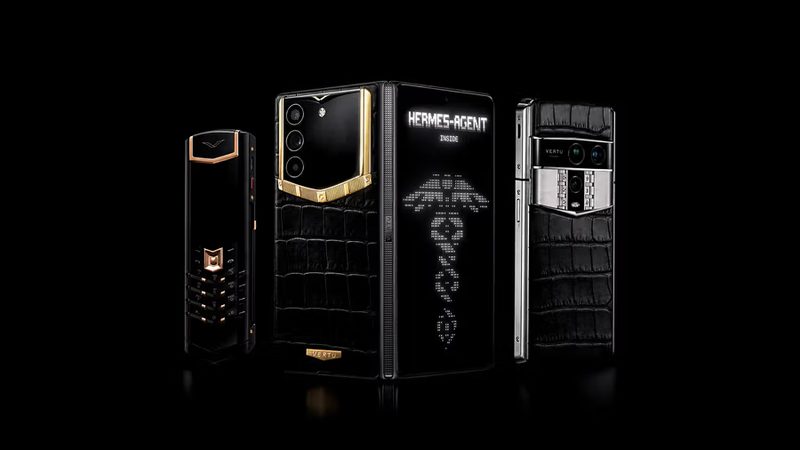
VERTU’s foldable framing is explicit here. Hermes Agent on AlphaFold is positioned as a private, permissioned “command terminal” that coordinates cross-app workflows, uses private spaces, and requires explicit approvals for sensitive actions (Hermes Agent inside AlphaFold).
This is the direction the market is moving toward, even if every brand uses different language for it: fewer “features,” more “outcomes.”
The tradeoffs buyers should keep in mind
Foldable AI devices are not automatically the best choice for everyone. A modern flagship still has to earn its price.
Repairability and total cost of ownership still matter
Foldables can be expensive to repair. The insurance recommendation from mainstream reviewers is not a throwaway line; it’s the reality of flexible displays and complex hinges.
If you’re trying to decide whether foldable is worth it, the most honest question is:
Do you actually benefit from a larger screen every day?
If not, a classic slab flagship may be the better long-term ownership experience.
Cloud AI can be convenient, but it changes the trust calculus
Even when your phone offers on-device intelligence, many “best” AI features still depend on cloud compute.
That’s not always a problem. But it should change how you think:
what gets uploaded,
what’s retained,
and how permissions escalate.
The safest flagship experiences will treat sensitive actions (payments, sending messages, changing security settings, exporting files) as a different category of risk, requiring explicit confirmation and clear previews.
Software support is the new premium spec
A flagship phone isn’t just hardware anymore. It’s the guarantee that your device stays secure while AI features evolve.
Longer support windows are becoming part of the premium definition, because AI capabilities will change faster than your upgrade cycle.
A quieter definition of “flagship” (and where VERTU fits)
In the US market, it’s easy to reduce flagships to the obvious winners: the biggest ecosystems, the most ad budget, the loudest keynote.
But the market is expanding into a second definition of flagship: phones that prioritize control, privacy boundaries, and ownership experience.
That’s where luxury players can be relevant without competing on the same battlefield.
VERTU’s approach is not “more specs.” It’s a blend of craftsmanship, privacy-first framing, and concierge-level service, with agentic AI positioned as a controlled operator rather than a chatty assistant.
If you’re curious about the concept of an agent phone as a category, VERTU’s explainer is useful context (What is the world’s first AI agent phone?).
Key takeaways
Key TakeawayThe next generation of new flagship phones will be defined by workflows (AI) as much as hardware.
Key TakeawayFoldables are re-entering the flagship tier because durability and usability are improving, and the larger canvas fits how AI wants to work.
Key TakeawayDon’t evaluate “AI phones” by a single metric. Ask where AI runs, what it can do, and what guardrails exist for sensitive actions.
FAQ
Are foldable phones durable now?
They’re significantly more durable than early generations, and improvements are increasingly measurable in hinge design, materials, and dust/water resistance. They’re still more complex than slab phones, so repair/insurance considerations remain part of ownership.
Do I need on-device AI to get a “flagship” experience?
Not strictly. But on-device AI often delivers faster responses and a better privacy posture for certain features. The best experiences are usually hybrid: some work on-device, some in the cloud.
What should I look for in a foldable hinge?
Quiet, consistent motion; stability at half-open positions; flush alignment when closed; and no new grinding sounds after repeated folds. The hinge is the part that reveals build quality over time.
Will the crease get worse over time?
In most cases, the crease is a stable cosmetic contour that may settle slightly with use. Sudden changes like flickering, touch issues, sharp ridges, or lifting protective layers are signs to service the device.
Next steps
If you’re tracking this shift, don’t start with model names. Start with a checklist:
Which daily workflows would you genuinely run better on a larger foldable canvas?
Which AI features must work offline or locally?
Which actions require explicit confirmation, and how clear are those guardrails?
For a practical security framework you can apply to any AI-enabled phone, see VERTU’s guide to mobile AI security.
Disclosure: This article references VERTU pages. Editorial judgment remains the priority.