


Introduction
A “most expensive phones in the world 2026” list can mean two very different things.
One category is mythology-with-paperwork: one-off jewel phones that are cited for record-setting prices, but often change hands privately (or not at all). The other is practical luxury: devices you can commission or purchase today, with a service pathway, warranty clarity, and support that won’t disappear the moment you travel.
This definitive 2026 guide covers both—without pretending they’re the same market.
Scope: The highest-cost phones publicly documented or widely cited as of 2026, plus contemporary luxury editions that are actually purchasable.
Verification notes: Where a figure comes from a public sale record, manufacturer list price, or a widely reported estimate, we mark that difference explicitly.
Update cadence: Rankings in this category shift less because of chipsets and more because of provenance, edition scarcity, and what gets publicly documented year to year (as many lists acknowledge when they rely on private sales and reported price bands, not transparent retail pricing).
Key takeaways: Separate record-holders from orderable editions; rank by verification strength; treat provenance as an audit trail; and insist on a software longevity commitment if you plan to carry the device.
For HNWIs and collectors, the point isn’t to win a dinner-party number. It’s to buy discreetly—minimizing provenance risk, maximizing longevity, and ensuring the object can be serviced, insured, transported, and eventually resold if needed.
The 2026 ranking of the most expensive phones in the world 2026
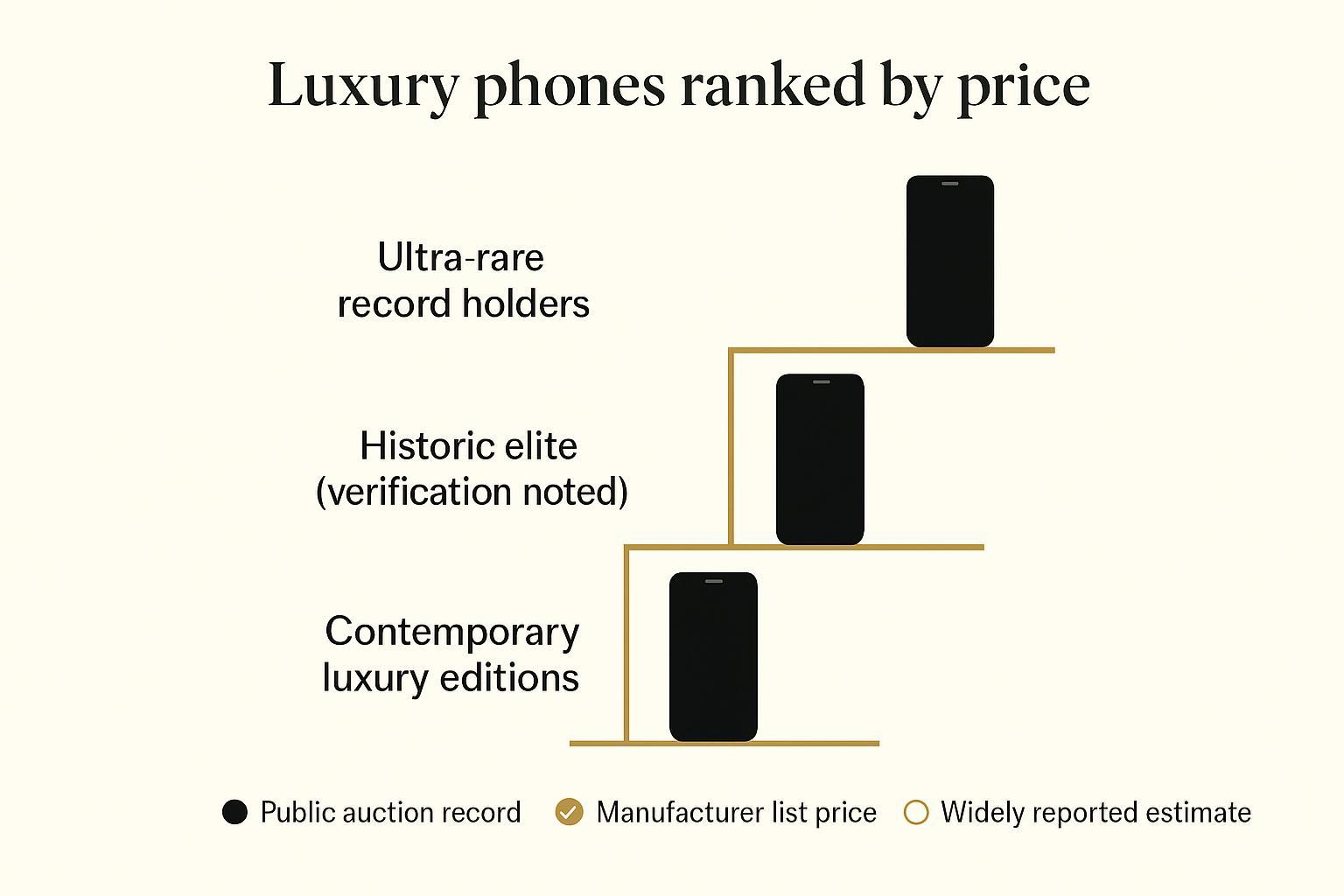
This ranking is ordered primarily by verification strength (public record > manufacturer list price > widely reported estimate), then by rarity and documented market relevance.
Ultra-rare record holders
These are the “top of the mountain” entries—typically one-offs or near-one-offs. Their value is driven by jewelry economics (stone grade, metalwork, maker story) more than device capability.
What to know before you care about the name: in this tier, the verification strength matters more than the headline number. A record-holder with unclear paperwork is just a rumor with a price tag.
How to verify: Ask whether the price is tied to a public transaction (auction record), a manufacturer’s list price, or a widely reported estimate. Treat anything else as marketing.
Examples you’ll repeatedly see cited in “most expensive phone” coverage include bespoke, jewel-encrusted iPhone commissions (often attributed to private clients) and extreme one-off builds from luxury customizers. Lists that compile these records often note that many figures are based on private commissions or reported estimates rather than clean auction data (see, for instance, the caveats in LuxuryProperty.com’s 2026 list).
Historic elite (verification noted)
This tier is where most “expensive phones in the world” lists spend their ink: iconic luxury models, earlier-era showpieces, and historically cited devices whose status persists because rarity outlasts technology.
You’ll commonly see:
jewel-focused models (diamonds, rubies, precious metals)
limited production runs
heritage luxury phone houses and famous collaborations
A useful example of how these historic lists are framed—and how little they often say about buyer workflow—is the classic “top 10” style coverage from outlets like Luxhabitat’s expensive-phone list. The names are memorable; the verification method usually isn’t.
Collector’s note: Historic doesn’t automatically mean “safe to buy.” In practice, the older the piece, the more the value depends on documentation completeness and serviceability—not the handset itself.
Contemporary luxury editions
This is the tier that matters if you intend to use the phone, not just vault it.
Here, “expensive” is typically a bundle:
materials + hand-assembly
limited edition logic (real scarcity, not just a colorway)
security posture (what the device and ecosystem meaningfully protect)
aftercare and service (global support, repairs, concierge-style assistance)
As a real-world example, VERTU sits in this “contemporary luxury editions” category: handcrafted construction and premium materials, paired with a service layer (often described as 24/7 concierge) and modern digital innovation including Web3/blockchain positioning in its brand profile. The practical point is not the logo—it’s the ownership stack: a luxury phone is only “worth it” if the maker can support the device and the owner’s workflow over time.
If you want a contemporary, brand-authored frame of today’s high-end landscape, see VERTU’s own perspective in most expensive phone right now—useful as a market lens, not as a substitute for independent verification.
How to evaluate
Before you compare a luxury smartphone price, decide what you’re actually pricing: materials, provenance, security posture, and the service pathway.
Materials and certification
Expensive phones in the world don’t justify their price by performance. They justify it by materials you can audit.
Start with the simple question: What part of this build is truly uncommon—and can it be certified?
Metals: look for hallmarks and documentation of purity and origin.
Gemstones: insist on third‑party lab reports (and verify report numbers directly with the issuing lab).
Assembly quality: settings, tolerances, edges, and transitions should read like fine jewelry—consistent and deliberate.
If you’re using VERTU as a reference point for what “materials + craft” pricing logic looks like, their own explanation of value drivers is captured in why VERTU phones are so expensive. Use it as a benchmark for questions you should ask any maker.
Provenance and documentation
For UHNW buyers, provenance is not paperwork theatre. It’s downside control—your authenticity checklist, in practice.
Minimum expectation for any high-value purchase:
proof of purchase / invoice
matching identifiers where applicable (serial, IMEI, edition numbers)
a clean chain of custody (who owned it, when, and where it was stored)
service history (especially if pre-owned)
For a practical “do this in this order” workflow, VERTU’s own buyer guidance is unusually explicit about treating authenticity as a process—identifiers first, then documents, then service history—see buy a VERTU phone safely.
There’s also a broader luxury-industry trend toward tamper-resistant digital provenance. The Aura Blockchain Consortium outlines why luxury brands adopt blockchain-style authenticity stamps in Authenticating luxury goods with blockchain. You don’t need a token to buy a phone—but you do want a record you can defend later.
How to verify: If a seller won’t share verifiable identifiers before money moves—or pushes off-platform payment—treat that as a decision, not a negotiation.
Security and software longevity
If you plan to carry the phone, “security” isn’t a single feature. It’s a maintenance commitment.
Evaluate:
Update policy: what is the guaranteed OS/security patch window, and how frequently are patches delivered?
Secure boot and hardware-backed security: what protection exists below the app layer?
Ecosystem fit: will your critical apps work reliably, and will the device remain compatible as the ecosystem changes?
A special caution for niche devices built on forked ecosystems: upstream changes and code cadence can shift, and forks can lag or diverge over time. For context on how Android’s public code cadence is evolving, see Forkable’s coverage of Google’s Android code cadence change. The buyer takeaway: ask the maker exactly how they source, integrate, and ship security fixes.
Ownership and logistics
Concierge and aftercare
This category is where luxury phones can quietly justify themselves.
A handset is a small object. Ownership is a long horizon—especially if the phone travels with you, holds sensitive communications, and must be serviced without drama.
Look for:
clear support routes and turnaround expectations
global handling (what happens when you’re outside your purchase region)
repair pathways that don’t compromise provenance
privacy-aware support processes (what data is accessed, how consent is handled)
As a contextual example, VERTU is often described as combining handcrafted builds with a 24/7 concierge-style service layer and a privacy/security posture, alongside digital innovation framing (including Web3/blockchain) in its brand materials. The point is not “buy this brand”—it’s that in the contemporary tier, service is part of the asset.
If you want to see how a luxury maker frames that “ownership stack,” VERTU’s phone price guide is a useful checklist for comparing like-for-like (materials, edition logic, and what service is included).
Insurance, customs, and shipping
Treat shipping like a high-value art move, not like e-commerce.
Insurance: “declared value” on a shipment is not the same thing as true insurance. Specialized shipping insurance exists because carrier liability has exclusions that matter at high values (see the myth-vs-facts breakdown in Cabrella’s guide).
Documentation: keep a full packet—invoice, appraisal where relevant, authentication documents, and pre-shipping photos.
Customs: requirements vary by route and item classification; plan for delays and be precise with paperwork.
For general documentation and insurance considerations around international shipping, the U.S. Federal Maritime Commission summarizes why paperwork and coverage matter in Documentation, Insurance, and Customs Requirements. (This is not legal advice—use a licensed broker for specific transactions.)
Maintenance and upgrades
Luxury phones age in two directions at once:
Material aging: leather conditioning, metal finishing, gemstone settings, clasp/button wear.
Software aging: patch windows, app compatibility, encryption standard evolution.
Before you buy, ask what “maintenance” really means:
Is the device designed to be serviced without breaking provenance?
Are parts replaceable without turning the phone into a “ship of Theseus” (originality lost)?
What happens if you need a battery replacement two years from now?
Market outlook 2025–2026
Demand drivers
The demand for the most expensive phones in the world is driven by a mix of forces that rarely show up in mainstream phone reviews:
Rarity and narrative: limited runs that are genuinely constrained by craft capacity.
Privacy posture: buyers increasingly want devices and support models that treat data as sensitive by default.
Service economics: for global travel and complex schedules, concierge and aftercare can matter more than camera performance.
Resale and liquidity
Liquidity depends on how defensible your asset is.
The best resale outcomes typically follow:
clean provenance packet
brand-recognized service history
completeness (packaging, documentation, edition materials)
a known buyer network (collectors, specialist dealers)
If you can’t explain the object’s provenance in two minutes, you’ll struggle to sell it in two years.
What may change rankings
Record-holder lists don’t change because a new chipset launches. They change because:
a private piece becomes publicly documented
a new one-off commission is announced
a historical claim is reclassified (estimate vs verified sale)
contemporary makers release new limited editions with transparent pricing
That’s why “definitive” should always include a verification framework—not just names.
Conclusion
The expensive phones in the world fall into three practical tiers:
Ultra-rare record holders: impressive, often unverifiable without public transaction data.
Historic elite: collectible names that remain culturally “top of list,” but require strict provenance discipline.
Contemporary luxury editions: the only tier where ownership experience—materials, service, privacy posture, and longevity—can be evaluated like a real purchase.
Your next steps should be boring on purpose:
Decide your intent: collectible, daily carry, or both.
Budget for verification: independent inspection, documentation review, secure payment/escrow.
Demand a provenance packet: identifiers, invoices, service history, edition documentation.
Score software longevity: update policy, ecosystem fit, security posture.
Plan logistics early: insurance that matches true value, controlled shipping, and customs paperwork.
Disclosure: This article references VERTU pages. Editorial judgment remains the priority.
![Top 10 Tourbillon Watches for Men [2026 Latest]](https://cdn.sanity.io/images/e0gp1l2g/production/8cb6bc45133cf9453382fc7d074465af588bb610-1800x1080.webp?w=800&h=450&q=82&auto=format&fit=crop)