

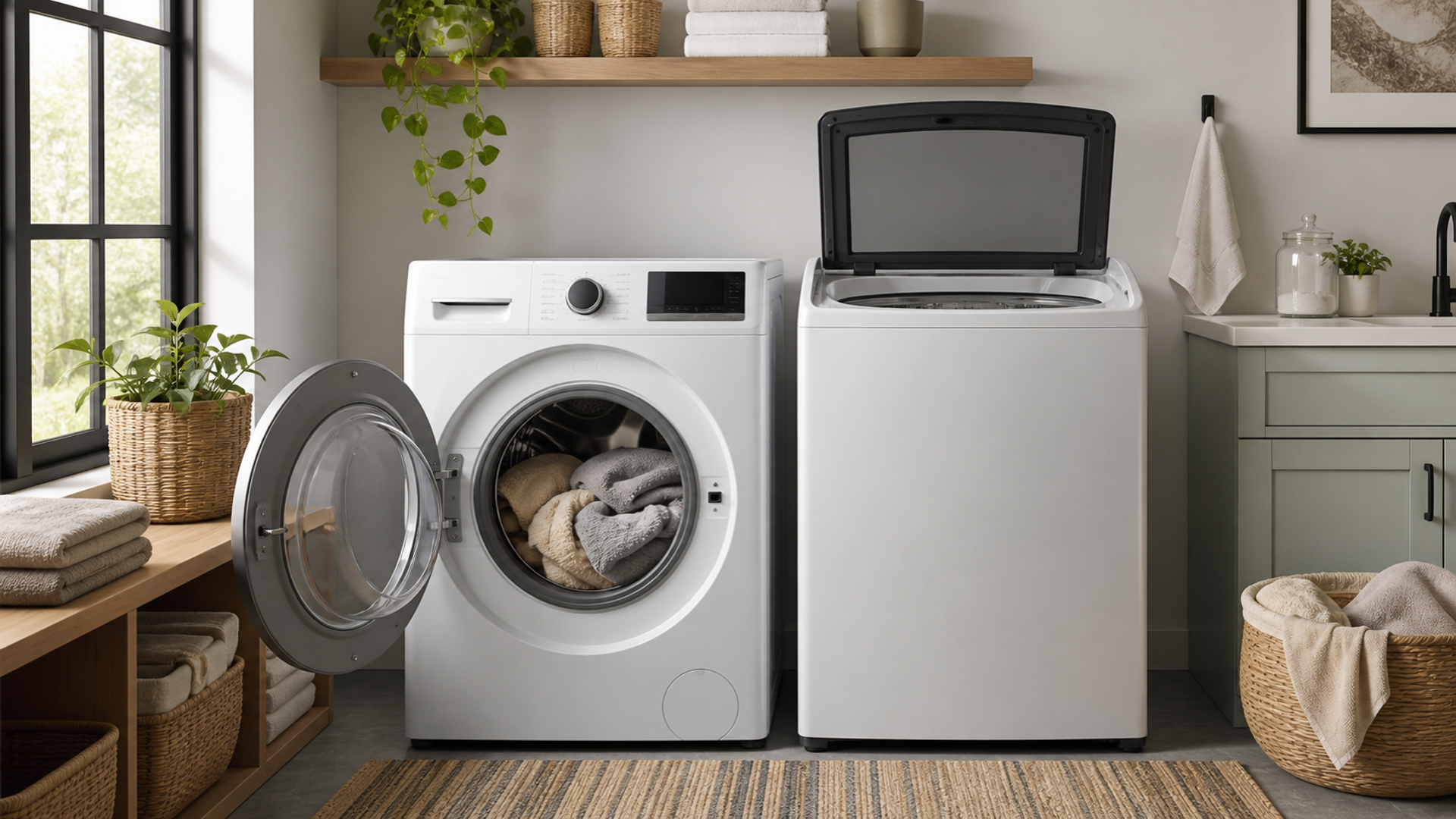
Front-load and top-load washers differ in loading height, wash action, water use, cycle design and installation. A front loader tumbles textiles through less water and can stack with a dryer. A top loader offers standing access and may use an agitator or impeller. Fabric mix, stains, ergonomics, floor, ventilation, utilities and maintenance decide the fit.
Start with laundry, body and room
Choose front load when efficient tumbling, high spin extraction, stacking and fabric care fit the household and gasket maintenance is realistic. Choose top load when standing access, mid-cycle loading or a preferred wash action matters more. Repair the current machine when cleaning, levelling, drainage or a replaceable part solves the complaint.
| Decision factor | Front-load washer | Top-load washer | Repair the present washer |
|---|---|---|---|
| Cleaning | Tumbling and programmes suit soil mix | Agitator or impeller suits loads | Fix detergent and loading first |
| Water and energy | Lower water and high spin reduce drying | Exact efficient model meets target | Measure present consumption |
| Ergonomics | Bending or pedestal is acceptable | Standing loading suits reach | Modify height or access |
| Space | Stacking saves room | Open top clearance remains | Resolve doors and drains |
| Maintenance | Gasket and door-dry routine is followed | Tub and lid remain easy to clean | Deep-clean present washer |
| Textiles | Tumble and spin controls suit delicates | Geometry suits bulky items | Use specialist care |
This front load vs top load washer matrix is the article's working value object. Read the front load vs top load washer rows together: the decisive failure mode depends on this topic's evidence, operating context and reader objective.
What loading orientation changes
Evidence 1. ENERGY STAR evaluates qualifying washers using water and energy metrics, but the label does not choose capacity or access for a household.
Evidence 2. Front-load designs commonly use tumbling and can extract more water at high spin speeds.
Evidence 3. Top-load designs vary between central-agitator and impeller systems, so top load is not one mechanism.
Evidence 4. Odour and vibration can arise from detergent over-dose, poor levelling, blocked drainage or closed damp doors rather than orientation alone.
Reader-visible sources checked for this article:
energystar.gov — reader-visible current or official evidence
energy.gov — reader-visible current or official evidence
For front load vs top load washer, these sources establish only the claims inside their documented scope. Recheck every changeable specification, availability condition, price, policy or service term in the relevant market before acting.
Measure a complete wash week
The decision changes at cleaning. Choose the first path only if tumbling and programmes suit soil mix; move to the second when agitator or impeller suits loads; use the third when fix detergent and loading first. Save the downside that would make this row fail.
For water and energy, the first route works when lower water and high spin reduce drying; the second requires exact efficient model meets target. The control for the third is measure present consumption. Verify this row against the exact product, property, account or environment before it can reverse the decision.
The ergonomics row exposes a practical boundary. Route one assumes bending or pedestal is acceptable, while route two is defensible only when standing loading suits reach. Route three depends on modify height or access. If that evidence is absent, keep the more reversible option.
Read space as a stop/go test: stacking saves room supports the first option; open top clearance remains supports the second; and resolve doors and drains supports the third. Record which source proves the condition and when it was checked.
A buyer can resolve maintenance without starting from a brand preference. Ask whether gasket and door-dry routine is followed; compare that with whether tub and lid remain easy to clean; then use deep-clean present washer as the third route's safeguard. An unknown condition stays unknown.
On textiles, popularity is not enough. The evidence for option one is that tumble and spin controls suit delicates. Option two means geometry suits bulky items. Option three is rational where use specialist care. Recheck any changeable term immediately before commitment.
Facts that would reverse the current choice
Reversal control 1 — Cleaning. Before choosing Front-load washer, write down how the decision changes if “Tumbling and programmes suit soil mix” proves false. Do the same for Top-load washer and “Agitator or impeller suits loads”. Keep the Repair the present washer route available until “Fix detergent and loading first” is verified. This control belongs to front load vs top load washer; update it from the cited source or exact supplier rather than copying a generic checklist.
Reversal control 2 — Water and energy. Before choosing Front-load washer, write down how the decision changes if “Lower water and high spin reduce drying” proves false. Do the same for Top-load washer and “Exact efficient model meets target”. Keep the Repair the present washer route available until “Measure present consumption” is verified. This control belongs to front load vs top load washer; update it from the cited source or exact supplier rather than copying a generic checklist.
Reversal control 3 — Ergonomics. Before choosing Front-load washer, write down how the decision changes if “Bending or pedestal is acceptable” proves false. Do the same for Top-load washer and “Standing loading suits reach”. Keep the Repair the present washer route available until “Modify height or access” is verified. This control belongs to front load vs top load washer; update it from the cited source or exact supplier rather than copying a generic checklist.
Reversal control 4 — Space. Before choosing Front-load washer, write down how the decision changes if “Stacking saves room” proves false. Do the same for Top-load washer and “Open top clearance remains”. Keep the Repair the present washer route available until “Resolve doors and drains” is verified. This control belongs to front load vs top load washer; update it from the cited source or exact supplier rather than copying a generic checklist.
Reversal control 5 — Maintenance. Before choosing Front-load washer, write down how the decision changes if “Gasket and door-dry routine is followed” proves false. Do the same for Top-load washer and “Tub and lid remain easy to clean”. Keep the Repair the present washer route available until “Deep-clean present washer” is verified. This control belongs to front load vs top load washer; update it from the cited source or exact supplier rather than copying a generic checklist.
Reversal control 6 — Textiles. Before choosing Front-load washer, write down how the decision changes if “Tumble and spin controls suit delicates” proves false. Do the same for Top-load washer and “Geometry suits bulky items”. Keep the Repair the present washer route available until “Use specialist care” is verified. This control belongs to front load vs top load washer; update it from the cited source or exact supplier rather than copying a generic checklist.
Audit a normal wash week
Count loads by weight and category: cotton, delicates, bedding, sportswear and heavily soiled pieces. Record programmes, pretreatment, detergent, duration and remaining moisture. A large drum has limited value if the household separates fabrics into small loads or cannot reach items comfortably.
Test the room
Measure doorway, footprint, lid or door swing, hoses, drain height, shut-off access, floor level and dryer relationship. Simulate loading with a full basket. For stacked equipment, verify controls and service access. High-speed spin can expose weak flooring, while a top lid can conflict with shelves.
Model total laundry energy
Compare rated annual water and energy, tariffs, detergent, hot-water source and moisture before drying. A washer that extracts more water may reduce dryer use, but only if suitable high spin is selected. Do not convert one label into savings without the actual load and programme pattern.
Write the care routine
Specify detergent dose, cleaning cycle, dispenser and filter cleaning, gasket wipe, door ventilation, hose inspection and imbalance response. Check service and parts support. Choose the machine whose routine the household will sustain; neglected hardware does not stay efficient simply because it tested well when new.
Three households, three answers
Compact apartment laundry
A stackable front loader can recover floor area when access is solved. Define the fact that would reverse this recommendation before committing.
User with limited bending
A top loader may offer better access when reach into the tub is tested. Define the fact that would reverse this recommendation before committing.
Machine smells after cold washes
Cleaning, dosing and drainage should be corrected before replacement. Define the fact that would reverse this recommendation before committing.
Action checklist
Count loads.
Weigh bulky items.
Measure room.
Test posture.
Compare duration.
Read energy data.
Check extraction.
Review cleaning.
Verify service.
Price ownership.
Continue the decision
The linked VERTU articles expand adjacent parts of the front load vs top load washer decision. They do not substitute for the external evidence above.
The front-load-top-load verdict
Choose front load when efficient tumbling, high spin extraction, stacking and fabric care fit the household and gasket maintenance is realistic. Choose top load when standing access, mid-cycle loading or a preferred wash action matters more. Repair the current machine when cleaning, levelling, drainage or a replaceable part solves the complaint.
Keep the front load vs top load washer decision reversible until its material cost, safety, access, privacy and compatibility facts are verified. Unknown evidence stays unknown; it is never silently scored as favourable.
![How to Scan Receipts and Documents with Your Phone [Full Guide]](https://cdn.sanity.io/images/e0gp1l2g/production/0db13feec1d5e72b8a8a5f976d1f3e86619c9228-3840x1860.webp?w=180&h=180&q=78&auto=format&fit=crop)
![How to Scan Receipts and Documents with Your Phone [Full Guide]](https://cdn.sanity.io/images/e0gp1l2g/production/0db13feec1d5e72b8a8a5f976d1f3e86619c9228-3840x1860.webp?w=800&h=450&q=82&auto=format&fit=crop)
![Top 10 Two-Tone Carbon-Fibre Watches for Men [2026 List]](https://cdn.sanity.io/images/e0gp1l2g/production/18870799ba33fab0e038968359cd5772d7d7db30-1024x576.webp?w=800&h=450&q=82&auto=format&fit=crop)
![Top 10 Luxury Watches with Digital Complication Displays for Men [Latest]](https://cdn.sanity.io/images/e0gp1l2g/production/c4f6bf8c080f291c39f7cc85c7344ecff2fd3799-1024x553.webp?w=800&h=450&q=82&auto=format&fit=crop)