

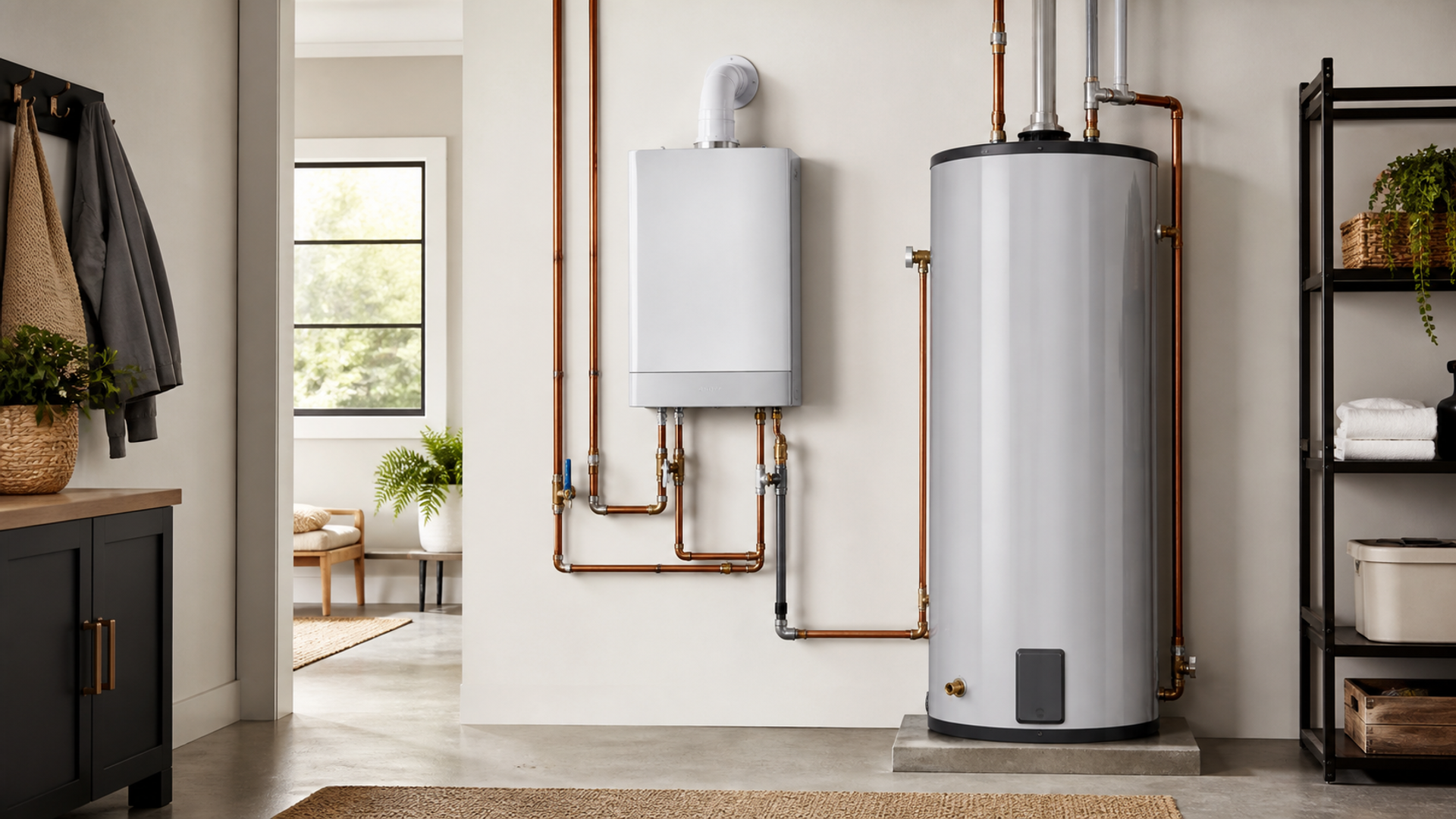
Tankless and storage water heaters solve hot-water demand differently. A storage model heats and holds a volume that can cover short peaks until recovery catches up. A tankless model heats water as it flows, avoiding storage losses but imposing a maximum flow and temperature-rise envelope. Fuel, incoming temperature, simultaneous outlets, venting, electrical service and maintenance decide the fit.
Begin with simultaneous demand
Choose tankless when the exact unit meets measured simultaneous flow at the required temperature rise and infrastructure is justified. Choose storage when known first-hour supply, simpler replacement and peak buffering suit the household. Optimise the present system when insulation, controls, fixtures or a local fault are the real constraint.
| Decision factor | Tankless water heater | Storage-tank water heater | Improve the existing system |
|---|---|---|---|
| Peak demand | Rated flow covers outlets at design rise | Tank volume and recovery cover first hour | Reduce fixtures or stagger demand |
| Fuel and power | Gas line, venting or service supports input | Existing connection supports replacement | Price enabling work first |
| Space | Wall mounting releases floor area | Protected tank location remains practical | Fix drainage and access |
| Wait and waste | Recirculation controls distant-fixture delay | Existing distribution remains compatible | Insulate lines and correct layout |
| Maintenance | Descaling matches water quality | Anode, sediment and relief checks are scheduled | Restore current maintenance |
| Outage behaviour | Fuel, power and controls remain available | Stored water and recovery are understood | Create an outage plan |
This tankless vs tank water heater matrix is the article's working value object. Read the tankless vs tank water heater rows together: the decisive failure mode depends on this topic's evidence, operating context and reader objective.
What storage and on-demand delivery change
Evidence 1. The US Department of Energy distinguishes storage heaters by tank volume and recovery and tankless heaters by on-demand flow through a heat exchanger.
Evidence 2. A tankless rating depends on flow and temperature rise; colder incoming water reduces available flow.
Evidence 3. Tankless equipment still needs energy, safe venting or electrical capacity, water-quality maintenance and correct distribution.
Evidence 4. Efficiency labels do not include every installation cost, recirculation loss, service visit or household behaviour.
Reader-visible sources checked for this article:
energystar.gov — reader-visible current or official evidence
energystar.gov — reader-visible current or official evidence
For tankless vs tank water heater, these sources establish only the claims inside their documented scope. Recheck every changeable specification, availability condition, price, policy or service term in the relevant market before acting.
Measure the house and incoming water
Read peak demand as a stop/go test: rated flow covers outlets at design rise supports the first option; tank volume and recovery cover first hour supports the second; and reduce fixtures or stagger demand supports the third. Record which source proves the condition and when it was checked.
A buyer can resolve fuel and power without starting from a brand preference. Ask whether gas line, venting or service supports input; compare that with whether existing connection supports replacement; then use price enabling work first as the third route's safeguard. An unknown condition stays unknown.
On space, popularity is not enough. The evidence for option one is that wall mounting releases floor area. Option two means protected tank location remains practical. Option three is rational where fix drainage and access. Recheck any changeable term immediately before commitment.
The decision changes at wait and waste. Choose the first path only if recirculation controls distant-fixture delay; move to the second when existing distribution remains compatible; use the third when insulate lines and correct layout. Save the downside that would make this row fail.
For maintenance, the first route works when descaling matches water quality; the second requires anode, sediment and relief checks are scheduled. The control for the third is restore current maintenance. Verify this row against the exact product, property, account or environment before it can reverse the decision.
The outage behaviour row exposes a practical boundary. Route one assumes fuel, power and controls remain available, while route two is defensible only when stored water and recovery are understood. Route three depends on create an outage plan. If that evidence is absent, keep the more reversible option.
Facts that would reverse the current choice
Reversal control 1 — Peak demand. Before choosing Tankless water heater, write down how the decision changes if “Rated flow covers outlets at design rise” proves false. Do the same for Storage-tank water heater and “Tank volume and recovery cover first hour”. Keep the Improve the existing system route available until “Reduce fixtures or stagger demand” is verified. This control belongs to tankless vs tank water heater; update it from the cited source or exact supplier rather than copying a generic checklist.
Reversal control 2 — Fuel and power. Before choosing Tankless water heater, write down how the decision changes if “Gas line, venting or service supports input” proves false. Do the same for Storage-tank water heater and “Existing connection supports replacement”. Keep the Improve the existing system route available until “Price enabling work first” is verified. This control belongs to tankless vs tank water heater; update it from the cited source or exact supplier rather than copying a generic checklist.
Reversal control 3 — Space. Before choosing Tankless water heater, write down how the decision changes if “Wall mounting releases floor area” proves false. Do the same for Storage-tank water heater and “Protected tank location remains practical”. Keep the Improve the existing system route available until “Fix drainage and access” is verified. This control belongs to tankless vs tank water heater; update it from the cited source or exact supplier rather than copying a generic checklist.
Reversal control 4 — Wait and waste. Before choosing Tankless water heater, write down how the decision changes if “Recirculation controls distant-fixture delay” proves false. Do the same for Storage-tank water heater and “Existing distribution remains compatible”. Keep the Improve the existing system route available until “Insulate lines and correct layout” is verified. This control belongs to tankless vs tank water heater; update it from the cited source or exact supplier rather than copying a generic checklist.
Reversal control 5 — Maintenance. Before choosing Tankless water heater, write down how the decision changes if “Descaling matches water quality” proves false. Do the same for Storage-tank water heater and “Anode, sediment and relief checks are scheduled”. Keep the Improve the existing system route available until “Restore current maintenance” is verified. This control belongs to tankless vs tank water heater; update it from the cited source or exact supplier rather than copying a generic checklist.
Reversal control 6 — Outage behaviour. Before choosing Tankless water heater, write down how the decision changes if “Fuel, power and controls remain available” proves false. Do the same for Storage-tank water heater and “Stored water and recovery are understood”. Keep the Improve the existing system route available until “Create an outage plan” is verified. This control belongs to tankless vs tank water heater; update it from the cited source or exact supplier rather than copying a generic checklist.
Log a real peak hour
Record showers, baths, sinks, dishwasher and laundry during the busiest hour. Note flow and overlap. For tankless sizing, calculate required temperature rise from the coldest inlet. For storage, compare usable volume and recovery rather than tank gallons alone. Keep a margin for changed occupancy without oversizing blindly.
Audit the installation envelope
Inspect gas meter and pipe capacity, combustion air, vent route, condensate, electrical service, breaker space, drain and service clearance. Obtain permits and qualified quotes. A wall-mounted appliance can demand more enabling work than a tank, while a larger tank may need structural and drainage changes.
Model distribution delay
Measure pipe length and time-to-hot at distant fixtures. Tankless equipment does not make water arrive instantly through long cold pipes. Evaluate insulated lines and demand-controlled recirculation, including energy and water trade-offs. Confirm that the exact product supports any planned recirculation mode.
Plan water-quality service
Test hardness and sediment, then price filtration, flushing, anode inspection, relief checks and local technician availability. Record warranty conditions. High efficiency can become a poor choice if scale reduces output and nobody services the heat exchanger, just as a neglected tank can corrode.
Three homes, three answers
Small household reclaiming utility space
Tankless can fit when peak flow is modest and infrastructure supports it. Define the fact that would reverse this recommendation before committing.
Large family with clustered showers
A sized storage or hybrid system may buffer peaks more predictably. Define the fact that would reverse this recommendation before committing.
Sound tank with long pipe waits
Distribution and recirculation work may solve the complaint. Define the fact that would reverse this recommendation before committing.
Action checklist
Measure fixture flow.
Log simultaneous use.
Record cold inlet.
Calculate rise.
Audit gas or electric service.
Inspect vent and drain.
Measure time-to-hot.
Test hardness.
Price service.
Compare installed cost.
Continue the decision
The linked VERTU articles expand adjacent parts of the tankless vs tank water heater decision. They do not substitute for the external evidence above.
The tankless-tank verdict
Choose tankless when the exact unit meets measured simultaneous flow at the required temperature rise and infrastructure is justified. Choose storage when known first-hour supply, simpler replacement and peak buffering suit the household. Optimise the present system when insulation, controls, fixtures or a local fault are the real constraint.
Keep the tankless vs tank water heater decision reversible until its material cost, safety, access, privacy and compatibility facts are verified. Unknown evidence stays unknown; it is never silently scored as favourable.



![Top 10 Tourbillon Watches for Men [2026 Latest]](https://cdn.sanity.io/images/e0gp1l2g/production/8cb6bc45133cf9453382fc7d074465af588bb610-1800x1080.webp?w=800&h=450&q=82&auto=format&fit=crop)