

Introduction
In 2026, “most expensive phone right now” can mean two very different things.
One meaning is literal: a record-setting object that changes hands through private sale or auction, priced like fine jewelry and collected like art. The other meaning is more practical: a luxury phone you can actually order, insure, travel with, and service.
This guide separates those two categories on purpose. If you’re looking for a headline-grabbing collectible, you’ll care about provenance, rarity, and documentation more than camera performance. If you want an orderable luxury daily driver, you’ll care about service, security posture, and whether the device fits your US carrier and travel patterns.
What you’ll get here: a 2026 ranking snapshot, a quick tour of the best-known record-setters, and a US-focused buying playbook designed to reduce risk.
Key Takeaway: In the ultra-luxury tier, the price is often driven by materials + scarcity + verification, not by the underlying phone platform.
2026 Rankings Snapshot
Record-setting collectibles (auction/private market)
These are the phones that end up on “most expensive in the world” lists because the story is the product: precious metals, rare stones, and limited production, sometimes single-unit pieces. Technology may be dated, but the object is priced as a collectible.
Orderable luxury daily drivers (new in 2026)
This category is where most real buyers should start. “Orderable” means you can pay through a legitimate channel, receive documentation, and expect some form of ongoing support, service, or concierge layer.
Price bands and availability caveats
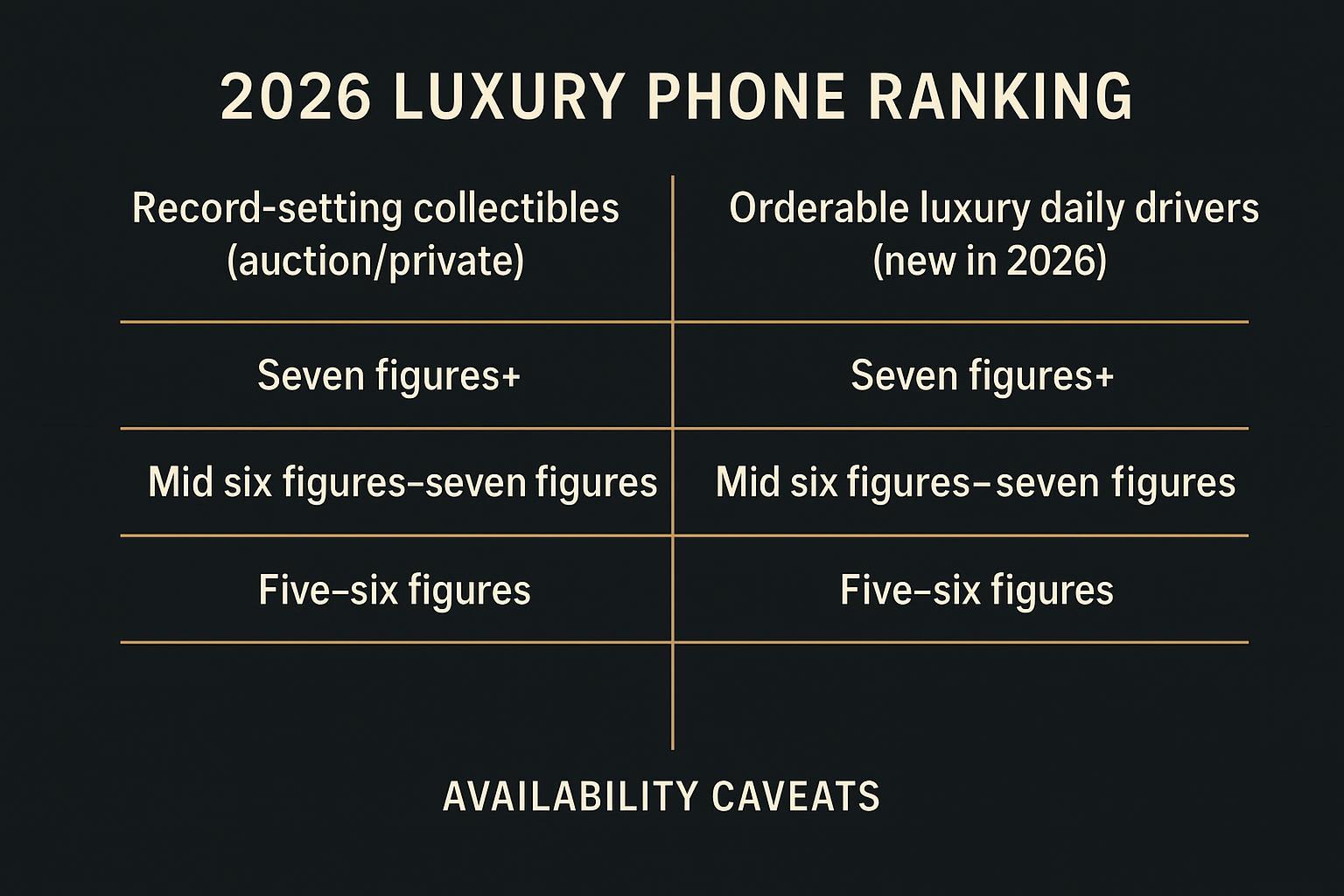
To keep the “most expensive phone right now” question usable, think in bands rather than single numbers:
Collectibles: can run from high six figures into “record-setting” eight-figure territory depending on stone quality, maker, and provenance.
Orderable luxury: often sits in the five-figure to low six-figure tier, with bespoke commissions rising based on materials, labor, and edition constraints.
Availability caveat: if a listing can’t show a clean chain of ownership, matching documentation, and verifiable identifiers, the “price” is just a number on a page.
Record-Setting Collectibles
Falcon Supernova iPhone 6 Pink Diamond
If you want a single widely cited “most expensive phone” headline, this is the name that shows up.
CNET reported in 2014 that Falcon offered an iPhone 6 variant topped with a pink diamond for $48.5 million, positioning it inside Falcon’s SuperNova collection of diamond-backed, precious-metal iPhones (with deposit and production timelines typical of commission work). The defining point is straightforward: the underlying handset is not the value; the materials and presentation are.
Source: CNET’s report, “Preorder an iPhone 6 with a pink diamond for $48.5 million” (2014).
Stuart Hughes one-off masterpieces
Stuart Hughes sits in the same universe of “jewelry first, device second.”
CNET described the Stuart Hughes iPhone 4S Elite Gold as a $9.4 million piece, built around precious materials and extensive diamond setting, and noted that only two units would be made. Whether you love the aesthetic or not, the logic is consistent: scarcity and materials set the value; the phone is the canvas.
Source: CNET’s coverage, “$9.4 million iPhone 4S is one garish gadget” (2011).
Goldvish Le Million and Gresso Luxor LV Jackpot
Two more names worth knowing if you’re navigating legacy “million-dollar phone” lore:
Goldvish “Le Million” is documented by Guinness World Records as the most expensive mobile phone record holder, sold for 1,000,000 euros in 2006 at the Millionaire Fair in Cannes.
Source: Guinness World Records, “Most expensive mobile phone (cell phone)”.
Gresso Luxor Las Vegas Jackpot is often referenced as a million-dollar luxury handset. Luxuo’s 2010 write-up describes it as a piece built from solid gold, black diamonds, and exotic materials, with strict production limits.
Source: Luxuo, “Gresso - Another Million-Dollar Cell Phone” (2010).
Collector’s note: In this tier, condition and documentation can matter as much as the object. A pristine device without a verifiable story still carries risk.
Orderable Luxury 2026
Concierge-first encrypted luxury phones
If you’re buying for daily use, the question isn’t “what’s the rarest?” It’s “what reduces friction and risk after the purchase?”
That’s where concierge-first luxury phones earn their place. The premium is not only materials; it’s the ownership workflow: direct access to human support, service coordination, and security-minded habits that suit a high-visibility life.
VERTU sits in this category as a brand that frames luxury mobile as a blend of craftsmanship, materials, and private service. On the service side, VERTU positions its concierge layer as a 24/7 owner benefit (see VERTU Concierge). On the product side, the company emphasizes handcrafted construction and premium finishes across current models (browse the VERTU phones collection).
On the security side, the language to keep in mind is careful: serious buyers should look for clear explanations of what is protected, what is stored, who can access requests, and what the retention and deletion options are. VERTU’s own writing leans into that evaluation mindset in its concierge and collector guidance, which can be useful as a checklist even if you ultimately buy elsewhere.
Bespoke custom iPhones and Androids (Caviar et al.)
Bespoke houses often start with a mainstream flagship platform, then rebuild the exterior: precious metals, carbon fiber, titanium, engraving, gem setting, and micro-edition storytelling.
When you evaluate this route, separate the artistry from the underlying device lifecycle:
How will you handle repairs if the handset needs a battery replacement or a screen repair?
Will the modification interfere with wireless charging, antennas, or heat dissipation?
Can you still receive software updates without friction?
If the seller cannot clearly answer those questions, you’re not buying a daily driver. You’re buying a display object that happens to turn on.
Boutique commissions and micro-limited runs (Goldvish, Tonino Lamborghini)
Boutique brands and micro-runs can be a clean middle ground: more personality than a standard flagship, less “auction object” than an eight-figure collectible.
This segment varies widely by maker, but your decision should follow a simple rule:
If the brand can provide documentation, service pathways, and realistic support expectations, it belongs in the orderable category.
If it can’t, treat it like a collectible and buy accordingly (with stricter verification and a higher tolerance for usability compromises).
How To Choose What To Buy
Rarity, provenance, and verification steps
In high-value phones, the fastest way to overpay is to confuse a claim with proof.
Start with a verification mindset:
How to verify: Ask for identifiers, matching documentation, and a clear chain of custody before you discuss payment structure.
Practical steps that matter:
Request the full set of documents: receipt/invoice, certificates, warranty cards (if any), and any edition paperwork.
Verify identifiers that can be checked (serials, IMEI where appropriate) and keep screenshots or signed confirmations.
For any “limited” claim, ask what exactly is limited: production count, finish, region, or packaging.
A helpful internal reference point for collector-style due diligence is VERTU’s own checklist framing in Collector's Phones: The Ultimate Investment Guide.
Tech longevity, updates, and service ecosystem
If you plan to use the phone, longevity becomes a service question, not a specs question.
Updates: Know whether the underlying platform is current enough to receive security updates.
Repairs: Understand where repairs happen, what is considered user-replaceable, and what voids support.
Travel reality: If you travel, your support model matters. A device that can’t be serviced without shipping it across borders is a lifestyle constraint.
Privacy, security, and daily usability
Privacy is not a single feature. It’s a set of behaviors you can maintain.
Use three tests:
Control: Can you separate sensitive apps/accounts from daily noise?
Clarity: Does the brand explain data access and retention in plain language?
Usability: Can you keep the phone secure without making it unpleasant to live with?
A luxury device that’s too fragile, too complex, or too difficult to service will quietly push you back to a mainstream phone. That defeats the point.
US Buyer Checklist
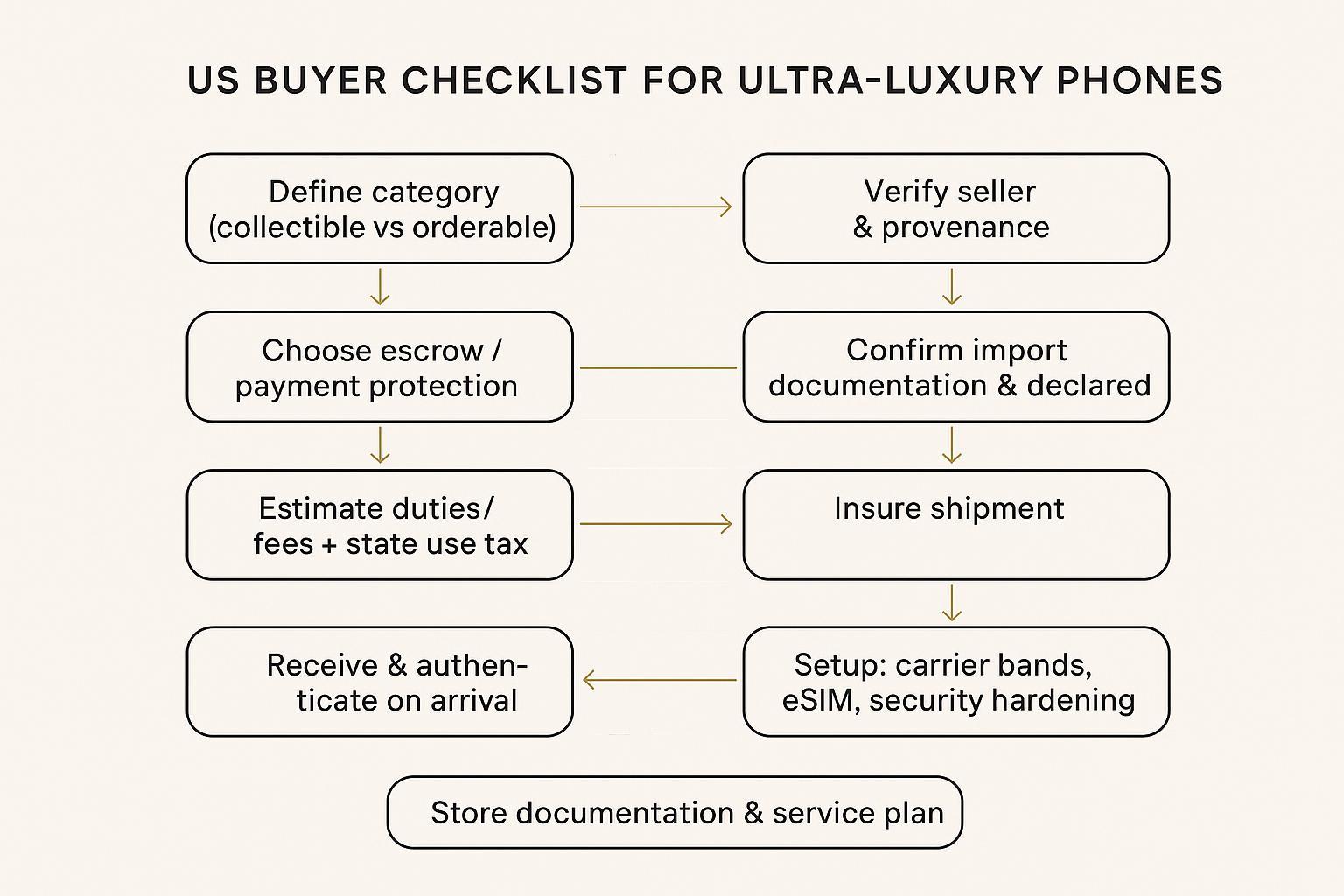
Import duties, state taxes, and insurance
US buying risk often shows up after you hit “pay.” The headline price is only part of your landed cost.
State use tax: Even if an item is exempt from federal duty, states may still treat the purchase as taxable use. California’s tax authority is explicit that federal duty treatment does not control state use tax, and foreign VAT is treated as part of purchase price for use-tax purposes.
Source: California Department of Tax and Fee Administration (CDTFA), “Use tax for foreign purchases”.
Insurance: For high-value shipments, treat insurance as non-optional. Confirm what the policy covers (loss, damage, theft) and what documentation is required to make a claim.
Authentication, escrow, and documentation
For any purchase that would be painful to unwind, structure the transaction so you can verify before funds are fully released.
Use escrow or staged payments where appropriate.
Define “delivery” precisely: not just arrival, but authentication steps completed.
Store all documentation in two places (physical + encrypted digital copy) and keep a clean ownership record.
Carrier bands, eSIM, and compliance
Before you buy, validate three practical realities:
Carrier compatibility: Check supported LTE/5G bands for where you actually live and travel.
eSIM support: If you rely on eSIM (or multiple numbers), confirm activation support with your carrier.
Compliance basics: Any wireless device used in the US should be legitimately compliant with US radio requirements; if a seller cannot provide clear model documentation, treat it as a risk signal.
Conclusion
The most expensive phone right now in 2026 is rarely the best phone to buy.
If your goal is to own a record-setter, buy like a collector: insist on provenance, treat verification as a process, and assume resale depends on documentation as much as materials. If your goal is to carry the device every day, buy like an operator: prioritize service, support, security habits, and compatibility.
Next steps: verify availability through legitimate channels, confirm how service works in your home state and during travel, and plan ownership like you would plan any other high-value asset.
If you want to explore orderable luxury options with a strong service layer, start with the official VERTU phones collection and review what is included in VERTU Concierge before you decide.
Disclosure: This article references VERTU pages. Editorial judgment remains the priority.
![Top 10 Tourbillon Watches for Men [2026 Latest]](https://cdn.sanity.io/images/e0gp1l2g/production/8cb6bc45133cf9453382fc7d074465af588bb610-1800x1080.webp?w=800&h=450&q=82&auto=format&fit=crop)