


Introduction
“Luxury Web3 lifestyle gadgets” aren’t just expensive devices with a crypto wallet. They’re objects you live with that quietly do three jobs at once: they anchor identity, prove provenance, and open access.
That combination matters now because the most valuable parts of a high-trust lifestyle are increasingly digital: memberships, invitations, travel support, private communications, and the secondary markets that turn ownership into liquidity. If the device is the doorway, Web3 is the lock, the key, and the logbook.
In that framing, VERTU COR Chain is best understood as a luxury Web3 service layer. Not “a blockchain for its own sake,” but a way to connect a device security stack, an on-chain membership credential, and service entitlements.
This article focuses on three sources of value that are especially relevant to privacy-sensitive HNWIs:
Identity: a secure, portable way to prove “it’s you,” without oversharing.
Provenance: a durable record of what you own, and how ownership changes.
Token-gated concierge value: access that can be verified on-device, with deliberate control over what gets revealed.
From Device To Identity
What makes a gadget “luxury” in Web3
In Web3, “luxury” is less about a spec sheet and more about control under stress. A luxury gadget should keep working when the stakes are high: travel days, high-value approvals, crowded events, and resale moments where authenticity has real financial consequence.
That’s why the most meaningful luxury Web3 gadgets tend to share three traits:
They treat identity as a first-class feature, not an app.
They make provenance portable, so the object’s story follows it.
They make access reversible and controllable, so membership can be granted, revoked, and transferred cleanly.
Digital identity anchored to secure elements
A serious Web3 identity system can’t start with “trust me, it’s my wallet address.” Wallet addresses are public, copyable, and easy to reuse in ways that create linkability.
A more defensible approach begins with a hardware-backed identity anchor. In security terms, this is where concepts like a secure element and a hardware root of trust matter: a tamper-resistant foundation that can protect keys and support device integrity checks.
You can think of it as the difference between a membership card printed on paper and a credential stored in a protected, audited vault. The latter doesn’t make breaches impossible, but it changes the attack economics.
Privacy by design for HNWIs
For HNWIs, “privacy” is not a preference. It’s operational.
Token-gated access can reduce the need for usernames and passwords, but it can also create new exposure if the same wallet is used everywhere. A token gate that checks a public address can become a trail.
The design goal is selective disclosure:
Prove eligibility without revealing more than necessary.
Separate identities (travel, collections, business) when appropriate.
Treat wallet hygiene as a lifestyle practice, not a one-time setup.
Collector’s note: The easiest privacy mistake in token-gated systems is convenience: one wallet, used everywhere, forever. The second easiest is signing prompts under time pressure.
COR Chain Architecture
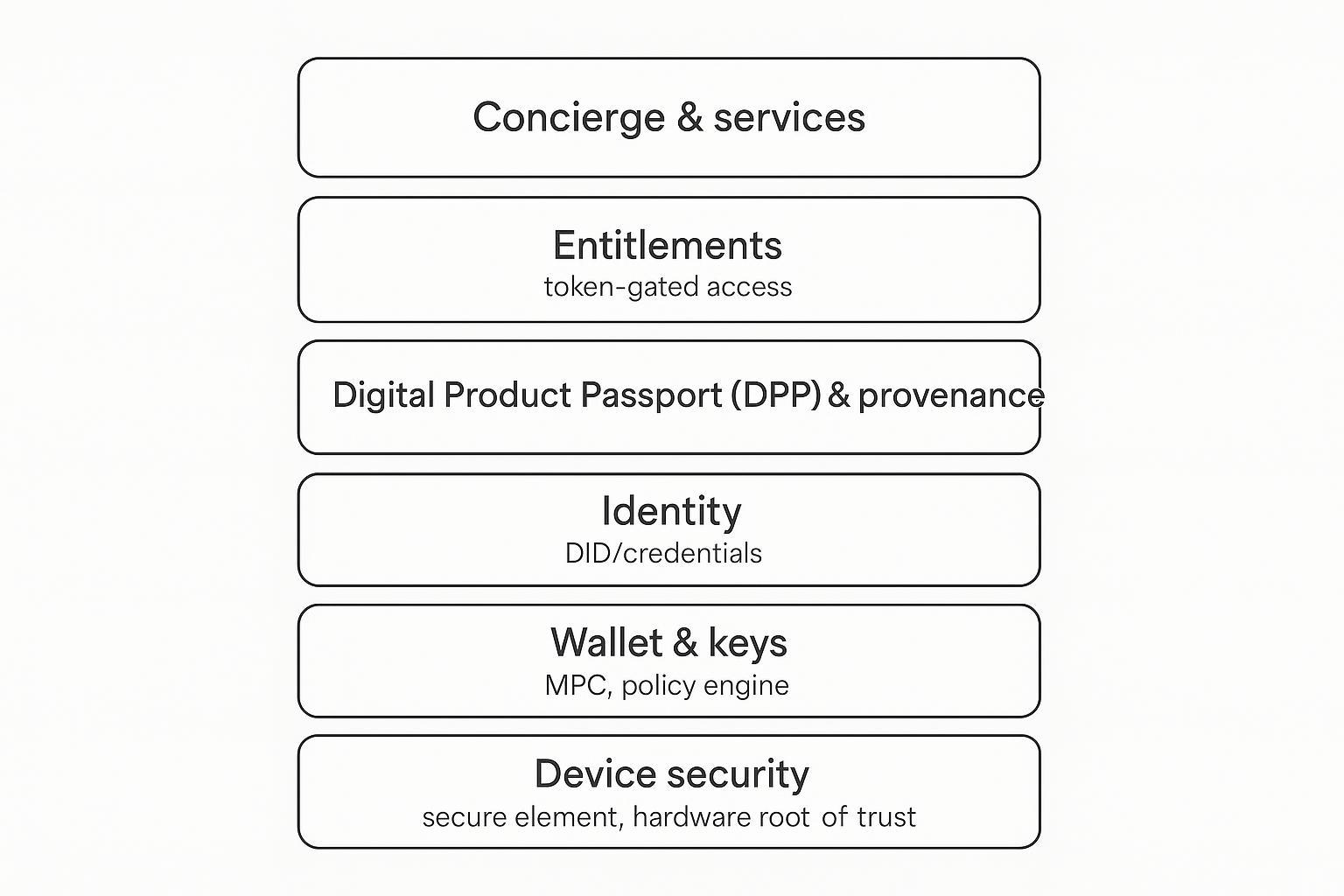
A luxury Web3 stack only works when device security, key custody, identity, provenance, and service entitlements reinforce each other.
Hardware root of trust and MPC wallet
There are two distinct layers to get right:
- Device trustcan the device protect secrets and prove integrity?
- Key managementcan the user avoid a single catastrophic point of failure?
For key management, one approach often discussed in modern wallet design is multi-party computation (MPC). In an MPC wallet, signing authority is distributed across key shares so that no single component holds the full private key, and a transaction can be approved without reconstructing a whole key in one place. Ledger’s glossary offers a clear non-marketing definition of this model in its MPC wallets explainer.
For device trust, a hardware root of trust underpins secure boot and key protection. NIST’s work on the concept frames roots of trust as the primitives that enable critical security functions (see the notion of hardware roots of trust at NIST).
In a COR Chain-style architecture, the practical takeaway is not “MPC is better” or “hardware is enough.” It’s that the wallet layer and the device layer should reinforce each other.
Digital product passports and provenance
Provenance has become a compliance topic as well as a luxury topic.
A digital product passport (DPP) is a product-linked digital record that carries verified information about an item’s identity and lifecycle. In the EU, the Ecodesign for Sustainable Products Regulation (ESPR) introduces the DPP as a digital identity card for products, components, and materials (see the EUR-Lex summary of the ESPR). The European Commission has also noted that technical preparation for DPP rollout is underway, including work on identifiers, data carriers, access rights, and a registry (see the Commission’s note on implementing the ESPR).
For luxury gadgets, a DPP-style record is useful even when regulation isn’t the buyer’s motivation. It supports:
authenticity checks
warranty and service continuity
resale confidence
clean ownership transfer
If COR Chain is the service layer, a DPP is the provenance layer that keeps “what you own” and “what’s happened to it” coherent.
Walled‑garden entitlements with selective interoperability
Luxury ecosystems are often walled gardens for a reason: the service depends on trust, and trust depends on tight control over what is considered “real” inside the system.
But complete isolation is rarely practical in Web3. A workable design is selective interoperability:
entitlements are issued and revoked inside a controlled environment
proofs can be presented outside that environment when needed
cross-chain dependencies are minimized (more on that in the Risk section)
This is where token-gated systems earn their keep: access can be granted based on eligibility proofs, without necessarily building a full account profile.
Membership In Action
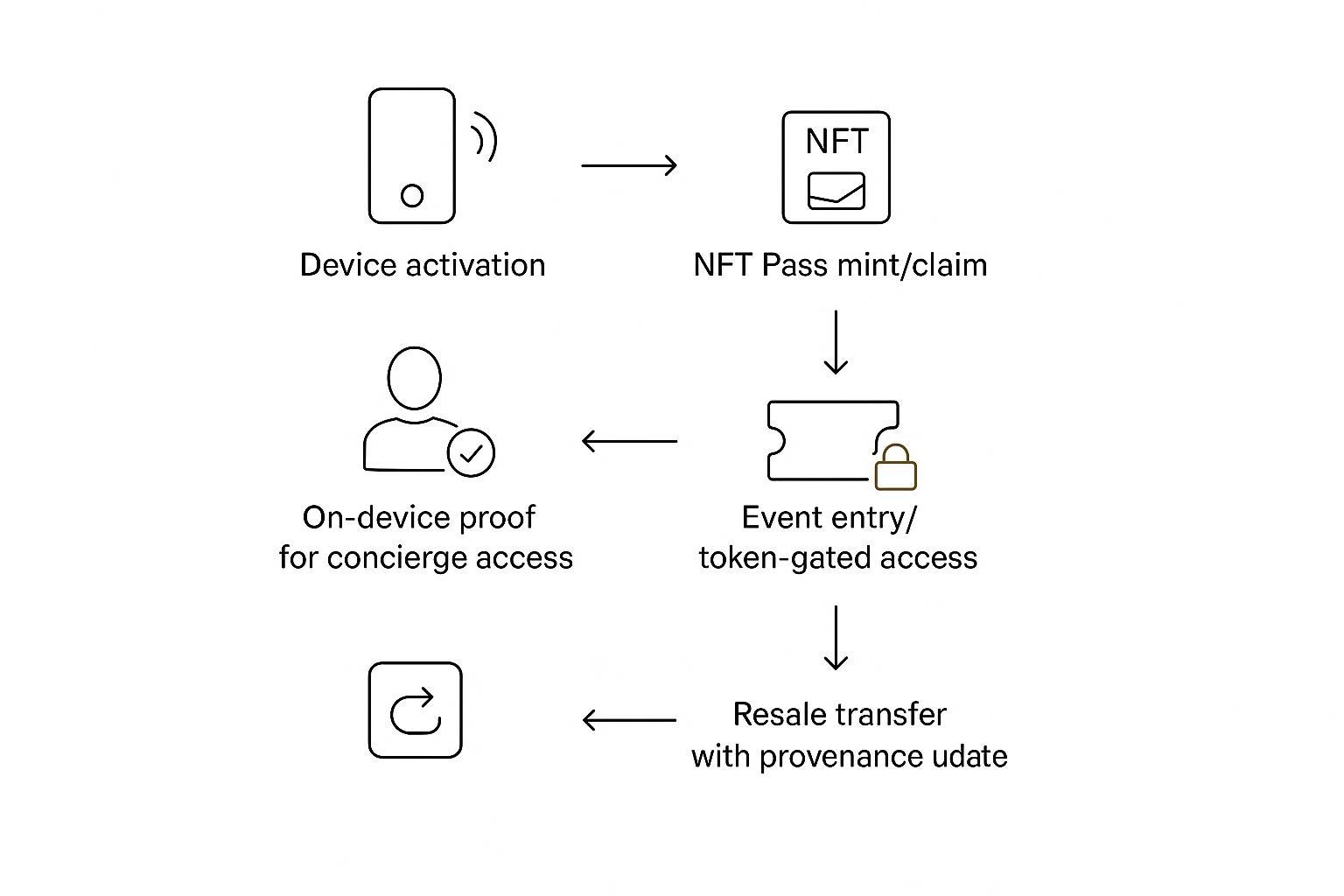
On‑device wallet proofs for token‑gated concierge
Token gating is simply access control based on token ownership. Ledger’s overview of what token gating is is a good neutral baseline.
In a luxury context, the important detail is where the proof happens. On-device proofs can reduce the amount of personal information that needs to be handed to a service desk during a time-sensitive moment.
VERTU’s own positioning ties membership to a tokenized credential. For example, it describes the Vertu NFT Pass as providing “exclusive membership, concierge services, and on-chain data analysis” on its page about Web3 phones versus traditional smartphones (VERTU’s explainer). In practice, a pass like this can function as a membership key whose eligibility can be verified before service is extended.
If you want to evaluate a token-gated concierge flow, ask:
Can the proof be presented without exposing your primary wallet address?
Can eligibility be checked without creating a permanent log of where you used it?
What happens if the device is lost, seized, or compromised?
Ownership transfer and resale with on‑chain updates
Resale is where provenance stops being theory. It’s also where provenance and resale become inseparable: if the record can’t survive a transfer, it can’t protect value.
A clean system should allow an owner to transfer the relevant credential (or reissue it) while updating the provenance record so that the next buyer can verify:
the object’s authenticity
the chain of custody (or at least the last verified transfer)
what services are transferable vs. non-transferable
This is the same basic logic that makes DPP initiatives compelling in luxury. The record is not merely marketing. It’s an integrity layer that can travel with the asset.
How to verify: If a product claims a provenance layer, look for explicit answers to two questions: “What exactly is recorded?” and “Who can write updates?” If the answer is vague, treat the provenance claim as cosmetic.
Wellness signals enhancing personalized services
Some luxury Web3 gadgets extend beyond identity and access into lifestyle telemetry.
VERTU COR Chain, for instance, is positioned as a “luxury AI wellness wearable” that reimagines a bead bracelet as an intelligent wearable. Its official product page lists lifestyle metrics such as heart rate, blood oxygen, HRV, body temperature, sleep, and energy trends, delivered through an app for daily records and long-term trend views. It also states the device is not a medical device and that insights are for general lifestyle reference only (VERTU COR Chain product page).
In a membership model, wellness signals can enhance service in subtle ways, without turning life into a dashboard. The best version of this is not “more data.” It’s better context:
when travel schedules are punishing, services can bias toward recovery-friendly choices
when a period of high strain is detected, workflows can reduce friction (fewer prompts, fewer repeated checks)
This is also where VERTU’s stack references can be interpreted as a system, not a set of features: device security to protect secrets, a membership pass to prove eligibility, and a private compute layer for sensitive context. VERTU describes a “Sovereign Private Server (VPS)” concept in its own AI tools writing, framing it as a private system anchored to the user’s control (see “The Operating System Is the Moat”). The important point for evaluation is not the branding. It’s the custody question: where does sensitive context live, and who can access it?
Risk, Compliance, And Control
Data custody, consent, and KYC/AML touchpoints
A luxury Web3 gadget can be privacy-forward and still run into compliance realities:
KYC/AML may apply around high-value services, payments, or transfers.
identity verification can be required for certain concierge actions.
The evaluation question is governance: how does the system handle consent, logging, and data retention?
A well-designed service should let you understand:
what data is collected by default
what is optional
what can be deleted
how access is audited
Cross‑chain risk and bridge minimization
Cross-chain functionality tends to be where elegant systems become fragile.
Bridges and cross-chain messaging introduce new trust assumptions and more ways for things to fail. Chainlink’s discussion of cross-chain security considerations is a practical starting point for thinking about the attack surface.
A conservative luxury approach is bridge minimization:
keep core membership and provenance on one primary chain where possible
treat cross-chain access as an edge case, not a default
prefer proof-based interoperability over custodial shortcuts
Service continuity and disaster recovery
Luxury buyers care about what happens on the worst day:
if your phone is lost, can you revoke credentials quickly?
if a service provider goes offline, does your ownership credential still function?
can you prove eligibility through a backup path without handing over your entire identity?
This is where operational discipline matters as much as cryptography. VERTU’s own onboarding-style guidance around setup and privacy is a useful reference point for what “ownership hygiene” looks like in practice (see its setup, care and privacy guide).
Outlook And What To Watch
Ecosystem integrations and secondary market services
The next phase of luxury Web3 gadgets won’t be defined by another wallet feature. It will be defined by integrations that reduce friction without increasing exposure:
verified resale rails that treat provenance as a shared standard
token-gated partners that can accept proofs without demanding account sprawl
service tiers that are transferable in clearly defined ways
Standards momentum around DPPs in luxury
DPPs are moving from experimentation to standardization pressure.
As the EU’s ESPR framework progresses, brands and platforms will have to decide what sits in the passport, what stays private, and what is revealed only under consent. Even in markets outside the EU, the expectation of lifecycle transparency is likely to travel.
Roadmap signals for the luxury mobile ecosystem
If you want to separate durable systems from short-lived gimmicks, watch for three signals:
Hardware-backed identity and clear key custody design
A provenance layer that specifies write permissions and auditability
Service entitlements that can be granted and revoked cleanly
VERTU’s broader Web3 positioning gives a sense of where luxury mobile is heading: an ecosystem where “ownership” is both functional and service-linked (see VERTU MetaVertu explained: luxury Web3 and digital ownership).
Conclusion
Luxury Web3 lifestyle gadgets earn their place when they deliver three outcomes without noise: identity you can prove, provenance you can trust, and access that respects your privacy.
A dedicated Web3 service layer matters because it connects these outcomes into an operational system. Device security anchors identity. A DPP-style provenance record supports ownership and resale. Token-gated entitlements make access verifiable without turning your life into a permanent trail.
Key Takeaway: If a luxury Web3 gadget cannot explain how it handles identity, provenance, and access under failure conditions, it’s not a system. It’s an accessory.
If you want a deeper look at how VERTU frames digital ownership and membership in its Web3 devices, start with VERTU’s digital ownership guide, then review the operational setup practices in its setup, care and privacy guide.
Disclosure: This article references VERTU pages. Editorial judgment remains the priority.



![Top 10 Luxury Smartwatches for Business Travel [2026]](https://cdn.sanity.io/images/e0gp1l2g/production/8b5e5b21db42a1c5f040e828bd041857353a8eb2-2560x1382.webp?w=800&h=450&q=82&auto=format&fit=crop)