Introduction
A smart ring lives where your phone and watch don’t: it’s always in contact with desks, door frames, gym equipment, luggage handles, and your own keys. So when you’re deciding between titanium vs liquid metal smart ring durability, the right question isn’t “Which material is strongest?” It’s “Which material will look good, feel good, and survive my real week?”
If you’ve been searching phrases like “liquidmetal ring durability”, you’re usually trying to predict one thing: how long the ring can stay presentable without special care.
This guide compares three buyer-relevant dimensions:
- Durabilityscratch visibility, scuffing, edge wear, and what happens when a ring takes a knock.
- Comfortweight, skin feel, sweat exposure, and how materials interact with coatings.
- Stylesurface finishes, color options, and how premium finishing affects long-term appearance.
Because most buyers don’t wear “a material.” You wear a finished object. Lab traits like hardness and ductility only matter insofar as they predict what you’ll notice after 90 days of daily wear.
Here’s how to use the guide:
Start with Material essentials to understand what “titanium” and “liquid metal” can mean in practice.
Use Durability and comfort to match material traits to your routine.
Use Style and finishes to decide whether your priority is a particular look — or keeping that look.
Key TakeawayFor rings, scratch resistance and impact tolerance are different problems. The best choice is the one that fits your wear pattern, not the one with the best-sounding spec.
Material essentials
Titanium in brief
Titanium is a proven wearable metal: light, strong for its weight, and widely used in watches and jewelry. It also forms a stable oxide layer that protects it from corrosion — a major reason it holds up well around sweat and daily moisture.
One nuance that surprises buyers: titanium can have a respectable hardness on paper, yet still show visible “character” quickly. As watch writers note, the surface oxide layer and the way titanium marks can change how scratches look compared with steel, even when hardness numbers suggest otherwise (see A Blog To Watch’s titanium watch buyer guide).
Liquidmetal in brief
“Liquid metal” in consumer products usually points to amorphous metal alloys — metals without the typical crystalline grain structure. Many sources describe these alloys as unusually strong, wear-resistant, and corrosion-resistant; NASA’s overview of Liquidmetal highlights strength and resistance to permanent deformation compared with conventional alloys (see NASA Spinoff: Amorphous Alloy Surpasses Steel and Titanium).
For a ring buyer, the important translation is this: when done well, liquid-metal-type alloys can be engineered for high surface durability and a very refined feel. But “liquid metal” is also a label that can hide variability — formulation, casting quality, and finishing matter.
Differences that matter
At a high level, you can think of the trade space like this:
Titanium tends to win on weight and broad real-world track record in wearables.
Liquid-metal-type alloys tend to win on surface hardness and scratch resistance in generalized material descriptions.
Coatings and finishing can overwhelm both. A great coating on a less-scratch-resistant base can look better long-term than a bare harder alloy.
Collector’s note: If a product page only says “titanium” or “liquid metal” with no grade, process, or finish detail, you’re not being told the part that controls daily wear.
Titanium vs Liquid Metal smart ring durability: durability and comfort
Scratch and wear
Scratches on a ring are rarely one dramatic event. They’re usually micro-abrasion: desks, zippers, ceramic mugs, gym knurling, and “ring-on-ring” contact.
In broad terms:
Titanium can be durable structurally but may show scuffs sooner depending on finish.
Liquid-metal-type alloys are often positioned as more scratch-resistant due to their amorphous structure and high hardness in many references.
The key is to separate three related concepts:
- Hardnessresistance to indentation.
- Scratch resistanceresistance to abrasion and visible marking.
- Ductility/toughnesshow forgiving the material is when stressed (more on that in the next section).
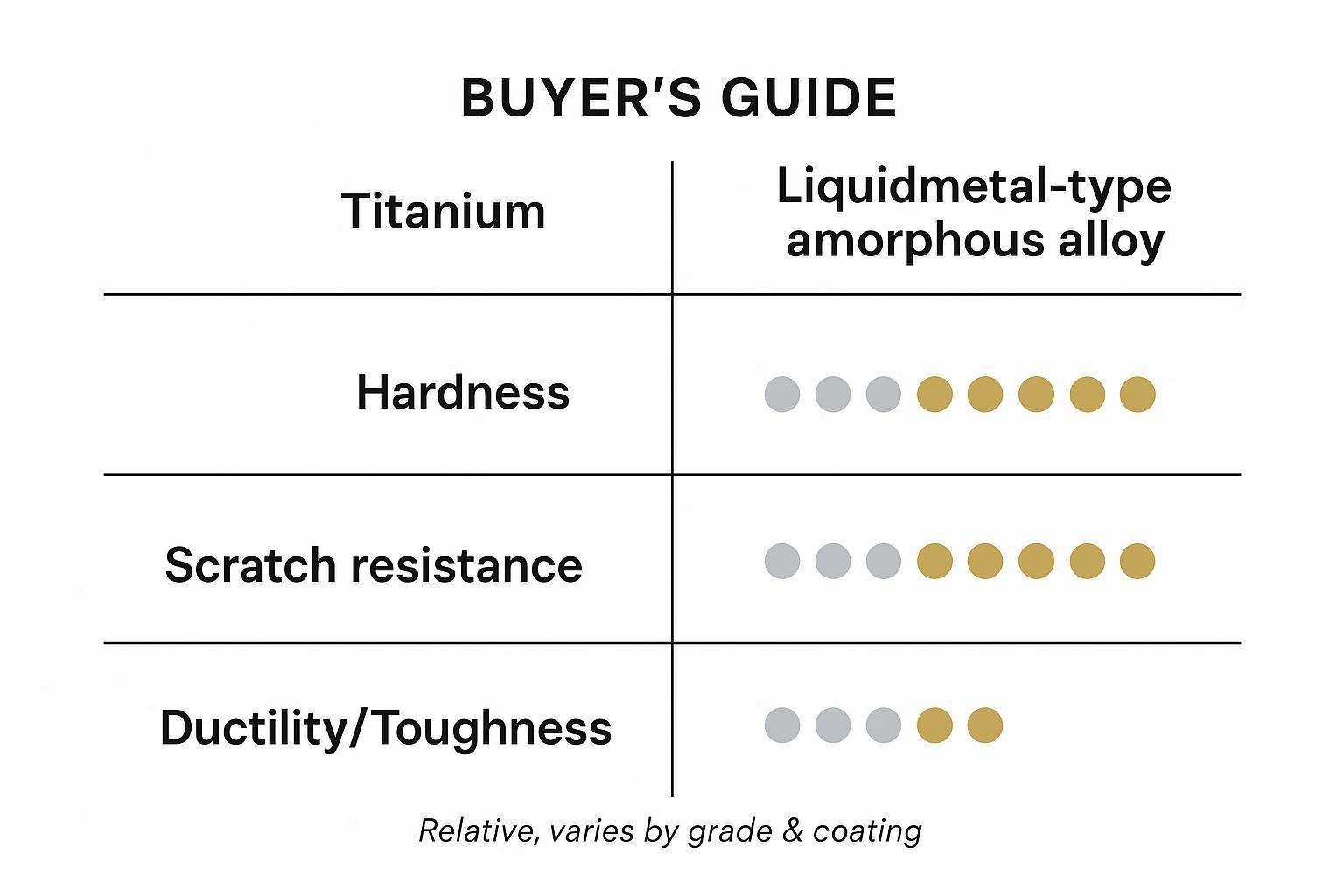
A practical buyer takeaway: if you care most about appearance retention, pay as much attention to the surface system (finish + coating) as the base metal.
Impact and fracture
A ring doesn’t just get scratched. It gets knocked.
This is where shoppers can misread the story. A very hard surface can still fail in a way that feels sudden if the design concentrates stress at an edge or a thin section.
When you’re evaluating impact durability, focus on what you can actually verify:
- Cross-section thicknessa slightly thicker ring often outlasts a thin one, regardless of alloy.
- Edge geometrysharp edges tend to show wear first and can concentrate impact stress.
- Construction around sensorsopenings, seams, and transitions are typical stress points.
How to verify: Look for plain-language durability guidance in the warranty terms. Even better: does the brand describe where cosmetic wear is expected (edges, underside, high-contact points) and how service/refinishing is handled?
Weight, skin, and sweat
Comfort is partly weight and partly friction.
Titanium is widely chosen for wearables because it’s light and generally well tolerated by sensitive skin. It’s commonly described as biocompatible and nickel-free in consumer medical explanations (for example, Healthline’s overview of titanium jewelry and biocompatibility). In other words, if you’re comparing titanium ring comfort sweat hypoallergenic concerns, titanium is often the conservative starting point.
Liquid-metal-type alloys vary more. “Corrosion resistant” is often claimed broadly for amorphous metals, but the real wearer experience depends on formulation and finishing, especially at edges and contact zones.
In daily use, sweat and skincare products matter less as “chemistry” and more as abrasion accelerants: grit trapped under the ring will act like sandpaper. That effect shows up faster on high-polish finishes than on fine brushing.
If you have sensitive skin, treat coatings as part of the material decision. A coating can change the skin-contact surface — for better or worse — depending on how it’s applied and how it wears.
Style and finishes
Coatings and colors
If you want the ring to look new for longer, coatings are often the decisive layer.
Two terms you’ll see often:
- PVD (Physical Vapor Deposition)a family of vacuum-deposited coatings used to add color and improve surface hardness.
- DLC (Diamond-Like Carbon)a coating often discussed as harder and more abrasion-resistant than typical PVD finishes.
In watch finishing, DLC is frequently positioned as the tougher, more scratch-resistant option, while PVD offers broader aesthetic versatility (see Bob’s Watches: PVD & DLC coating overview).
What matters for a ring isn’t just the label — it’s edge coverage, adhesion, and what happens when the coating is breached. On dark coatings, a small chip or edge wear can be more visible because the base metal underneath contrasts.
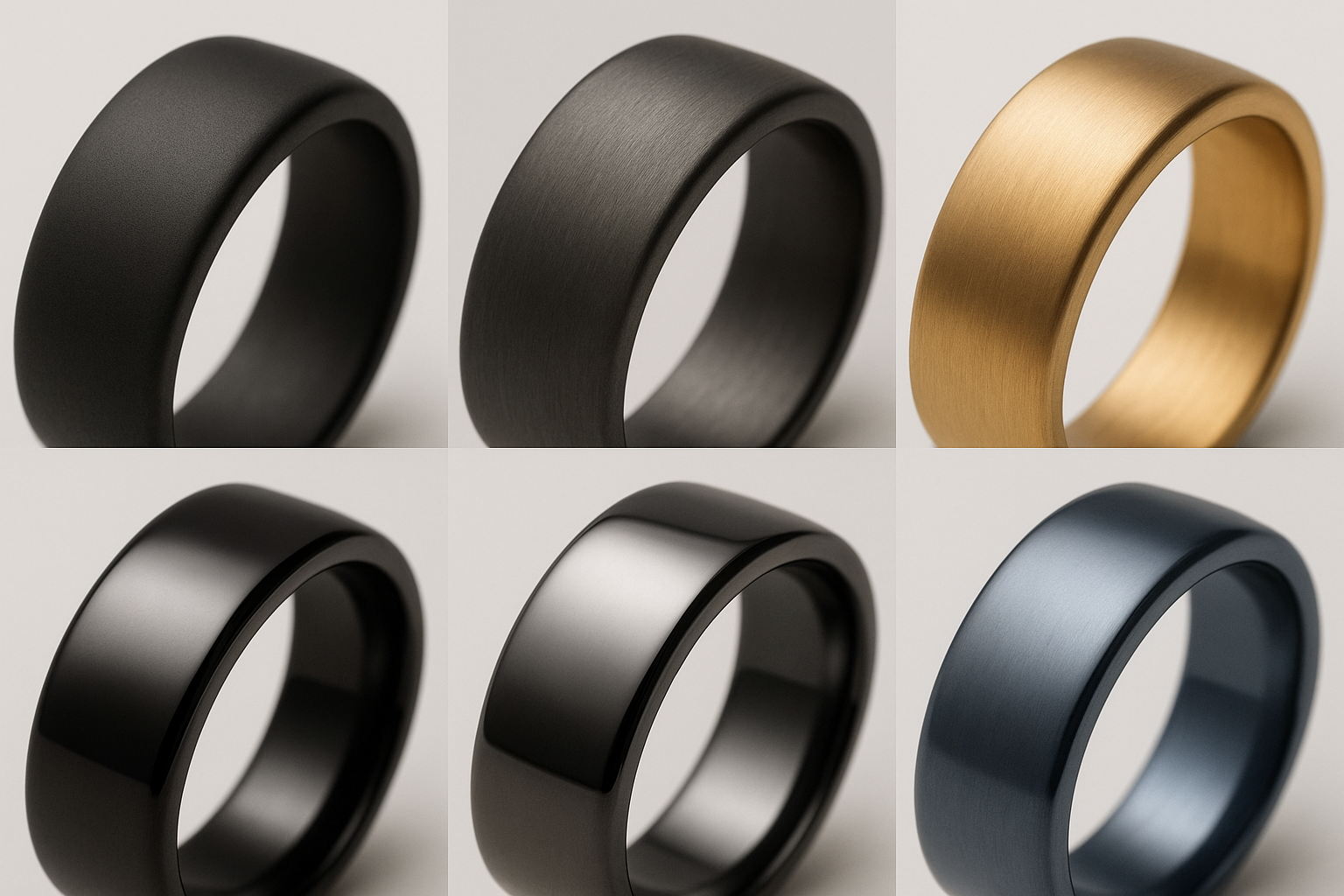
Edge geometry and fit
Fit affects both durability and comfort.
A few patterns you can rely on:
Rounded edges typically feel better and wear more gracefully because they don’t concentrate contact on a sharp corner.
High-polish surfaces show micro-scratches sooner than brushed finishes, even if the material is the same.
Interior comfort curves (a slightly rounded inner edge) reduce pressure points during long wear.
This is also where “titanium smart ring scratch resistance” can become a misleading phrase: you’re not buying titanium in the abstract — you’re buying a specific geometry and finish.
Premium finishing in practice
In luxury finishing, durability isn’t a single headline material. It’s a sequence of decisions that reduce long-term wear visibility:
- Surface prepconsistent brushing or polishing before any coating is applied.
- Coating process controldeposition quality, adhesion, and uniform thickness where it matters.
- Edge disciplinesoftened transitions and protected high-wear points (underside edges, corners).
- Serviceabilityclear guidance on what can be refinished and what must be replaced.
The buyer takeaway is simple: if you’re paying for a premium ring, you should expect the maker to be specific about finishing — not poetic. “Coated” or “hardened” without process detail is not a durability claim.
Conclusion
Titanium and liquid-metal-type alloys can both be excellent choices. The best material is the one that aligns with how you actually live — and how you want the ring to look after months of wear.
Who should choose which material
Choose titanium if:
You want a proven, lightweight daily-wear material.
Comfort and low-fuss wear matter more than keeping a flawless surface.
You prefer brushed finishes that age quietly.
Choose a liquid-metal-type alloy if:
Your priority is surface hardness and scratch resistance (especially on high-polish looks).
You want a dense, refined feel and you trust the maker’s process details.
You’re willing to judge the piece by finishing quality, not the material label.
Key takeaways: durability, comfort, style
- DurabilitySeparate cosmetic wear (scratches) from structural durability (impact and stress concentration).
- ComfortWeight and edge geometry matter as much as the metal. Skin tolerance is usually excellent with titanium, but coatings can change the contact surface.
- StylePVD vs DLC coating quality and edge coverage often decide how long the ring looks “new.”
Quick decision checklist for buyers
Do you know the exact material (titanium grade, or specific amorphous alloy) — not just the marketing label?
Is the finish brushed or polished, and does that match how you’ll wear it?
If coated: is it DLC or PVD, and does the brand explain durability and service?
Are the edges softened and the underside designed for constant contact?
Does the warranty distinguish cosmetic wear from structural issues in a way that feels realistic?
![Top 10 Smartwatches for On-Wrist Voice Notes for Men [New]](https://cdn.sanity.io/images/e0gp1l2g/production/e7630bbd3f3a13378c868abfa960bb193c73b8f1-3840x1860.webp?w=180&h=180&q=78&auto=format&fit=crop)
![Top 10 Smartwatches for On-Wrist Voice Notes for Men [New]](https://cdn.sanity.io/images/e0gp1l2g/production/e7630bbd3f3a13378c868abfa960bb193c73b8f1-3840x1860.webp?w=800&h=450&q=82&auto=format&fit=crop)