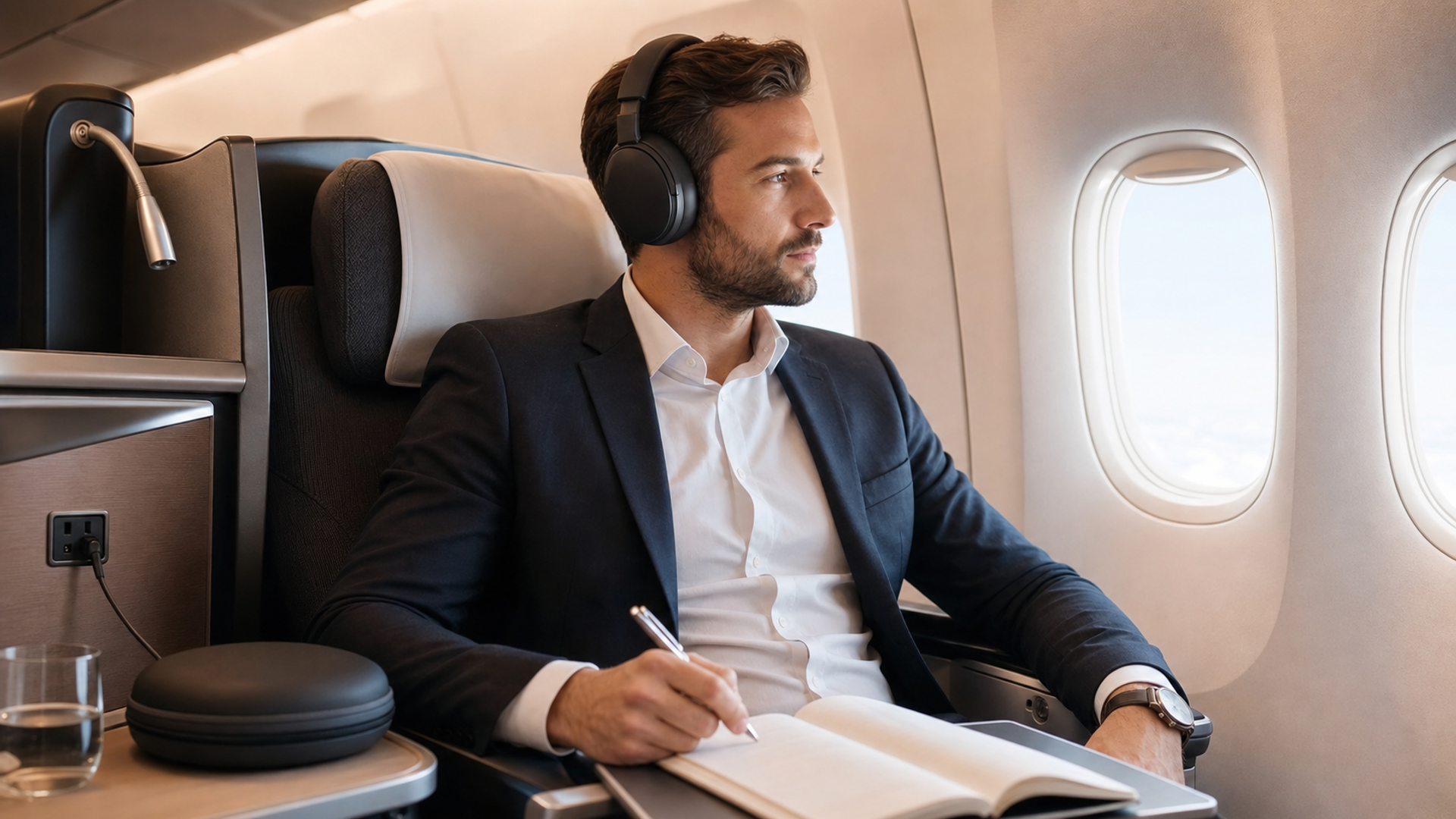
For most long-haul travellers in 2026, the Sony WH-1000XM6 is the strongest all-round choice because it combines a foldable travel design, up to 30 hours of official noise-cancelling playback, an included analogue cable and passive wired operation. Choose Bose QuietComfort Ultra Headphones (2nd Gen) if comfort and cabin quiet matter more than maximising battery; Sennheiser Momentum 4 if multi-sector endurance is the priority; and AirPods Max 2 if you value Apple's H2 ecosystem and accept a heavier design and Apple's stated 20-hour battery.
That verdict is about travel fit, not laboratory sound quality. The best headphone for a 14-hour flight must remain comfortable against a headrest, connect to the seat when Bluetooth is unavailable, fit in the cabin bag and still have power after delays. Active noise cancellation is essential, but a strong shortlist also needs a sensible cable path and controls you can operate in the dark.
The long-haul decision matrix
| Model | Best for | Official battery signal | Seat-screen path | Travel design | Main compromise |
|---|---|---|---|---|---|
| Sony WH-1000XM6 | Best overall balance | Up to 30h NC on; 40h off | Included stereo cable; passive operation stated | Foldable with hard-style case | Comfort and sound preference remain personal |
| Bose QuietComfort Ultra 2nd Gen | Comfort-first cabin use | 30h listed; Bose also states mode-dependent figures | Included 3.5-to-2.5mm cable; USB-C audio | Folds into supplied case | Battery trails Momentum 4; immersive modes use more power |
| Sennheiser Momentum 4 Wireless | Maximum endurance | Up to 60h via Bluetooth with ANC under stated conditions | Check supplied cable and aircraft adapter for your package | Flat-folding case design | Less compact than a true folding hinge; control preference divides users |
| Apple AirPods Max 2 | Apple ecosystem and spatial features | Up to 20h with ANC | Wired use needs the appropriate USB-C/3.5mm path | Slim Smart Case, non-folding metal design | Heavier, less protective case and shortest listed battery here |
Manufacturer battery figures use controlled conditions and are not directly comparable as a scientific test. Volume, codecs, calls, temperature and listening modes alter results. The table records current official claims observed on 3 August 2026; it does not pretend to be a head-to-head measurement.
What long-haul noise cancellation must actually do
Aircraft noise is not one sound. Low, steady engine and airflow noise is where over-ear ANC can reduce fatigue most dramatically. Voices, service sounds and sudden announcements are harder, and you still need an awareness mode or quick control when the crew speaks.
The earcup seal matters as much as the algorithm. Glasses, hair, jaw movement and head shape can break that seal. A headphone that performs brilliantly for one reviewer can create pressure or heat for another after three hours. This is why we do not assign a universal comfort score from specifications.
For travellers deciding between form factors, our guide to noise-cancelling headphones versus open-ear earbuds for a long flight explains why open designs improve awareness but cannot create the same acoustic isolation. If sleep and low-frequency cabin noise are the priority, over-ear ANC remains the safer starting point.
Sony WH-1000XM6: best overall for most travellers
Sony's official WH-1000XM6 specifications list up to 30 hours of continuous music playback with noise cancellation on and 40 hours with it off. The page also confirms a stereo mini-jack, an included connection cable, a carrying case and passive operation.
That last point is travel-critical. If the battery is depleted or the aircraft entertainment system only offers analogue output, the headphone can still function through the cable. The folding design reduces cabin-bag volume, and physical controls for key actions are easier to use than an entirely gesture-led interface when you are tired.
Sony is the best default rather than an absolute winner. Some heads prefer Bose's clamp and cushion geometry; some listeners prefer Sennheiser's tuning. Test the XM6 with glasses and against a seat headrest before the return period ends.
Buy it if: you want one capable headphone for flights, office calls and daily travel, with a credible wired fallback.
Skip it if: you already know the Sony fit creates pressure or you need the longest possible battery between charges.
Bose QuietComfort Ultra 2nd Gen: best for comfort-first travel
Bose has built its travel reputation around the QuietComfort shape, and the second-generation Ultra is the premium version to shortlist. The current Bose product page lists a 30-hour battery, adjustable noise cancellation, a carrying case, a 3.5mm-to-2.5mm audio cable and USB-C audio. Bose's mode notes should be read carefully because immersive processing and ANC settings change endurance.
The reason to choose Bose is not a spreadsheet victory. It is the combination of a forgiving around-ear fit, effective cabin-noise control and a compact folding case. Travellers who wear headphones for most of a long flight often value that comfort more than an extra day of standby.
The analogue cable is important for aircraft entertainment; USB-C audio is more useful with a laptop, tablet or phone. Confirm whether the aircraft has a single or dual-prong socket and carry the correct passive adapter. Do not assume the airline supplies one.
Our detailed AirPods Max 2 versus Bose QuietComfort Ultra 2 comparison is the better next step if those are your final two.
Buy it if: cabin comfort and quiet are your first priorities and 30 hours is sufficient.
Skip it if: you want the longest battery or dislike capacitive volume control.
Sennheiser Momentum 4 Wireless: best for battery endurance
Sennheiser's Momentum 4 page states up to 60 hours of Bluetooth playback with ANC under its test conditions. That gives it the clearest endurance advantage in this shortlist for a traveller moving through several flights, trains and hotel days without a reliable charging routine.
The Momentum 4 also supports USB-C charging and is designed around a broad, padded headband. Its earcups rotate flat, but the packed shape is not as compact as Sony or Bose's folding hinge. The touch-control system is another personal variable: some users enjoy the clean surface; others prefer distinct buttons when wearing gloves or sitting in darkness.
Battery is not a reason to ignore fit. Sixty theoretical hours have little value if the headband becomes uncomfortable after two. Try a full film or a two-hour working session before taking it on a non-refundable trip.
Buy it if: you want multi-day endurance and balanced everyday use.
Skip it if: minimum packed size or physical controls are essential.
AirPods Max 2: best for a committed Apple traveller
AirPods Max 2 uses Apple's H2 chip and adds improved ANC, Adaptive Audio, USB-C lossless audio, Live Translation and other Apple-platform features. Apple states up to 20 hours of listening with ANC, and the design combines an aluminium cup, stainless-steel frame and mesh canopy.
The Apple integration is the reason to buy: automatic switching, spatial audio, familiar controls and features coordinated with iPhone, iPad and Mac. The cost is practical. The metal construction is heavier than the principal plastic travel rivals, the earcups do not fold inward, and the Smart Case protects less of the headphone than a conventional zipped shell.
Wired cabin use also requires attention. USB-C digital audio is not the same as plugging directly into an aircraft's 3.5mm socket. Carry the correct Apple-supported cable for analogue sources and test it before departure. Twenty hours can cover one long flight, but a delay and onward sector reduce the margin.
Buy it if: Apple integration is worth more to you than minimum weight and maximum battery.
Skip it if: you travel with a small personal item, sleep against the window or need two long sectors without charging.
The pre-flight fit test
Do not judge a travel headphone in a five-minute shop demonstration. Recreate the journey at home:
wear it for two continuous hours with your glasses;
lean against a sofa or headrest and turn your head both ways;
play speech quietly and check whether ANC pressure feels comfortable;
switch between phone and laptop if you rely on multipoint;
connect the analogue cable with Bluetooth disabled;
place the headphone, cable and adapter in the exact cabin bag;
test transparency or awareness mode for conversation;
confirm that controls work without looking.
If heat, clamp or crown pressure appears in two hours, it will not improve on a 14-hour sector. Return or exchange within the seller's terms rather than hoping the cabin distracts you.
Cable and power discipline
Charge to full before leaving, but also pack a short USB-C cable and a compliant power bank in cabin baggage. Power banks must not be placed in checked baggage under common aviation rules; follow the operating airline and departure-country requirements.
For seat entertainment, carry a simple 3.5mm cable where the headphone supports it and a dual-prong aircraft adapter only if needed. Bluetooth transmitters can be useful, but their battery, codec and pairing behaviour add another failure point. A direct cable remains the most predictable fallback.
Turn off spatial or immersive modes if battery margin becomes important. Keep awareness mode accessible during boarding, meal service and safety announcements. Noise cancellation should reduce fatigue, not isolate you from instructions.
The best travel accessories for long-haul business trips includes the rest of the cabin system: charging, cables, sleep and document organisation.
Final verdict
Buy Sony WH-1000XM6 for the most balanced travel package, Bose QuietComfort Ultra 2nd Gen for comfort-first cabin use, Sennheiser Momentum 4 for endurance, and AirPods Max 2 for the deepest Apple experience. Any of the four can be the right answer after a proper fit test.
The wrong purchase is the one chosen from an ANC claim alone. On a long-haul flight, comfort, cable compatibility, packed volume and power margin determine whether the headphone remains useful after hour eight.
Related VERTU reading
Sources and verification
Sources were checked for this 3 August 2026 publication package. Terms and specifications can change; recheck the linked source before acting.