The best travel accessories for a long-haul business trip solve one of five costly problems: lost power, poor sleep, misplaced essentials, insecure information or disruption. They should be compact, legal to carry, easy to inspect and compatible with the journey. A beautiful object that duplicates hotel equipment or remains buried in an overhead bag is not useful.
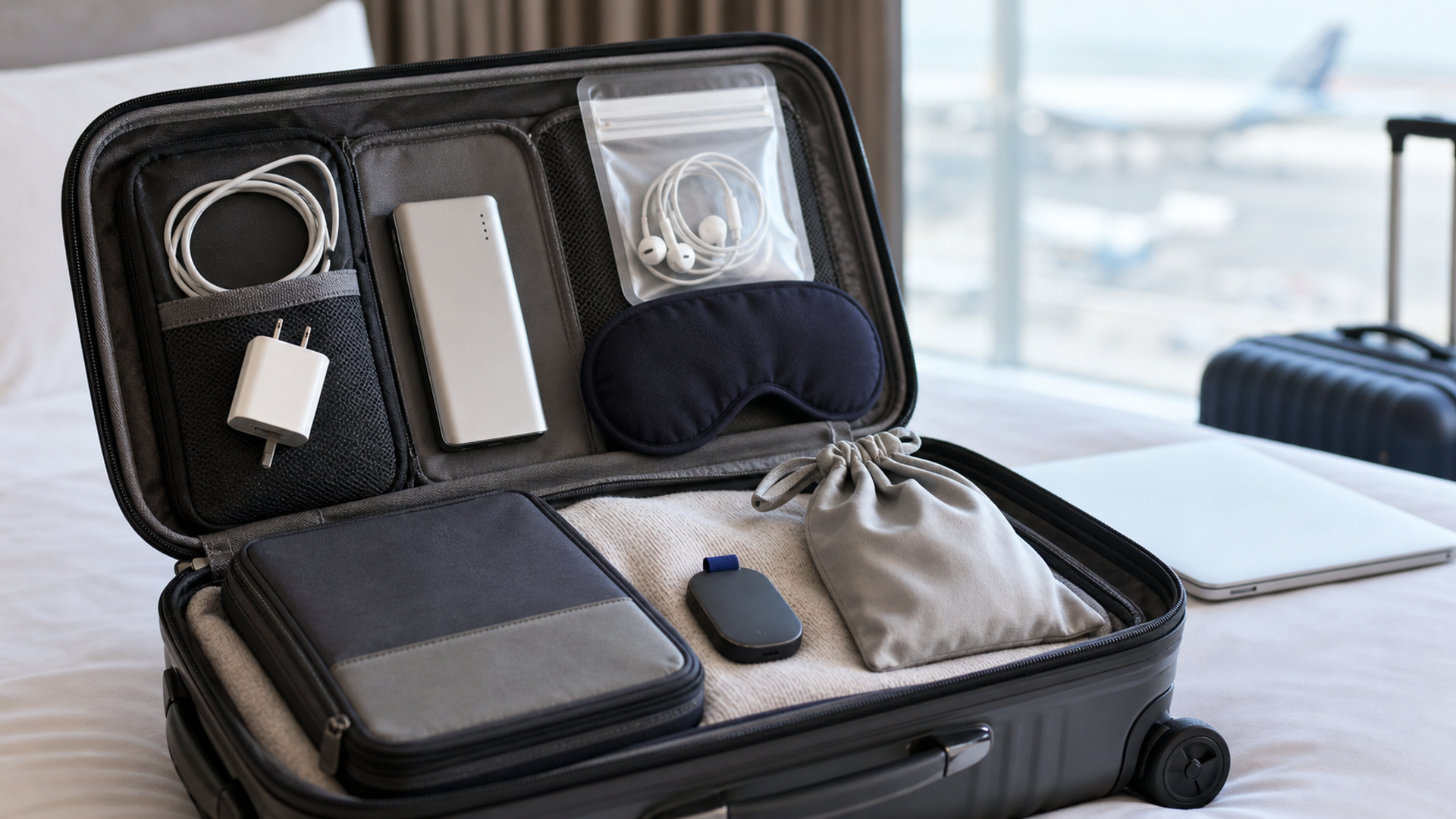
The essential kit is a compliant power bank, compact multi-port charger, short cable set, sealed noise-cancelling audio, eye mask, empty reusable bottle, document wallet, luggage tracker and a small recovery pouch. The exact choices depend on aircraft, destination, health needs and company policy.
Pack by failure, not by category
Begin with the itinerary: home to airport, security, lounge, aircraft, connection, arrival, hotel and meeting. At each stage, ask what failure would create delay or impair judgement. The accessory must either prevent that failure or make recovery faster.
Avoid packing ten “travel gadgets” because they are travel-labelled. A universal adaptor without the destination plug you need is useless; a large neck pillow may consume the space needed for work equipment. Every item should have a named problem, journey stage and storage position.
Long-haul accessory matrix
| Problem | Essential item | Carry-on location | Selection test |
|---|---|---|---|
| Phone/laptop power | Compliant power bank and charger | Personal item, never checked | Airline watt-hour rules and ports |
| Cabin noise | Sealed ANC earbuds/headphones | Seat pocket pouch | Comfort after two hours |
| Sleep | Eye mask and compact support | Top of personal item | No pressure points |
| Lost luggage | Tracker and identity card | Tracker inside bag | Network and battery status |
| Document loss | Slim zipped document wallet | Secure inner pocket | One-hand access |
| Spill/illness | Small recovery pouch | Exterior or top pocket | Allowed liquids and medication |
| Connection disruption | Offline itinerary and contacts | Phone plus paper fallback | Works without network |
The table prioritises access. An emergency item in checked luggage is not part of the active travel system.
Power bank: start with aviation rules
Lithium power banks belong in carry-on baggage, not checked baggage. Airlines and regulators control allowed capacity, labelling and use. The US FAA's PackSafe guidance explains spare-battery requirements; IATA publishes broader dangerous-goods guidance for passengers. Always check the operating carrier, including codeshares.
Choose a clearly labelled watt-hour rating, protected ports and enough output for the actual devices. Capacity claims in milliamp-hours are less useful without voltage and conversion losses. Do not carry a swollen, damaged or recalled battery.
Keep it accessible for inspection and prevent metal objects from shorting the terminals.
Charger and cable architecture
A compact multi-port charger can replace several bricks, but total output is shared. Confirm that one port can support the laptop's required USB-C Power Delivery profile and that simultaneous phone charging does not reduce it below a useful level.
Pack one short seat cable, one longer hotel cable and the minimum adaptors. Label them discreetly and inspect for damage. A cable with intermittent power creates heat and wastes time. If the laptop uses a proprietary connector, carry the original or a tested spare.
Do not rely on aircraft USB ports for sensitive devices or meaningful power. A charge-only USB data blocker can reduce data exposure, but an AC outlet with your own charger is clearer when available.
Audio: quiet versus awareness
Sealed active noise-cancelling earbuds or headphones are the aircraft choice because they reduce steady low-frequency cabin noise. Fit and battery duration matter more than maximum marketing language. Open-ear audio is better suited to terminals and arrival areas where announcements and colleagues must remain audible.
VERTU's Phantom Series OWS earbuds fit that awareness-led ground use, subject to current availability and product specifications. They are not a substitute for sealed ANC on a noisy long-haul sector. The detailed noise-cancelling versus open-ear guide explains the distinction.
Carry a wired fallback if an important call or in-flight system depends on audio.
Sleep accessories that earn their space
A good eye mask blocks light without pressing on the eyelids. A support item should work with the aircraft headrest and pack small. Test it in a chair before travel; many neck pillows push the head forward. A clean scarf or light layer can provide warmth more efficiently than a bulky blanket.
Earplugs remain useful even when carrying ANC because they need no battery and can be worn during sleep. Do not combine devices in a way that creates discomfort or prevents you from hearing safety instructions when required.
Set a sleep plan around destination time, hydration and cabin service rather than expecting an accessory to eliminate jet lag.
Documents and identity
Use one zipped wallet for passport, boarding documents, visa evidence and a backup payment card. Keep it in a consistent secure pocket. Store encrypted digital copies separately, with access available offline but protected by strong authentication.
Do not place every identity and payment item in the same wallet. A secondary card and copy of essential contacts should be physically separate. Remove expired visas and unnecessary cards to reduce confusion and exposure.
The wallet should be discreet and easy to handle at immigration without revealing unrelated documents.
Trackers and luggage recovery
A luggage tracker can indicate where a bag appears in a participating device network; it does not guarantee recovery or provide continuous GPS. Check battery status and name the tracker without publishing personal details. Follow airline rules and local law.
Place a physical identity card inside the bag with a phone number or monitored email, avoiding a full home address where unnecessary. Photograph the bag and contents before departure, and retain baggage receipts.
If the tracker suggests theft, work with the airline or authorities rather than confronting a person. Treat location as evidence to support recovery, not personal enforcement.
The disruption pouch
Keep a small pouch with essential medication, one change of base layer, toothbrush, stain wipe appropriate to clothing, pen, cable, earplugs and any item required for the first meeting. Respect liquid and medication rules; keep prescriptions and original packaging where needed.
This pouch turns a delayed checked bag from a crisis into an inconvenience. It should be light enough to remain in the personal item. Review it after each trip because expired products and depleted medication are common failure points.
A calm arrival depends more on this small redundancy than on a large collection of premium accessories.
Data and device security
Update devices before departure, enable strong locks and review account recovery. Use your own mobile data or a trusted connection for sensitive work; a VPN does not make an untrusted device or fraudulent login page safe. Disable automatic connection to open Wi-Fi.
Pack a privacy screen only if it preserves readability and colour for the work. Choose a seating position that limits shoulder surfing. Avoid confidential calls in lounges, even with noise-cancelling headphones.
For higher-risk travel, use a minimised device profile with only the data needed. VERTU's passkey versus password guide provides a practical recovery and authentication framework.
Clothing and material care accessories
A small shoe bag, breathable garment sleeve, soft cloth and empty stain pouch can protect business clothing without carrying a miniature wardrobe-care shop. Do not apply an unfamiliar cleaning product during travel. Blot, isolate and seek specialist care for valuable leather, silk or tailored garments.
Use pouches to separate hardware from soft materials. Power-bank edges, cable ends and zips can mark leather or scratch eyewear. A structured packing system protects objects and makes security screening faster.
Avoid compressing a work bag or structured shoe simply to maximise capacity. The apparent space saving may create lasting deformation.
When Concierge support adds value
Accessories handle predictable failures; they cannot rebook a cancelled route, negotiate a hotel arrival or coordinate several suppliers. A concierge becomes relevant when disruption crosses systems: airline, ground transport, accommodation, restaurant and meeting schedule.
VERTU Concierge may assist eligible users with authorised coordination according to the current service scope and availability. It cannot guarantee airline inventory, border decisions, weather outcomes or third-party performance. The traveller should still retain booking references, insurance contacts and a direct airline route.
The combination is sensible: a self-sufficient personal kit for immediate continuity and a human service for complex coordination.
The 15-minute final pack audit
Put every accessory on a table. Remove anything without a named failure. Confirm power-bank labelling, medication, passport validity and destination plugs. Charge devices, update offline documents and check tracker batteries. Put seat-use items into one pouch and disruption items into another.
Weigh the personal item and verify the operating airline's limits. Sit with it under a chair and retrieve the passport, charger and eye mask without unpacking. If the process is awkward at home, it will be worse in a dark cabin.
The best long-haul kit is not the most elaborate. It is the smallest system that keeps the traveller powered, rested, secure and able to recover.
Review the kit after arrival. Record what was used, what failed and what remained untouched. Remove one unnecessary object before the next trip and replace only the component linked to a real failure. That small feedback loop keeps the carry-on light while making the travel system more dependable over time.