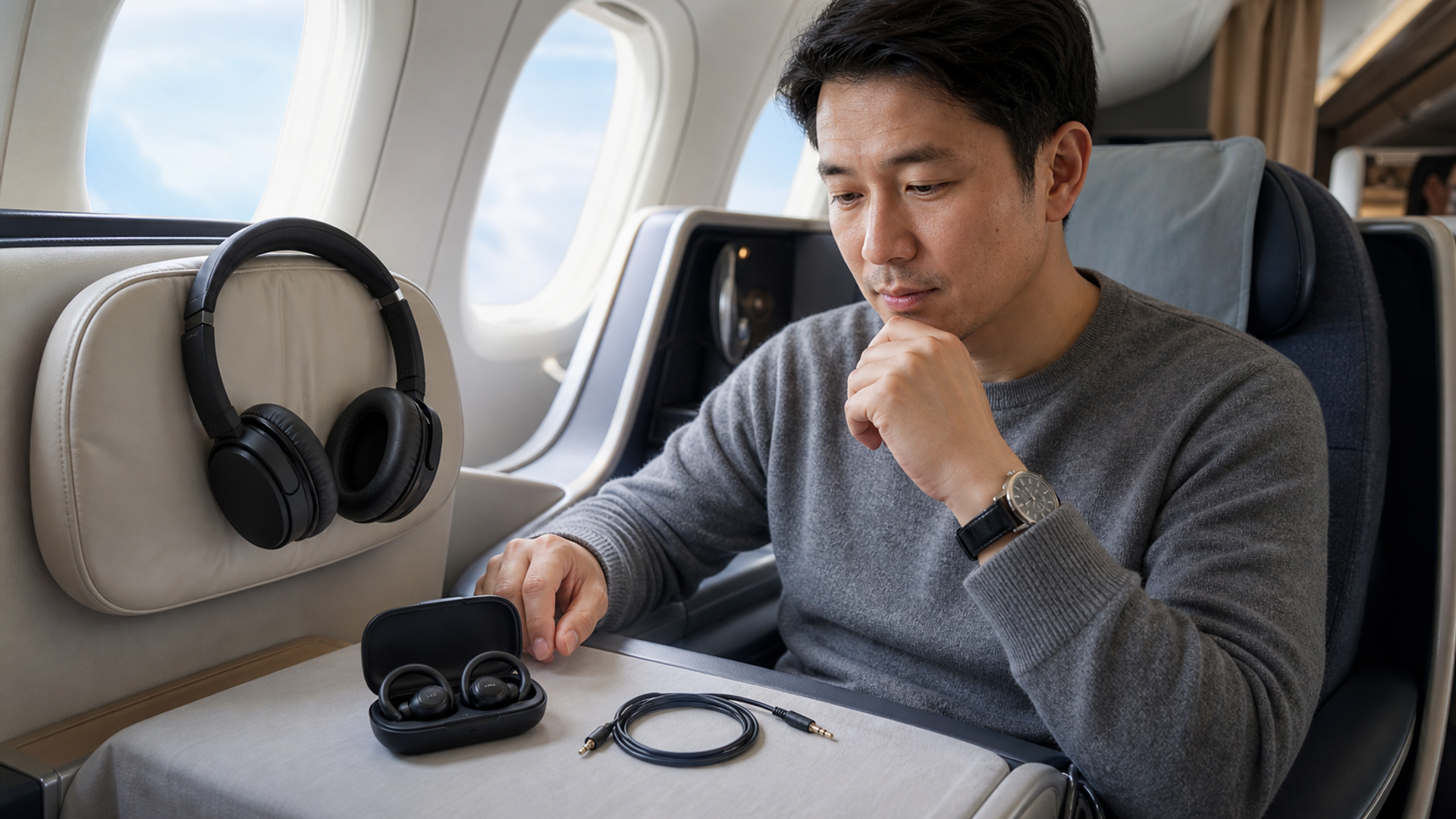
For a long flight, noise-cancelling headphones are usually the better primary choice because they reduce the temptation to raise volume against steady cabin noise. Open-ear earbuds are better for terminal awareness, conversations and travellers who dislike pressure or ear-canal contact, but they do not isolate you from engine and airflow noise. The most practical answer is often one noise-reducing primary device and a small awareness-focused backup.
This is not merely a sound-quality comparison. On a ten-hour journey, fit, heat, battery, announcements and listening level matter more than a dramatic five-minute demonstration in a shop.
Quick verdict by flight moment
| Flight moment | Better starting point | Why |
|---|---|---|
| Busy terminal and gate changes | Open-ear earbuds | Easier awareness of announcements and people nearby |
| Take-off and cruise | Noise-cancelling headphones | Better control of steady low-frequency cabin noise |
| Meal service or conversation | Open-ear or transparency mode | Less friction when speaking |
| Sleep | Depends on fit | Over-ear cups can press against a seat; open designs let in cabin noise |
| Working with spoken audio | Noise-cancelling | Reduces masking noise and the urge to increase volume |
| Walking through an unfamiliar airport | Open-ear | Environmental awareness is more valuable than isolation |
Why cabin noise changes the decision
People increase playback volume when outside sound masks speech or music. That is the important mechanism, not whether one product advertises more microphones than another. The World Health Organization's safe-listening guidance recommends well-fitted, noise-cancelling headphones in noisy situations because they can reduce the need to turn the volume up.
WHO uses 80 dB for up to 40 hours a week as one example of a listening level and duration relationship; at 90 dB, its example falls to four hours a week. Those are public-health examples, not a personal diagnosis. The practical lesson is simple: level and duration work together. A long flight makes modest volume more important than a short commute.
Noise cancellation works best on relatively consistent sound such as engine rumble and airflow. It cannot make a cabin silent, and performance varies with fit, cup seal and algorithm. A loose spectacle arm, hair under a cushion or an earbud that does not seal can change the result.
Open-ear products take the opposite approach. They leave the ear canal open or position a speaker near it, preserving more environmental sound. That is useful when walking, waiting for a gate announcement or speaking to cabin crew. In a loud cabin, however, the same openness means external noise still competes with the content.
Comfort is a system, not a product category
Over-ear noise-cancelling headphones
Over-ear designs distribute contact around the ear and avoid placing a tip inside the canal. Many travellers find this comfortable for several hours. Others experience clamp pressure, heat around the cups or interference with glasses.
They are also physically large. A case takes space, and sleeping against a window or headrest can push one cup out of position. If you intend to sleep, test the headphones in the posture you actually use rather than sitting upright at a desk.
Sealed in-ear noise-cancelling earbuds
Although not the title's open-ear option, sealed in-ear buds are the compact middle ground. They can combine passive isolation with active cancellation and fit easily in a pocket. Their success depends heavily on tip size. A poor seal weakens bass and cancellation; an aggressive seal can become uncomfortable.
Open-ear earbuds
Open-ear designs avoid the occluded feeling some users dislike and are often easier for conversation. They can remain cooler and reduce the sense of being cut off from a terminal. The trade-off is privacy and noise rejection: people nearby may hear more leakage at high volume, while you hear more of the cabin.
Compare the ownership details
| Decision factor | Noise-cancelling over-ear | Open-ear earbuds |
|---|---|---|
| Steady cabin-noise reduction | Strongest category tendency | Limited by open design |
| Announcement awareness | Use transparency or remove one cup | Naturally stronger |
| Packing volume | High | Low |
| Heat over long wear | Can be significant | Usually lower |
| Sleep against seat | Often awkward | Smaller, but fit still matters |
| Battery redundancy | Some work passively with cable | Usually stop when battery is flat |
| Privacy at a quiet gate | Generally good | Leakage depends on design and volume |
| Cleaning | Wipe cushions and headband | Clean contact surfaces and charging case |
Battery claims should be compared under the same conditions. Active noise cancellation, voice calls, spatial processing and high volume can all change endurance. A quoted total that includes repeated case recharging is not the same as continuous playback on one charge.
If the aircraft provides seat-back entertainment, confirm the physical connection. A wireless-only product may need an airline Bluetooth transmitter or a cable mode. Test it before departure; a premium headphone is not useful if it cannot receive the source you plan to use.
A safe-listening routine for long-haul travel
Start playback before the loudest part of boarding and set a comfortable, low level.
Enable noise cancellation rather than compensating with volume.
Use your phone's sound-exposure or volume-limit feature where available.
Take quiet breaks instead of wearing audio continuously.
If you notice ringing, muffled hearing or discomfort, stop listening rather than changing modes.
Clean contact surfaces after the journey and let cushions or earbuds dry before closing the case.
WHO recommends keeping device volume below 60 per cent of maximum as a broad consumer habit and, where monitoring is available, staying below an 80 dB average. Percentage controls differ among devices, so treat the number as a prompt to monitor exposure, not as a guarantee that every product at 60 per cent produces the same level.
Which traveller should choose which?
Choose noise-cancelling headphones if you spend most of the flight working, watching films or listening to speech; you are sensitive to steady cabin noise; and you accept the case size. They should be the default for someone who otherwise turns audio up to overcome the aircraft.
Choose open-ear earbuds if awareness and conversation dominate; you dislike sealed tips or warm over-ear cups; and your listening will occur mainly in the terminal or during quieter parts of the journey. They are also a useful second device for walking through an airport.
Consider carrying both only if they solve different jobs. Two expensive audio products that both run flat before landing are not redundancy. A compact wired pair can be the more reliable backup.
VERTU's current knowledge base lists Phantom open-wear earbuds with AI translation and transcription, 8.8 g earpieces and a stated 25-hour total battery figure, while also noting that the former product URL now routes to the current earbuds collection. Availability and exact specifications should be checked on the live collection before purchase. Those features do not change the category trade-off: an open-wear design prioritises awareness and comfort over cabin isolation.
Your audio plan should sit inside the wider journey. Save essential files locally using an appropriate phone storage choice, prepare an eSIM or hotspot setup, and treat hotel connectivity through a threat-based travel network guide.
Do the seat-and-cable test at home
Wear the chosen device for two uninterrupted hours before the trip. Glasses, earrings, hairstyles and headrests change pressure in ways a five-minute shop test will not reveal. Recline against a chair and turn your head as if trying to sleep. Large ear cups can collide with a winged headrest; a rigid ear hook can become uncomfortable against a travel pillow.
Check the wired fallback. Some aircraft entertainment systems still use a 3.5 mm socket, while headphones differ in whether noise cancellation works over cable. Pack the correct cable and any airline adapter in an accessible pouch. Bluetooth pairing may be available, but it should not be the only plan.
For calls after landing, test microphone performance in background noise. A model that sounds excellent to the wearer can transmit wind and terminal announcements poorly. Keep announcements visible, use transparency mode when interacting with crew and remove the device when situational attention is required.
Battery behaviour deserves the same rehearsal. Test the device with noise cancellation enabled, because the advertised maximum may use a different mode or volume. Confirm whether it can play while charging and pack a short cable that does not trail across the seat. If the battery is replaceable only by the manufacturer, long-term service support belongs in the buying decision.
Cleanliness affects comfort over a long itinerary. Wipe ear pads or tips using the maker's approved method, let them dry fully and carry spare tips only in a clean case. Shared aircraft adapters and seat surfaces should not enter the ear. If pressure, pain, dizziness or persistent ringing develops, stop listening; noise cancellation is not a treatment for an ear or sinus problem.
Travellers with an existing hearing condition or hearing devices should test compatibility with a qualified professional and the relevant manufacturers. Active noise cancellation changes perceived background noise; it does not reduce every hazardous sound in every situation. Keep the crew call, alarm and announcement pathway available. For children, use age-appropriate equipment and supervision rather than assuming an adult volume limit or fit is suitable.
After landing, note discomfort and battery remaining; that evidence is more useful for the return flight than a specification-sheet promise.
The practical verdict
Buy noise cancellation for the cabin and open-ear awareness for movement. If one device must do everything, a well-fitting noise-cancelling model with a convincing transparency mode is the safer all-round choice for long-haul travel. Test fit for at least an hour, verify the aircraft connection and prioritise a lower listening level over a louder specification sheet.