

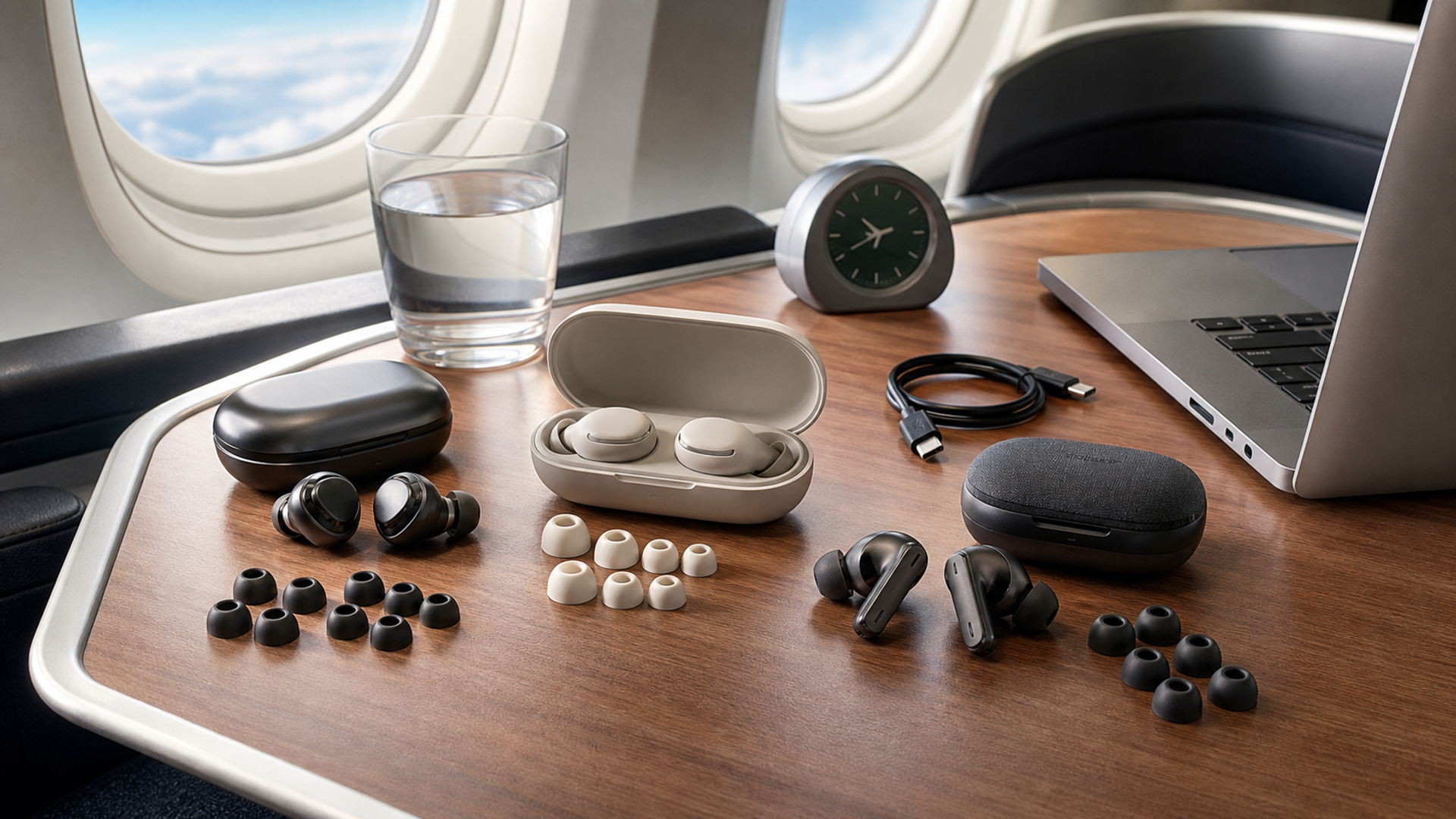
The best noise-cancelling earbuds for business travel are not simply the pair with the strongest laboratory claim. They must reduce steady cabin noise, remain comfortable for several hours, make speech intelligible on calls, switch reliably between devices and survive a complete journey with a case small enough to keep accessible.
For most Apple-centred travellers, AirPods Pro 3 are the most coherent ecosystem choice. Sony's WF-1000XM6 are the strongest all-round alternative for travellers who prioritise current noise-cancelling engineering and cross-platform flexibility. Bose QuietComfort Ultra Earbuds (2nd Gen) remain a comfort-and-quiet specialist worth trying in person. The right answer still depends on fit, because a poor seal can erase the advantage of any premium model.
The 2026 shortlist
This guide uses current manufacturer information rather than pretending to reproduce a controlled acoustic laboratory. Apple lists active noise cancellation, adaptive audio, five tip sizes and up to eight hours of listening with ANC for AirPods Pro 3. Sony describes the WF-1000XM6 as its latest flagship true-wireless model, with a redesigned fit, four microphones per earbud and new noise-processing hardware. Bose positions its QuietComfort Ultra Earbuds (2nd Gen) around immersive audio, quiet and stability.
These are decision candidates, not a universal ranking. Ear anatomy, phone platform, call environment and route length change the result.
Business-travel decision matrix
| Traveller priority | Best starting point | Why | Check before buying |
|---|---|---|---|
| Apple devices and seamless switching | AirPods Pro 3 | Deep Apple integration and compact case | Non-Apple feature limits |
| Maximum current Sony ANC engineering | Sony WF-1000XM6 | New processor, microphones and adaptive design | Fit with supplied tips |
| Quiet-focused comfort | Bose QC Ultra Earbuds (2nd Gen) | Strong quiet/comfort positioning | Case size and multipoint workflow |
| Calls across mixed devices | Sony or Bose | Broader cross-platform orientation | Test laptop call controls |
| Awareness in terminals and streets | Adaptive/transparency modes | Safer environmental awareness | Wind handling and voice audibility |
| Open-ear comfort | VERTU OWS or another open-ear design | No ear-canal seal | Not a substitute for aircraft ANC |
The final row is intentionally separate. Open-ear earbuds serve awareness and comfort; they do not create the passive seal required for serious low-frequency cabin-noise reduction.
Why fit outranks the specification sheet
Active noise cancellation works with passive isolation. The ear tip must seal the canal so the electronics are not fighting leakage. One ear may require a different tip size from the other. Jaw movement, glasses, skin oils and a long flight can change the seal over time.
Run the manufacturer's fit test where available, then verify it manually. Play speech at a moderate level near a fan or train. Turn your head, smile and speak. If bass disappears or external noise changes sharply, the seal is unstable. Try another tip size or material before concluding that the ANC is poor.
Comfort also changes after an hour. A pair that feels secure for ten minutes may create pressure at the tragus or canal during a long sector.
Cabin noise is different from office noise
Aircraft cabins produce sustained low-frequency engine and airflow noise. Good ANC is effective against that predictable sound. Voices, clattering service items and announcements are less uniform and may remain audible. No earbud should be expected to create silence.
In an office, the priority may reverse: reducing ventilation hum while keeping speech natural in transparency mode. On a street, full cancellation can reduce situational awareness. Business travellers need fast control over quiet, adaptive and awareness modes without navigating a phone menu.
Test controls with gloves, damp fingers and while seated. A technically excellent mode is less useful if it is awkward to reach when cabin crew speak.
Calls: microphone quality is situational
Manufacturers now use multiple microphones, beamforming, bone-conduction sensors and machine learning to isolate speech. Those systems can perform differently in wind, station announcements and reverberant lounges. A quiet-room sample does not predict an airport call.
Make three test recordings: near a road, beside a coffee machine and while walking with luggage. Listen for clipped consonants, pumping background noise and delay. Then test the actual conferencing applications used by your organisation, because laptop Bluetooth profiles and application processing can change the result.
For critical calls, a wired USB headset in the carry-on remains a sensible fallback. Redundancy is more professional than expecting one wireless device to cover every environment.
Battery: plan around the itinerary, not the headline
Quoted listening time is measured under specified conditions. ANC, spatial audio, calls, high volume and ageing batteries can reduce it. The useful calculation is continuous sector time plus transfer time, with a margin.
AirPods Pro 3 list up to eight hours with ANC, which covers many flights but not every long-haul itinerary without a case break. Other models should be assessed using their current official specifications. Do not rely on the charging case being accessible if it is packed in an overhead bag.
Charge the case before departure, keep a short cable in the seat pocket and confirm whether wireless charging works with the pad in your hotel or lounge.
Ecosystem and multipoint
Apple's advantage is coherence across current Apple devices: pairing, settings, Find My and automatic switching. Travellers using an Android phone and Windows laptop may value conventional Bluetooth multipoint and a platform-neutral app more highly.
Multipoint is not identical across brands. Some earbuds keep two connections but prioritise media unexpectedly; others handle calls well but require manual switching for high-quality codecs. Test the precise phone-laptop combination. Corporate laptops may restrict companion applications, so configure firmware and controls before travel.
Also check how the earbuds behave when a nearby tablet wakes. An unwanted device switch during a board call is a workflow failure, not a minor inconvenience.
Comfort, hygiene and pressure
Ear canals become sensitive during long wear. Alternate between earbuds, over-ear headphones and quiet periods. Clean tips according to manufacturer guidance and allow them to dry before returning them to the case. Do not share tips.
Pressure sensation is not necessarily harmful, but it can be unpleasant. Vent design, tip size and ANC tuning affect it. If a model creates persistent discomfort, choose another fit rather than tolerating it because a review declared it “best”.
People using hearing-related features should follow the manufacturer's eligibility and regional guidance. This article is a travel-device decision guide, not medical advice.
Security and lost-device recovery
Earbuds can expose call audio and meeting notifications if they reconnect to the wrong device. Remove old pairings, use a strong device lock and review Bluetooth names that reveal personal information. Update firmware before departure, not during a connection.
Location features can help find a case or earbud, but availability and precision vary. They should not be used to confront a suspected thief. Record serial numbers and understand the manufacturer's replacement policy.
For confidential calls, the larger risk is often the environment: people nearby, visible screens and an untrusted conference link. ANC does not create conversational privacy.
Where VERTU OWS earbuds fit
VERTU's Phantom Series OWS earbuds occupy a different category: open-ear wear prioritises awareness and avoids an in-canal seal. That can be valuable in terminals, hotel arrival areas and situations where an executive must hear colleagues. It is not an evidence-based substitute for sealed ANC earbuds during a noisy flight.
The relevant comparison is use case, not brand prestige. A traveller might carry sealed ANC earbuds for the aircraft and use open-ear audio on the ground. VERTU's guide to noise-cancelling versus open-ear audio on a long flight explains that boundary in more depth. Product availability and features should be checked on the current VERTU product page.
For a broader market view, the existing premium wireless earbuds guide can supply additional candidates, but its claims should be rechecked against current manufacturer pages.
How to choose in 20 minutes
Bring your phone and, if possible, your work laptop to the retailer. Confirm seal and comfort. Switch between quiet and awareness modes. Record a voice note. Pair a second device. Put the case in the pocket you use on flights. Check that controls work without looking.
Then choose by your dominant failure cost. If an unstable call is costly, prioritise microphones and switching. If fatigue from cabin noise is the problem, prioritise seal and ANC. If ear-canal discomfort dominates, accept less isolation and choose an open-ear or over-ear alternative.
The best business-travel earbud is the one that remains predictable at hour eight.
A pre-flight configuration routine
Complete firmware updates at home, then rename the earbuds without personal or company identifiers. Save the preferred control layout, download any companion-app settings and pair only the devices needed for the trip. Confirm that the laptop can select the earbuds as both microphone and speaker, not merely as media output.
At the gate, check charge levels for each bud and the case. Pack a short USB-C cable where it can be reached without opening the overhead bag. Download essential audio instead of depending on aircraft Wi-Fi, and carry spare clean tips in a small case. These steps sound ordinary, but they remove most of the avoidable failures that make premium hardware feel unreliable while travelling. Predictability is the real premium.
![Top 10 Luxury Smartwatches for Business Travel [2026]](https://cdn.sanity.io/images/e0gp1l2g/production/8b5e5b21db42a1c5f040e828bd041857353a8eb2-2560x1382.webp?w=800&h=450&q=82&auto=format&fit=crop)