

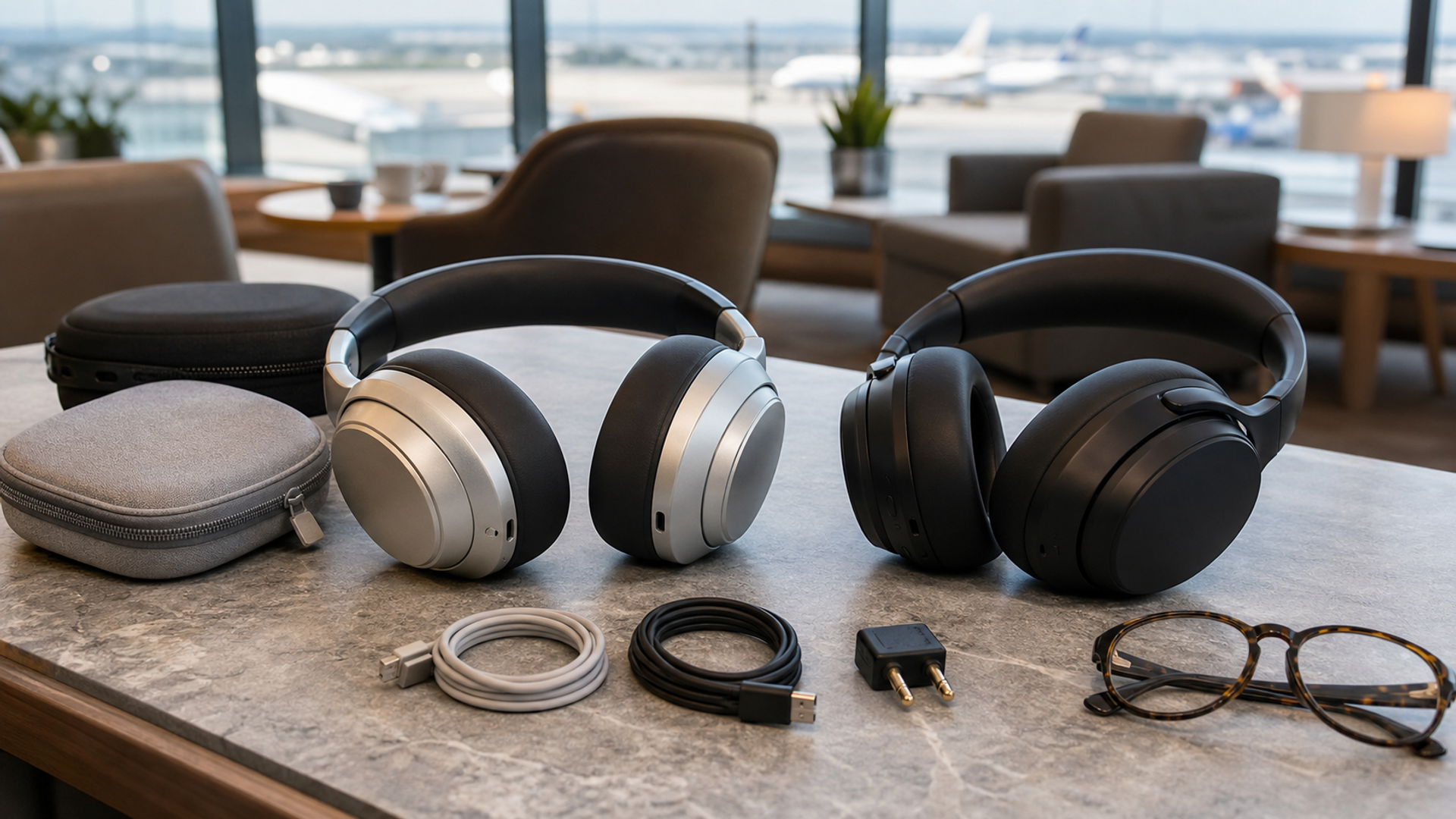
Choose AirPods Max 2 when you live inside Apple’s ecosystem and value effortless device switching, USB-C lossless and ultra-low-latency listening with supported sources, and Apple’s spatial-audio experience. Choose Bose QuietComfort Ultra Headphones (2nd Gen) when lower weight, longer quoted battery life and a more conventional travel case matter most. Both are premium noise-cancelling headphones; the better flight companion is the one you will actually carry, charge and connect across your travel devices.
Apple’s current AirPods Max 2 specifications list H2 chips, up to 20 hours of listening with Active Noise Cancellation, a weight of 386.2 grams and Bluetooth 5.3. Bose lists up to 30 hours of battery life with Immersive Audio off, up to 23 hours with it on, Bluetooth 5.4 and a headphone weight of 0.583 pounds—about 264 grams. Those numbers create a clear portability advantage for Bose, but they do not predict fit, cabin noise performance or microphone quality for every person.
Premium travel-headphone matrix
| Decision factor | AirPods Max 2 | Bose QuietComfort Ultra 2nd Gen | Travel consequence |
|---|---|---|---|
| Weight | 386.2 g | About 264 g | Bose places roughly 122 g less on the head and in the bag |
| Quoted battery | Up to 20 hours with ANC | Up to 30 hours; up to 23 with Immersive Audio | Bose offers more published margin for long disruptions |
| Charging | USB-C | USB-C | One-cable travel is possible with current devices |
| Ecosystem | Deep Apple integration | Broad Bluetooth use and Bose app features | Match the headphones to phone, tablet and laptop mix |
| Wired use | Check Apple’s supported USB-C audio and cable requirements | Bose publishes USB and analogue listening options for current model | Verify the exact seatback and laptop connection before departure |
| Spatial mode | Apple Spatial Audio with supported content | Bose Immersive Audio | Preference depends on content and motion sensitivity |
| Case | Smart Case protects some surfaces but is compact | Protective travel case with a conventional enclosure | Bose is easier to throw into crowded luggage |
| Cabin comfort | Metal build, mesh canopy and strong clamping profile | Lighter body and plush QuietComfort design | Try for at least an hour with glasses |
Weight becomes a feature after hour four
AirPods Max 2 uses an aluminium-and-stainless-steel construction that feels substantial and distinctive. The mesh canopy spreads weight, but 386.2 grams remains significant. Some users find the clamp and balance comfortable; others develop pressure at the crown, jaw or glasses after extended wear. A five-minute shop test cannot simulate a long-haul cabin.
Bose is materially lighter. Lower mass reduces the load on the neck and makes it easier to keep the headphones around the neck during boarding. Weight is not the only comfort variable: ear-cup depth, pad heat, clamping force and head shape still matter. People with larger ears or thick glasses should test seal and pressure.
When possible, conduct a one-hour home trial with the actual glasses, earrings and travel pillow. Recline against a seat or headrest. Large ear cups can be pushed forward by winged headrests, altering both comfort and noise cancellation.
Noise cancellation: compare the cabin, not a showroom
Both product families are known for active noise cancellation, but manufacturers do not publish a single directly comparable cabin-noise score. ANC is generally strongest against continuous low-frequency sound such as engine rumble and ventilation. Voices, clattering service carts and sudden announcements are harder and depend on fit, microphones and processing.
A good seal is essential. Hair, glasses and jaw movement can create leakage. Bose’s lighter fit may maintain comfort for longer; Apple’s structure may feel more stable to some heads. Neither should be expected to create silence, and safety announcements still need attention.
Transparency or aware modes matter during boarding, lounge calls and conversations. Test how natural your own voice sounds and how quickly controls can switch modes without looking. A theoretically stronger ANC system can be less useful if its controls cause friction every time a crew member speaks.
Battery life and disruption margin
Apple states up to 20 hours with ANC, enough on paper for many intercontinental journeys. Bose states up to 30 hours with Immersive Audio off and up to 23 hours with it on. Real endurance varies with volume, temperature, call use, features and battery age.
Travel planning should include the itinerary around the flight. A two-hour airport wait, fourteen-hour sector, connection and ground transfer can exceed the headline duration. Bose’s longer figure creates more buffer. AirPods Max 2 owners should exploit short charging windows and carry an appropriate power source.
Before departure, check remaining battery in the device ecosystem, update firmware at home and confirm the charger works. Do not begin an update through unstable airport Wi-Fi. Lithium-battery rules normally require headphones and spare power banks to remain in cabin baggage; verify the airline’s current policy.
Apple ecosystem versus cross-platform flexibility
AirPods Max 2 has its strongest case for an Apple user. Pairing, iCloud association, automatic switching, Find My and Spatial Audio can reduce daily friction across iPhone, iPad and Mac. USB-C audio adds a valuable route for supported lossless and ultra-low-latency listening, but the precise cable, source and feature support should be checked in Apple’s current documentation.
Bose works well across major Bluetooth platforms and offers multipoint-style workflows through its current software stack. That can be preferable for a traveller moving between an Android phone and Windows laptop. App availability, corporate-device restrictions and remembered-device behaviour should be tested before travel.
Corporate laptops sometimes block companion apps or Bluetooth profiles. If meetings matter, confirm microphone selection and call behaviour in Teams, Zoom or the relevant platform. A premium music headphone may not replace a certified office headset in a noisy environment.
Seatback entertainment and cables
Aircraft entertainment systems are inconsistent. Some new cabins support Bluetooth; many still use a 3.5 mm socket, occasionally a two-prong airline connector. Neither price nor release year guarantees that the included accessories cover your flight.
Bose publishes analogue and USB listening paths for the current model. AirPods Max 2 uses USB-C and relies on supported Apple cable and audio configurations; buyers should verify whether their intended wired connection is available rather than assuming any USB-C cable carries bidirectional analogue audio.
Pack and test the exact cable and airline adaptor. Connect it to a real analogue source before travel. If the headphone requires battery power for processing or wired listening, confirm behaviour when nearly depleted. A compact Bluetooth transmitter can add flexibility, but it introduces pairing, latency and another battery.
Case design and bag space
Bose’s conventional case protects the ear cups and gives cables a known place, but occupies volume. AirPods Max’s Smart Case is slimmer and triggers an ultra-low-power state, yet leaves parts of the headphone more exposed. Many travellers add a third-party hard case, eliminating some of Apple’s space advantage.
Measure the packed object, not the unfolded marketing image. A headphone that must travel in a hard case can consume a large fraction of a compact personal item. If you frequently travel with one bag, lighter foldable headphones may be a better category despite lower prestige.
Do not hang expensive headphones from an exterior strap in airports. Keep serial information and proof of purchase securely recorded for insurance without storing them only in the same bag.
Calls, microphones and hotel work
Microphone performance changes with wind, background voices, firmware and the connected application. Test a recorded call from a café, a quiet room and near a fan. Listen for voice compression, background pumping and sidetone comfort. Do not rely on reviews recorded with a different phone and firmware.
AirPods Max 2 benefits from Apple’s integrated processing and device ecosystem. Bose focuses heavily on voice pickup and ANC experience, but individual performance still depends on fit and software. For confidential calls, headphones do not make an open lounge private. Use an appropriate location and organisational communications policy.
On a hotel desk, weight matters less and charging simplicity matters more. If one headset can serve the flight, room and office, it earns its luggage volume.
Sound and spatial audio
Sound preference is subjective. Compare familiar lossless or high-quality tracks at matched perceived volume. AirPods Max 2 and Bose use different tuning, processing and spatial systems. More dramatic spatialisation is not necessarily more accurate, and some listeners find head tracking tiring on a moving vehicle.
Disable spatial or immersive modes and compare ordinary stereo. Then test the features with supported film content. If motion creates discomfort, a conventional stable soundstage is the better travel mode.
Equalisation can change tonal balance but cannot repair physical discomfort. Decide in this order: fit, ANC, battery, connection, then sound preference.
A third category: open-ear travel audio
VERTU Phantom OWS earbuds are an open-wearable-stereo product with a different use case. Current VERTU product knowledge lists 8.8-gram weight, up to 25 hours total battery and AI translation/transcription features. They should not be presented as a like-for-like replacement for over-ear ANC headphones. An open-ear design prioritises awareness and lightness; it cannot create the same physical isolation in an aircraft cabin.
For an eligible traveller, a sensible two-device setup could use over-ear ANC for the flight and open-ear audio for terminal movement, ground transport or translation support. VERTU Concierge may assist with supported travel coordination where available, but it cannot change airline equipment or guarantee a service outcome. Significant external actions require user authorisation.
Pre-flight test
Wear each model for one hour with your normal glasses.
Test ANC beside a fan and with recorded cabin noise.
Confirm battery after a realistic work-and-music session.
Pair phone, tablet and laptop in the intended order.
Verify the exact seatback cable or Bluetooth transmitter.
Record a call in a noisy room.
Check case dimensions against the personal item.
Download entertainment before departure.
Pack a charging cable and legal cabin power source.
Confirm return policy before exposing pads and metal to travel wear.
Verdict
AirPods Max 2 is the stronger premium choice for an Apple-centred traveller who will use its ecosystem, USB-C audio and spatial features enough to justify the weight. Bose QuietComfort Ultra 2nd Gen is the more broadly practical travel choice for most people because it is substantially lighter, publishes longer battery life and packs in a conventional protective case. On a long trip, comfort and continuity beat brand affinity; test both against the whole journey.
Related VERTU reading
Our noise-cancelling headphones versus open-ear earbuds guide explains when the category should change. For smaller sealed options, see the premium wireless earbuds guide.
![How to Scan Receipts and Documents with Your Phone [Full Guide]](https://cdn.sanity.io/images/e0gp1l2g/production/0db13feec1d5e72b8a8a5f976d1f3e86619c9228-3840x1860.webp?w=180&h=180&q=78&auto=format&fit=crop)
![How to Scan Receipts and Documents with Your Phone [Full Guide]](https://cdn.sanity.io/images/e0gp1l2g/production/0db13feec1d5e72b8a8a5f976d1f3e86619c9228-3840x1860.webp?w=800&h=450&q=82&auto=format&fit=crop)
![Top 10 Two-Tone Carbon-Fibre Watches for Men [2026 List]](https://cdn.sanity.io/images/e0gp1l2g/production/18870799ba33fab0e038968359cd5772d7d7db30-1024x576.webp?w=800&h=450&q=82&auto=format&fit=crop)
![Top 10 Luxury Watches with Digital Complication Displays for Men [Latest]](https://cdn.sanity.io/images/e0gp1l2g/production/c4f6bf8c080f291c39f7cc85c7344ecff2fd3799-1024x553.webp?w=800&h=450&q=82&auto=format&fit=crop)