

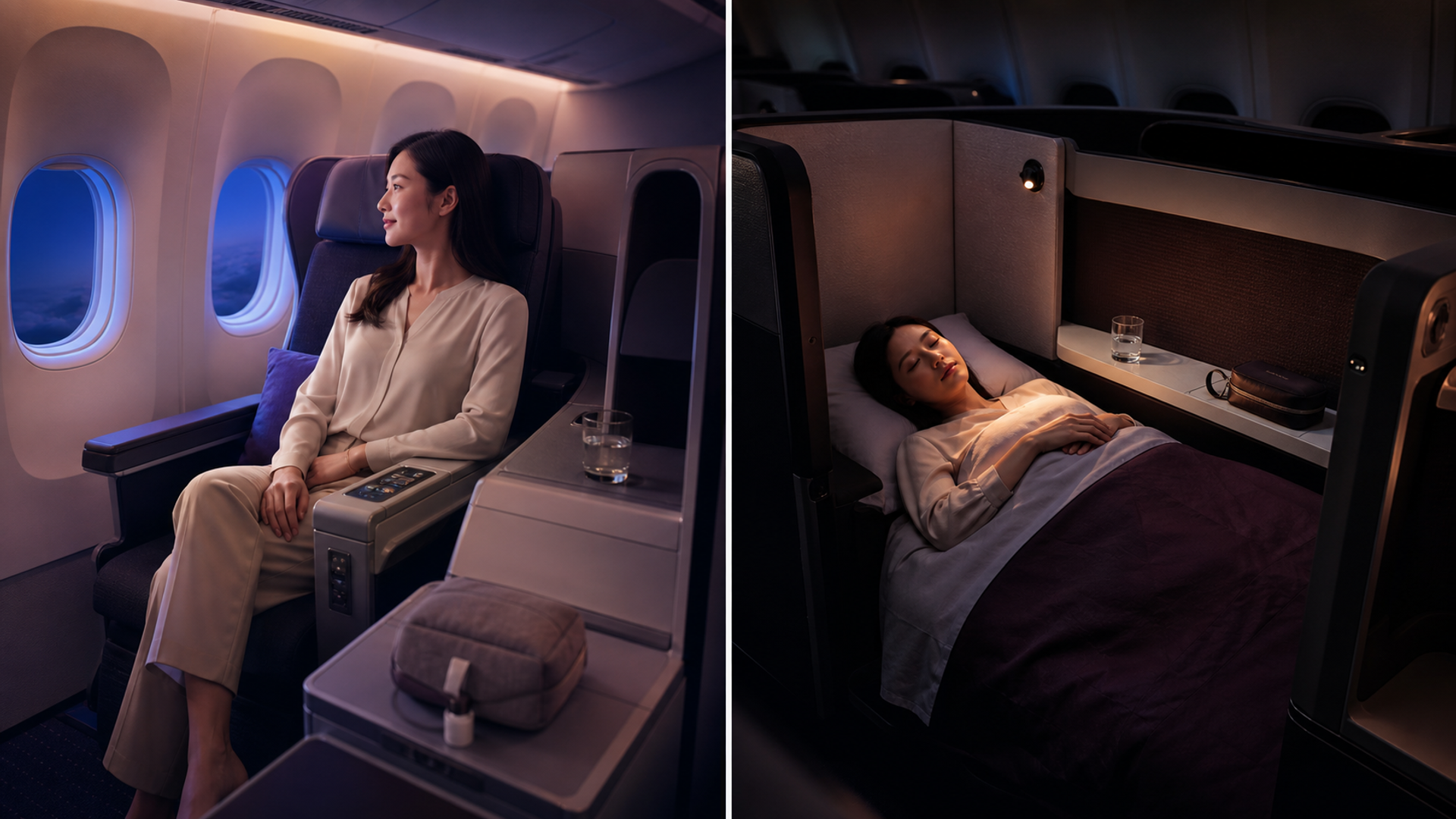
Air Canada Premium Economy is the disciplined choice when you want a larger recliner, a quieter cabin and useful airport priority without paying for a bed. Air Canada Business Class becomes the stronger buy when the itinerary includes the airline's long-haul Signature Class product, an overnight sector and an arrival that leaves little time to recover. The cabin name alone does not settle the decision: aircraft, fare family, airport and schedule all change the value.
This comparison treats the ticket as a complete journey rather than a seat photograph. It uses current Air Canada product and fare information, while recognising that aircraft substitutions, partner flights and market-specific fare rules can alter the delivered experience.
Quick answer
Choose Premium Economy for a daytime long-haul flight, a relaxed leisure arrival or a large fare gap. Choose Business Class when the confirmed aircraft offers a lie-flat Signature Class pod, the flight protects a meaningful sleep window and your first day is valuable enough to justify the premium.
The best decision is often asymmetric. Business may be rational on an overnight eastbound sector before a meeting, while Premium Economy may be the better return choice on a daylight flight. Price each direction separately when the fare permits it.
Air Canada cabin decision matrix
| Decision factor | Premium Economy | Business / Signature Class | What to verify |
|---|---|---|---|
| Seat category | Wider recliner with greater pitch and recline | Lie-flat executive pod on relevant long-haul aircraft | Operating aircraft and seat map |
| Sleep | Better seated rest | Horizontal sleep and greater privacy | Realistic sleep window |
| Airport experience | Priority check-in, boarding and baggage | Stronger premium path; lounge access depends on itinerary and fare | Airport, ticket and operating carrier |
| Dining | Upgraded meal and beverages | More elaborate dining and service | Flight length and service timing |
| Baggage | Two checked bags on the published product page | Business allowance varies by itinerary and fare | Booking-specific allowance |
| Best use | Day flight, leisure, value control | Night flight, immediate work, privacy | Fare gap and arrival stakes |
Start with the aircraft, not the marketing label
Air Canada's official Premium Economy description publishes a 38-inch seat pitch and seven inches of recline, with seat width varying by aircraft. It also lists two checked bags, priority airport services, power and USB access, meals and beverages. Those benefits make a real difference from Economy, but the seat remains an angled recliner rather than a bed.
The airline's long-haul Signature Class material describes executive pods extending to an approximately 80-inch lie-flat bed, an 18-inch touchscreen and premium airport services. The current Air Canada product PDF is useful for understanding that flagship proposition, but it should not replace checking the exact aircraft assigned to your flight.
A cabin name can survive an equipment swap. Before paying, confirm the operating carrier, aircraft type, seat map and whether the Business product on that sector is the pod you expect. Recheck after schedule notifications and before the last practical cancellation date. A codeshare sold by Air Canada but operated by another airline follows the operating carrier's seat and service.
The meaningful difference is sleep autonomy
Premium Economy improves body angles and personal space. The larger pitch, greater recline, leg support and smaller cabin can reduce stiffness and make a long daytime sector substantially easier. Travellers who can sleep in a recliner may get enough rest for a low-pressure arrival.
Signature Class changes the decision because a flat surface gives you control over when and how you sleep. You can finish work, skip a long meal, lower the bed and avoid climbing over a neighbour. That autonomy is most valuable on a nine- to fourteen-hour overnight sector. On a six-hour eastbound flight, meal service and descent can reduce the usable sleep block so sharply that the bed has less time to earn its price.
Do not use scheduled flight duration as the sleep number. Subtract boarding, taxi, take-off, meal service, pre-landing service and the time you personally need to settle. Then estimate your likely sleep in each seat. The gap between those two estimates is the product you are buying.
Price the upgrade per protected hour
The fare difference is more useful when converted into an outcome. Suppose Business costs £1,100 more and you expect three additional useful hours of sleep. The premium is about £367 per protected hour. That may be excessive before a quiet holiday afternoon and rational before a board presentation.
Use this five-step test:
Identify the first fixed commitment after arrival.
Estimate the realistic onboard sleep window.
Estimate your own sleep in a recliner and in a flat bed.
Count confirmed airport and baggage benefits that you do not already receive through status.
Divide the fare difference by the useful hours or risks protected.
Run the calculation again if the fare changes. The hardware may be identical while the answer changes completely. A discounted Business fare with restrictive conditions can also be less useful than a flexible Premium Economy fare on an uncertain trip.
Fare family matters almost as much as cabin
Air Canada's current international fare options distinguish Premium Economy Standard and Latitude, and Business Standard and Latitude. Changes, cancellations, upgrades, lounge treatment and other conditions can differ by fare family and market.
That means “Business versus Premium Economy” is sometimes the wrong first comparison. A flexible Premium Economy Latitude fare may be preferable to a cheaper, restrictive Business fare if the meeting date can move. Conversely, a competitively priced Business Standard ticket may be compelling on a fixed itinerary.
Compare the final basket, not the headline fare. Include change fees, seat selection, baggage, lounge eligibility, mileage and the cost of an extra hotel night only when those items genuinely differ. Do not count elite-status benefits twice.
Lounge access has value only when you can use it
Air Canada Business Class can include lounge access in eligible circumstances, while Premium Economy is not a universal lounge-access product. Yet lounge value depends on the airport, ticket, time and terminal. A three-hour connection can make a shower, meal and quiet workspace important. A 50-minute connection makes the same benefit almost theoretical.
Check the exact lounge, opening hours, guest rules and walking time to the gate. A lounge at origin may have little value if you arrive shortly before departure. On disruption days, a quiet seat and power are useful, but a lounge cannot make an airline operate a cancelled flight or override rebooking rules.
Eligible VERTU clients may use human Concierge support to coordinate flights, airport assistance, chauffeur transfers, hotels or dining where available and subject to service terms. Concierge cannot guarantee an Air Canada seat, upgrade, lounge admission, schedule or recovery outcome; material bookings require user authorisation, and the airline retains responsibility for the ticket and operation. The useful role is continuity between suppliers, not control over them.
Dining and service: daylight changes the value
Premium Economy includes a more considered meal and beverage service than Economy on eligible flights. Business offers greater space, more individual service and a broader premium dining proposition. These differences are enjoyable, but their value depends on whether you plan to stay awake.
On a daytime flight, dining, workspace and service pacing can be part of the reason to upgrade. On an overnight flight, a long dinner can consume the sleep window that justified Business. Decide before boarding whether you will dine fully, eat quickly or sleep immediately. If you have confirmed lounge access, eating on the ground may protect more rest.
Menus, wines and amenities change. Avoid assigning a large amount of value to a specific dish or amenity kit. The durable factors are seat category, privacy, access and control over time.
Baggage and priority: useful, but check the ticket
Air Canada's Premium Economy page lists two checked bags and priority check-in, boarding and baggage handling. Business can deliver a stronger premium path, but the applicable allowance and airport treatment depend on route, fare, status and operating airline.
Priority boarding matters if overhead space and working time are important; it matters less if you prefer to remain in the lounge. Priority baggage can reduce waiting, but delivery order is not guaranteed enough to support a tight self-connection. If your status already provides these benefits, the incremental value of Business shrinks.
For itineraries involving several airlines, read the baggage rule for the complete ticket. A generous allowance on the long-haul sector does not automatically solve a separate regional ticket.
Three booking scenarios
Overnight Toronto to Europe before work
Business is usually stronger when the confirmed aircraft has a Signature Class pod and the morning commitment cannot move. The bed, aisle independence and premium ground path directly protect arrival performance.
Daylight Europe to Canada for leisure
Premium Economy often captures most of the useful comfort. You can sit more comfortably, work and dine without buying a sleep product you will barely use. A direct Premium Economy flight can also beat a connecting Business itinerary.
Couple travelling together
Two adjacent Premium Economy seats can offer a calmer shared journey at a much lower total price than two pods. Business becomes stronger if one traveller cannot sleep upright, needs frequent aisle access or faces an immediate commitment.
Compare the complete itinerary
Do not compare only two cabins on one flight. Compare schedule, aircraft, connection, fare flexibility and arrival time with other carriers. The Singapore Airlines cabin comparison shows how fleet and route change the same decision. The best business-class airlines guide provides a route-seat-lounge framework rather than a decorative ranking.
A nonstop Premium Economy itinerary can outperform Business with a risky connection. Likewise, an overnight Business flight arriving at a useful hour can create more real value than a cheaper schedule that wastes the first day.
Pre-booking checklist
Is the flight operated by Air Canada?
Which aircraft and seat map are shown now?
Does Business mean the long-haul Signature Class pod on this sector?
How many realistic hours can you sleep?
What happens in the first eight hours after landing?
Does the exact ticket include the lounge you plan to use?
Are baggage and priority benefits already supplied by status?
Which fare family gives acceptable change and cancellation terms?
Is a nonstop Premium Economy option better than a connecting Business one?
Final verdict
Air Canada Premium Economy wins when the journey needs better sitting, extra space and priority treatment rather than a bed. Business Class earns its premium when a verified Signature Class pod, a real overnight sleep window and a valuable arrival day align. Confirm the aircraft and fare family, calculate the upgrade per protected hour and buy the cabin that solves the hardest part of the itinerary.
Sources
Air Canada, Premium Economy Class, accessed 3 August 2026.
Air Canada, International fare options, accessed 3 August 2026.
Air Canada, Signature Class product overview PDF, accessed 3 August 2026.


![Top 10 Luxury Smartwatches for Business Travel [2026]](https://cdn.sanity.io/images/e0gp1l2g/production/8b5e5b21db42a1c5f040e828bd041857353a8eb2-2560x1382.webp?w=800&h=450&q=82&auto=format&fit=crop)