Key takeaways: A modern luxury AI phone should earn its price through privacy-first on-device intelligence, hardware you can trust under stress, and service that actually executes when your calendar is non-negotiable.
Introduction
Luxury used to be about materials and scarcity. Now it’s also about control.
A built-in AI assistant can be useful, but only if it respects your privacy, responds instantly, and stays reliable when you’re in transit, off-grid, or simply not in the mood to hand your context to a cloud server.
That’s why luxury plus AI matters now: lower latency, more autonomy, and meaningful utility. It’s also a response to a new reality where sensitive work, travel patterns, and personal preferences live on one device.
So what defines a modern luxury phone with an AI assistant built in for discerning buyers?
- On-device intelligence firstthe phone can handle core tasks locally, so speed and privacy are features, not marketing.
- Craftsmanship that survives real lifematerials, structure, and durability that hold up in daily executive use.
- Security you can verifyclear boundaries around where your data lives, how it’s protected, and how it can be deleted.
- Service that closes the loopwhen you ask for something, it gets done, discreetly.
This guide is for executives, creators, and luxury connoisseurs who treat their phone as a private command center.
How to use it:
Scan the feature sections and underline what you actually need.
Map each feature to a real use case (not a hypothetical one).
Use the 2026 checklist at the end to pressure-test any shortlist.
Defining luxury features today
On-device AI and NPU performance
On-device AI isn’t just a buzzword. It’s a practical shift: your phone performs more AI tasks locally instead of sending every request to a remote server. In other words, the device starts to behave like an on-device AI smartphone by default, not as a thin client.
Chip makers highlight the benefits clearly: local inference can reduce latency, keep more processing on the device, and reduce dependence on continuous connectivity, which supports both responsiveness and privacy posture (see MediaTek’s explainer on on-device AI, NPUs, and why low latency matters).
But a luxury buyer should care about more than “AI.” You’re buying sustained usefulness.
Here’s what to look for.
An NPU that’s built for sustained work, not just demos. AI tasks can be bursty (a quick summary) or sustained (long transcription, translation, camera processing). Heat and battery are the real governors.
A clear boundary between on-device and cloud escalation. The best assistants handle sensitive, fast tasks locally, and only use cloud computation when you explicitly opt in.
Memory discipline. A good assistant can remember what you want it to remember, and forget what you don’t.
How to verify: Ask one question: “Which tasks run locally by default, and which ones leave the device?” If the answer is vague, treat it as a risk.
Also keep expectations realistic. On-device AI is constrained by compute, memory, and energy limits. The academic literature is blunt about it: edge devices need compression and efficient architectures because model size, storage, and battery life are hard constraints, not inconveniences (see this survey on on-device AI models and resource limits).
In other words: the best luxury AI phone is not the one that promises the biggest model. It’s the one that makes the right workloads feel instant, private, and dependable.
Materials, durability, and design
Luxury isn’t only how a phone looks on a desk. It’s how it behaves in year three.
For a modern luxury device, evaluate design the same way you evaluate a watch case or a luggage frame: by the parts you don’t see.
Materials you can feel and maintain. Titanium, sapphire-grade glass, and quality leather aren’t just aesthetics. They affect scratch resistance, grip, and aging.
Structural integrity under daily stress. Real-world durability includes torsion (pocket pressure), drops, and thermal cycling from travel.
Ergonomics for long sessions. If you take calls for hours or review documents on the move, weight distribution and edge design matter.
A subtle tell: true luxury phones don’t chase “thin at all costs.” They prioritize long-term stability, comfort, and serviceability.
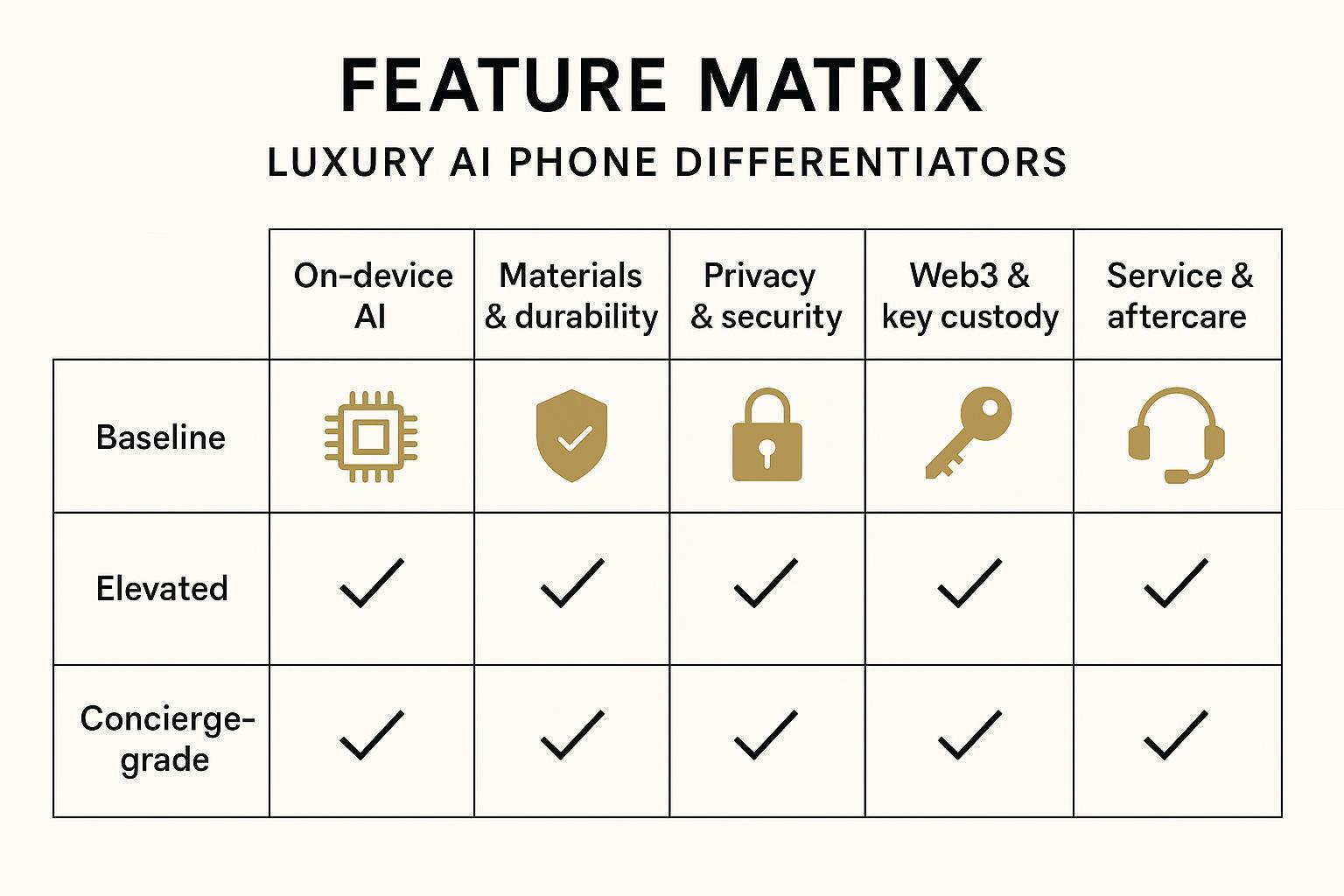
Privacy, security, and Web3 concierge
For discerning buyers, privacy is not a setting. It’s a design philosophy.
Start with the concept of data sovereignty: which laws and governance regimes can touch your data, and whether your private context is routed off-device. This is the logic behind a privacy-first AI phone.
VERTU’s guide on data sovereignty for AI phones and private context frames the right questions: key custody, inspectable memory, and deletion that applies to caches and indexes, not only a visible “history” screen.
This is where “luxury” becomes functional.
Security architecture that is legible. If a device claims confidential computing, it should be able to explain concepts like a trusted execution environment (TEE) and attestation in plain terms.
Key custody you control. If Web3 services are part of the proposition, you’re not buying a wallet icon. You’re buying custody design, recovery paths, and authorization workflows.
A concierge layer that respects discretion. The most premium model is hybrid: AI for speed, human judgment for edge cases, and clear rules for retention.
In that hybrid category, VERTU describes concierge services such as Ruby Key and an AI-powered assistant Ruby Talk as part of its positioning around concierge-grade assistance (see VERTU’s complete guide to luxury phones with AI). If you’re comparing options, treat this as a reference point for what a luxury phone concierge service can look like when it’s designed into the ownership model.
The useful takeaway isn’t the name. It’s the model: fast automation when it’s safe, and a human team when context, taste, or discretion matters.
Executive use cases that deliver ROI
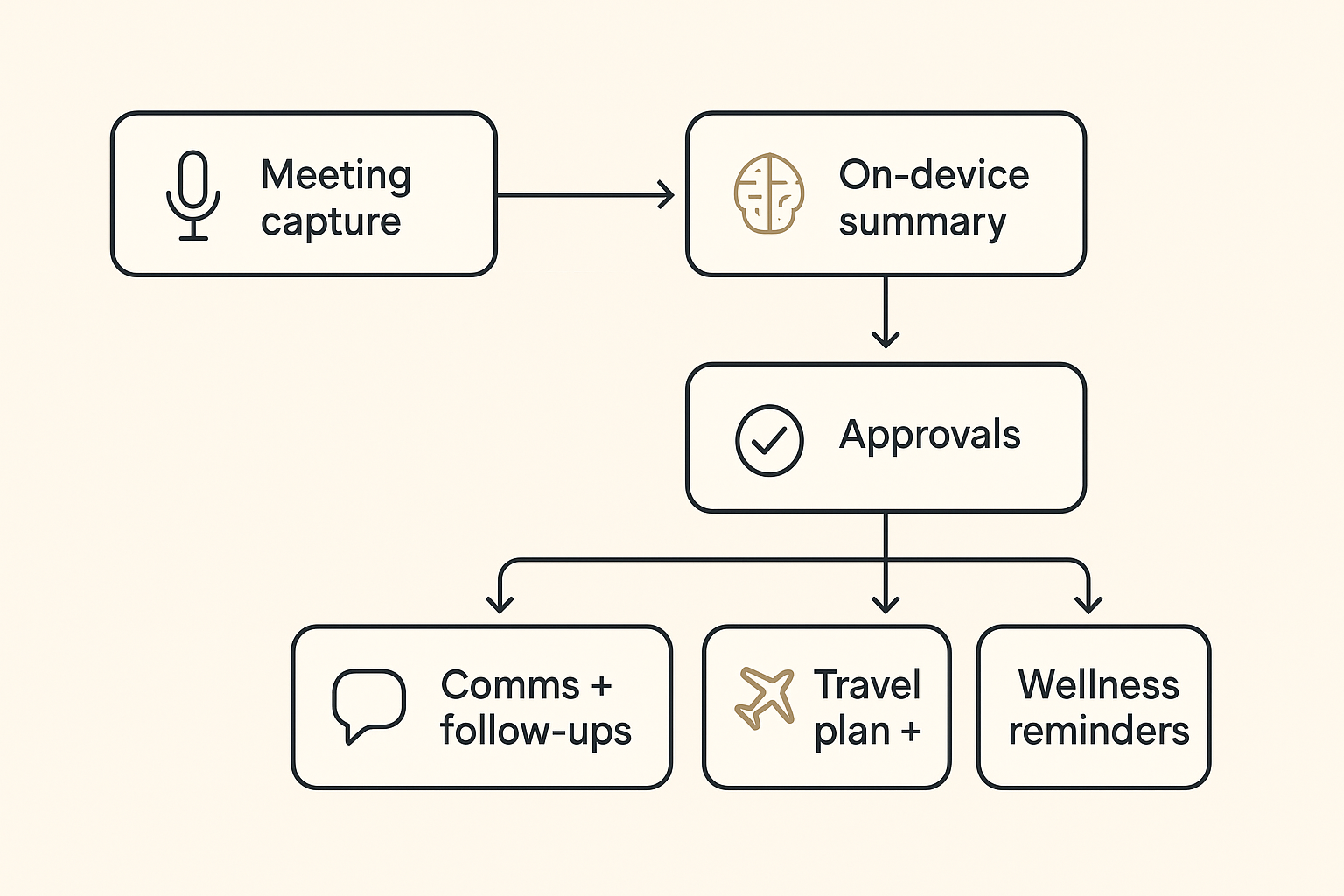
The quickest way to judge an AI assistant is to ask a simple question: does it reduce cognitive load without increasing risk?
Productivity and communications
For executives, ROI comes from fewer context switches and fewer dropped details.
Look for workflows like:
Meeting capture that turns into a clean summary, action list, and follow-ups.
Message drafting that respects tone and confidentiality.
Calendar intelligence that understands constraints (time zones, buffers, priorities).
The bar is not “it can write an email.” The bar is “it helps you finish the work.”
Creativity and real-time translation
If you create, negotiate, or operate across borders, real-time translation and content assistance can be a quiet advantage.
The luxury standard here is restraint:
translation that is accurate enough for business context
local processing for sensitive passages when possible
frictionless switching between languages and channels
And for creative work: quick concept capture, outline generation, and polished rewrites that still sound like you.
Travel, health, and lifestyle
When you travel frequently, the phone becomes a travel stack: boarding passes, identity checks, itinerary changes, last-minute dinners, and time zone whiplash.
A capable assistant can coordinate details. A premium assistant knows when to escalate.
This is also where service matters. A strong concierge proposition is not “24/7 availability” on paper. It’s fast access, clear scope, and follow-through. VERTU’s buyer guide on how to evaluate a luxury phone with 24/7 concierge service recommends testing access, discretion, and closed-loop execution with real requests.
Buying checklist for 2026 (luxury phone with AI assistant built in)
The luxury mistake is buying a story.
Buy a system.
Specs to verify (AI, power, thermal)
On-device defaults: Which assistant features run locally by default?
NPU performance under real load: Does the phone stay responsive during long transcription/translation sessions, or does it throttle?
Thermal behavior: Does performance hold during long calls, navigation, or extended AI workloads?
Battery realism: What happens when you run transcription, translation, and travel-day usage together?
Privacy controls: Can you inspect, export, and delete assistant memory?
Ecosystem and integration
Your real stack: email, calendar, docs, messaging, VPN, MFA, travel apps.
Cross-device continuity: can you keep your existing Apple/Google workflows without rebuilding everything?
Identity and access: support for secure authentication and separation of personal vs business contexts.
Service, warranty, and aftercare
Luxury is aftercare.
Service access: is support reachable quickly, globally, and through a low-friction channel?
Concierge evaluation: can you test the service with a time-bound request, a nuance-heavy request, and a discretion-sensitive request?
Web3 phone security: if you’ll store keys or sign transactions, confirm custody model, recovery options, and the approval flow for sensitive actions.
Warranty clarity: what is covered, for how long, and what is the repair/replacement process while you travel?
Collector’s note: The best ownership experience feels boring in the best way. No drama. No scrambling for support. No “please reinstall and try again.”
Conclusion
A luxury phone with an AI assistant built in earns long-term value when three things are true.
First, its intelligence is privacy-first and fast, with on-device capability that reduces latency and keeps more of your context under your control.
Second, its hardware is resilient: materials and structure that stand up to real travel, real workdays, and real years.
Third, its service is trustworthy. When help is needed, the system executes without friction.
Finalize your shortlist using the checklist and align it with your ecosystem, not someone else’s.
Disclosure: This article references VERTU pages. Editorial judgment remains the priority.