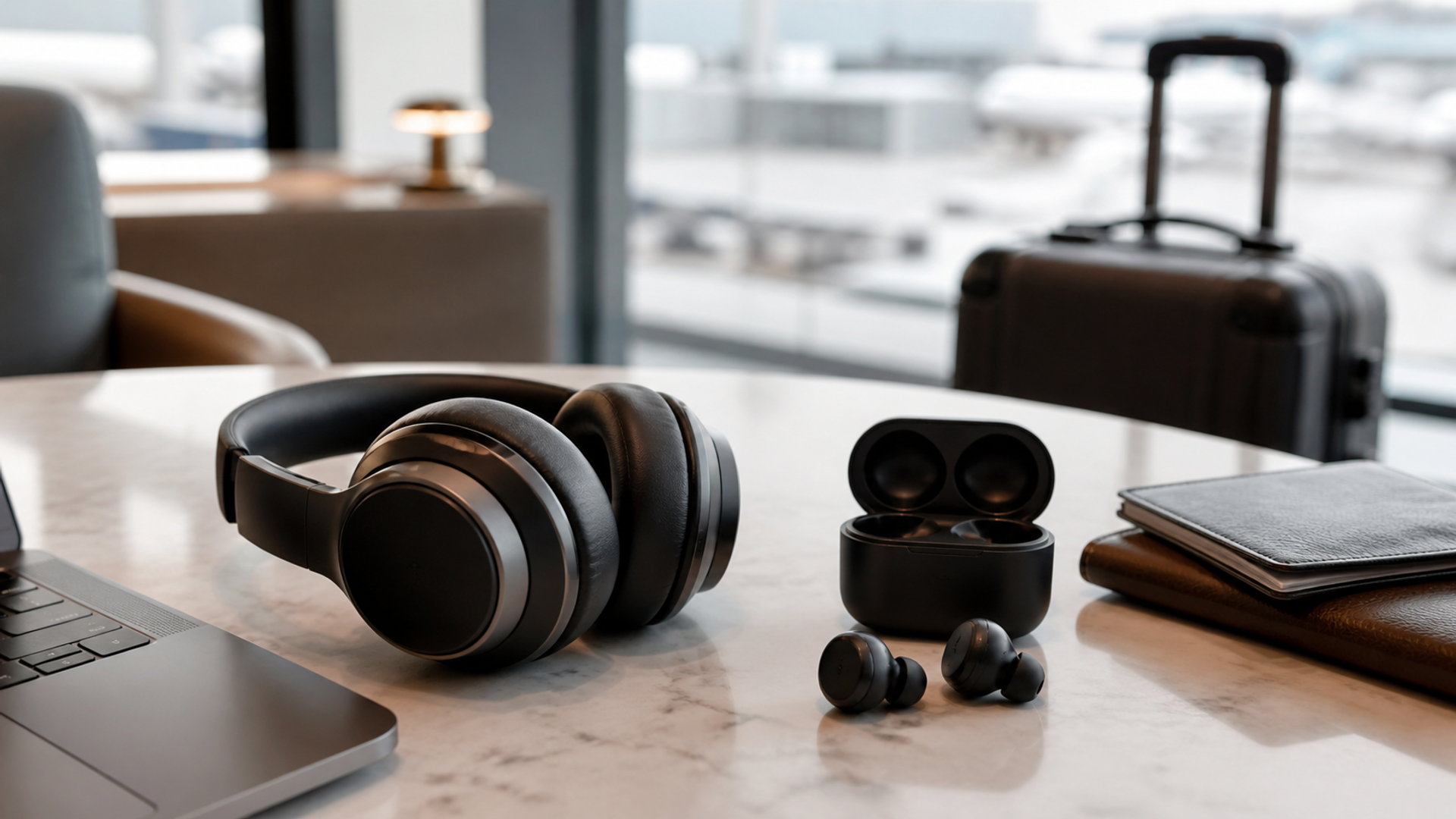
Headphones versus earbuds is a fit, portability and operating-context decision. Over-ear headphones can provide large pads, broad passive coverage and long battery capacity, but they occupy bag space and can become hot. Earbuds are compact and easy to carry, yet their seal, pressure, stability and tiny batteries vary sharply by ear. Sound quality, active noise cancellation and microphone performance cannot be inferred from form factor alone.
Start with the listening environment
Choose over-ear headphones when long seated listening, strong passive coverage and battery endurance matter more than bulk. Choose earbuds when portability, movement and pocketable charging lead. Use both formats when travel, exercise, calls and focused listening create genuinely different fit and safety requirements.
| Decision factor | Over-ear headphones | In-ear earbuds | Use both formats |
|---|---|---|---|
| Portability | Bag space is available | Pocket carry is essential | Keep one of each |
| Comfort | Pads and clamp remain comfortable | Tips stay secure without pressure | Change size or format |
| Noise | Large cups support isolation and ANC | A good in-ear seal controls noise | Use situational awareness |
| Calls | Boom or cup microphones test well | Earbud microphones test well outdoors | Use the phone microphone |
| Battery | Long single-charge use matters | Charging case fits breaks | Carry a wired fallback |
| Movement | Seated work dominates | Exercise and quick transitions dominate | Use task-specific devices |
This headphones vs earbuds matrix is the article's working value object. Read the headphones vs earbuds rows together: the decisive failure mode depends on this topic's evidence, operating context and reader objective.
How fit and format change performance
Evidence 1. Bose frames the choice around portability, comfort, battery, sound and use context rather than declaring a universal format winner.
Evidence 2. The company distinguishes open-ear and in-ear designs by how they interact with the ear canal and environmental awareness.
Evidence 3. Active noise cancellation and passive isolation are separate mechanisms and depend on fit and implementation.
Evidence 4. Microphone, codec, latency, water rating, battery and multipoint behaviour must be verified on the exact model.
Reader-visible sources checked for this article:
bose.com — reader-visible current or official evidence
bose.com — reader-visible current or official evidence
For headphones vs earbuds, these sources establish only the claims inside their documented scope. Recheck every changeable specification, availability condition, price, policy or service term in the relevant market before acting.
Test comfort, calls and power
The decision changes at portability. Choose the first path only if bag space is available; move to the second when pocket carry is essential; use the third when keep one of each. Save the downside that would make this row fail.
For comfort, the first route works when pads and clamp remain comfortable; the second requires tips stay secure without pressure. The control for the third is change size or format. Verify this row against the exact product, property, account or environment before it can reverse the decision.
The noise row exposes a practical boundary. Route one assumes large cups support isolation and ANC, while route two is defensible only when a good in-ear seal controls noise. Route three depends on use situational awareness. If that evidence is absent, keep the more reversible option.
Read calls as a stop/go test: boom or cup microphones test well supports the first option; earbud microphones test well outdoors supports the second; and use the phone microphone supports the third. Record which source proves the condition and when it was checked.
A buyer can resolve battery without starting from a brand preference. Ask whether long single-charge use matters; compare that with whether charging case fits breaks; then use carry a wired fallback as the third route's safeguard. An unknown condition stays unknown.
On movement, popularity is not enough. The evidence for option one is that seated work dominates. Option two means exercise and quick transitions dominate. Option three is rational where use task-specific devices. Recheck any changeable term immediately before commitment.
Facts that would reverse the current choice
Reversal control 1 — Portability. Before choosing Over-ear headphones, write down how the decision changes if “Bag space is available” proves false. Do the same for In-ear earbuds and “Pocket carry is essential”. Keep the Use both formats route available until “Keep one of each” is verified. This control belongs to headphones vs earbuds; update it from the cited source or exact supplier rather than copying a generic checklist.
Reversal control 2 — Comfort. Before choosing Over-ear headphones, write down how the decision changes if “Pads and clamp remain comfortable” proves false. Do the same for In-ear earbuds and “Tips stay secure without pressure”. Keep the Use both formats route available until “Change size or format” is verified. This control belongs to headphones vs earbuds; update it from the cited source or exact supplier rather than copying a generic checklist.
Reversal control 3 — Noise. Before choosing Over-ear headphones, write down how the decision changes if “Large cups support isolation and ANC” proves false. Do the same for In-ear earbuds and “A good in-ear seal controls noise”. Keep the Use both formats route available until “Use situational awareness” is verified. This control belongs to headphones vs earbuds; update it from the cited source or exact supplier rather than copying a generic checklist.
Reversal control 4 — Calls. Before choosing Over-ear headphones, write down how the decision changes if “Boom or cup microphones test well” proves false. Do the same for In-ear earbuds and “Earbud microphones test well outdoors”. Keep the Use both formats route available until “Use the phone microphone” is verified. This control belongs to headphones vs earbuds; update it from the cited source or exact supplier rather than copying a generic checklist.
Reversal control 5 — Battery. Before choosing Over-ear headphones, write down how the decision changes if “Long single-charge use matters” proves false. Do the same for In-ear earbuds and “Charging case fits breaks”. Keep the Use both formats route available until “Carry a wired fallback” is verified. This control belongs to headphones vs earbuds; update it from the cited source or exact supplier rather than copying a generic checklist.
Reversal control 6 — Movement. Before choosing Over-ear headphones, write down how the decision changes if “Seated work dominates” proves false. Do the same for In-ear earbuds and “Exercise and quick transitions dominate”. Keep the Use both formats route available until “Use task-specific devices” is verified. This control belongs to headphones vs earbuds; update it from the cited source or exact supplier rather than copying a generic checklist.
Build a use map
List commute, aircraft, office, gym, calls, sleep and home listening. Give each context requirements for awareness, pack size, microphone, sweat and continuous runtime. Record the exact model, recipe, room, climate, material or operating condition and the time of the check. Separate observed behaviour from a marketing label, and repeat the test in the intended setting rather than under ideal showroom conditions. If one format fails a safety-critical context, keep a second option rather than forcing universality. Save the evidence that would reverse the choice, because a change in fit, specification, maintenance, service, price or environment must reopen the decision rather than inherit an old conclusion.
Run a fit session
Wear each candidate for at least forty-five minutes with glasses, jewellery and usual hairstyle. Try every permitted tip and adjustment and note heat, clamp, jaw movement and pressure. Record the exact model, recipe, room, climate, material or operating condition and the time of the check. Separate observed behaviour from a marketing label, and repeat the test in the intended setting rather than under ideal showroom conditions. If comfort deteriorates after the demo window, sound quality cannot make it a daily choice. Save the evidence that would reverse the choice, because a change in fit, specification, maintenance, service, price or environment must reopen the decision rather than inherit an old conclusion.
Test the radio path
Pair with the actual phone and laptop and test switching, calls, video latency and crowded wireless areas. Verify which codec and microphone mode are really active rather than relying on a box logo. Record the exact model, recipe, room, climate, material or operating condition and the time of the check. Separate observed behaviour from a marketing label, and repeat the test in the intended setting rather than under ideal showroom conditions. If connection recovery is poor, choose reliability over a marginal sound preference. Save the evidence that would reverse the choice, because a change in fit, specification, maintenance, service, price or environment must reopen the decision rather than inherit an old conclusion.
Plan power and hygiene
Measure realistic runtime with ANC and calls, and inspect replaceable pads, tips and battery service. Carry a cable or second device when a dead battery would interrupt work. Record the exact model, recipe, room, climate, material or operating condition and the time of the check. Separate observed behaviour from a marketing label, and repeat the test in the intended setting rather than under ideal showroom conditions. If consumables or cleaning are unavailable, ownership cost should reduce the score. Save the evidence that would reverse the choice, because a change in fit, specification, maintenance, service, price or environment must reopen the decision rather than inherit an old conclusion.
Three days, three answers
Long-haul cabin
Over-ear comfort and battery may justify the bag space. Define the fact that would reverse this recommendation before committing.
City movement and short calls
Earbuds can win on quick carry when awareness is managed. Define the fact that would reverse this recommendation before committing.
Hybrid executive day
Two specialised formats may be more reliable than one compromise. Define the fact that would reverse this recommendation before committing.
Action checklist
Map contexts.
Wear forty-five minutes.
Test seal.
Check awareness.
Make outdoor calls.
Test switching.
Measure battery.
Price consumables.
Verify water rating.
Carry fallback.
Continue the decision
The linked VERTU articles expand adjacent parts of the headphones vs earbuds decision. They do not substitute for the external evidence above.
The headphones-versus-earbuds verdict
Choose over-ear headphones when long seated listening, strong passive coverage and battery endurance matter more than bulk. Choose earbuds when portability, movement and pocketable charging lead. Use both formats when travel, exercise, calls and focused listening create genuinely different fit and safety requirements.
Keep the headphones vs earbuds decision reversible until its material cost, safety, access, privacy and compatibility facts are verified. Unknown evidence stays unknown; it is never silently scored as favourable.