

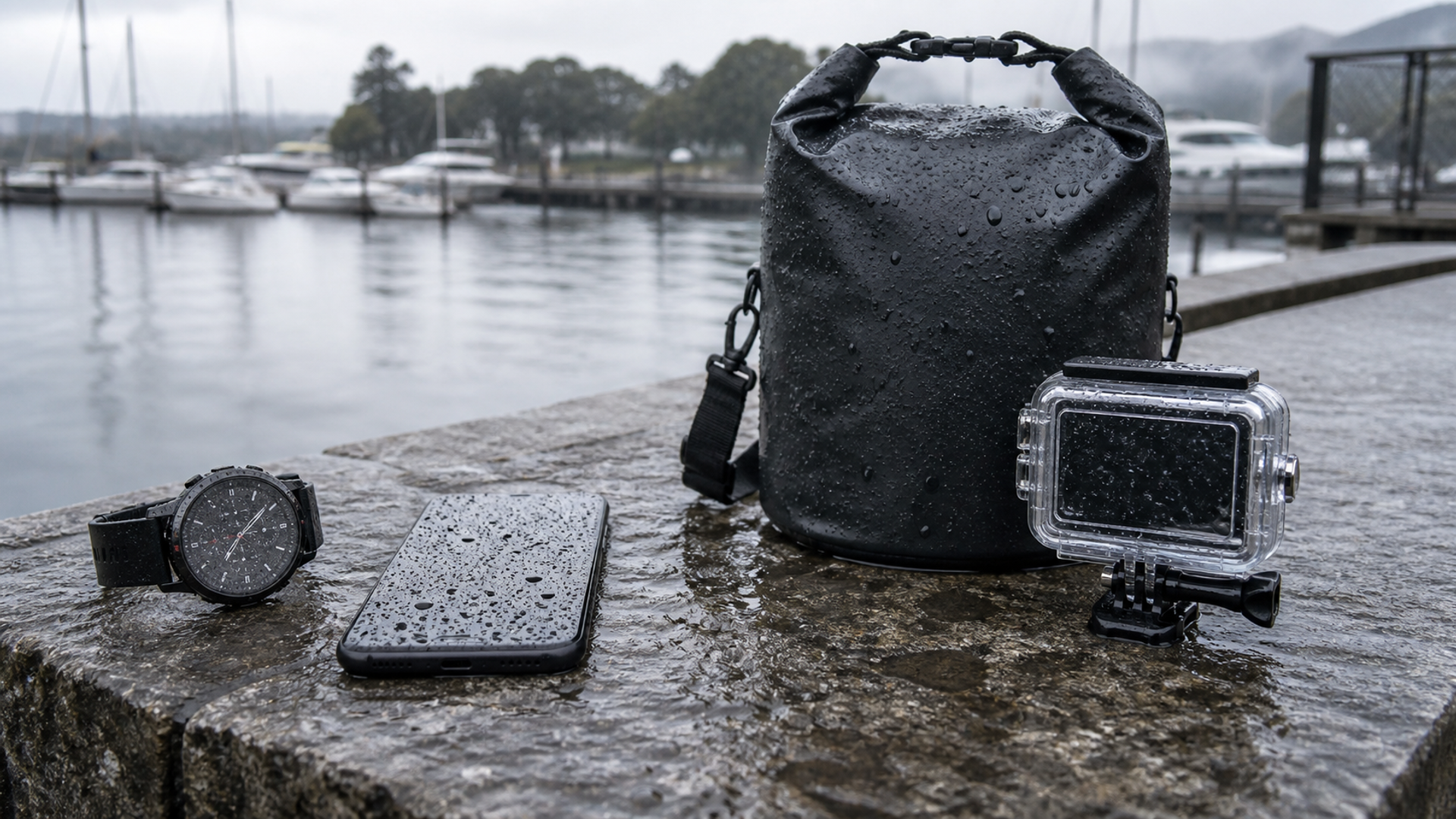
Water-resistant versus waterproof sounds binary, but real protection is conditional. Consumer products often use ingress-protection ratings or a maker-specific test statement. An IP code separates protection against solids from protection against water, and higher numbers do not turn every device into an unlimited underwater object. Depth, duration, water type, pressure, temperature, motion, age, impact and opened seals can all change the result.
Read the claim literally
Choose a water-resistant product when the documented splash or brief-exposure test matches ordinary use. Choose a higher waterproof or immersion rating only when the exact depth, duration and operating restrictions match the activity. Add a case, dry bag or redundant storage when failure would damage safety, identity, work or irreplaceable data.
| Decision factor | Water-resistant product | Waterproof-rated product | Add a protective system |
|---|---|---|---|
| Exposure | Rain and accidental splashes define the risk | Planned immersion matches a documented test | Use a certified enclosure |
| Depth and time | No immersion claim is needed | Limits exceed the intended activity | Keep the item out of water |
| Water type | Fresh-water conditions match guidance | Salt or chlorinated use is explicitly allowed | Add rinsing and isolation |
| Age and damage | Seals are inspected and intact | Service can verify protection | Treat protection as reduced |
| Data consequence | Failure is inconvenient | Failure threatens critical data or access | Use redundant backup |
| Warranty | Terms cover the intended exposure | Specific use is supported | Assume no liquid-damage cover |
This water resistant vs waterproof matrix is the article's working value object. Read the water resistant vs waterproof rows together: the decisive failure mode depends on this topic's evidence, operating context and reader objective.
How IP ratings define exposure
Evidence 1. IEC explains IP codes as a two-digit system describing protection against solid objects and water under defined tests.
Evidence 2. An IP rating is not a universal statement for every depth, duration, temperature, chemical or moving-water condition.
Evidence 3. Apple states that water and splash resistance are not permanent conditions and may decrease with normal wear.
Evidence 4. Liquid-damage warranty treatment can differ from a product's resistance claim, so the test rating and commercial remedy must be read separately.
Reader-visible sources checked for this article:
iec.ch — reader-visible current or official evidence
support.apple.com — reader-visible current or official evidence
For water resistant vs waterproof, these sources establish only the claims inside their documented scope. Recheck every changeable specification, availability condition, price, policy or service term in the relevant market before acting.
Verify the exact test boundary
On exposure, popularity is not enough. The evidence for option one is that rain and accidental splashes define the risk. Option two means planned immersion matches a documented test. Option three is rational where use a certified enclosure. Recheck any changeable term immediately before commitment.
The decision changes at depth and time. Choose the first path only if no immersion claim is needed; move to the second when limits exceed the intended activity; use the third when keep the item out of water. Save the downside that would make this row fail.
For water type, the first route works when fresh-water conditions match guidance; the second requires salt or chlorinated use is explicitly allowed. The control for the third is add rinsing and isolation. Verify this row against the exact product, property, account or environment before it can reverse the decision.
The age and damage row exposes a practical boundary. Route one assumes seals are inspected and intact, while route two is defensible only when service can verify protection. Route three depends on treat protection as reduced. If that evidence is absent, keep the more reversible option.
Read data consequence as a stop/go test: failure is inconvenient supports the first option; failure threatens critical data or access supports the second; and use redundant backup supports the third. Record which source proves the condition and when it was checked.
A buyer can resolve warranty without starting from a brand preference. Ask whether terms cover the intended exposure; compare that with whether specific use is supported; then use assume no liquid-damage cover as the third route's safeguard. An unknown condition stays unknown.
Facts that would reverse the current choice
Reversal control 1 — Exposure. Before choosing Water-resistant product, write down how the decision changes if “Rain and accidental splashes define the risk” proves false. Do the same for Waterproof-rated product and “Planned immersion matches a documented test”. Keep the Add a protective system route available until “Use a certified enclosure” is verified. This control belongs to water resistant vs waterproof; update it from the cited source or exact supplier rather than copying a generic checklist.
Reversal control 2 — Depth and time. Before choosing Water-resistant product, write down how the decision changes if “No immersion claim is needed” proves false. Do the same for Waterproof-rated product and “Limits exceed the intended activity”. Keep the Add a protective system route available until “Keep the item out of water” is verified. This control belongs to water resistant vs waterproof; update it from the cited source or exact supplier rather than copying a generic checklist.
Reversal control 3 — Water type. Before choosing Water-resistant product, write down how the decision changes if “Fresh-water conditions match guidance” proves false. Do the same for Waterproof-rated product and “Salt or chlorinated use is explicitly allowed”. Keep the Add a protective system route available until “Add rinsing and isolation” is verified. This control belongs to water resistant vs waterproof; update it from the cited source or exact supplier rather than copying a generic checklist.
Reversal control 4 — Age and damage. Before choosing Water-resistant product, write down how the decision changes if “Seals are inspected and intact” proves false. Do the same for Waterproof-rated product and “Service can verify protection”. Keep the Add a protective system route available until “Treat protection as reduced” is verified. This control belongs to water resistant vs waterproof; update it from the cited source or exact supplier rather than copying a generic checklist.
Reversal control 5 — Data consequence. Before choosing Water-resistant product, write down how the decision changes if “Failure is inconvenient” proves false. Do the same for Waterproof-rated product and “Failure threatens critical data or access”. Keep the Add a protective system route available until “Use redundant backup” is verified. This control belongs to water resistant vs waterproof; update it from the cited source or exact supplier rather than copying a generic checklist.
Reversal control 6 — Warranty. Before choosing Water-resistant product, write down how the decision changes if “Terms cover the intended exposure” proves false. Do the same for Waterproof-rated product and “Specific use is supported”. Keep the Add a protective system route available until “Assume no liquid-damage cover” is verified. This control belongs to water resistant vs waterproof; update it from the cited source or exact supplier rather than copying a generic checklist.
Decode the rating
Find the exact IP code or maker test for the exact model and configuration. Separate the solids digit, water digit, depth, duration and any letter suffix instead of reading only the largest number. Record the exact model, recipe, room, climate, material or operating condition and the time of the check. Separate observed behaviour from a marketing label, and repeat the test in the intended setting rather than under ideal showroom conditions. If the seller cannot identify the standard or model evidence, treat the claim as unverified. Save the evidence that would reverse the choice, because a change in fit, specification, maintenance, service, price or environment must reopen the decision rather than inherit an old conclusion.
Map the exposure
Write down rain, shower, pool, sea, steam, high-pressure spray, soap and temperature change. Compare each condition with the documented test and note that motion can increase pressure. Record the exact model, recipe, room, climate, material or operating condition and the time of the check. Separate observed behaviour from a marketing label, and repeat the test in the intended setting rather than under ideal showroom conditions. If the activity falls outside the test, protection must come from another system. Save the evidence that would reverse the choice, because a change in fit, specification, maintenance, service, price or environment must reopen the decision rather than inherit an old conclusion.
Inspect condition
Check seals, ports, trays, doors, cracks and prior impacts before exposure. Follow drying and charging guidance and never insert cables into a wet port contrary to instructions. Record the exact model, recipe, room, climate, material or operating condition and the time of the check. Separate observed behaviour from a marketing label, and repeat the test in the intended setting rather than under ideal showroom conditions. If the product has been opened or damaged, assume the original test no longer proves current condition. Save the evidence that would reverse the choice, because a change in fit, specification, maintenance, service, price or environment must reopen the decision rather than inherit an old conclusion.
Protect the consequence
Back up data, carry independent identification and keep emergency communication separate. Use a quality enclosure and test it empty before critical travel or field work. Record the exact model, recipe, room, climate, material or operating condition and the time of the check. Separate observed behaviour from a marketing label, and repeat the test in the intended setting rather than under ideal showroom conditions. If one failure would strand the user, no resistance label should be the only control. Save the evidence that would reverse the choice, because a change in fit, specification, maintenance, service, price or environment must reopen the decision rather than inherit an old conclusion.
Three exposure plans, three answers
Daily commute in rain
A documented splash-resistant product may be sufficient. Define the fact that would reverse this recommendation before committing.
Snorkelling holiday
Only a purpose-built depth and duration system should be considered. Define the fact that would reverse this recommendation before committing.
Passport and phone in a tender
A dry bag plus backup matters more than a device claim alone. Define the fact that would reverse this recommendation before committing.
Action checklist
Find exact model.
Decode IP digits.
Read depth.
Read duration.
Check water type.
Inspect seals.
Review warranty.
Back up data.
Test enclosure empty.
Recheck after damage.
Continue the decision
The linked VERTU articles expand adjacent parts of the water resistant vs waterproof decision. They do not substitute for the external evidence above.
The protection-claim verdict
Choose a water-resistant product when the documented splash or brief-exposure test matches ordinary use. Choose a higher waterproof or immersion rating only when the exact depth, duration and operating restrictions match the activity. Add a case, dry bag or redundant storage when failure would damage safety, identity, work or irreplaceable data.
Keep the water resistant vs waterproof decision reversible until its material cost, safety, access, privacy and compatibility facts are verified. Unknown evidence stays unknown; it is never silently scored as favourable.
![How to Scan Receipts and Documents with Your Phone [Full Guide]](https://cdn.sanity.io/images/e0gp1l2g/production/0db13feec1d5e72b8a8a5f976d1f3e86619c9228-3840x1860.webp?w=180&h=180&q=78&auto=format&fit=crop)
![How to Scan Receipts and Documents with Your Phone [Full Guide]](https://cdn.sanity.io/images/e0gp1l2g/production/0db13feec1d5e72b8a8a5f976d1f3e86619c9228-3840x1860.webp?w=800&h=450&q=82&auto=format&fit=crop)
![Top 10 Two-Tone Carbon-Fibre Watches for Men [2026 List]](https://cdn.sanity.io/images/e0gp1l2g/production/18870799ba33fab0e038968359cd5772d7d7db30-1024x576.webp?w=800&h=450&q=82&auto=format&fit=crop)
![Top 10 Luxury Watches with Digital Complication Displays for Men [Latest]](https://cdn.sanity.io/images/e0gp1l2g/production/c4f6bf8c080f291c39f7cc85c7344ecff2fd3799-1024x553.webp?w=800&h=450&q=82&auto=format&fit=crop)