

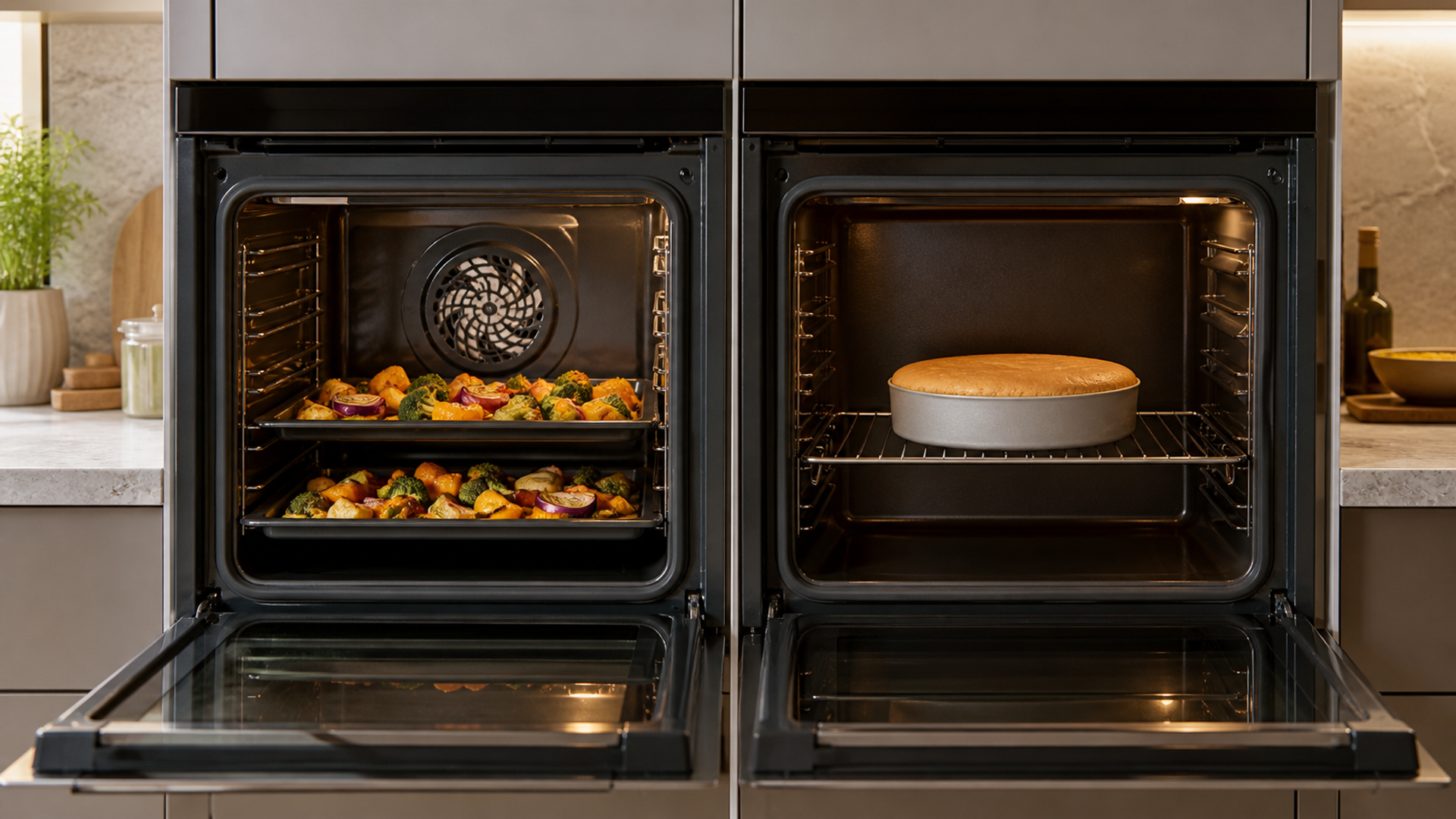
Convection versus conventional oven is a heat-distribution decision. A conventional mode relies mainly on radiant heat and natural air movement; convection adds a fan, and some ovens also add a dedicated heating element. Moving air can improve browning and multi-rack consistency, but it can also dry delicate food or demand changes to temperature and time. The word convection does not guarantee identical fan strength, element design or control logic across ovens.
Start with the food you cook
Choose convection for roasting, browning and many multi-rack tasks when the recipe and oven support it. Choose conventional heat for delicate cakes, custards and recipes developed around still air. Use both modes when the oven is reliable and the cook records how each dish responds.
| Decision factor | Convection oven | Conventional oven | Use both modes |
|---|---|---|---|
| Browning | Air movement improves surface colour | Gentler still air avoids premature crust | Switch modes near the finish |
| Multi-rack use | Circulation reduces rack differences | One centred rack is sufficient | Rotate trays deliberately |
| Delicate structure | The recipe tolerates faster setting | Still air protects rise and surface | Start conventional |
| Moisture | Crisping is desirable | Moisture retention matters | Cover then uncover |
| Recipe support | Convection instructions are available | The tested recipe assumes conventional heat | Reduce temperature cautiously |
| Oven design | Fan and element behaviour are documented | Conventional mode is more predictable | Run a calibration bake |
This convection oven vs conventional oven matrix is the article's working value object. Read the convection oven vs conventional oven rows together: the decisive failure mode depends on this topic's evidence, operating context and reader objective.
How moving air changes a bake
Evidence 1. Whirlpool explains that convection ovens use a fan to circulate hot air, while conventional ovens rely on stationary heat sources.
Evidence 2. Some convection systems include a third heating element, so performance differs by model and mode.
Evidence 3. Manufacturers commonly advise reducing temperature or time for some convection recipes, but exact conversion depends on the food and oven.
Evidence 4. Pan colour, rack position, load, preheating and actual temperature can matter as much as the mode label.
Reader-visible sources checked for this article:
whirlpool.com — reader-visible current or official evidence
whirlpool.com — reader-visible current or official evidence
For convection oven vs conventional oven, these sources establish only the claims inside their documented scope. Recheck every changeable specification, availability condition, price, policy or service term in the relevant market before acting.
Test recipes and cavity behaviour
Read browning as a stop/go test: air movement improves surface colour supports the first option; gentler still air avoids premature crust supports the second; and switch modes near the finish supports the third. Record which source proves the condition and when it was checked.
A buyer can resolve multi-rack use without starting from a brand preference. Ask whether circulation reduces rack differences; compare that with whether one centred rack is sufficient; then use rotate trays deliberately as the third route's safeguard. An unknown condition stays unknown.
On delicate structure, popularity is not enough. The evidence for option one is that the recipe tolerates faster setting. Option two means still air protects rise and surface. Option three is rational where start conventional. Recheck any changeable term immediately before commitment.
The decision changes at moisture. Choose the first path only if crisping is desirable; move to the second when moisture retention matters; use the third when cover then uncover. Save the downside that would make this row fail.
For recipe support, the first route works when convection instructions are available; the second requires the tested recipe assumes conventional heat. The control for the third is reduce temperature cautiously. Verify this row against the exact product, property, account or environment before it can reverse the decision.
The oven design row exposes a practical boundary. Route one assumes fan and element behaviour are documented, while route two is defensible only when conventional mode is more predictable. Route three depends on run a calibration bake. If that evidence is absent, keep the more reversible option.
Facts that would reverse the current choice
Reversal control 1 — Browning. Before choosing Convection oven, write down how the decision changes if “Air movement improves surface colour” proves false. Do the same for Conventional oven and “Gentler still air avoids premature crust”. Keep the Use both modes route available until “Switch modes near the finish” is verified. This control belongs to convection oven vs conventional oven; update it from the cited source or exact supplier rather than copying a generic checklist.
Reversal control 2 — Multi-rack use. Before choosing Convection oven, write down how the decision changes if “Circulation reduces rack differences” proves false. Do the same for Conventional oven and “One centred rack is sufficient”. Keep the Use both modes route available until “Rotate trays deliberately” is verified. This control belongs to convection oven vs conventional oven; update it from the cited source or exact supplier rather than copying a generic checklist.
Reversal control 3 — Delicate structure. Before choosing Convection oven, write down how the decision changes if “The recipe tolerates faster setting” proves false. Do the same for Conventional oven and “Still air protects rise and surface”. Keep the Use both modes route available until “Start conventional” is verified. This control belongs to convection oven vs conventional oven; update it from the cited source or exact supplier rather than copying a generic checklist.
Reversal control 4 — Moisture. Before choosing Convection oven, write down how the decision changes if “Crisping is desirable” proves false. Do the same for Conventional oven and “Moisture retention matters”. Keep the Use both modes route available until “Cover then uncover” is verified. This control belongs to convection oven vs conventional oven; update it from the cited source or exact supplier rather than copying a generic checklist.
Reversal control 5 — Recipe support. Before choosing Convection oven, write down how the decision changes if “Convection instructions are available” proves false. Do the same for Conventional oven and “The tested recipe assumes conventional heat”. Keep the Use both modes route available until “Reduce temperature cautiously” is verified. This control belongs to convection oven vs conventional oven; update it from the cited source or exact supplier rather than copying a generic checklist.
Reversal control 6 — Oven design. Before choosing Convection oven, write down how the decision changes if “Fan and element behaviour are documented” proves false. Do the same for Conventional oven and “Conventional mode is more predictable”. Keep the Use both modes route available until “Run a calibration bake” is verified. This control belongs to convection oven vs conventional oven; update it from the cited source or exact supplier rather than copying a generic checklist.
Map the menu
List the dishes cooked weekly and mark roasting, pastry, bread, casseroles and reheating. Assign each dish a required outcome such as even colour, protected rise or moisture retention. Record the exact model, recipe, room, climate, material or operating condition and the time of the check. Separate observed behaviour from a marketing label, and repeat the test in the intended setting rather than under ideal showroom conditions. If only one occasional dish benefits, dual-mode flexibility may matter more than buying a new oven. Save the evidence that would reverse the choice, because a change in fit, specification, maintenance, service, price or environment must reopen the decision rather than inherit an old conclusion.
Calibrate the cavity
Check level, preheat completion and temperature with an appropriate independent method. Bake identical small items across rack positions and photograph colour and spread. Record the exact model, recipe, room, climate, material or operating condition and the time of the check. Separate observed behaviour from a marketing label, and repeat the test in the intended setting rather than under ideal showroom conditions. If one corner remains cold, service or airflow obstruction may be the real issue. Save the evidence that would reverse the choice, because a change in fit, specification, maintenance, service, price or environment must reopen the decision rather than inherit an old conclusion.
Convert one variable
Keep pan, portion, rack and recipe constant while changing only mode. Start from manufacturer guidance and record time to colour, centre temperature and resting result. Record the exact model, recipe, room, climate, material or operating condition and the time of the check. Separate observed behaviour from a marketing label, and repeat the test in the intended setting rather than under ideal showroom conditions. If texture worsens, return to conventional heat or use convection only for the finish. Save the evidence that would reverse the choice, because a change in fit, specification, maintenance, service, price or environment must reopen the decision rather than inherit an old conclusion.
Protect safety and service
Follow the appliance manual for racks, cookware, foil, cleaning and ventilation. Confirm local repair support and whether the fan, sensor and element are separately serviceable. Record the exact model, recipe, room, climate, material or operating condition and the time of the check. Separate observed behaviour from a marketing label, and repeat the test in the intended setting rather than under ideal showroom conditions. If controls or temperature accuracy are unstable, mode comparisons should wait for repair. Save the evidence that would reverse the choice, because a change in fit, specification, maintenance, service, price or environment must reopen the decision rather than inherit an old conclusion.
Three kitchens, three answers
Two trays of roast vegetables
Convection can improve circulation and browning when trays are spaced. Define the fact that would reverse this recommendation before committing.
Tall delicate sponge
Conventional heat may protect an even rise. Define the fact that would reverse this recommendation before committing.
Mixed weekly cooking
A well-understood dual-mode oven offers the most control. Define the fact that would reverse this recommendation before committing.
Action checklist
List weekly dishes.
Read the manual.
Verify fan type.
Calibrate temperature.
Use equal pans.
Test rack positions.
Record time.
Check moisture.
Save successful settings.
Service unstable heat.
Continue the decision
The linked VERTU articles expand adjacent parts of the convection oven vs conventional oven decision. They do not substitute for the external evidence above.
The oven-mode verdict
Choose convection for roasting, browning and many multi-rack tasks when the recipe and oven support it. Choose conventional heat for delicate cakes, custards and recipes developed around still air. Use both modes when the oven is reliable and the cook records how each dish responds.
Keep the convection oven vs conventional oven decision reversible until its material cost, safety, access, privacy and compatibility facts are verified. Unknown evidence stays unknown; it is never silently scored as favourable.

![Top 10 Tourbillon Watches for Men [2026 Latest]](https://cdn.sanity.io/images/e0gp1l2g/production/8cb6bc45133cf9453382fc7d074465af588bb610-1800x1080.webp?w=800&h=450&q=82&auto=format&fit=crop)