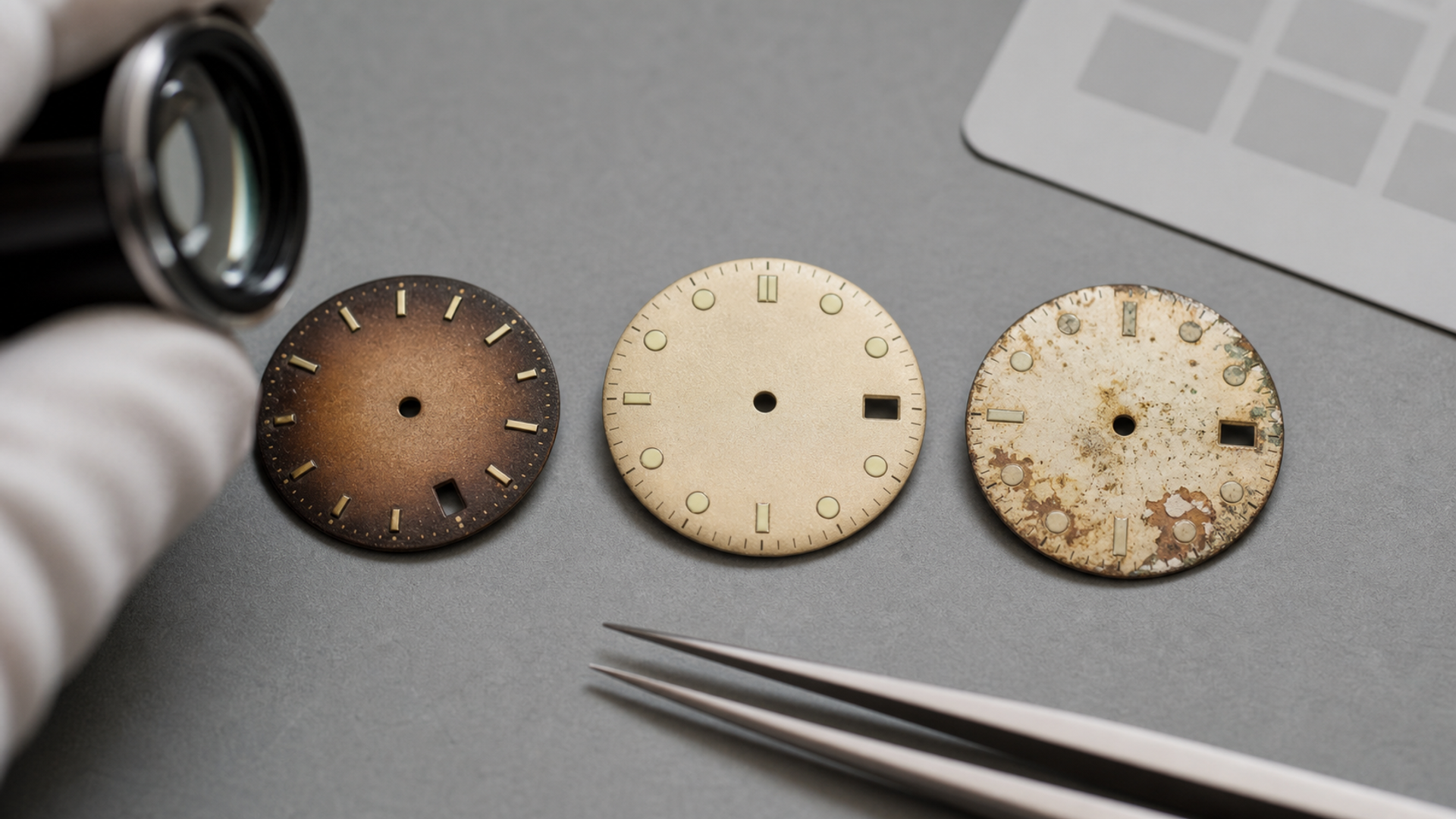
A brown vintage-watch dial is not automatically “tropical”, and an evenly aged dial is not automatically original. The useful question is not whether a dial looks old or attractive. It is whether the dial, hands, luminous material, case and documented history tell a coherent story—and whether the seller discloses the parts of that story that cannot be settled from photographs.
That distinction matters because the market can reward graceful, reference-correct ageing while discounting corrosion, unstable paint, undisclosed refinishing or replacement parts. In its June 2026 analysis of three Paul Newman Daytonas, Phillips identified condition and originality as central determinants of value, then supported the judgement with specific details: serial-range correctness, dial configuration, lume shape and colour, case definition and period-correct components. The lesson is not that collectors should memorise every Daytona font. It is that a valuable conclusion is built from several consistent observations, not one seductive colour.
This guide offers a visual triage system, not an authentication service. It can help you decide whether to proceed, ask for better evidence or stop. It cannot prove originality, establish how a colour change occurred, test whether luminous material has been renewed, or reveal corrosion beneath the dial.
Four conditions that are often confused
Collectors use “patina” broadly, but four different conditions deserve separate treatment.
Tropical fading usually describes a colour change—often from black towards brown—associated with the way a particular dial finish has reacted over time. The term is meaningful only when the reference is known to age that way and the example remains structurally sound. Brown alone is not evidence.
Honest patina is the wider category: gradual changes that appear compatible with age and use, such as a warmer dial tone, softened but intact printing, or luminous plots that have changed colour in a broadly consistent way. Phillips’ Patina Diaries gives examples of subtle, balanced ageing and also acknowledges marks caused by humidity or past servicing. “Honest” does not mean flawless; it means the condition is understandable and disclosed.
Water or moisture damage is deterioration, not romance. Warning signs include rust, flaking, bubbling, spreading stains, oxidised hands, deposits beneath the crystal or damage concentrated around openings and the dial edge. Sotheby’s collector guide to watch condition explicitly distinguishes desirable tropical fading from rust, flaking and other integral damage.
Restoration or replacement can be legitimate, especially when it preserves a watch that would otherwise be unusable. The issue is disclosure and fit with the buyer’s goal. A redial, service dial, replacement hands or renewed luminous material may make a watch cleaner or safer to wear, but it is a different proposition from an untouched survivor. “Restored” should not be used as a synonym for “fake”; nor should restoration be hidden behind the word “excellent”.
The dial-ageing decision tree
Use this sequence before zooming in on one photogenic detail. Each branch produces an action, not a verdict.
1. Does the whole watch make chronological sense?
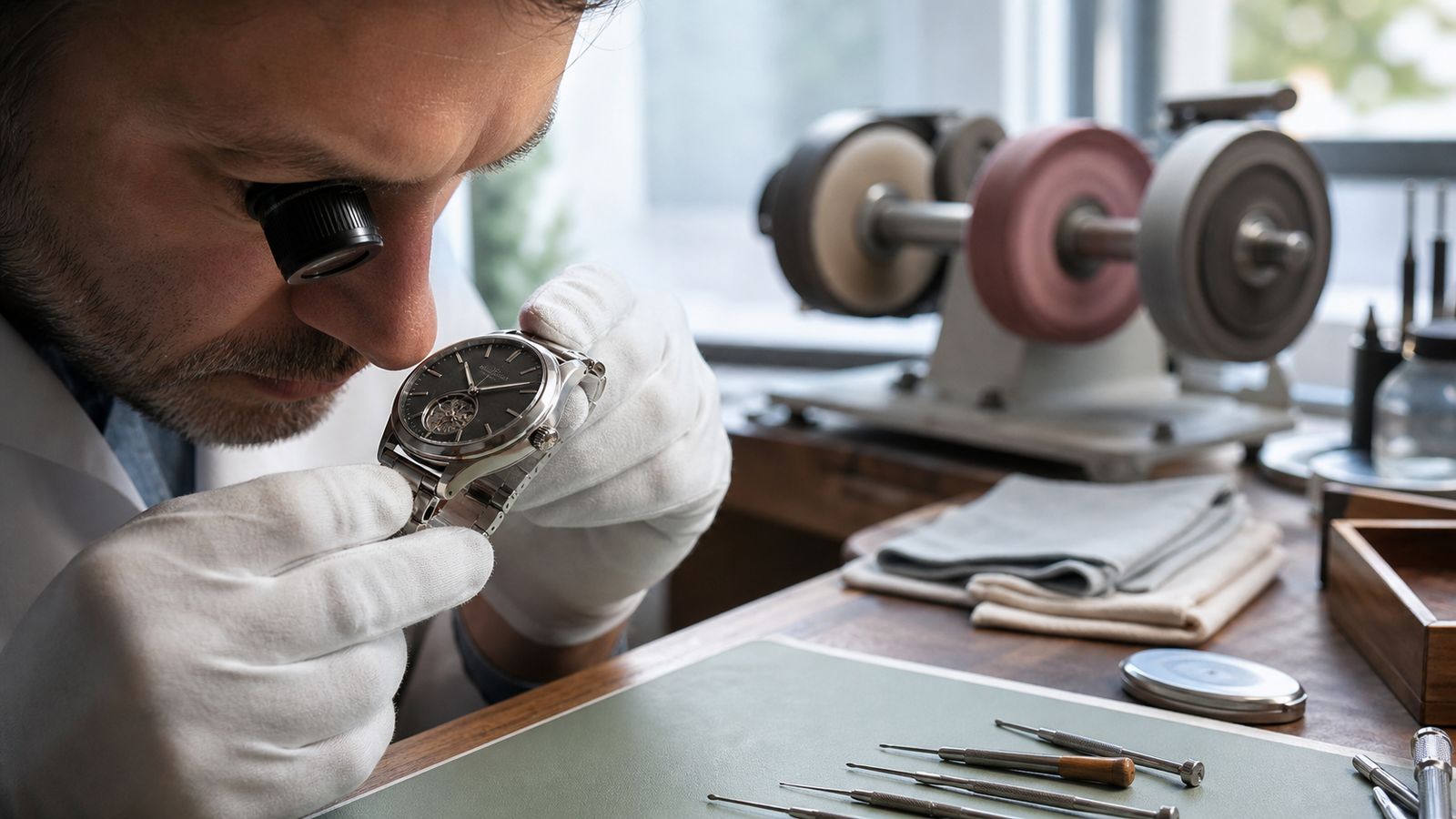
Compare the dial with the case, bracelet, bezel, hands and crown. A heavily worn case paired with an immaculate dial may be perfectly explainable—a documented service replacement, for example—but it requires an explanation. Sotheby’s recommends starting with the watch as a whole because an apparent mismatch is easier to see before a loupe or macro photograph narrows your attention.
Coherent wear and documented service history: continue.
A visible mismatch with a plausible, disclosed explanation: ask for supporting records and original parts, if retained.
A visible mismatch with no explanation: pause the purchase.
2. Is the colour change gradual and structurally stable?
Look for tonal continuity across the main dial and subdials. Attractive ageing often reads as a controlled shift rather than a collection of unrelated defects. Change may not be perfectly uniform. Abrupt tide marks, isolated dark patches, green deposits, bubbles or lifted paint are reasons to stop and request a professional condition assessment; photographs may show that a surface is compromised, but they cannot establish the cause or reveal damage beneath the dial.
Gradual tone, intact surface, no visible corrosion: possible patina; continue.
Uneven but stable-looking marks: ask for high-resolution oblique-light images and a condition explanation.
Flaking, bubbling, rust or deposits: pause and request an in-person professional condition assessment.
The distinction is visible in auction language. Phillips described one 1937 world-time dial as having a warmer centre and marks consistent with its age, while its 2026 Daytona analysis emphasised full lume plots, intact printing and well-preserved surfaces. Auction descriptions are evidence about those lots, not universal formulas; use them to learn what specialists document, not to transfer a verdict from one reference to another.
3. Do the printing and furniture belong together?
Inspect the logo, minute track, numerals, subdial text and any signatures at the same magnification. You are looking for consistency in edge quality, ink density, alignment and ageing—not pixel-perfect uniformity from a handmade or early industrial process.
Then compare the dial furniture: applied markers, hands, date apertures and subdial rings. Reference scholarship matters here. In its catalogue entry for a 1951 Patek Philippe reference 2499, Phillips documented the dial variation, enamel scales, movement-number engraving and case features together. That is the standard to emulate: configuration evidence plus condition evidence.
Printing style and components correspond to verified reference examples: continue.
One element looks materially newer or differently executed: request a macro image and provenance for that component.
Seller relies on vague claims such as “all original” without reference-specific evidence: do not price the claim as fact.
4. Does the luminous material age consistently—with room for service history?
Matching lume is useful, but “matching” is not a magic word. Compare colour, texture, plot shape, height and completeness across the hour plots and hands. Fresh, brightly glowing material on a decades-old watch can indicate replacement or reluming, but photographs, exposure settings and charge time can distort both colour and brightness. Some service interventions are old enough to have developed their own ageing.
Broadly consistent colour and texture, with period-appropriate behaviour: possible original or old service material; seek specialist confirmation.
Hands and plots differ: ask whether hands, dial or luminous compound were replaced, and when.
Perfectly uniform, freshly textured material on an otherwise aged watch: request explicit relume disclosure and ultraviolet images from a specialist.
Do not scrape, touch or disturb unidentified vintage luminous material. Some older luminous watches and dials may contain radioactive material; the US Environmental Protection Agency advises against taking radium watches or instrument dials apart. If the composition is unknown, ask a qualified watchmaker or radiation-safety specialist to assess it before any work.
5. Is there a plausible path for moisture?
Check the crystal edge, crown side, pushers, dial perimeter and hand stack for clustered anomalies. Several marks appearing in related locations are a reason to request a professional inspection, not proof of a particular moisture path. A clean exterior photograph cannot rule out a compromised movement or the underside of the dial.
No visible moisture pattern and recent professional inspection: proceed to provenance and price.
One ambiguous mark: ask for the inside caseback, movement and dial-edge photographs from a professional opening.
Multiple related clues: stop and commission an independent condition inspection before bidding.
What photographs can—and cannot—tell you
Good photographs reduce uncertainty; they do not eliminate it. Request a straight-on image, both oblique angles, ultraviolet response where appropriate, unedited close-ups of dial text and lume, the case from all sides, the movement, inside caseback and any removed original parts. Ask for files large enough to inspect, not screenshots compressed by a marketplace.
Also request a written condition report that distinguishes observation from attribution. “Brown dial” is an observation. “Naturally tropical from sun exposure” is a causal claim that may not be provable. “Original dial” is an attribution that should be supported by reference scholarship, provenance and physical inspection.
Photography introduces its own errors. White balance can turn cream into green or brown; polarising filters can suppress reflections; sharpening can make printing look harsher; and warm lighting can make lume appear attractively matched. Phillips notes that some patinated watches are difficult to represent accurately in photographs. When colour carries a premium, inspect the watch under neutral light or appoint an independent specialist.
The five questions to send before you bid
Is the dial original to the watch, a period replacement, a later service dial or refinished? Ask the seller to state which, and on what evidence.
Have the hands or luminous material been replaced or restored? Request dates, invoices and photographs of retained parts.
Is there any corrosion, flaking, moisture ingress or instability not visible in the listing images? Make the condition report answer the risk directly.
Can I see unedited macro images and the movement or an independent watchmaker’s report? Do not ask the seller to open a watch without the correct expertise.
What is the return, inspection or dispute process if the physical condition differs materially? Condition is also a transaction term.
This due diligence fits into a wider collecting system. VERTU’s guide to what AI watch valuations can and cannot establish explains why an image-led estimate still needs condition and provenance checks. For collection strategy, the three-watch collection framework helps prevent a visually exciting dial from becoming an unplanned duplicate. And because the crystal is the dial’s first line of defence, the guide to sapphire, mineral and Hesalite crystals clarifies the ownership trade-offs around scratches, impacts and replacement.
The collector’s conclusion: buy the disclosure, not the adjective
“Tropical”, “honest” and “untouched” are not grades. They are claims that must be unpacked. A desirable aged dial normally combines reference-correct configuration, coherent wear, stable surfaces, credible luminous material, a compatible case and transparent records. A damaged or restored dial can still be worth owning, provided its condition is understood and its price reflects the intervention.
The decision tree therefore ends in one of three places: proceed because the evidence coheres; obtain an independent inspection because uncertainty remains material; or walk away because the seller is asking you to pay for a story that the watch cannot yet support. Character is part of vintage collecting. Disclosure is what makes character collectable.