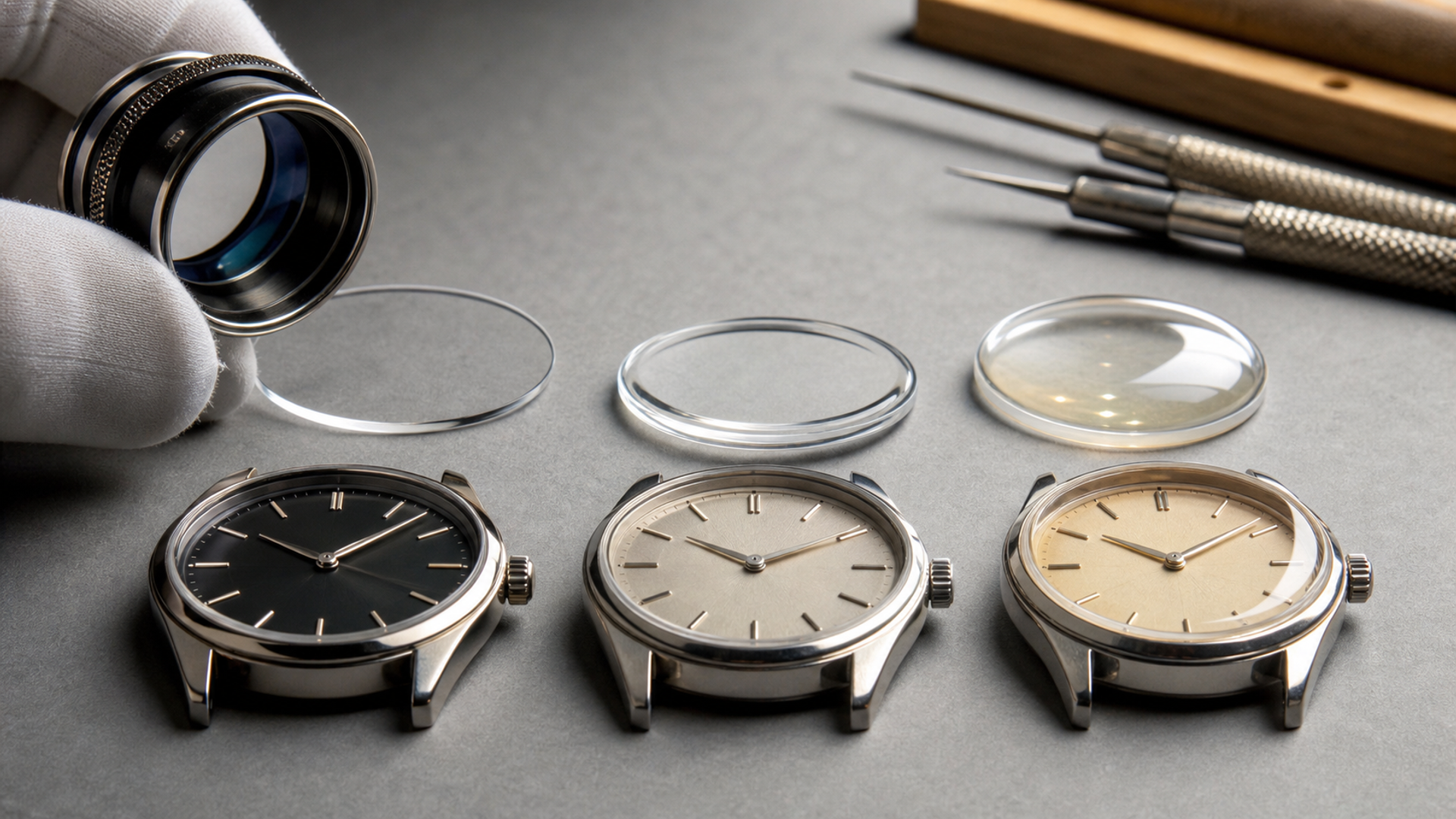
Choose sapphire when scratch resistance and long-term clarity matter most. Choose mineral glass when a shaped design, cost or maker-specific construction makes it the right engineering choice. Choose Hesalite or another acrylic crystal when warmth, heritage, a distinctive dome or easier refinishing matters more than resistance to everyday marks. The best crystal is not a hardness contest; it is part of the watch's design and service system.
Collectors often inspect the movement and case while treating the transparent cover as a specification line. That misses how often the crystal shapes the ownership experience. It determines reflections, distortion at the edge, how quickly marks appear, how the dial feels at different angles and what happens when replacement is needed years later.
Ownership matrix
| Question | Sapphire | Mineral glass | Hesalite / acrylic |
|---|---|---|---|
| Everyday scratch resistance | Usually strongest | Moderate, formulation dependent | Marks most readily |
| Complex curves and shapes | Possible but difficult and costly | Strong design flexibility | Excellent shaping flexibility |
| Edge distortion and warmth | Depends on geometry and coating | Depends on shape | Often valued for a warm, domed look |
| Anti-reflective treatment | Common on premium watches | Available | Less central to the category |
| Light scratch refinishing | Usually specialist work | Usually replacement or specialist work | Some light marks may be polishable, model dependent |
| Heritage appeal | Modern premium norm | Important in shaped watchmaking | Strong on historically faithful tool and space watches |
| Replacement concern | Exact geometry and coating | Exact shaped component | Exact profile and sealing still matter |
These are tendencies. A crystal is not a standalone sheet: thickness, curvature, coatings, gasket, bezel and case geometry affect performance. Compare exact references rather than assuming all sapphire or all mineral glass behaves identically.
Sapphire: the clarity-preservation choice
Watch sapphire is synthetic corundum made for transparency and hardness. OMEGA's own technical material describes sapphire crystal as very hard, highly transparent and extremely scratch-resistant. The Federation of the Swiss Watch Industry's Watch.swiss material notes that sapphire sits at nine on the Mohs scale in the context of a sapphire watch case.
That is why sapphire is so attractive for a daily luxury watch. Keys, desk surfaces and routine contact are less likely to leave visible marks than on acrylic. Years later, a well-kept sapphire crystal can preserve the clean first impression of the dial.
Hardness is not invulnerability. Sapphire can chip or break under an unfortunate impact, particularly at an edge. Anti-reflective coatings can also mark even when the crystal underneath remains sound. Ask whether the coating is internal, external or on both sides; an exposed outer coating may show wear differently from bare sapphire.
Sapphire is also difficult to shape and finish. Citizen describes how sapphire ingots have directional properties that require polishing to be adjusted to the material's orientation. That manufacturing burden helps explain why complex domes, facets and unusual geometry can become meaningful craft details rather than decorative language.
Sapphire suits you if:
you wear the watch frequently around desks, luggage and daily objects;
you want the dial to remain visually clean with minimal polishing;
you accept specialist replacement cost if damage occurs;
you appreciate coatings and optical engineering as part of the design.
Mineral glass: the shape-led middle ground
Mineral glass is often dismissed as a cheaper alternative. That is too crude. It generally scratches more readily than sapphire, but it can offer important shaping possibilities. Watch.swiss's account of Cartier's manufacture explains that mineral glass can be heated and formed into the curves required by watches such as the Crash, Tortue and Tank Américaine. In those cases, the material participates in the design language.
The same source notes that precise shaping and edge finishing contribute to fit and water resistance. A shaped crystal is therefore not interchangeable with a flat generic part. Its geometry, tolerances and relationship to the case matter.
Mineral formulations and hardening processes vary. Seiko's Hardlex, for example, is its name for specially hardened inorganic glass. That does not make every mineral crystal equivalent or permit a universal hardness claim. The useful buyer question is not “Is it mineral?” but “Why did the maker choose this specific crystal, and can the exact part be serviced?”
Mineral glass suits you if:
the crystal's curve is central to the watch's identity;
you accept more visible wear in exchange for the design;
replacement cost and service access are known;
the watch will not face constant abrasive contact.
Hesalite and acrylic: marks, warmth and historical honesty
Hesalite is a branded acrylic used in watchmaking; other makers use related polymer crystals under different names. Acrylic is softer than mineral and sapphire, so it accumulates marks more easily. That apparent weakness creates two ownership advantages: light scratches can sometimes be polished, and the material can be formed into distinctive domes with a warm optical character.
For historically faithful watches, acrylic can be part of the story rather than a compromise. The OMEGA Speedmaster's space history is associated with acrylic crystals, and NASA's Apollo surface-journal analysis documents both their role and a failure in extreme lunar conditions. That evidence should not be turned into a claim that acrylic is indestructible. It shows that material choice belongs to a complete operating environment.
Acrylic can also produce edge distortion that collectors value because it changes the dial as the wrist turns. What looks less clinically clear in a specification comparison may feel more alive on the wrist.
Hesalite or acrylic suits you if:
historical continuity matters to the reference;
you enjoy a domed, warmer visual effect;
you accept regular light marks and careful polishing;
you have confirmed replacement availability and water-resistance service.
Reflections matter as much as scratches
A highly scratch-resistant crystal that behaves like a mirror can reduce legibility. Anti-reflective treatment changes that, but it adds another surface whose wear needs to be understood. Citizen describes a sapphire crystal with low refractive index and anti-reflective coating as part of a deliberate legibility system on The Citizen.
View a watch in daylight, office lighting and at a shallow angle. Look for three things:
Can you read the hands without tilting the wrist repeatedly?
Does the edge distort the dial attractively or distractingly?
Is an external coating creating a colour cast or visible marks?
Online product images are controlled. They rarely show the reflection that appears under a meeting-room light or the distortion visible at arm's length.
Service and replacement are collector questions
A damaged crystal can affect more than appearance. The seal, gasket and case interface contribute to water resistance. Replacement should therefore use the correct component and be followed by the maker's required testing.
Ask an authorised service centre:
Is the original crystal still available for this reference?
Does replacement include the gasket and pressure test?
Will the anti-reflective treatment match the original?
Can a light acrylic mark be polished without changing the intended profile?
Does replacing a historically correct crystal affect collectability?
Do not polish an unknown coating or shaped crystal with a generic compound. A technique suitable for acrylic can damage an anti-reflective layer or alter a crisp edge on another material.
Inspect coatings, edges and distortion
“Sapphire” alone does not describe the viewing experience. Anti-reflective coating may sit on the inside, outside or both surfaces. External coating can produce excellent clarity but may show marks that look like scratches in the crystal itself. Ask whether the coating can be removed or renewed and whether doing so changes the intended appearance.
Look at the dial under daylight and strong point light. Tilt the watch through shallow angles. Check for a coloured reflection, milky haze, edge distortion and disappearing hands against a dark dial. A domed crystal will distort by design; the question is whether that character supports legibility and the watch's style.
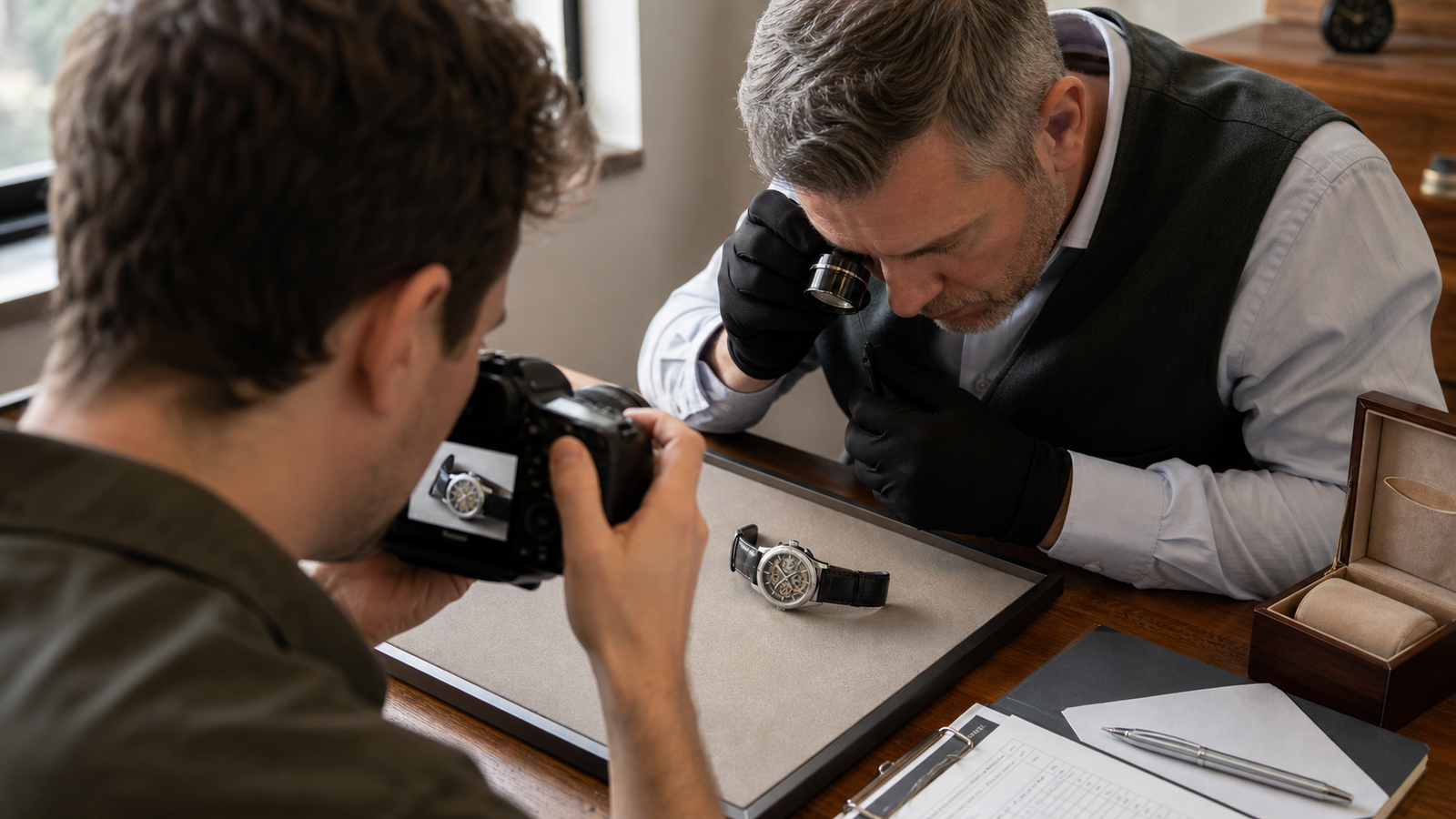
Inspect the perimeter with magnification. Chips often begin at an exposed edge rather than in the centre. A tension ring, cyclops lens or unusual faceting changes both the visual result and replacement complexity. Straight-on product photographs rarely reveal these ownership details.
Separate scratch resistance from impact behaviour
Sapphire's high hardness makes it resistant to many everyday scratches, but hardness is not the same as immunity to fracture. Mineral and acrylic materials respond differently to impact and abrasion. A softer surface may mark more readily while absorbing a knock without the same failure pattern.
That distinction should influence activity choice, not create false confidence. Remove a fine watch before work involving tools, stone edges or heavy impact regardless of crystal. A crystal protects the dial from ordinary use; it is not personal protective equipment.
If a crystal is chipped or cracked, stop exposing the watch to water. Even when the opening is small, water resistance can no longer be assumed. Have the case, gasket and movement inspected, then require the appropriate pressure test after repair.
Vintage crystals require provenance judgement
On a vintage watch, a replacement crystal can be correct, period-compatible, generic or visually wrong. The original drawing may specify a profile, tension ring, magnifier or signed centre that affects both appearance and sealing. A flatter modern substitute can change how the dial fills the case even if its diameter fits.
Ask the seller for side photographs and service invoices. Check whether polishing has softened the profile or removed a mark collectors expect. For historically important acrylic designs, scratches may be repairable while deep crazing, deformation or compromised sealing calls for replacement.
NASA's Apollo experience report on the wrist watch is a useful reminder that material choice follows an operating environment. The flight-qualified watch's acrylic crystal was not selected because it was universally superior; it belonged to a complete design assessed for a specific mission.
Price the next service, not only the purchase
Before buying, request an indicative crystal-replacement cost and lead time from an authorised or respected independent service route. Include gaskets, coatings, water-resistance testing and shipping. A proprietary faceted sapphire component can turn a small edge chip into an expensive, long wait.
For a frequently worn watch, that cost may be justified by years of preserved clarity. For a low-value watch with a complex mineral shape, replacement economics may be disproportionate. Ask whether the old crystal will be returned and whether changing it affects originality documentation.
Insurance may cover accidental damage, but deductibles and authorised-repair conditions vary. Keep pre-damage photographs and do not allow an emergency repair to discard an important original component without agreement.
Ask what the specification leaves out
A product page may state only “sapphire crystal” or “mineral glass”. Ask whether the component is flat, domed or box-shaped; whether coating is internal or external; whether a magnifier is bonded; and whether replacement stock is expected to remain available. These details can matter more to ownership than the generic material name.
On a pre-owned watch, compare the crystal profile with trusted reference photographs and examine the seal after purchase through a competent service provider. A replacement is not automatically bad, but an undisclosed or incorrectly fitted part changes the decision. The goal is to understand what is on the watch now, not merely what the original catalogue promised.
The same caution applies to marketing terms such as “scratchproof”. No watch crystal is immune to every contact or impact. Ask for the material, coating and service facts that can be verified, then decide whether the likely marks and replacement path suit the way the watch will actually be worn.
Record those answers with the purchase documents, because they will also help a future watchmaker, insurer or buyer understand the component fitted to the watch.
When comparing two references, include the crystal in the wrist test rather than treating it as a line on a specification table. Photograph both under the same light, read the date and minute track from an angle, and note where reflections obscure the hands. A material that preserves an immaculate surface but frustrates daily reading may be the wrong ownership choice; a softer crystal whose marks can be managed may provide the more satisfying watch.
Choose by ownership pattern
For a one-watch daily collection, sapphire is usually the most forgiving choice. For an expressive shaped watch, mineral glass may be integral to the design. For a heritage chronograph or vintage-style piece, acrylic can create the character the collector actually wants.
Crystal choice should be considered alongside case material, luxury smartwatch construction and the maker's service network. A crystal that survives daily wear but cannot be replaced in the correct form may be a poor long-term choice.
The first-collector maison framework helps place that service question beside originality and provenance. For travel, add the documentation and insurance checklist.
The practical verdict
Sapphire wins the narrow scratch-resistance comparison, but it does not win every watch. Mineral glass enables shapes that define important designs. Hesalite and acrylic accept visible life in exchange for warmth, heritage and serviceable character.
Buy the crystal that belongs to the watch you want to own, then understand its care. A collector who knows why the material was chosen will make a better decision than one who simply checks for the hardest word on the specification sheet.