AI can make a luxury watch valuation faster, but it cannot make every uncertainty disappear. The Heritage Club in Dubai launched a digital service on 13 July 2026 that uses a photograph to identify a watch and combine that result with market data before producing an immediate purchase valuation. It is a revealing example of where automation helps—and where a collector still needs an expert.
An instant quote can be useful for orientation or liquidity planning. It is not the same as a complete appraisal of authenticity, condition, provenance and future saleability. Those distinctions matter most when two apparently identical references differ greatly after inspection.
What an AI valuation can do well
Image recognition can narrow a watch to a brand, collection, model and possible reference. A structured system can then compare recent listings, dealer networks and transaction information more quickly than a person searching each source manually.
That speed is valuable when the owner needs a realistic opening range rather than an insurance document or auction estimate. The Heritage Club says its tool is designed to support a potential transaction through its purchase and buy-back service, not merely display a generic market number.
The commercial context is important. A purchase offer, auction estimate, private-sale expectation, replacement value and insurance valuation answer different questions. A number without its purpose can be technically calculated and still mislead the owner.
AI quote versus expert appraisal
| Valuation question | AI from photographs and data | Physical expert inspection | Why it changes value |
|---|---|---|---|
| Brand and model family | Often useful | Confirms identification | Wrong family makes every comparison irrelevant |
| Exact reference and production detail | Possible when visible | Checks engravings, movement and configuration | Small reference differences can affect demand |
| Case and bracelet condition | Limited by lighting and angle | Evaluates polishing, wear and replaced parts | Over-polishing and damage affect collectability |
| Dial, hands and lume originality | Difficult from one image | Compares age, printing and components | Service parts can alter value materially |
| Movement condition | Usually unavailable | Opens or tests where appropriate | Service needs change net proceeds |
| Provenance and papers | Can record uploaded documents | Verifies consistency and chain of ownership | Provenance affects confidence and saleability |
| Current market range | Fast aggregation | Adds dealer and collector judgement | Listings are not always completed transactions |
| Immediate cash offer | Can calculate a starting offer | Confirms risk before funds are committed | Buyer margin, storage and resale risk are included |
The matrix shows why “AI valuation” should be understood as a workflow, not a single vision model. Identification, market matching, compliance checks and expert verification are separate stages.
The photograph determines the ceiling of the first result
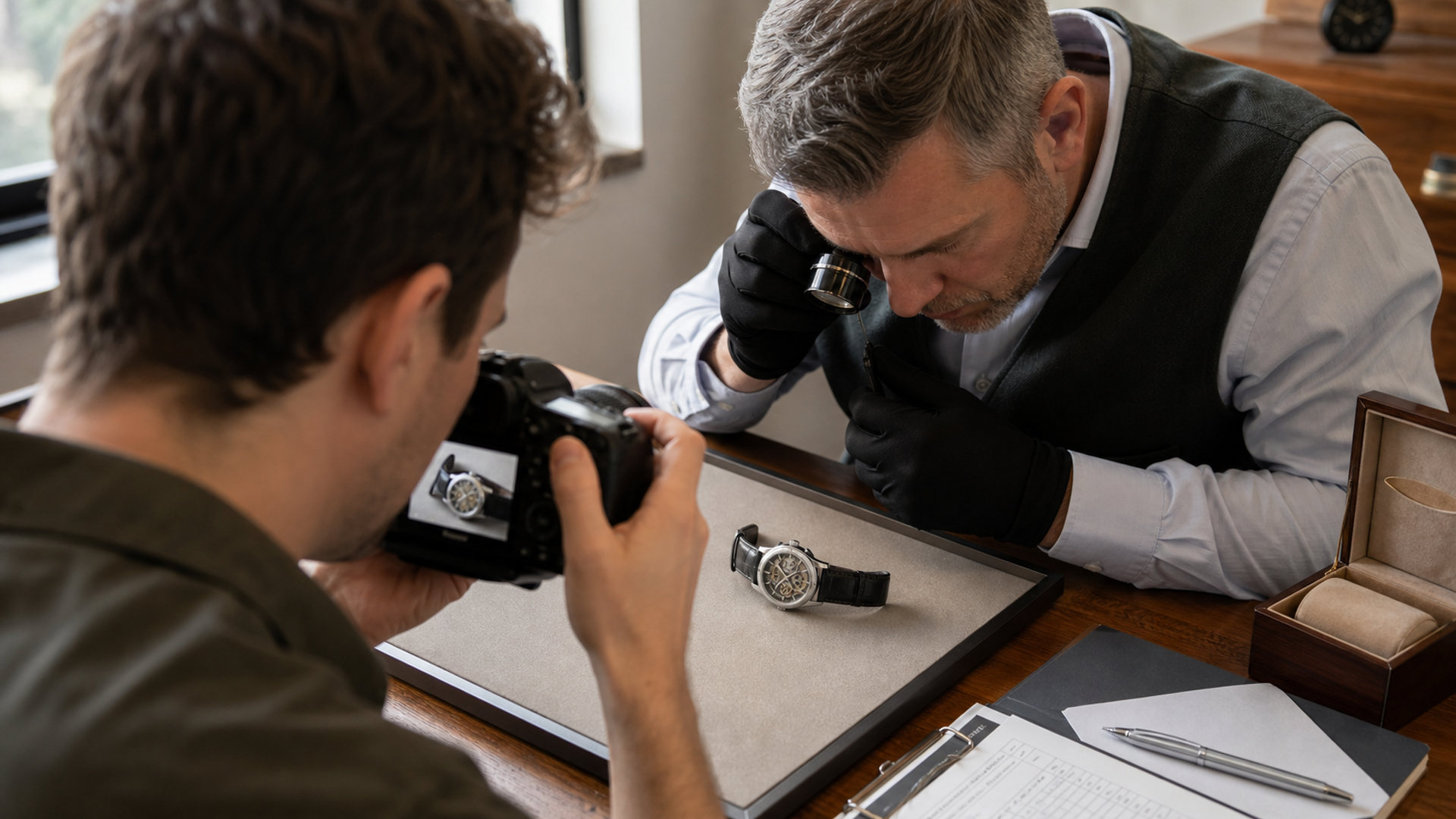
A valuation tool cannot inspect information the photograph does not contain. Reflections can hide scratches; a polished case can look crisp from one angle; a replacement dial may appear convincing at screen resolution. Owners should provide a deliberate image set:
straight-on dial in neutral light;
case from both sides;
crown and pushers;
caseback and visible reference markings;
clasp and full bracelet;
box, warranty card, service records and receipts;
close-ups of damage or modifications.
Do not edit out wear. A flattering image may improve a provisional estimate and then reduce trust when the watch arrives.
Four values a collector should never confuse
Purchase offer
This is what a buyer is prepared to pay now. It reflects expected resale price, authentication risk, service cost, capital tied up and the buyer's margin.
Private-sale expectation
This may be higher, but the owner accepts photography, negotiation, payment risk, shipping, returns and time. An asking price is not evidence of a completed sale.
Auction estimate
An auction house sets a range for a particular sale context. Fees, reserve, bidder interest and the catalogue narrative influence the result.
Insurance or replacement value
This can reflect the cost of replacing the watch through a suitable channel. It should not be presented as the amount a dealer would pay in cash.
A seven-point trust checklist
Before acting on an instant luxury watch valuation, ask:
Purpose: Is this a purchase offer, estimate or replacement value?
Data date: When were the comparison prices refreshed?
Transaction basis: Are they completed sales, asking prices or dealer quotes?
Reference certainty: Has the exact reference been confirmed?
Condition adjustment: What assumptions were made about polishing, service and originality?
Human inspection: At what stage does an expert authenticate the watch?
Custody and payment: Who holds the watch, how is it insured and when does ownership transfer?
The Heritage Club describes an in-person authentication stage, tamper-proof sealing and insured vault storage for its purchase-and-buy-back process. Those service claims apply to that provider and should be verified in the current agreement before a transaction.
AI is most valuable as a discrepancy detector
The best use of automation may be to surface disagreement. If image identification suggests one reference, paperwork another and market data a third configuration, the system should stop rather than average the results.
Collectors should welcome uncertainty labels. A wide range with a clear reason is more trustworthy than a precise number built on an unverified dial or incomplete provenance. The same principle applies when comparing watch value retention across brands: category trends do not determine the condition of one watch.
Ownership care also affects future evidence. Store the watch, papers and replaced service parts deliberately. Our watch box, winder or safe decision guide explains how storage choices vary by movement, access and risk.
How condition changes the number
Two watches sharing a reference can deserve different offers. Case geometry may have softened after polishing; bracelet stretch can require expensive work; moisture can mark a dial while leaving the exterior apparently clean. A recently serviced movement can be positive, but an undocumented service may introduce replacement parts that a collector values differently.
Ask the appraiser to separate deductions:
authentication uncertainty;
missing box or papers;
case, crystal and bracelet condition;
movement service requirement;
replaced or non-original components;
market liquidity for the exact configuration;
dealer margin and transaction cost.
A single unexplained discount prevents the owner from deciding whether to service the watch, locate missing paperwork or seek another channel.
Protect the watch during a remote valuation
Photographs can expose serial numbers, home interiors and ownership documents. Crop only irrelevant surroundings, not the watch's condition, and send files through the provider's official channel. Confirm the business identity before uploading a passport or proof of address for compliance checks.
Before shipping, photograph the watch running, the complete delivery set, packaging and sealed parcel. Use insured transport suitable for the declared value and obtain written custody terms. If the transaction includes a right to repurchase, read the repurchase price, deadline, storage, insurance, default and governing-law clauses. That arrangement is not identical to a conventional sale or a conventional loan.
The practical verdict
Use an AI valuation to identify the likely reference, establish a current range and decide whether a professional transaction is worth pursuing. Do not use it as the sole proof of authenticity, originality, mechanical condition or insurance value.
The most credible platforms will not try to eliminate the expert. They will make the expert's time more precise: arrive with better images, a narrower reference set, clearer provenance questions and a transparent record of how the opening number was produced.