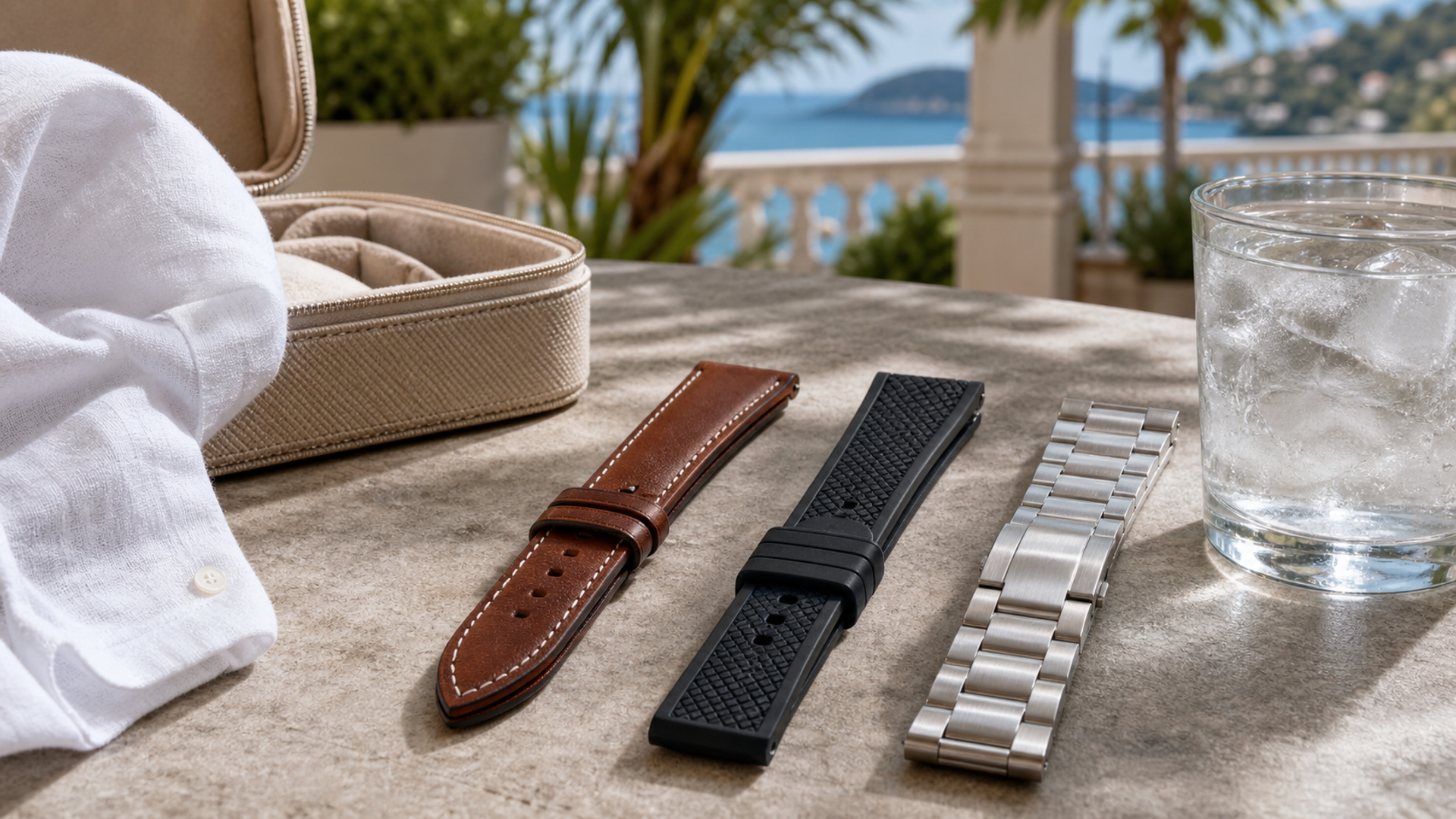
For repeated swimming, perspiration and easy rinsing, a suitable rubber strap or metal bracelet is usually more practical than leather. Leather remains the most elegant choice for many watches, but water and prolonged moisture can accelerate wear. The best summer solution is often not one universal strap; it is a deliberate rotation based on the day’s exposure and the watch’s actual water-resistance status.
Material is only half the decision. Fit, clasp security, ventilation, cleaning and the ability to dry fully matter just as much in heat.
Hot-weather decision matrix
| Material | Water and sweat | Cleaning | Heat comfort | Ageing pattern | Best summer role |
|---|---|---|---|---|---|
| Leather | Least tolerant of repeated moisture | Gentle, maker-specific care | Soft but can hold moisture | Darkening, stiffness, odour, edge wear | Dry evenings, formal settings, controlled wear |
| Rubber/elastomer | Usually practical when watch and strap are intended for water | Often rinse/soapy water per maker guidance | Flexible; can feel warm without ventilation | UV, cosmetic and surface ageing | Swimming, sport, humid travel |
| Metal bracelet | Water-capable when watch is rated and crown secured | Fresh-water rinse and careful drying | Conducts heat; adjustable fit helps | Scratches, trapped salt/dirt | Daily travel, sea and pool with correct watch rating |
| Fabric/textile | Varies by construction and hardware | Often washable but verify | Breathable; stays wet after immersion | Fraying, staining, hardware wear | Casual walking, quick-change travel |
Do not infer watch water resistance from the strap. A rubber strap does not make a non-water-resistant watch safe for a pool. The case, crown, seals and current testing determine that boundary.
Leather: preserve it by choosing the moment
Cartier advises owners to avoid bringing a leather strap into contact with water or other liquids because this can accelerate wear in its watch care recommendations. That is a useful rule across fine leather: repeated saturation, perspiration and slow drying are harder on the material than occasional careful wear.
Choose leather for a dry dinner, air-conditioned meeting or short formal occasion. On a very humid day, loosen the fit slightly if the maker and clasp allow safe adjustment, and let the strap air after wear. Do not seal a damp leather strap in a travel pouch.
Avoid improvised oils, alcohol wipes, perfume and household cleaners. Finishes and linings vary. Follow the watch or strap maker’s care instructions, and ask a specialist before treating exotic or coloured leather.
Rubber: practical, not maintenance-free
Rubber or engineered elastomer is the obvious summer choice for many sports and dive watches because it tolerates moisture and can be cleaned. Yet sunlight, heat, cosmetics and chemicals still affect it. Cartier’s guidance for a rubber strap notes that intense sunlight and dense urban exposure may accelerate ageing and recommends cleaning with soapy water while avoiding cosmetic varnishes.
Check the underside for cracking, tackiness, discolouration and damaged spring-bar holes. Rinse salt and pool residue with fresh water when the watch is suitable for it, then dry thoroughly. Replace a strap whose attachment area is compromised; the value at risk is the entire watch.
Ventilated designs can improve comfort, while a deployant clasp may spread pressure differently from a pin buckle. Try the actual combination in heat rather than assuming all rubber feels the same.
Metal bracelet: robust, but rinse the spaces
A metal bracelet handles water and perspiration well when paired with a watch that is currently water-resistant. Salt, sunscreen and grit collect between links and around the clasp. Rolex’s care guidance recommends fresh-water rinsing after sea wear and allows cleaning the case and bracelet with soapy water and a soft brush, excluding leather straps, while reminding owners to secure the crown.
Use the procedure specified for your watch. Do not immerse a vintage piece, damaged crown or untested watch merely because the bracelet is steel. After rinsing, dry between links and inspect the clasp.
Heat can change wrist size through swelling. A bracelet with a safe micro-adjustment or extension can be more comfortable across a long day. Too loose increases movement and impact; too tight is uncomfortable and may trap moisture.
Fabric: breathable with a drying plan
Textile straps can be comfortable on a hot walk and easy to pack. They also absorb water and perspiration. A wet fabric strap under a watch case can remain damp longer than expected.
Confirm whether the fabric, dye and hardware are intended for immersion. Rotate to a dry spare rather than wearing the same saturated strap through dinner. Inspect stitching and attachment points after washing.
Match the strap to the day
Pool or sea
Use a watch with confirmed water resistance and a suitable rubber or metal attachment. Rinse with fresh water according to maker guidance. Leather stays in the room.
City heat
Rubber, metal and breathable fabric can all work. Consider security and sleeve friction on crowded transport. Wipe perspiration away at the end of the day.
Formal evening
Leather delivers the classic appearance after the day’s moisture has passed. Change straps only with the proper system and tools; a scratched lug or unsecured spring bar is not worth a quick style change.
Multi-climate trip
Pack two roles: one water-tolerant strap or bracelet and one dry formal option. Store each separately, dry and supported. Photograph the watch and identifiers before travel and keep insurance documentation current using the luxury-watch travel checklist.
The two-minute post-wear routine
Check whether the watch encountered salt, chlorine, sunscreen or heavy perspiration.
Follow the maker’s cleaning guidance for the exact watch and strap.
Dry all surfaces and the underside; never apply direct high heat.
Inspect clasp, spring bars, stitching and attachment holes.
Store only when fully dry and away from direct sun.
If the watch took an impact, the crown was open, condensation appears under the crystal or water resistance is uncertain, arrange inspection rather than testing it with another swim.
What to choose
Choose leather for dry, considered wear and accept that it is a consumable element. Choose rubber for repeated water and sport when the complete watch supports those activities. Choose a bracelet for versatile daily travel and easy rinsing, provided you manage fit and trapped residue. Choose fabric for breathable casual use with a clear wash-and-dry routine.
Before purchasing a spare, verify lug width, spring-bar type, clasp compatibility, case clearance and whether the watch uses a proprietary quick-change system. A visually suitable strap is unsafe if the attachment is wrong. Have a specialist fit valuable or unfamiliar watches, then pull-test the connection gently over a soft surface before wearing it outside.
The collector’s best summer strap is the one matched to exposure before leaving the room. Style matters; preserving the watch matters more.