

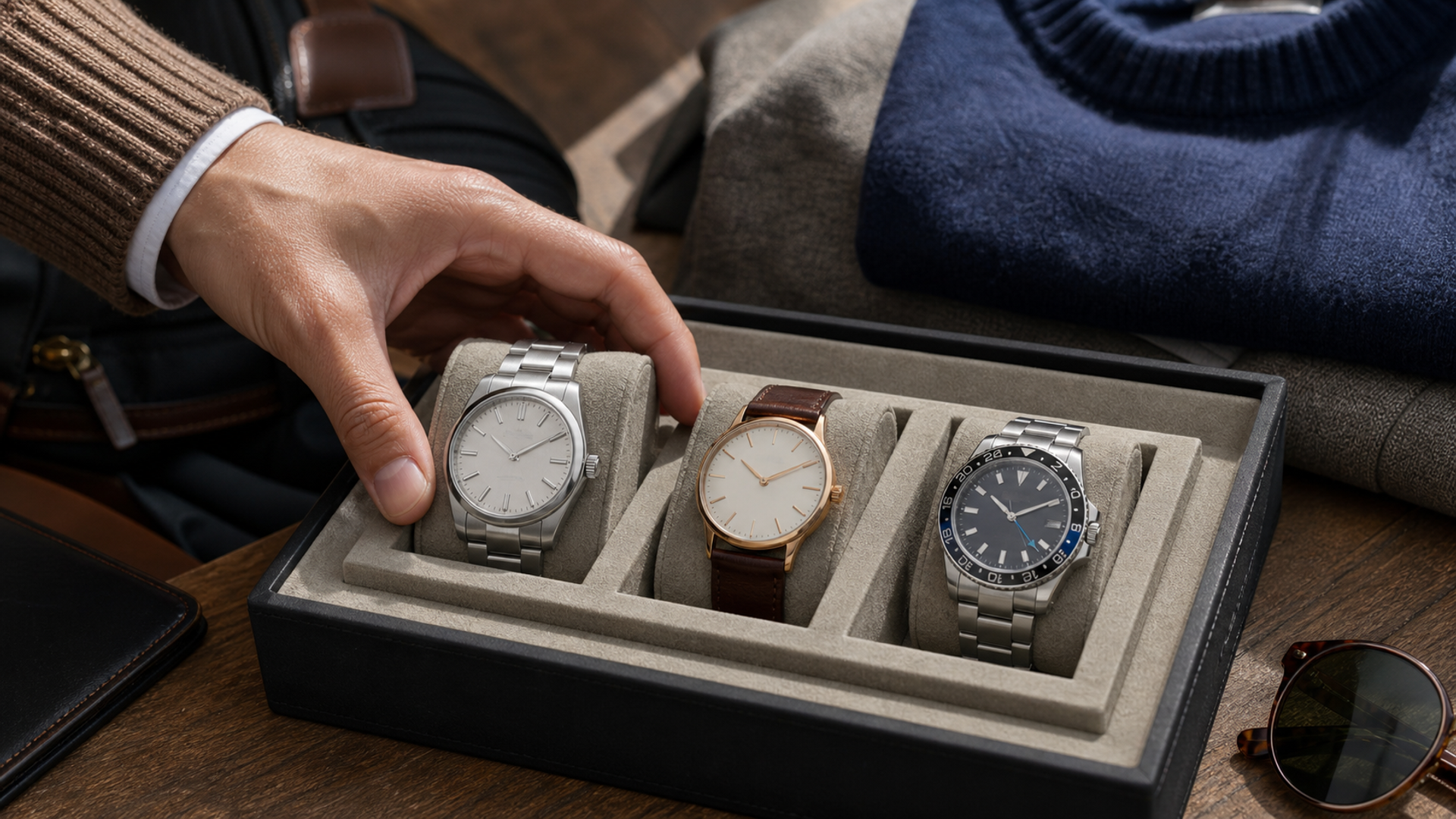
The strongest three-watch collection gives each watch a different job: one dependable daily watch, one more formal or emotionally significant watch, and one specialist watch for travel, sport or a complication. The point is not to cover every possible category. It is to prevent three attractive purchases from collapsing into the same steel sports watch with a different logo.
The role-first collection
| Slot | Core job | Useful characteristics | Common mistake |
|---|---|---|---|
| Daily | Work, weekends and ordinary travel | Comfortable, legible, robust, easy to service | Buying for resale attention rather than wrist time |
| Formal or personal | Important meetings, dinners and occasions | Distinct proportions, refined dial, emotional meaning | Choosing something too fragile or theatrical to wear |
| Specialist | GMT, chronograph, dive, world time or connected function | One capability the other two cannot provide | Adding another near-identical daily sports watch |
Begin with the life already being lived. A collector in tailored clothing who rarely enters water may need a slim daily watch and a travel complication, not a 300-metre dive watch. Someone who spends weekends outdoors may use a robust sports watch more often than a traditional dress piece. Categories are prompts, not obligations.
Step 1: audit the watch you already wear
For four weeks, record which watch is chosen, where it goes and why another option was rejected. Note diameter, thickness, bracelet or strap, dial colour and complication. The exercise reveals functional preferences that showroom excitement can hide.
If a 40mm steel watch on bracelet is worn every day, the next purchase should solve a different situation. A smaller precious-metal or leather-strap watch changes posture and visual weight. A GMT adds a travel function. A coloured sports watch may feel different in a photograph yet occupy exactly the same role.
Step 2: use an overlap score
Score every proposed pair from zero to two on six dimensions:
| Dimension | 0 points | 1 point | 2 points |
|---|---|---|---|
| Case material | Clearly different | Same family, different finish | Same material and finish |
| Shape and size | Different silhouette | Similar proportion | Near-identical |
| Dial and colour | Contrasting | Some overlap | Same visual effect |
| Strap or bracelet | Different wearing character | Interchangeable | Same construction |
| Function | Different purpose | Partial overlap | Same complication |
| Occasion | Different setting | Shared use | Same role |
A pair scoring nine to twelve is probably duplicative. That is not forbidden—deep collections often study one form—but it is inefficient in a first three-watch set. A score below six usually creates more range.
Step 3: choose the daily anchor
The daily watch should disappear physically while remaining clear visually. Test it after several hours, not only for five minutes. Check crown contact, bracelet taper, clasp thickness, dial reflection and whether the watch fits under the most frequently worn cuff.
Practical ownership matters more than theoretical toughness. Confirm water-resistance guidance, magnetic exposure advice and the service route in the buyer's country. A daily watch that must cross borders for every adjustment may be less convenient than a more modest reference with local support.
Step 4: make the second watch genuinely different
The formal or personal slot is where a collection gains character. It might be a rectangular design, a hand-wound dress watch, a family heirloom or a craft-led dial. It need not be expensive, but it should alter how the wearer experiences time: quieter, more tactile or connected to a specific occasion. This analysis is supported by Cartier watch collections.
Do not confuse “formal” with “never worn”. A watch that is too precious for dinner, a wedding or an important meeting has no real role. Consider scratch visibility, strap replacement and how the case will age. Patina can be part of ownership; fear should not be the dominant relationship.
Step 5: let the third watch solve a real problem
The specialist slot should answer a sentence beginning with “I need to…”. Track home time while travelling. Time an event. Wear a watch in water. Read several cities. Receive critical alerts without holding a phone. If the sentence cannot be completed, delay the purchase.
Complications should be tested in the setting that justifies them. A GMT needs intuitive local-hour adjustment. A chronograph needs legible registers and comfortable pushers. A world timer must be readable without a manual. A connected watch needs a charging routine and supported apps in the relevant region.
Budget for ownership, not only acquisition
Divide a collection budget into purchase, service and flexibility. Mechanical watches require periodic inspection and eventual service; intervals and cost depend on brand, movement and use. Straps, insurance, shipping and tax also change total ownership. Keep a reserve rather than spending the entire budget on the third watch.
Provenance is especially important when buying pre-owned. Ask for the reference, serial information where appropriate, service history, replaced parts and seller return terms. Papers can support a story but do not replace an inspection. A polished case, mismatched hands or an undocumented dial may matter more than a missing outer box.
A worked example
Consider a globally mobile professional who wears a dark suit twice a week and travels monthly:
Daily: a restrained steel automatic on bracelet, selected for comfort and local service.
Formal/personal: a slim rectangular or round watch on leather, visually distinct and suited to evening wear.
Specialist: a traveller GMT with independent local hour, chosen for actual flights rather than popularity.
The three pieces differ in material feel, strap, silhouette and function. A fourth purchase should face a higher bar: it must deepen one area intentionally or open a new role.
When three watches are enough
A collection is complete when every owned watch is chosen without guilt and a new candidate cannot explain the role it would take. Completion is not permanent; work, clothing and travel change. But pausing is part of collecting well. It creates time to understand service, ageing and attachment—the parts of ownership that do not appear on release day.
Build from roles, measure overlap and buy slowly. Three watches with distinct work are more coherent than ten references competing for the same Saturday afternoon.
![How to Scan Receipts and Documents with Your Phone [Full Guide]](https://cdn.sanity.io/images/e0gp1l2g/production/0db13feec1d5e72b8a8a5f976d1f3e86619c9228-3840x1860.webp?w=180&h=180&q=78&auto=format&fit=crop)
![How to Scan Receipts and Documents with Your Phone [Full Guide]](https://cdn.sanity.io/images/e0gp1l2g/production/0db13feec1d5e72b8a8a5f976d1f3e86619c9228-3840x1860.webp?w=800&h=450&q=82&auto=format&fit=crop)
![Top 10 Two-Tone Carbon-Fibre Watches for Men [2026 List]](https://cdn.sanity.io/images/e0gp1l2g/production/18870799ba33fab0e038968359cd5772d7d7db30-1024x576.webp?w=800&h=450&q=82&auto=format&fit=crop)
![Top 10 Luxury Watches with Digital Complication Displays for Men [Latest]](https://cdn.sanity.io/images/e0gp1l2g/production/c4f6bf8c080f291c39f7cc85c7344ecff2fd3799-1024x553.webp?w=800&h=450&q=82&auto=format&fit=crop)