Polishing can make a scratched watch look brighter. It can also remove metal, soften bevels, thin lugs and erase the evidence collectors use to judge originality. The right answer is not “never polish” or “always restore”. It depends on the watch, the owner’s objective, the condition of the case and the skill and method of the person doing the work.
The irreversible part is the key. Dirt can be cleaned. A movement can be serviced. A strap can be changed. Metal removed from a case cannot be put back without a more substantial restoration. Before approving the standard “refinish case and bracelet” line on a service estimate, decide whether you are maintaining a daily-wear object, preserving a collectible or preparing a heavily damaged watch for a different life.
The collector value test
| Question | Preserve without polishing | Consider restrained refinishing | Stop and seek specialist opinion |
|---|---|---|---|
| Is the watch vintage, rare or unusually original? | Usually yes | Only with reference-specific expertise | If originality may drive material value |
| Are case edges, bevels and hallmarks crisp? | Preserve them | Very light work only if explicitly agreed | If the provider cannot describe geometry |
| Are scratches superficial? | Live with them or clean only | Optional for a modern daily wearer | If removal would change shape |
| Is damage deep or structurally sharp? | Safety may require intervention | Repair may be justified | If welding or laser restoration is proposed |
| Is the watch a modern piece kept for enjoyment? | Owner preference | Manufacturer-standard refinishing can be reasonable | If future collectability is important |
| Has it already been heavily polished? | Avoid compounding loss | Specialist correction may improve coherence | If lugs, crown guards or hallmarks are weak |
What polishing actually changes
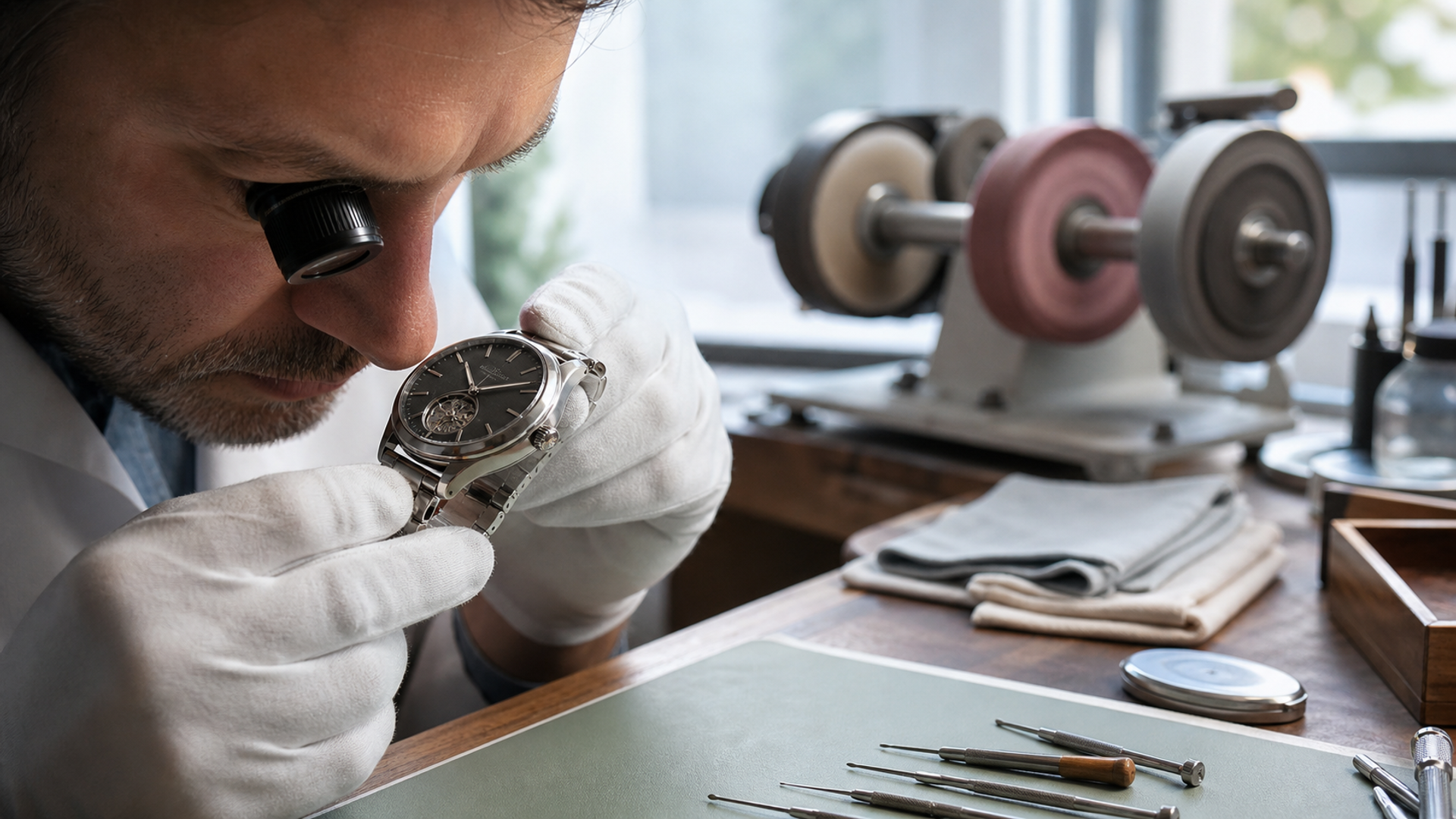
Polishing is not paint. To reduce a scratch, material around it must be removed until the surface reaches the depth of the mark. Satin brushing also changes a surface mechanically. Done well, a trained refinisher can reproduce the intended direction, contrast and transitions. Done aggressively, the process rounds edges and changes proportions.
Christie’s watch-care guidance warns that polishing can alter original finishes, remove metal and change bevels and lug symmetry. Sotheby’s condition guide similarly identifies proportions, lugs, hallmarks and original surface character as evidence collectors examine.
This matters because a watch case is a piece of design. The transition from polished flank to brushed top, the sharpness of a chamfer and the depth of a hallmark are part of its identity. A mirror finish everywhere may look shiny while being less faithful to the original object.
Service and refinishing are separate decisions
A mechanical watch may need movement service, seals, pressure testing or replacement of worn functional parts. None of those automatically requires cosmetic polishing.
Ask the service provider to separate the estimate into:
movement diagnosis and service;
water-resistance work;
mandatory safety or functional parts;
optional case and bracelet refinishing;
optional replacement of dial, hands, crown or bezel components.
Then approve each line individually. Write “no polishing or refinishing without further written approval” if preservation is the objective. Verbal instructions can disappear between intake desk and workshop.
Rolex’s official servicing procedure describes refinishing the case and bracelet according to original finishes as part of its full process. For a modern owner who wants the watch returned to manufacturer presentation, that may be desirable. A vintage collector may instead ask what can be omitted and which original parts can be retained. The brand’s functional standard and the collector’s originality standard are related but not identical goals.
Read the case before deciding
Photograph the watch before service in diffuse daylight. Capture the front, back, both flanks, all four lugs, crown guards, hallmarks, clasp and bracelet stretch. Use consistent angles and include a ruler or macro reference where useful.
Look for:
symmetrical lug thickness;
clear bevels or chamfers expected for the reference;
even brushing direction;
crisp transitions between brushed and polished surfaces;
legible hallmarks and serial/reference engravings;
crown-guard shape;
bezel profile;
previous waves, dips or rounded edges from machine work.
Do not diagnose originality from one photograph. Compare known strong examples of the same reference and production period. Case shapes evolve. A bevel expected on one generation may never have existed on another.
Our auction condition-report guide explains how to turn catalogue language into follow-up questions. For a watch already owned, the same discipline improves a service intake.
Metal changes the risk
Steel can tolerate skilled refinishing, but repeated work still changes geometry. Gold and platinum are softer and hallmarks can be especially vulnerable. Coated cases introduce another issue: polishing can remove or unevenly alter the coating. Titanium may use blasted, brushed or proprietary finishes that are difficult to reproduce outside the manufacturer.
Gem-set cases need specialist assessment. Polishing near settings can affect edges and the security or appearance of stones. A simple instruction to “make it look new” is not adequate for a complex case.
Ask the provider which machines, abrasives and finishing references will be used. A credible answer should be specific to the watch, not merely “our technician is experienced”.
Four ownership goals, four answers
1. Preserve a vintage collectible
Default to cleaning and mechanical conservation. Preserve original case geometry, dial, hands and period components where safe. If intervention is necessary, document it and use a specialist familiar with the reference.
2. Refresh a modern daily watch
Light manufacturer-standard refinishing can be reasonable if scratches reduce enjoyment and future collector value is secondary. Avoid making it an automatic part of every service; repeated polishing accumulates.
3. Repair significant damage
A deep impact, sharp gouge or distorted case may justify laser welding, case work or component replacement. This is restoration, not ordinary polishing. Request before-and-after documentation and understand how it will be disclosed at resale.
4. Prepare for sale
Do not assume shine increases price. For a collector watch, an unpolished case with honest wear may be more desirable than a freshly rounded one. Ask a reputable specialist to assess it before work. Disclose previous refinishing rather than using lighting to hide it.
The service-authorisation checklist
Before handing over the watch, record:
| Item | Required evidence |
|---|---|
| Current condition | Dated high-resolution photographs |
| Requested work | Line-by-line written authorisation |
| Prohibited work | “No polish”, dial work or part replacement as applicable |
| Parts policy | Whether removed original parts will be returned |
| Finish reference | Manufacturer specification or agreed example |
| Geometry limits | Hallmarks, bevels, lug symmetry and crown guards protected |
| Water resistance | Test standard and result after service |
| Documentation | Invoice, parts list, measurements and warranty |
Keep the final invoice with the watch. Our guide to pre-owned watch service records shows why a detailed record is more valuable than a generic “recently serviced” claim.
How to speak to the watchmaker
Replace “please tidy it up” with a precise brief:
> Service the movement and test water resistance. Do not polish, brush, lap, laser weld or refinish the case, bezel, caseback, clasp or bracelet without sending photographs and a written proposal. Do not replace the dial, hands, crown or bezel insert without approval. Return any replaced original parts where policy permits.
For a modern daily watch where refinishing is desired, specify the opposite with equal care: preserve hallmarks and geometry, reproduce the reference-correct transitions, and stop if removing a deep mark would materially change the shape.
Verdict
Do not polish a vintage, rare or notably crisp watch by default. Preserve evidence and get reference-specific advice. Consider restrained, documented refinishing for a modern daily wearer when personal enjoyment outweighs originality concerns and the provider can reproduce the intended geometry. Treat deep repair as restoration and disclose it.
The scratches are visible; removed metal is not. That is why the decision belongs to the owner before the watch reaches the polishing wheel.
When uncertain, pause the cosmetic work.
Document that choice.