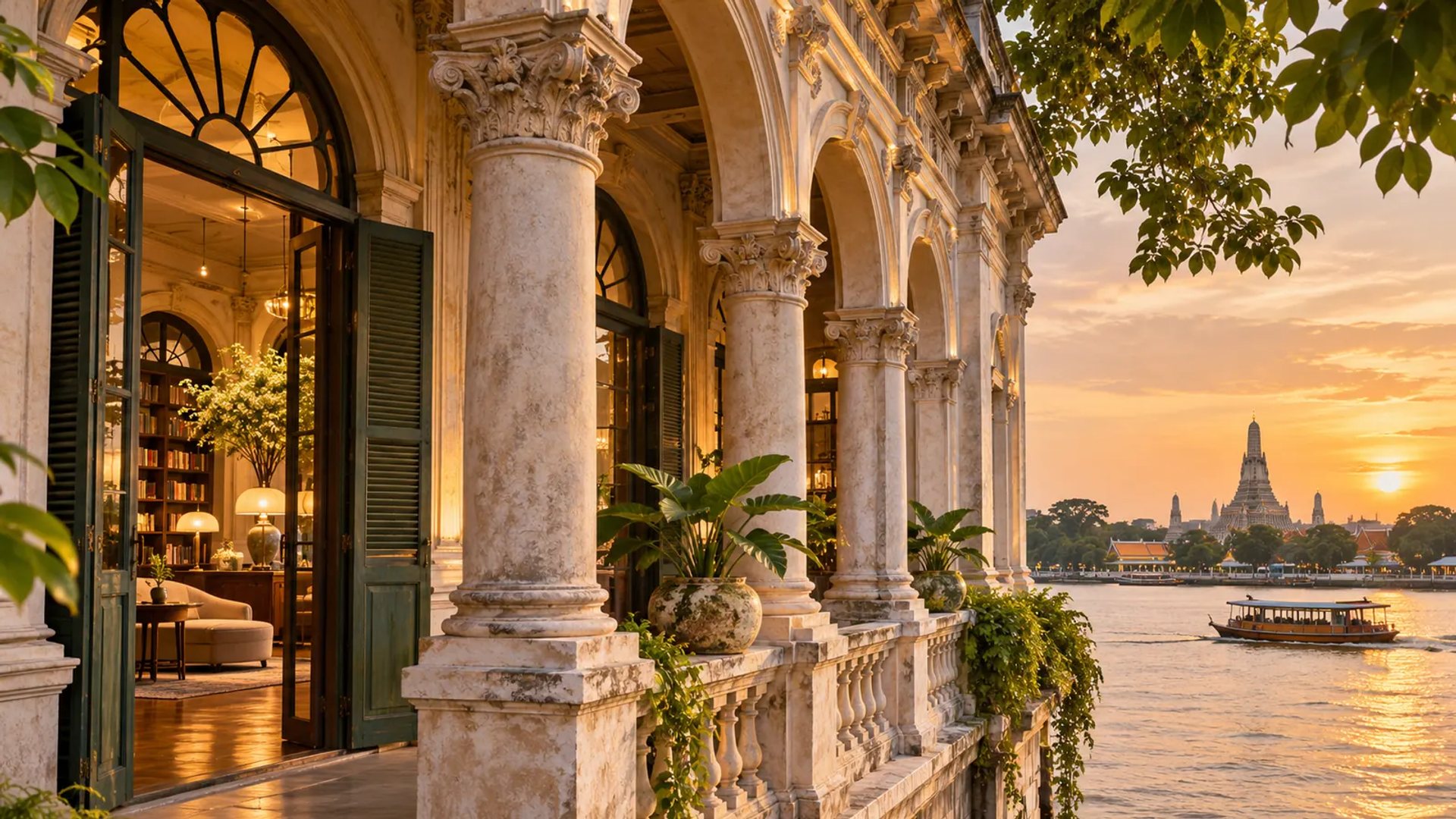
Langham Bangkok shows why restoring an old building can offer a luxury hotel something a new building cannot simply order: a specific address, a documented civic past and an architectural relationship with its city. The Langham, Custom House, Bangkok is taking reservations for stays from 20 December 2026; as of 23 November, it has not yet opened. Its conversion of the 1888 riverside Custom House is therefore a forthcoming example of adaptive reuse, rather than a hotel that can already be reviewed from a completed stay.
Key Takeaways
- The Langham project gives a historic Bangkok landmark a new public-facing hospitality use, with reservations beginning 20 December 2026.
- The official opening offer describes 60 guest rooms and 15 suites, a deliberately smaller scale than many new-build city hotels.
- Heritage creates value only when the restoration protects what is historically meaningful and the new use works well for guests.
- Prospective guests should check the room location, access arrangements and opening-stage services for their own dates.
What is the Langham Bangkok project?
The Langham, Custom House, Bangkok is a hotel project centred on the former Custom House beside the Chao Phraya River. The hotel’s official site describes the building as a former gateway to Thailand and states that reservations are open for stays from 20 December onward. Its inaugural offer dates the opening season from 20 December 2026 to 31 March 2027. Those dates matter: a preview of an imminent hotel should not be mistaken for a first-hand assessment of an operating one.
Completed in 1888, the historic complex has served purposes quite unlike modern hospitality. The hotel identifies the main Custom House and an early post office among the site’s components and says the property was designated a national monument in 2002. These are not decorative references invented for a lobby. They are part of the building’s recorded identity, and they create responsibilities for any new operator. The useful question is not whether an old façade looks appealing in photographs; it is how the building’s past shapes the guest’s present-day experience without being reduced to scenery.
Why restore rather than rebuild?
Restoration can keep a place-specific story in use. A new hotel can replicate columns, arches or vintage fittings, but it cannot acquire the original building’s position in Bangkok’s commercial history. The old Custom House was designed for a river-facing city in which movement of goods and people had a practical meaning. Converting it into a hotel changes its function while allowing visitors to encounter that geography. This is the central promise of adaptive reuse: continuity of place alongside a new working purpose.
That promise is conditional. Restoration may demand complex structural work, conservation decisions and compromises over service spaces. Guestrooms need contemporary ventilation, water systems, fire provisions and accessibility arrangements. A hotel also needs routes for staff and deliveries that do not turn every historic passage into a back-of-house corridor. The more valuable the surviving fabric, the more carefully the designer must decide what can be altered. A compelling heritage claim should therefore lead to questions about what was preserved, what was newly built and how the two connect.
There is a commercial reason too. When many luxury hotels offer similar polished interiors, a credible address can be difficult to copy. But historic character alone cannot substitute for sleep quality, privacy, quiet or service. A guest who books for the river view may care more about room orientation and sound than about a general claim of architectural significance. A successful restoration turns the story into a functioning stay, rather than asking guests to tolerate inconvenience as the price of authenticity.
What do the room numbers tell us?
Langham’s opening offer lists 60 guest rooms and 15 suites. Together, that is 75 accommodation units, and the breakdown gives a better sense of scale than the broad phrase “boutique hotel”. It suggests a relatively intimate property by the standards of a major international city, although the number by itself proves nothing about service quality. What matters is how the rooms are placed across the restored and newer parts of the complex, and whether guests understand what type of space they are reserving.
Before booking, compare the precise room description with the experience you want. A heritage-building room may appeal because of proportions or architectural details; a room in an adjoining structure may offer a different layout or more predictable technical infrastructure. Neither is automatically better. Ask whether the quoted room has a balcony, a river-facing aspect or a particular building location rather than inferring these from an image of the property. Hotel photography often highlights the most distinctive spaces, while a booking category may cover several layouts.
| Decision | What to verify | Why it matters |
|---|---|---|
| Arrival date | Whether your stay begins on or after 20 December 2026 | The hotel is taking future reservations, not describing an already completed stay |
| Room category | Building position, outlook, balcony and layout in the exact rate | Heritage and newly built spaces can offer different experiences |
| Access | Vehicle arrival, step-free route and luggage handling | Historic sites may have multiple entrances or level changes |
| Facilities | Which restaurants, spa or other services operate on your dates | Opening-stage service schedules may change |
| Terms | Cancellation, inclusions and taxes on the actual booking page | Editorial coverage is not a booking contract |
How can heritage become a real guest experience?
The best case is not a museum with beds. It is a sequence that lets a visitor understand the site while still moving easily through it. Arrival should make the riverfront setting legible; signs and routes should make the historical parts easy to find; staff should be able to explain what is original without delivering a rehearsed lecture. The building’s age can add texture to a meal or a short walk, but a guest should not need an architecture degree to enjoy the stay.
Service is particularly important because a restored building can have less standardised circulation than a tower designed around hotel operations. Personalised arrival and informed guidance can make a complicated site feel generous rather than confusing. The hotel describes a “Service Stylist” on its own website, yet the practical value of any service promise can only be judged once the hotel is operating. For now, treat the description as the operator’s plan, and ask directly about the elements that will affect your visit.
Bangkok also offers a wider context. The Custom House occupies a river location linked to trade and urban change, not an isolated resort landscape. A stay can be planned around nearby streets, ferry connections and the cultural life of the river. That makes the building an anchor for exploring the city, rather than a self-contained spectacle. Travellers who prefer to spend most of a trip inside a resort should weigh that difference when choosing between properties.
What should a responsible restoration preserve?
At minimum, a credible account of a heritage conversion should distinguish original fabric from reconstruction and contemporary additions. Original materials may need repair or protective treatment; replacement components should not silently erase the evidence of age. The design also has to respect the building’s public history. A former customs facility cannot be described as if it has always been a private residence or an aristocratic salon. Accuracy makes the story more interesting, because the actual work of a city is often richer than an invented romantic past.
Environmental claims need the same discipline. Reusing an existing structure can retain embodied materials, but no single heritage project should be declared automatically lower-carbon without a project-specific comparison of renovation work, new construction, operations and the building’s expected life. The most persuasive reason to care about this Bangkok conversion today is that a distinctive landmark may remain relevant and accessible through a viable new use. Any carbon figure would require its own independently described boundary and evidence.
How does the opening date change your planning?
An opening booking carries a different kind of uncertainty from a stay at an established hotel. On 23 November 2026, public information supports a planned first stay date of 20 December. It does not establish how a particular room, restaurant or service will perform in practice. If your visit is tied to an immovable celebration, confirm the booking directly and monitor official notices before travel. A flexible date offers more room to adjust if an opening schedule changes.
Request written confirmation for the elements that matter most: the room category, accessibility needs, transfer arrangements and any restaurant reservation. Keep the confirmation alongside the booking terms. This is a practical precaution for any new hotel, not a prediction that this project will be delayed. News of an opening can travel faster than operational details, and a guest’s requirements are always more specific than a press release.
What does the project say about luxury more broadly?
The Langham example suggests that contemporary luxury is often a matter of stewardship: choosing which parts of a place to carry forward, making the new work understandable and maintaining standards after the launch photographs have been taken. The 1888 date offers historical depth, but the harder achievement is to make the building useful in 2026 and beyond. A restored hotel succeeds when its story, service and physical setting reinforce one another.
That principle extends beyond hotels to objects and craft. Material provenance, repair decisions and the way a product ages can matter more than a quick impression of novelty. Yet a hotel conversion is not proof of any specific VERTU material, manufacturing technique or service entitlement. Readers interested in the brand’s own work should consult its current official site for product-specific details rather than treating an architectural analogy as a product claim.
Frequently asked questions
Is the Langham Bangkok open now?
Not as of 23 November 2026. The official hotel site accepts reservations for stays from 20 December 2026 onward, and its inaugural-season offer begins on that date. Check the hotel directly for changes before booking travel.
How many rooms will the hotel have?
The official opening offer specifies 60 guest rooms and 15 suites, or 75 accommodation units in total. Confirm the exact room category and building position when making a reservation.
Is the Bangkok Custom House an original historic building?
Yes. The project centres on the former Custom House, completed in 1888. The contemporary hotel conversion also incorporates new work, so ask the property which features in a particular space are original, restored or newly added.
Is a restored hotel always more sustainable than a new one?
No automatic conclusion follows from restoration alone. A meaningful environmental comparison would need to account for retained materials, construction interventions, operations and lifespan using a consistent boundary.
Conclusion
Langham Bangkok offers a timely case study in how an old building can gain a new role without losing its identity. The 1888 Custom House, 75 planned rooms and suites, and 20 December 2026 first-stay date are concrete facts; the quality of the finished guest experience remains to be seen. For a traveller, the sensible next step is to compare the exact room and opening-stage services with the trip they intend to take.
Sources and editorial scope
Hotel history, room count and booking dates come from The Langham’s Bangkok site and its opening offer. Observations on adaptive reuse are editorial analysis, not a first-hand hotel review or a measured environmental assessment.