

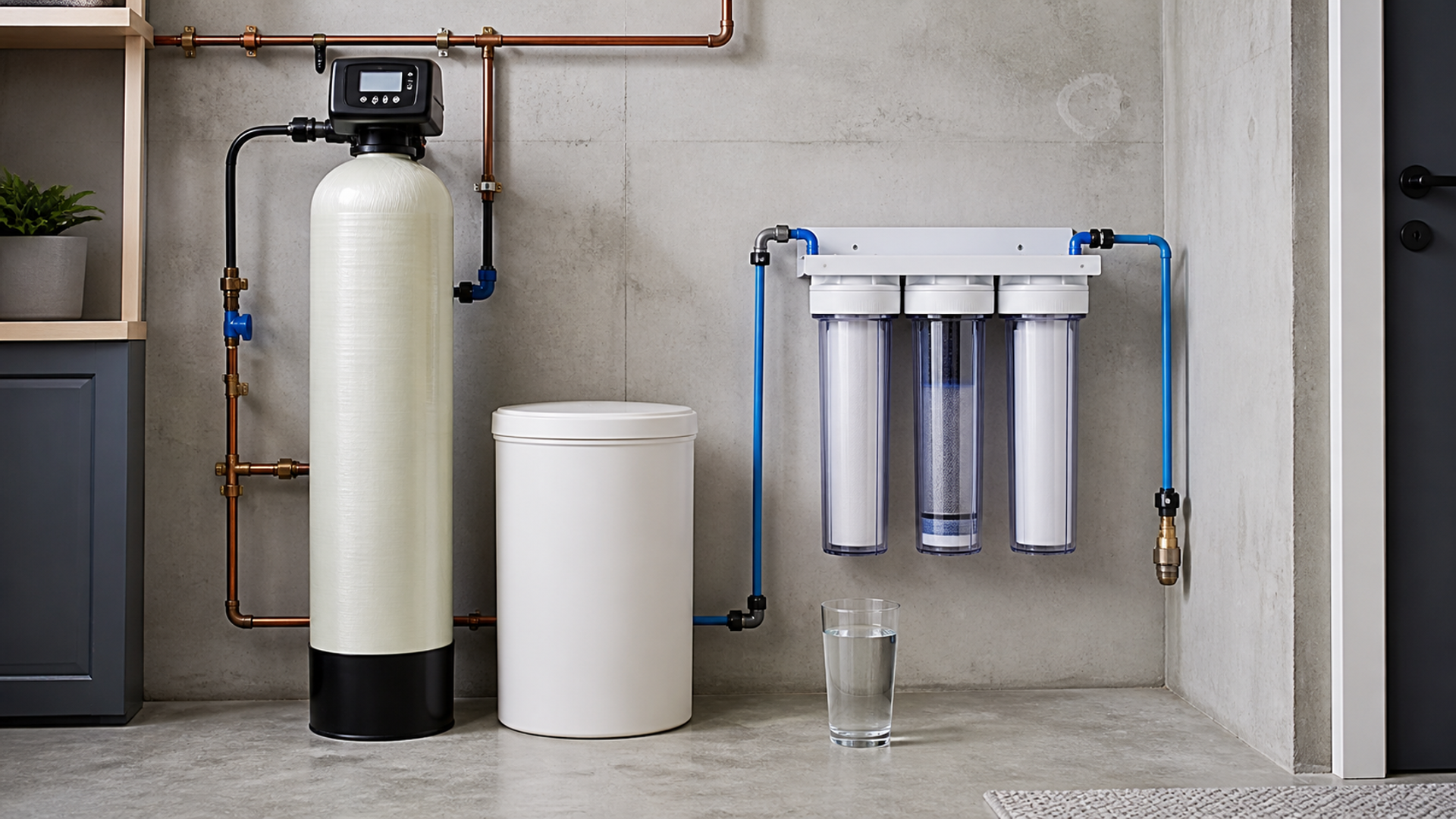
A water softener and a water filter solve different problems. A conventional ion-exchange softener reduces hardness minerals such as calcium and magnesium, which can limit scale and change soap performance. A filter is a broad category: sediment, activated carbon, reverse osmosis and other technologies target different substances and use points. Clear-looking water does not prove safety, and hard water does not automatically mean contaminated water. The decision starts with a current water report and a defined treatment claim.
Test the water before buying hardware
Choose a softener when measured hardness and scale are the target and the household accepts salt, regeneration and maintenance. Choose a certified filter when testing identifies a substance, taste or sediment problem that the exact system is certified to reduce. Use a combined treatment train only when testing proves both needs and a qualified design controls flow, waste, pressure, hygiene and servicing.
| Decision factor | Water softener | Water filter | Use a tested combined treatment train |
|---|---|---|---|
| Measured problem | Hardness exceeds the household's chosen threshold | A named substance or taste problem is verified | Treat both only from a real test |
| Treatment claim | Ion exchange addresses calcium and magnesium | Certified media address listed contaminants | Match every stage to a claim |
| Point of use | Whole-home scale control is desired | Drinking-water treatment may be sufficient | Split whole-home and tap treatment |
| Waste and consumables | Salt and regeneration water are planned | Cartridges, membranes or backwash are planned | Model annual operating cost |
| Health context | Sodium and local advice are reviewed | Microbiological or chemical risk gets expert advice | Do not self-design a safety-critical system |
| Verification | Retest hardness and appliance scale | Retest the target substance as appropriate | Keep service and test records |
This water softener vs water filter matrix is the article's working value object. Read the water softener vs water filter rows together: the decisive failure mode depends on this topic's evidence, operating context and reader objective.
Hardness and contaminants are separate targets
Evidence 1. NSF advises selecting home water treatment according to the specific substances or performance claims involved and recognised certification standards.
Evidence 2. The UK Drinking Water Inspectorate distinguishes filters from softeners and notes that softening changes hardness rather than broadly purifying water.
Evidence 3. Private wells and changing source conditions may require periodic laboratory testing beyond taste, smell or appearance.
Evidence 4. Installation, stagnation, bypass settings and overdue consumables can undermine a correctly chosen treatment technology.
Reader-visible sources checked for this article:
nsf.org — reader-visible current or official evidence
dwi.gov.uk — reader-visible current or official evidence
For water softener vs water filter, these sources establish only the claims inside their documented scope. Recheck every changeable specification, availability condition, price, policy or service term in the relevant market before acting.
Match certification to the stated claim
The decision changes at measured problem. Choose the first path only if hardness exceeds the household's chosen threshold; move to the second when a named substance or taste problem is verified; use the third when treat both only from a real test. Save the downside that would make this row fail.
For treatment claim, the first route works when ion exchange addresses calcium and magnesium; the second requires certified media address listed contaminants. The control for the third is match every stage to a claim. Verify this row against the exact product, property, account or environment before it can reverse the decision.
The point of use row exposes a practical boundary. Route one assumes whole-home scale control is desired, while route two is defensible only when drinking-water treatment may be sufficient. Route three depends on split whole-home and tap treatment. If that evidence is absent, keep the more reversible option.
Read waste and consumables as a stop/go test: salt and regeneration water are planned supports the first option; cartridges, membranes or backwash are planned supports the second; and model annual operating cost supports the third. Record which source proves the condition and when it was checked.
A buyer can resolve health context without starting from a brand preference. Ask whether sodium and local advice are reviewed; compare that with whether microbiological or chemical risk gets expert advice; then use do not self-design a safety-critical system as the third route's safeguard. An unknown condition stays unknown.
On verification, popularity is not enough. The evidence for option one is that retest hardness and appliance scale. Option two means retest the target substance as appropriate. Option three is rational where keep service and test records. Recheck any changeable term immediately before commitment.
Facts that would reverse the current choice
Reversal control 1 — Measured problem. Before choosing Water softener, write down how the decision changes if “Hardness exceeds the household's chosen threshold” proves false. Do the same for Water filter and “A named substance or taste problem is verified”. Keep the Use a tested combined treatment train route available until “Treat both only from a real test” is verified. This control belongs to water softener vs water filter; update it from the cited source or exact supplier rather than copying a generic checklist.
Reversal control 2 — Treatment claim. Before choosing Water softener, write down how the decision changes if “Ion exchange addresses calcium and magnesium” proves false. Do the same for Water filter and “Certified media address listed contaminants”. Keep the Use a tested combined treatment train route available until “Match every stage to a claim” is verified. This control belongs to water softener vs water filter; update it from the cited source or exact supplier rather than copying a generic checklist.
Reversal control 3 — Point of use. Before choosing Water softener, write down how the decision changes if “Whole-home scale control is desired” proves false. Do the same for Water filter and “Drinking-water treatment may be sufficient”. Keep the Use a tested combined treatment train route available until “Split whole-home and tap treatment” is verified. This control belongs to water softener vs water filter; update it from the cited source or exact supplier rather than copying a generic checklist.
Reversal control 4 — Waste and consumables. Before choosing Water softener, write down how the decision changes if “Salt and regeneration water are planned” proves false. Do the same for Water filter and “Cartridges, membranes or backwash are planned”. Keep the Use a tested combined treatment train route available until “Model annual operating cost” is verified. This control belongs to water softener vs water filter; update it from the cited source or exact supplier rather than copying a generic checklist.
Reversal control 5 — Health context. Before choosing Water softener, write down how the decision changes if “Sodium and local advice are reviewed” proves false. Do the same for Water filter and “Microbiological or chemical risk gets expert advice”. Keep the Use a tested combined treatment train route available until “Do not self-design a safety-critical system” is verified. This control belongs to water softener vs water filter; update it from the cited source or exact supplier rather than copying a generic checklist.
Reversal control 6 — Verification. Before choosing Water softener, write down how the decision changes if “Retest hardness and appliance scale” proves false. Do the same for Water filter and “Retest the target substance as appropriate”. Keep the Use a tested combined treatment train route available until “Keep service and test records” is verified. This control belongs to water softener vs water filter; update it from the cited source or exact supplier rather than copying a generic checklist.
Build the baseline
Obtain the utility report or an accredited laboratory test appropriate to the supply. Record hardness, named contaminants, sampling point, date and any plumbing-specific concern. Record the exact product, material, room, garment, vehicle, water report or operating condition and the time of the check. Separate observed behaviour from marketing language, and repeat the comparison in the intended setting rather than an ideal demonstration. If there is no measured target, do not let a salesperson define one from a countertop demonstration. Preserve the evidence that would reverse the choice: a change in fit, specification, maintenance, safety, price or environment must reopen the decision rather than inherit an old conclusion.
Match certification
Read the exact model's certified reduction claims, flow, capacity and test conditions. Separate material-safety certification from contaminant-reduction performance and confirm replacement intervals. Record the exact product, material, room, garment, vehicle, water report or operating condition and the time of the check. Separate observed behaviour from marketing language, and repeat the comparison in the intended setting rather than an ideal demonstration. If the certificate does not name the target, the filter cannot earn credit for it. Preserve the evidence that would reverse the choice: a change in fit, specification, maintenance, safety, price or environment must reopen the decision rather than inherit an old conclusion.
Design the installation
Map incoming pressure, drain, bypass, power, waste route, drinking taps and appliance connections. Use a competent installer where plumbing, hygiene or local rules require it and prevent cross-connections. Record the exact product, material, room, garment, vehicle, water report or operating condition and the time of the check. Separate observed behaviour from marketing language, and repeat the comparison in the intended setting rather than an ideal demonstration. If the system creates unacceptable pressure loss or hygiene risk, redesign it. Preserve the evidence that would reverse the choice: a change in fit, specification, maintenance, safety, price or environment must reopen the decision rather than inherit an old conclusion.
Operate and verify
Schedule salt, sanitisation, cartridge changes, leak checks and follow-up tests. Log water use and calculate consumables, regeneration and waste over a full year. Record the exact product, material, room, garment, vehicle, water report or operating condition and the time of the check. Separate observed behaviour from marketing language, and repeat the comparison in the intended setting rather than an ideal demonstration. If results do not improve the target metric, service or replace the system rather than adding unproven stages. Preserve the evidence that would reverse the choice: a change in fit, specification, maintenance, safety, price or environment must reopen the decision rather than inherit an old conclusion.
Three homes, three answers
Visible limescale with compliant municipal water
A correctly sized softener may address the actual problem. Define the fact that would reverse this recommendation before committing.
Chlorine taste at one drinking tap
A certified point-of-use carbon filter may be enough. Define the fact that would reverse this recommendation before committing.
Private well with hardness and a verified contaminant
A professionally designed multi-stage system and retesting are appropriate. Define the fact that would reverse this recommendation before committing.
Action checklist
Get water report.
Define target.
Use accredited test.
Match certification.
Size flow.
Plan drainage.
Price consumables.
Prevent stagnation.
Retest outcome.
Keep service log.
Continue the decision
The linked VERTU articles expand adjacent parts of the water softener vs water filter decision. They do not substitute for the external evidence above.
The softener-versus-filter verdict
Choose a softener when measured hardness and scale are the target and the household accepts salt, regeneration and maintenance. Choose a certified filter when testing identifies a substance, taste or sediment problem that the exact system is certified to reduce. Use a combined treatment train only when testing proves both needs and a qualified design controls flow, waste, pressure, hygiene and servicing.
Keep the water softener vs water filter decision reversible until its material cost, safety, access, privacy and compatibility facts are verified. Unknown evidence stays unknown; it is never silently scored as favourable.
![How to Scan Receipts and Documents with Your Phone [Full Guide]](https://cdn.sanity.io/images/e0gp1l2g/production/0db13feec1d5e72b8a8a5f976d1f3e86619c9228-3840x1860.webp?w=180&h=180&q=78&auto=format&fit=crop)
![How to Scan Receipts and Documents with Your Phone [Full Guide]](https://cdn.sanity.io/images/e0gp1l2g/production/0db13feec1d5e72b8a8a5f976d1f3e86619c9228-3840x1860.webp?w=800&h=450&q=82&auto=format&fit=crop)
![Top 10 Two-Tone Carbon-Fibre Watches for Men [2026 List]](https://cdn.sanity.io/images/e0gp1l2g/production/18870799ba33fab0e038968359cd5772d7d7db30-1024x576.webp?w=800&h=450&q=82&auto=format&fit=crop)
![Top 10 Luxury Watches with Digital Complication Displays for Men [Latest]](https://cdn.sanity.io/images/e0gp1l2g/production/c4f6bf8c080f291c39f7cc85c7344ecff2fd3799-1024x553.webp?w=800&h=450&q=82&auto=format&fit=crop)