An air purifier is a fan, filter and operating schedule matched to a particular room. Maximum-area claims can obscure the speed, noise and air-change rate behind the number. Blueair Classic Pro CP7i, Dyson Big+Quiet and IQAir HealthPro Plus suit different priorities, but none replaces source control or appropriate ventilation.
The short answer by room and pollutant
Choose Blueair CP7i when strong published CADR and a conventional high-throughput room purifier fit; Dyson Big+Quiet when whole-room air movement, sensing and form factor matter alongside particle filtration; and IQAir HealthPro Plus when a staged filtration system and specialist replacement-filter route justify the size and cost. Size the unit using smoke CADR and room volume, then check noise and filter cost at the speed you will actually run.
| Decision factor | Blueair CP7i | Dyson Big+Quiet | IQAir HealthPro Plus |
|---|---|---|---|
| Primary goal | High particle clean-air delivery is central | Air projection, sensing and quieter design matter | Staged specialist filtration is preferred |
| Room sizing | Verified CADR meets the target air-change rate | Model airflow and tested room plan meet the target | Selected fan speed meets room-volume needs |
| Noise | Usable speed is acceptable during occupancy | Low-speed operation and placement suit living areas | Noise at required airflow suits the room |
| Filter ownership | Replacement cost and availability are acceptable | Combined filter and service route are acceptable | Multiple filter stages and schedules are manageable |
| Placement | Clear intake and outlet space is available | Projection path and footprint fit the room | Large cabinet and unrestricted airflow fit |
| Evidence | AHAM-style particle metrics answer the goal | Feature set is interpreted within published scope | Manufacturer airflow and filter data are verified |
This best air purifiers 2026 matrix is the article's working value object. Read the best air purifiers 2026 rows together: the decisive failure mode depends on this topic's evidence, operating context and reader objective.
What CADR and official guidance establish
Evidence 1. The US Environmental Protection Agency advises that portable air cleaners can reduce airborne particles when correctly sized and operated, but they do not remove every pollutant and do not replace source control or ventilation where appropriate.
Evidence 2. AHAM's air-filtration standards explain Clean Air Delivery Rate as a combined measure of removal performance and airflow, enabling like-for-like particle comparisons when the pollutant and test basis match.
Evidence 3. Blueair's US CP7i page publishes pollen, dust and smoke CADR plus a noise range and recommended-room framing; the smoke CADR is the conservative starting point for particle sizing.
Evidence 4. Dyson and IQAir describe different airflow, sensing and filter architectures, so claims about formaldehyde, gases or particles must stay within the exact model's documented filter and test scope.
Reader-visible sources checked for this article:
epa.gov — reader-visible current or official evidence
ahamverifide.org — reader-visible current or official evidence
blueair.com — reader-visible current or official evidence
dyson.com — reader-visible current or official evidence
iqair.com — reader-visible current or official evidence
For best air purifiers 2026, these sources establish only the claims inside their documented scope. Recheck every changeable specification, availability condition, price, policy or service term in the relevant market before acting.
Size for clean-air delivery, not floor area alone
The primary goal row exposes a practical boundary. Route one assumes high particle clean-air delivery is central, while route two is defensible only when air projection, sensing and quieter design matter. Route three depends on staged specialist filtration is preferred. If that evidence is absent, keep the more reversible option.
Read room sizing as a stop/go test: verified CADR meets the target air-change rate supports the first option; model airflow and tested room plan meet the target supports the second; and selected fan speed meets room-volume needs supports the third. Record which source proves the condition and when it was checked.
A buyer can resolve noise without starting from a brand preference. Ask whether usable speed is acceptable during occupancy; compare that with whether low-speed operation and placement suit living areas; then use noise at required airflow suits the room as the third route's safeguard. An unknown condition stays unknown.
On filter ownership, popularity is not enough. The evidence for option one is that replacement cost and availability are acceptable. Option two means combined filter and service route are acceptable. Option three is rational where multiple filter stages and schedules are manageable. Recheck any changeable term immediately before commitment.
The decision changes at placement. Choose the first path only if clear intake and outlet space is available; move to the second when projection path and footprint fit the room; use the third when large cabinet and unrestricted airflow fit. Save the downside that would make this row fail.
For evidence, the first route works when aHAM-style particle metrics answer the goal; the second requires feature set is interpreted within published scope. The control for the third is manufacturer airflow and filter data are verified. Verify this row against the exact product, property, account or environment before it can reverse the decision.
Facts that would reverse the current choice
Reversal control 1 — Primary goal. Before choosing Blueair CP7i, write down how the decision changes if “High particle clean-air delivery is central” proves false. Do the same for Dyson Big+Quiet and “Air projection, sensing and quieter design matter”. Keep the IQAir HealthPro Plus route available until “Staged specialist filtration is preferred” is verified. This control belongs to best air purifiers 2026; update it from the cited source or exact supplier rather than copying a generic checklist.
Reversal control 2 — Room sizing. Before choosing Blueair CP7i, write down how the decision changes if “Verified CADR meets the target air-change rate” proves false. Do the same for Dyson Big+Quiet and “Model airflow and tested room plan meet the target”. Keep the IQAir HealthPro Plus route available until “Selected fan speed meets room-volume needs” is verified. This control belongs to best air purifiers 2026; update it from the cited source or exact supplier rather than copying a generic checklist.
Reversal control 3 — Noise. Before choosing Blueair CP7i, write down how the decision changes if “Usable speed is acceptable during occupancy” proves false. Do the same for Dyson Big+Quiet and “Low-speed operation and placement suit living areas”. Keep the IQAir HealthPro Plus route available until “Noise at required airflow suits the room” is verified. This control belongs to best air purifiers 2026; update it from the cited source or exact supplier rather than copying a generic checklist.
Reversal control 4 — Filter ownership. Before choosing Blueair CP7i, write down how the decision changes if “Replacement cost and availability are acceptable” proves false. Do the same for Dyson Big+Quiet and “Combined filter and service route are acceptable”. Keep the IQAir HealthPro Plus route available until “Multiple filter stages and schedules are manageable” is verified. This control belongs to best air purifiers 2026; update it from the cited source or exact supplier rather than copying a generic checklist.
Reversal control 5 — Placement. Before choosing Blueair CP7i, write down how the decision changes if “Clear intake and outlet space is available” proves false. Do the same for Dyson Big+Quiet and “Projection path and footprint fit the room”. Keep the IQAir HealthPro Plus route available until “Large cabinet and unrestricted airflow fit” is verified. This control belongs to best air purifiers 2026; update it from the cited source or exact supplier rather than copying a generic checklist.
Reversal control 6 — Evidence. Before choosing Blueair CP7i, write down how the decision changes if “AHAM-style particle metrics answer the goal” proves false. Do the same for Dyson Big+Quiet and “Feature set is interpreted within published scope”. Keep the IQAir HealthPro Plus route available until “Manufacturer airflow and filter data are verified” is verified. This control belongs to best air purifiers 2026; update it from the cited source or exact supplier rather than copying a generic checklist.
Calculate the target clean-air delivery
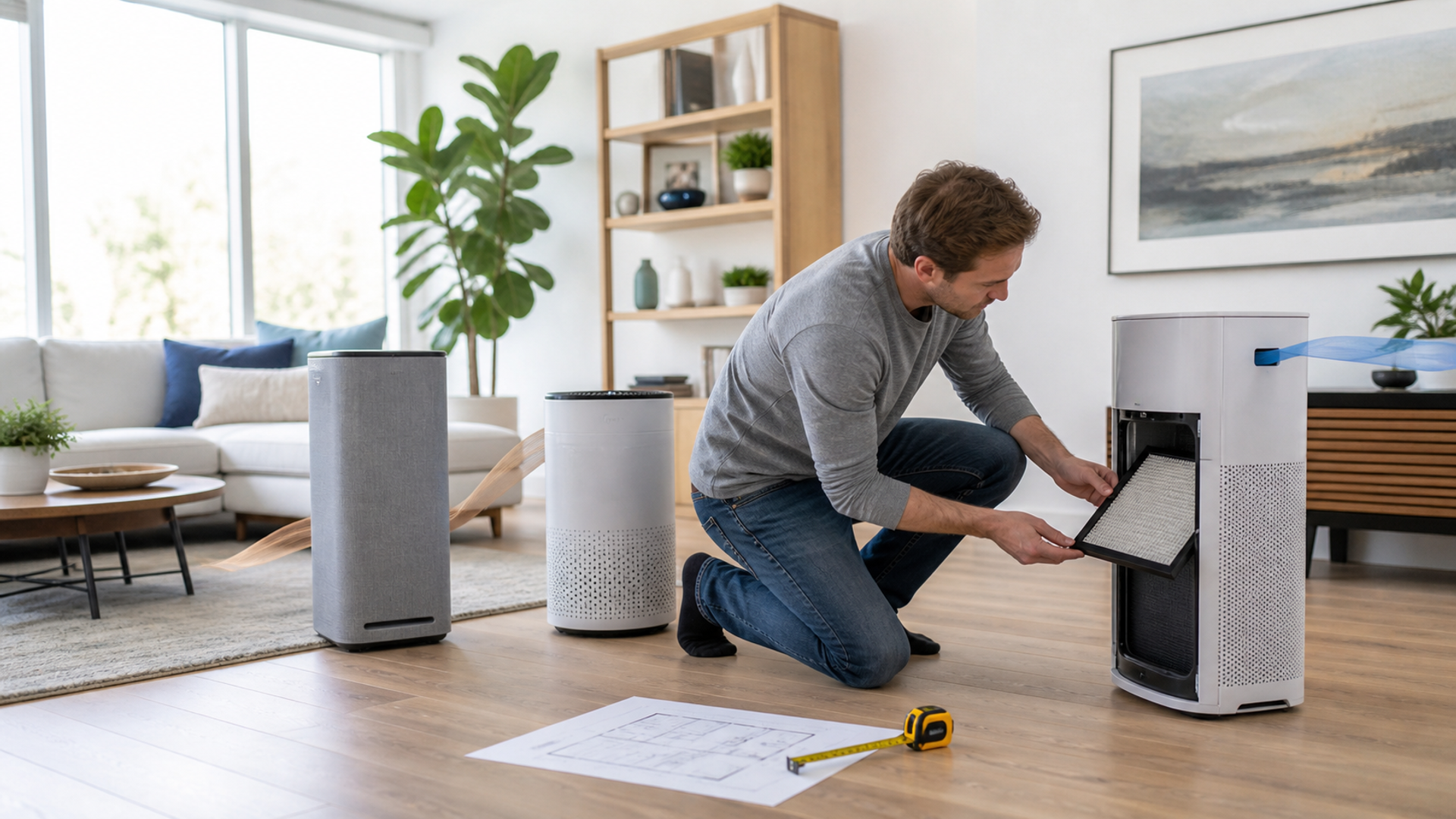
Measure room length, width and ceiling height. Choose a target air-change rate appropriate to the goal, then convert it into clean-air delivery per hour. Compare that requirement with the relevant CADR, usually smoke for fine-particle sizing, while keeping units consistent. Open plans, tall ceilings and communicating rooms need more than a simple floor-area label. If the required speed is too noisy, use a larger unit at a lower speed or more than one well-placed unit.
Separate particles from gases
HEPA-style particle filtration can address dust, pollen and smoke particles within its performance range, while odours and gases require suitable sorbent media and enough contact time. No single consumer specification proves removal of every volatile compound. Identify the source first: cooking, wildfire smoke, renovation, pets or an outdoor event. Reduce or isolate the source and ventilate safely where possible before expecting a portable purifier to solve the whole problem.
Price five years of filters and electricity
Find the current replacement-filter price and interval for the market, then adjust for local pollution and operating hours. Add electricity at the expected fan speed. A lower purchase price can become expensive if filters are scarce or the household delays replacement. Record the filter model, order source and change date. Avoid unofficial filters unless their fit, pressure drop and performance are independently established.
Place and operate it as a system
Keep intakes and outlets clear of walls, curtains and furniture, and avoid hiding a unit where its airflow short-circuits. Run the purifier long enough to maintain clean air rather than only after a sensor changes colour. Close windows during severe outdoor smoke when public-health guidance supports doing so, but manage carbon dioxide and other indoor sources separately. Clean pre-filters and sensors according to instructions and reassess after moving furniture.
Three rooms that need different purifiers
A large living room focused on particles
Blueair CP7i may lead when its verified smoke CADR meets the room-volume target at an acceptable noise level. Filter price and physical placement should be confirmed before purchase. Define the fact that would reverse this recommendation before committing.
A design-sensitive open living area
Dyson Big+Quiet can fit when projection, sensing and form factor matter, but the buyer should compare particle performance and filter ownership against the room's calculated requirement rather than a visual preference alone. Define the fact that would reverse this recommendation before committing.
A bedroom needing specialist filtration
IQAir HealthPro Plus may suit a user who accepts the larger cabinet and staged filter costs. The required airflow must be tested at night because a high specification at an unused noisy speed provides little practical benefit. Define the fact that would reverse this recommendation before committing.
Action checklist
Measure room volume rather than floor area alone.
Define whether particles, gases or both are the target.
Calculate the required clean-air delivery.
Compare smoke CADR on a consistent basis.
Check noise at the fan speed you will use.
Price replacement filters for five years.
Verify filter availability in the destination market.
Plan unobstructed intake and outlet placement.
Use source control and ventilation where appropriate.
Record filter, pre-filter and sensor maintenance.
Continue the decision
The linked VERTU articles expand adjacent parts of the best air purifiers 2026 decision. They do not substitute for the external evidence above.
The air-purifier verdict
Choose Blueair CP7i when strong published CADR and a conventional high-throughput room purifier fit; Dyson Big+Quiet when whole-room air movement, sensing and form factor matter alongside particle filtration; and IQAir HealthPro Plus when a staged filtration system and specialist replacement-filter route justify the size and cost. Size the unit using smoke CADR and room volume, then check noise and filter cost at the speed you will actually run.
Keep the best air purifiers 2026 decision reversible until its material cost, safety, access, privacy and compatibility facts are verified. Unknown evidence stays unknown; it is never silently scored as favourable.