

-1axvohqw.webp)
- Aviation ThresholdThe 100 Watt-hour (Wh) mark is the gold standard for global air travel. Power banks rated under 100Wh (typically up to ~27,000mAh at 3.7V) are permitted in carry-on baggage on commercial flights without prior airline approval.
- Carry-On StrictnessLithium-ion power banks are strictly prohibited in checked luggage. If your carry-on bag is gate-checked, your battery pack must be removed and kept with you in the cabin.
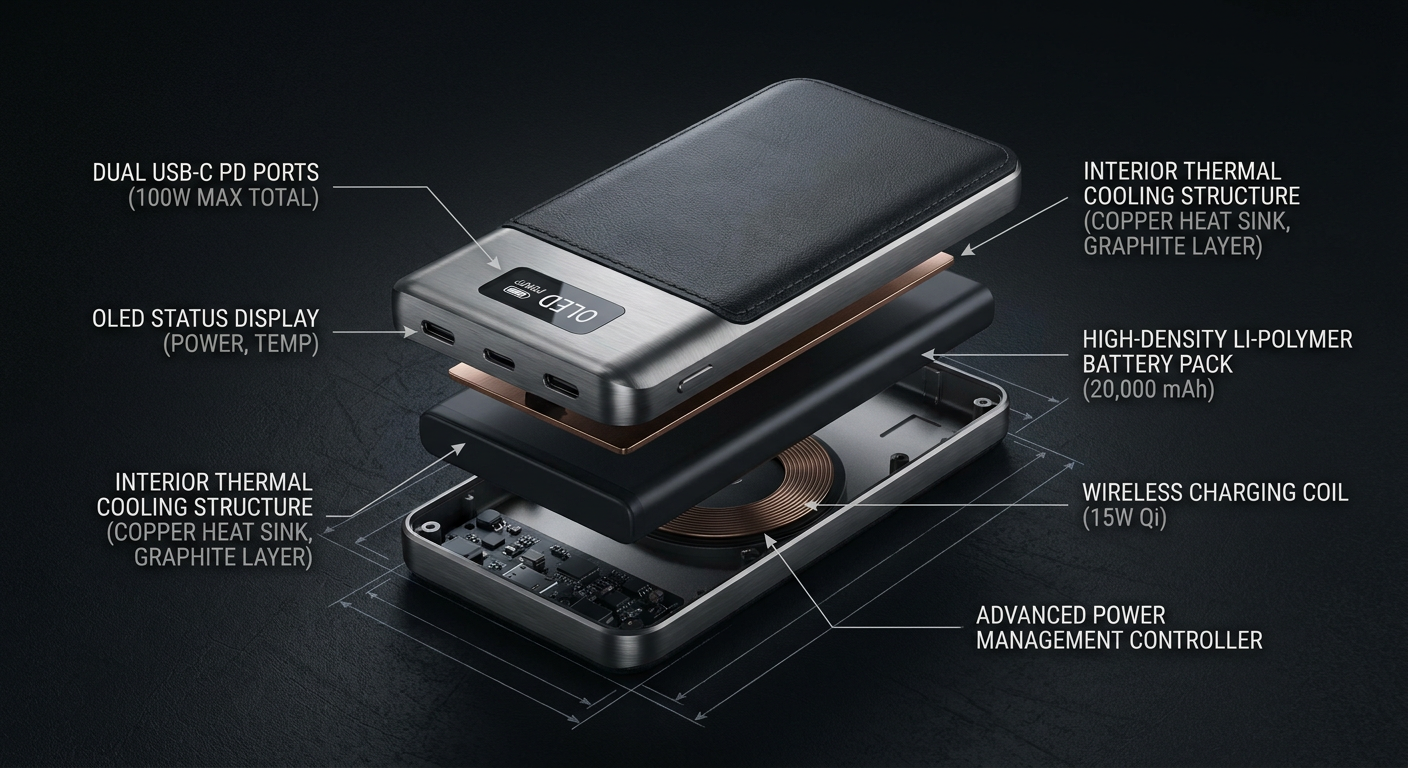
- Executive CraftsmanshipTrue luxury power banks distinguish themselves through aircraft-grade titanium chassis, supple hand-stitched leathers, real-time OLED telemetry, multi-stage thermal dissipation, and bi-directional USB-C PD 3.1 fast charging up to 140W.
- Bespoke EcosystemBeyond hardware specs, premium travel tech integrates white-glove concierge support, hardware-level encryption, and tailor-made personalization for high-net-worth jet-setters.
Introduction
For the modern executive, international air travel in 2026 demands absolute reliability. Stepping onto a long-haul flight from New York to London or Singapore with a depleted laptop or phone is a productivity risk no leader can afford. Yet, cheap plastic battery packs often overheat, lack sufficient wattage for high-performance laptops, and look completely out of place sitting beside a Rimowa cabin bag or a bespoke leather briefcase.
Choosing an executive portable charger involves balancing uncompromised output power with strict international aviation compliance. Air travel security agencies have tightened enforcement surrounding lithium-ion batteries. Knowing the exact regulatory threshold before boarding ensures your departure remains seamless and stress-free.
The magic threshold for effortless global travel is under 100 Watt-hours (Wh). This guide provides a curated selection of the finest luxury power banks under 100Wh, examining the engineering, materials, and airline compliance rules that ensure you fly with complete confidence.
Travel rules that matter
FAA/TSA thresholds at a glance
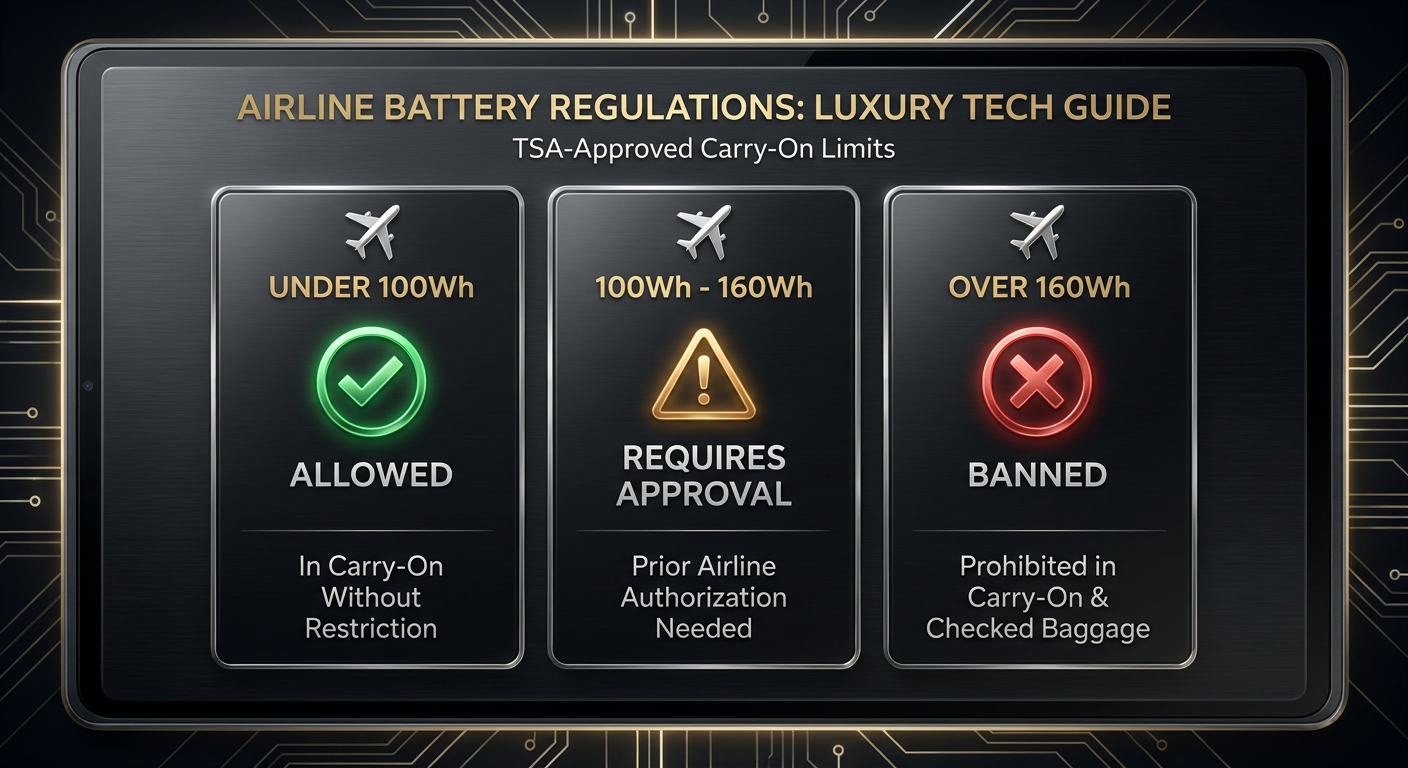
Aviation security standards governed by the FAA PackSafe Lithium Battery Guidelines and TSA Portable Charger Rules categorize portable lithium-ion batteries by their total energy capacity expressed in Watt-hours (Wh).
The compliance rules are divided into three distinct tiers:
- Under 100Wh (Up to ~27,000mAh)Unrestricted for personal use in carry-on luggage. No prior notification or airline approval is needed.
- 100Wh to 160Wh (~27,000mAh to 43,200mAh)Permitted in carry-on luggage only with explicit airline approval prior to boarding. Most carriers limit passengers to a maximum of two spare batteries in this category.
- Over 160Wh (>43,200mAh)Completely prohibited on commercial passenger aircraft.
Carry-on only, storage, and quantity nuances
A fundamental rule enforced by TSA screening officers globally is that spare lithium-ion power banks must remain in carry-on baggage. They are strictly forbidden in checked cargo holds due to the risk of undetected thermal runaway fires.
If airline staff require you to gate-check your carry-on roller bag on a full flight, you must immediately remove all power banks and carry them into the passenger cabin. Furthermore, major carriers in 2026 prohibit passengers from recharging power banks from in-seat AC outlets while airborne, reinforcing the necessity of arriving at the airport with your battery fully charged.
Verifying watt-hours on labels and specs
Screening officers at international hubs do not rely on marketing claims or total milliamp-hour (mAh) numbers printed on retail packaging. They inspect the physical casing of the power bank for a clearly legible Wh rating. If a battery pack lacks a factory-stamped Wh rating or if the label has worn off through extended use, security personnel retain the authority to confiscate the device.
What makes it luxury
Materials and craftsmanship cues
Mass-market power banks rely heavily on painted plastic enclosures that scratch easily and trap heat during heavy discharge cycles. In contrast, luxury power banks utilize materials engineered for durability, tactile satisfaction, and optimal thermal management.
- Aerospace-Grade MetalsAnodized aluminum and brushed titanium alloys provide structural rigidity and serve as passive heat sinks, drawing heat away from internal battery cells.
- Hand-Selected LeathersPremium power banks frequently feature accents crafted from full-grain calfskin or exotic leathers, mirroring the aesthetic of high-end travel accessories.
- Sapphire Crystal & Smoked GlassHigh-transparency windows and scratch-resistant sapphire crystal overlays protect integrated digital telemetry screens and internal circuitry.
Charging tech: USB-C PD/PPS, Qi2/MagSafe
A luxury portable charger must match the sophisticated power requirements of modern executive hardware:
- USB-C Power Delivery 3.1 (EPR)Delivers single-port outputs of 100W to 140W, capable of fast-charging a 16-inch MacBook Pro or high-performance flagship laptop to 50% in approximately 30 minutes.
- Programmable Power Supply (PPS)Dynamically adjusts voltage and current in real time to optimize efficiency and minimize heat accumulation in connected devices.
- Qi2 & MagSafe AlignmentMagnetic wireless charging pads delivering 15W of cable-free output with active magnetic locking to hold smartphones securely in place during turbulence.
Safety and certifications that signal quality
High-output power banks pack immense energy density into compact enclosures. Premium manufacturers subject their power banks to rigorous independent testing and safety certifications, including UN38.3 (UN transportation safety testing for lithium batteries), UL2056 / UL1973, and CE/FCC compliance. Multi-point thermal sensors continuously monitor core temperatures, automatically throttling current if ambient cabin conditions rise.
Editor’s picks under 100Wh
Compact magnetic daily carry (10,000mAh class)
Ideal for short business trips, daily commutes, and in-flight smartphone top-ups.
- Capacity & Energy~10,000mAh / 36Wh to 38.5Wh
- Maximum Output30W USB-C PD wired + 15W Qi2 wireless
- Build & ErgonomicsUltra-slim anodized aluminum chassis paired with a tactile leather rear grip. Fits comfortably behind your phone without blocking camera lenses.
- Travel AdvantageWeighing under 250 grams, this compact daily carry easily slides into a suit jacket pocket or leather portfolio while guaranteeing a full phone recharge during transit.
Executive laptop-ready brick (~20,000–26,000mAh)
The quintessential workhorse for long-haul flight productivity.
- Capacity & Energy~24,000mAh to 25,600mAh / 86.4Wh to 94.7Wh
- Maximum Output140W single-port USB-C PD 3.1 (Bi-directional)
- Build & ErgonomicsHeavy-gauge matte metal enclosure with reinforced corner bumpers and anti-slip silicone footings for stable desk placement.
- Travel AdvantageSits safely below the 100Wh limit while providing enough reserve capacity to fully recharge a 16-inch laptop and a smartphone simultaneously at 35,000 feet.
Display-forward multi-port powerhouse
Engineered for executives managing complex multi-device ecosystems.
- Capacity & Energy~27,000mAh / ~99.9Wh (Precision engineered to sit exactly 0.1Wh below the 100Wh threshold)
- Maximum Output200W–250W combined multi-port output
- Build & ErgonomicsTransparent dark-tinted glass panel revealing gold-plated circuit traces, paired with a high-contrast color OLED display showing real-time voltage, current, wattage, temperature, and battery health cycles.
- Travel AdvantageAllows simultaneous rapid charging of a laptop, tablet, and smartphone without triggering thermal throttling.
How to read the specs like a pro
Wh vs mAh: the conversion that matters
Many travelers evaluate battery packs purely by their milliamp-hour (mAh) figure, but Watt-hours (Wh) represent the true measure of stored electrical energy. The mathematical conversion formula is:
Wh = mAh × Nominal Voltage (V)/1000
Standard lithium-ion battery cells operate at an internal nominal voltage of 3.7 Volts. Applying this formula illustrates why 27,000mAh is the safe benchmark:
Wh = 27,027 × 3.7/1000 ≈ 100.00 Wh
Therefore, any portable battery rated at or below 27,000mAh using standard 3.7V chemistry will safely fall within the 100Wh TSA allowance.
Output and input: watts, ports, and pass-through
Understanding electrical output terminology prevents slow charging frustration:
- Single-Port Max WattageThe maximum power a single USB-C port can deliver. Laptops require at least 65W to 140W for rapid charging.
- Combined Total OutputThe aggregate power distributed across all active ports. A charger advertised as "150W Total" might split into 100W + 30W + 20W across three ports.
- Pass-Through ChargingAdvanced power management that allows the power bank to recharge itself from a wall outlet while simultaneously supplying clean, regulated power to connected devices.
Self-recharge speed, displays, and thermal design
A large 25,000mAh battery pack can take over six hours to recharge if limited to standard 18W input. Premium luxury chargers support 100W+ fast input recharging, replenishing from zero to 80% capacity in approximately 30 minutes during a quick airport lounge layover. High-resolution OLED telemetry displays provide real-time visibility into exact recharge duration and operating cell temperatures.
Concierge-level ownership and personalization
Warranty, service, and travel support signals
Purchasing luxury tech is an investment in long-term reliability and dedicated service. Leading brands back their travel hardware with extended global warranties, express advance-replacement programs for traveling executives, and dedicated customer support helplines.
Personalization, materials, and gift-ready packaging
For corporate gifting or personal distinction, bespoke options elevate travel hardware into a refined lifestyle accessory. Laser-engraved monograms, custom colorways, custom-stitched leather sheaths, and heavy-gauge presentation boxes make premium power banks ideal gifts for board members and frequent travelers.
Brand integration opportunity
In the realm of mobile luxury, few brands understand the synergy between handcrafted heritage and secure tech like VERTU.
Originally established in England, VERTU pioneered the luxury mobile category by blending rare materials with white-glove personal services. For executives building a cohesive travel setup, pairing an elite portable charger with VERTU Luxury Accessories creates an integrated ecosystem of style and performance.
VERTU devices and curated travel companions incorporate:
- Artisanal CraftsmanshipHand-finished titanium, sapphire crystal displays, and exotic leathers that age gracefully across years of global travel.
- 24/7 White-Glove ConciergeInstant access via the iconic Ruby Key to a dedicated personal assistant capable of managing travel logistics, securing last-minute dining reservations, or coordinating flight arrangements during travel disruptions, detailed in the VERTU Concierge Service Guide.
- Privacy & Secure TechAdvanced hardware isolation, sandboxed applications, and encrypted communication channels designed to protect sensitive executive data in public airport terminals and international destinations.
For guidance on selecting complementary high-end tech accessories, explore the comprehensive VERTU Luxury Smartphone Accessories Buying Guide.
DisclosureThis article references VERTU pages and products. Editorial independence and objective safety guidance remain the primary priority.
Conclusion
Key takeaways for choosing a travel-safe luxury power bank
Selecting the right luxury power bank for international travel comes down to three non-negotiable principles:
- Verify the 100Wh ThresholdEnsure the physical casing has a clear, factory-stamped rating under 100Wh (or under 27,000mAh) to clear security checkpoints worldwide without delay.
- Prioritize PD 3.1 & PPS PowerDemand at least 65W to 140W single-port USB-C output to keep modern laptops fully powered during long flights.
- Invest in Premium CraftsmanshipChoose aerospace metals, smart OLED telemetry, and certified thermal management for safety and durability.
Final checklist before you fly
Confirm the power bank's capacity is clearly stamped on the physical body as < 100Wh.
Pack all portable power banks in your carry-on baggage—never in checked luggage.
Fully recharge your power bank in the airport lounge prior to boarding.
Ensure high-wattage braided USB-C cables (rated for 100W/140W) are easily accessible in your personal bag.
Keep your power bank stored in a protective sleeve away from loose metal items to prevent short-circuiting.

![Top 10 Tourbillon Watches for Men [2026 Latest]](https://cdn.sanity.io/images/e0gp1l2g/production/8cb6bc45133cf9453382fc7d074465af588bb610-1800x1080.webp?w=800&h=450&q=82&auto=format&fit=crop)