

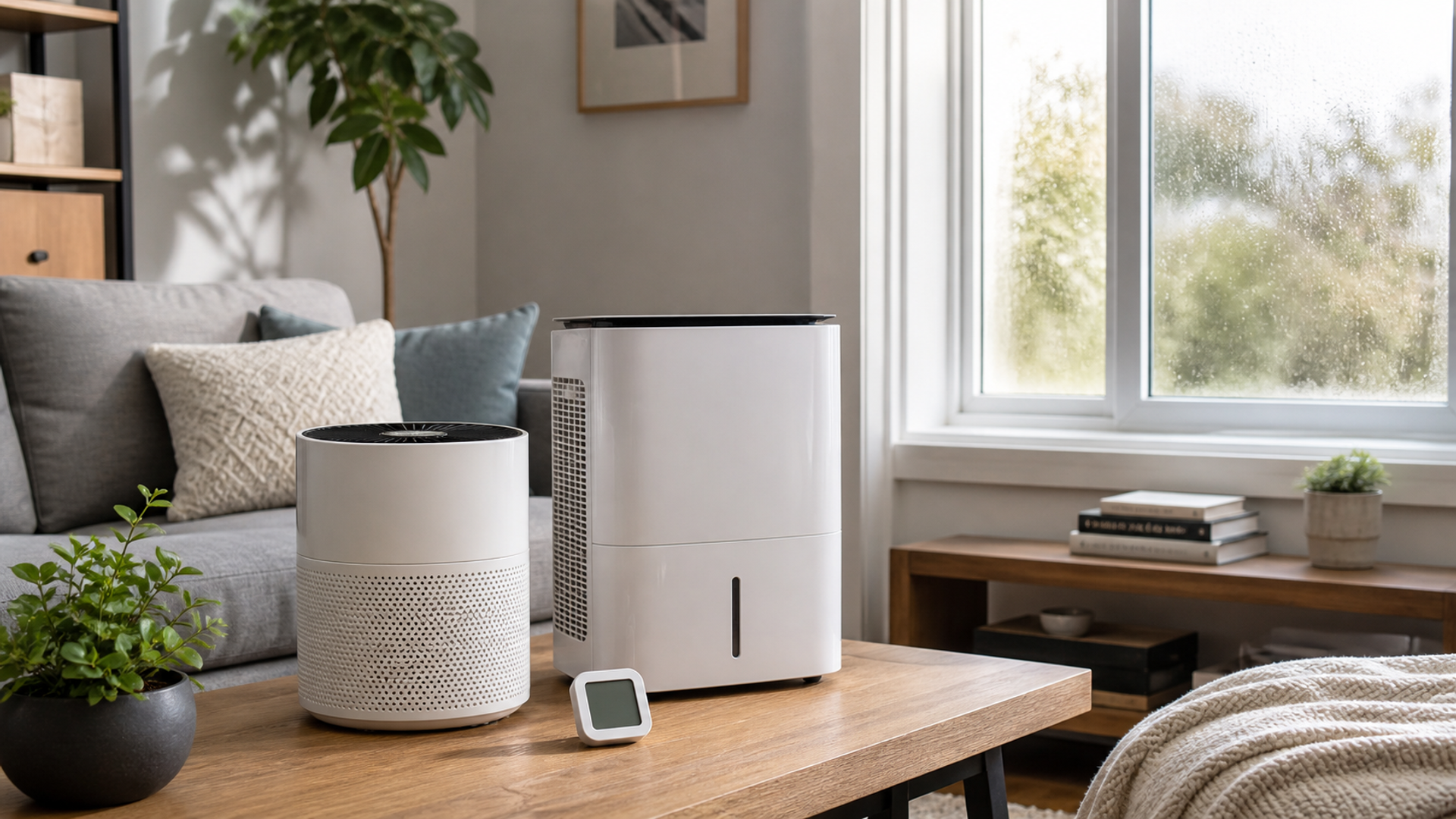
An air purifier and a dehumidifier act on different variables. A purifier moves air through a filter to reduce selected airborne particles; a dehumidifier removes water from the air. Smoke, pollen and dust are not the same problem as condensation, damp odour or persistently high relative humidity, even when the symptoms appear in the same room.
Name the air problem before buying a machine
Choose an air purifier for a measured particle problem after source control and ventilation have been considered. Choose a dehumidifier for verified excess humidity and moisture load. Use source control, building repair, ventilation or both devices when particles and damp coexist; neither machine repairs a leak or replaces professional assessment of serious mould or combustion hazards.
| Decision factor | Air purifier | Dehumidifier | Use source control or both |
|---|---|---|---|
| Observed problem | Smoke, pollen or airborne particles dominate | Condensation and high humidity dominate | The source is unknown or mixed |
| Measurement | Room volume and CADR can be matched | Relative humidity and pint capacity can be matched | Monitoring comes before purchase |
| Source control | Particle source has been reduced | Leaks and moisture entry have been addressed | Repair or ventilation is the first action |
| Maintenance | Filter cost and replacement access are acceptable | Drainage and coil cleaning are practical | Two neglected machines would add risk |
| Noise | Fan setting works during sleep and calls | Compressor cycling works in the room | Relocation or building work is better |
| Safety boundary | No gas or combustion emergency exists | No structural damp emergency exists | Qualified inspection is required |
This air purifier vs dehumidifier matrix is the article's working value object. Read the air purifier vs dehumidifier rows together: the decisive failure mode depends on this topic's evidence, operating context and reader objective.
What filtration and moisture removal can do
Evidence 1. The US EPA states that portable air cleaners can help reduce indoor air pollution but cannot remove every pollutant and work best alongside source control and ventilation.
Evidence 2. ENERGY STAR sizes dehumidifiers by moisture-removal capacity and operating conditions rather than by filter performance.
Evidence 3. Relative humidity, particle concentration and symptoms are different measurements; one device should not be purchased as a substitute for the other.
Evidence 4. Visible mould, active leaks, combustion concerns or persistent health symptoms require appropriate professional attention rather than a device-only answer.
Reader-visible sources checked for this article:
epa.gov — reader-visible current or official evidence
energystar.gov — reader-visible current or official evidence
For air purifier vs dehumidifier, these sources establish only the claims inside their documented scope. Recheck every changeable specification, availability condition, price, policy or service term in the relevant market before acting.
Measure room load and maintenance
A buyer can resolve observed problem without starting from a brand preference. Ask whether smoke, pollen or airborne particles dominate; compare that with whether condensation and high humidity dominate; then use the source is unknown or mixed as the third route's safeguard. An unknown condition stays unknown.
On measurement, popularity is not enough. The evidence for option one is that room volume and CADR can be matched. Option two means relative humidity and pint capacity can be matched. Option three is rational where monitoring comes before purchase. Recheck any changeable term immediately before commitment.
The decision changes at source control. Choose the first path only if particle source has been reduced; move to the second when leaks and moisture entry have been addressed; use the third when repair or ventilation is the first action. Save the downside that would make this row fail.
For maintenance, the first route works when filter cost and replacement access are acceptable; the second requires drainage and coil cleaning are practical. The control for the third is two neglected machines would add risk. Verify this row against the exact product, property, account or environment before it can reverse the decision.
The noise row exposes a practical boundary. Route one assumes fan setting works during sleep and calls, while route two is defensible only when compressor cycling works in the room. Route three depends on relocation or building work is better. If that evidence is absent, keep the more reversible option.
Read safety boundary as a stop/go test: no gas or combustion emergency exists supports the first option; no structural damp emergency exists supports the second; and qualified inspection is required supports the third. Record which source proves the condition and when it was checked.
Facts that would reverse the current choice
Reversal control 1 — Observed problem. Before choosing Air purifier, write down how the decision changes if “Smoke, pollen or airborne particles dominate” proves false. Do the same for Dehumidifier and “Condensation and high humidity dominate”. Keep the Use source control or both route available until “The source is unknown or mixed” is verified. This control belongs to air purifier vs dehumidifier; update it from the cited source or exact supplier rather than copying a generic checklist.
Reversal control 2 — Measurement. Before choosing Air purifier, write down how the decision changes if “Room volume and CADR can be matched” proves false. Do the same for Dehumidifier and “Relative humidity and pint capacity can be matched”. Keep the Use source control or both route available until “Monitoring comes before purchase” is verified. This control belongs to air purifier vs dehumidifier; update it from the cited source or exact supplier rather than copying a generic checklist.
Reversal control 3 — Source control. Before choosing Air purifier, write down how the decision changes if “Particle source has been reduced” proves false. Do the same for Dehumidifier and “Leaks and moisture entry have been addressed”. Keep the Use source control or both route available until “Repair or ventilation is the first action” is verified. This control belongs to air purifier vs dehumidifier; update it from the cited source or exact supplier rather than copying a generic checklist.
Reversal control 4 — Maintenance. Before choosing Air purifier, write down how the decision changes if “Filter cost and replacement access are acceptable” proves false. Do the same for Dehumidifier and “Drainage and coil cleaning are practical”. Keep the Use source control or both route available until “Two neglected machines would add risk” is verified. This control belongs to air purifier vs dehumidifier; update it from the cited source or exact supplier rather than copying a generic checklist.
Reversal control 5 — Noise. Before choosing Air purifier, write down how the decision changes if “Fan setting works during sleep and calls” proves false. Do the same for Dehumidifier and “Compressor cycling works in the room”. Keep the Use source control or both route available until “Relocation or building work is better” is verified. This control belongs to air purifier vs dehumidifier; update it from the cited source or exact supplier rather than copying a generic checklist.
Reversal control 6 — Safety boundary. Before choosing Air purifier, write down how the decision changes if “No gas or combustion emergency exists” proves false. Do the same for Dehumidifier and “No structural damp emergency exists”. Keep the Use source control or both route available until “Qualified inspection is required” is verified. This control belongs to air purifier vs dehumidifier; update it from the cited source or exact supplier rather than copying a generic checklist.
Identify particles or moisture
Use a reliable humidity monitor, inspect condensation and damp sources, and record when symptoms occur. Do not infer high humidity from dust or infer particles from a damp smell.
Size for the exact room
Measure room volume, door position and moisture or particle load. Compare CADR for purifiers and tested capacity for dehumidifiers at relevant conditions.
Price maintenance for a year
Include replacement filters, electricity, drainage, cleaning and noise. A machine that is switched off or poorly maintained has little practical value.
Escalate building problems
Repair water entry, unsafe combustion, blocked extraction and serious contamination. Equipment can support a plan but cannot make a damaged building sound.
Three indoor-air situations
Wildfire smoke or seasonal pollen
A correctly sized purifier can be the relevant tool after windows, seals and source pathways are managed. Define the fact that would reverse this recommendation before committing.
Cool basement with condensation
A dehumidifier can help only after leaks, drainage and ventilation are checked. Define the fact that would reverse this recommendation before committing.
Damp room with dust and odour
Measurement and source control may justify both devices, but a building defect stays the first problem. Define the fact that would reverse this recommendation before committing.
Action checklist
Measure relative humidity.
Name the particle source.
Inspect leaks and extraction.
Calculate room volume.
Match CADR or capacity.
Check filter availability.
Plan continuous drainage.
Test night-time noise.
Set maintenance reminders.
Escalate serious hazards.
Continue the decision
The linked VERTU articles expand adjacent parts of the air purifier vs dehumidifier decision. They do not substitute for the external evidence above.
The indoor-air device verdict
Choose an air purifier for a measured particle problem after source control and ventilation have been considered. Choose a dehumidifier for verified excess humidity and moisture load. Use source control, building repair, ventilation or both devices when particles and damp coexist; neither machine repairs a leak or replaces professional assessment of serious mould or combustion hazards.
Keep the air purifier vs dehumidifier decision reversible until its material cost, safety, access, privacy and compatibility facts are verified. Unknown evidence stays unknown; it is never silently scored as favourable.
![How to Scan Receipts and Documents with Your Phone [Full Guide]](https://cdn.sanity.io/images/e0gp1l2g/production/0db13feec1d5e72b8a8a5f976d1f3e86619c9228-3840x1860.webp?w=180&h=180&q=78&auto=format&fit=crop)
![How to Scan Receipts and Documents with Your Phone [Full Guide]](https://cdn.sanity.io/images/e0gp1l2g/production/0db13feec1d5e72b8a8a5f976d1f3e86619c9228-3840x1860.webp?w=800&h=450&q=82&auto=format&fit=crop)
![Top 10 Two-Tone Carbon-Fibre Watches for Men [2026 List]](https://cdn.sanity.io/images/e0gp1l2g/production/18870799ba33fab0e038968359cd5772d7d7db30-1024x576.webp?w=800&h=450&q=82&auto=format&fit=crop)
![Top 10 Luxury Watches with Digital Complication Displays for Men [Latest]](https://cdn.sanity.io/images/e0gp1l2g/production/c4f6bf8c080f291c39f7cc85c7344ecff2fd3799-1024x553.webp?w=800&h=450&q=82&auto=format&fit=crop)