

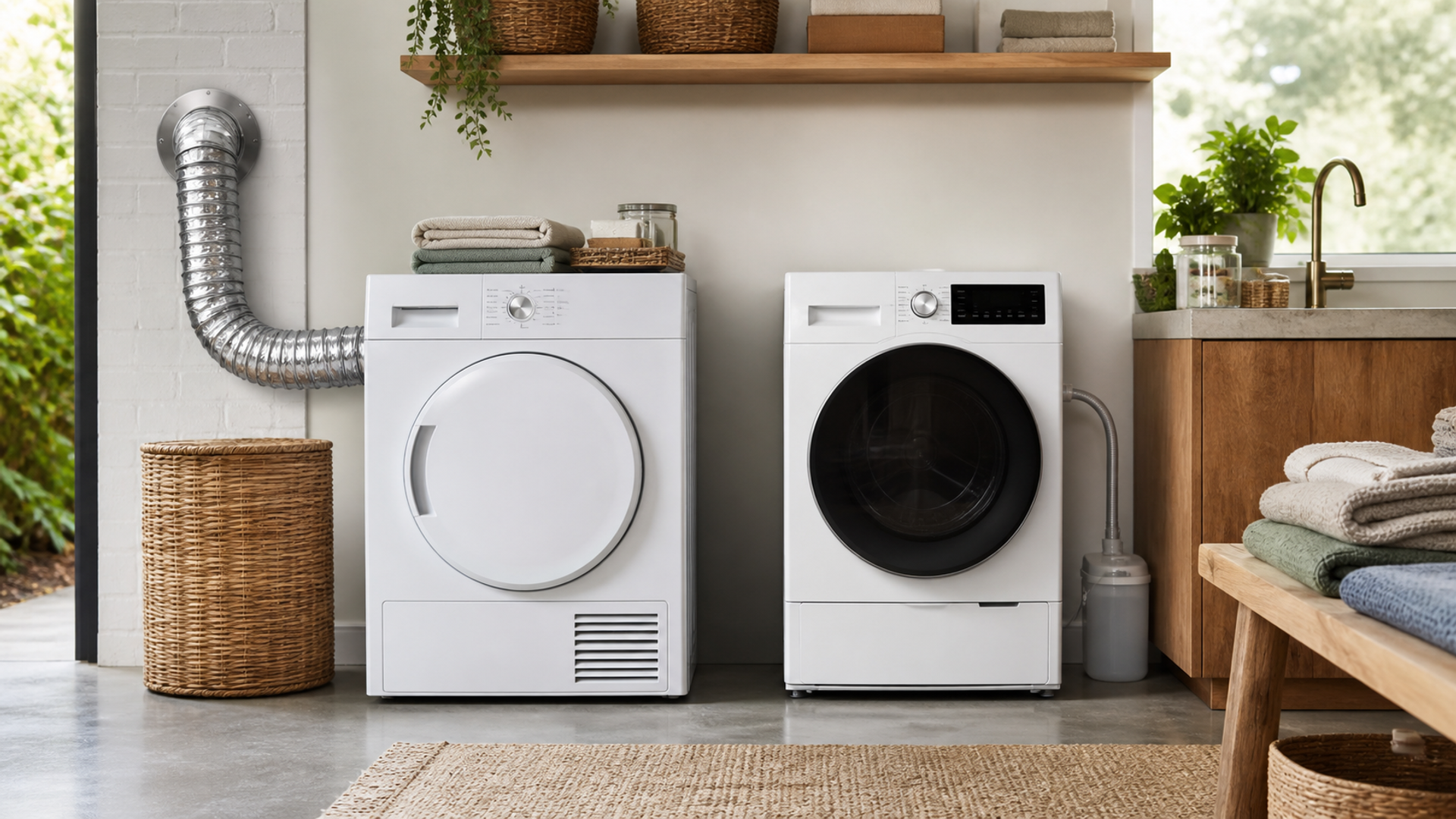
Vented versus heat-pump dryer trades installation, energy, cycle behaviour, fabric temperature and maintenance. A vented dryer sends warm humid air outside through a safe duct. A heat-pump dryer recirculates air, removes moisture and normally needs drainage or a tank rather than an exterior vent. Neither format wins until the home, load pattern and local energy price are measured.
Start with the room and utility bill
Choose vented when a compliant short duct exists, rapid cycles matter and operating cost is acceptable. Choose heat pump when ventless placement, lower-temperature care and lower electricity use justify higher purchase cost and potentially longer cycles. Improve washer extraction, sensors or duct maintenance first when fixable issues cause inefficiency.
| Decision factor | Vented dryer | Heat-pump dryer | Improve the current laundry system |
|---|---|---|---|
| Installation | A short compliant vent exists | Ventless placement and drainage solve the room | Repair the current duct |
| Energy | Usage is light or fuel cost favourable | Frequent loads make efficiency valuable | Increase washer spin |
| Cycle time | Fast turnaround is important | Longer cycles fit the schedule | Stagger loads |
| Fabric care | Existing heat suits the wardrobe | Lower heat benefits garments | Line-dry sensitive pieces |
| Maintenance | Duct and lint path can be cleaned | Filters, exchanger and drain will be maintained | Restore neglected equipment |
| Lifetime cost | Lower initial price dominates | Savings and avoided vent repay premium | Delay until measurements support it |
This vented vs heat pump dryer matrix is the article's working value object. Read the vented vs heat pump dryer rows together: the decisive failure mode depends on this topic's evidence, operating context and reader objective.
How the drying loops differ
Evidence 1. ENERGY STAR describes heat-pump dryers as closed-loop systems that remove moisture and reuse heated air.
Evidence 2. Heat-pump dryers do not require an exterior vent and generally use less electricity than standard dryers.
Evidence 3. Condensed water must be drained or emptied from a tank.
Evidence 4. Washer extraction, load size, sensors, filter cleanliness and airflow also affect drying.
Reader-visible sources checked for this article:
energystar.gov — reader-visible current or official evidence
energystar.gov — reader-visible current or official evidence
For vented vs heat pump dryer, these sources establish only the claims inside their documented scope. Recheck every changeable specification, availability condition, price, policy or service term in the relevant market before acting.
Model installation and lifetime cost
On installation, popularity is not enough. The evidence for option one is that a short compliant vent exists. Option two means ventless placement and drainage solve the room. Option three is rational where repair the current duct. Recheck any changeable term immediately before commitment.
The decision changes at energy. Choose the first path only if usage is light or fuel cost favourable; move to the second when frequent loads make efficiency valuable; use the third when increase washer spin. Save the downside that would make this row fail.
For cycle time, the first route works when fast turnaround is important; the second requires longer cycles fit the schedule. The control for the third is stagger loads. Verify this row against the exact product, property, account or environment before it can reverse the decision.
The fabric care row exposes a practical boundary. Route one assumes existing heat suits the wardrobe, while route two is defensible only when lower heat benefits garments. Route three depends on line-dry sensitive pieces. If that evidence is absent, keep the more reversible option.
Read maintenance as a stop/go test: duct and lint path can be cleaned supports the first option; filters, exchanger and drain will be maintained supports the second; and restore neglected equipment supports the third. Record which source proves the condition and when it was checked.
A buyer can resolve lifetime cost without starting from a brand preference. Ask whether lower initial price dominates; compare that with whether savings and avoided vent repay premium; then use delay until measurements support it as the third route's safeguard. An unknown condition stays unknown.
Facts that would reverse the current choice
Reversal control 1 — Installation. Before choosing Vented dryer, write down how the decision changes if “A short compliant vent exists” proves false. Do the same for Heat-pump dryer and “Ventless placement and drainage solve the room”. Keep the Improve the current laundry system route available until “Repair the current duct” is verified. This control belongs to vented vs heat pump dryer; update it from the cited source or exact supplier rather than copying a generic checklist.
Reversal control 2 — Energy. Before choosing Vented dryer, write down how the decision changes if “Usage is light or fuel cost favourable” proves false. Do the same for Heat-pump dryer and “Frequent loads make efficiency valuable”. Keep the Improve the current laundry system route available until “Increase washer spin” is verified. This control belongs to vented vs heat pump dryer; update it from the cited source or exact supplier rather than copying a generic checklist.
Reversal control 3 — Cycle time. Before choosing Vented dryer, write down how the decision changes if “Fast turnaround is important” proves false. Do the same for Heat-pump dryer and “Longer cycles fit the schedule”. Keep the Improve the current laundry system route available until “Stagger loads” is verified. This control belongs to vented vs heat pump dryer; update it from the cited source or exact supplier rather than copying a generic checklist.
Reversal control 4 — Fabric care. Before choosing Vented dryer, write down how the decision changes if “Existing heat suits the wardrobe” proves false. Do the same for Heat-pump dryer and “Lower heat benefits garments”. Keep the Improve the current laundry system route available until “Line-dry sensitive pieces” is verified. This control belongs to vented vs heat pump dryer; update it from the cited source or exact supplier rather than copying a generic checklist.
Reversal control 5 — Maintenance. Before choosing Vented dryer, write down how the decision changes if “Duct and lint path can be cleaned” proves false. Do the same for Heat-pump dryer and “Filters, exchanger and drain will be maintained”. Keep the Improve the current laundry system route available until “Restore neglected equipment” is verified. This control belongs to vented vs heat pump dryer; update it from the cited source or exact supplier rather than copying a generic checklist.
Reversal control 6 — Lifetime cost. Before choosing Vented dryer, write down how the decision changes if “Lower initial price dominates” proves false. Do the same for Heat-pump dryer and “Savings and avoided vent repay premium”. Keep the Improve the current laundry system route available until “Delay until measurements support it” is verified. This control belongs to vented vs heat pump dryer; update it from the cited source or exact supplier rather than copying a generic checklist.
Audit the vent and room
Trace duct length, bends, material, termination and cleaning access, then measure doors, stacking and service clearance. For heat pump verify drainage and ambient limits; for vented verify a legal exterior route. Record the exact model, material, room, recipe or operating condition and the time of the check. Keep the observation separate from a marketing promise, and repeat the test under the intended use rather than an ideal showroom condition. A crushed or lint-loaded duct must be fixed before blaming the dryer. Save the result and the evidence that would reverse it, because a change in fit, specification, service, price or environment must reopen this decision rather than inherit an old conclusion.
Measure a month
Count loads, wet weight, textiles, cycles, washer spin and remaining moisture. Time representative cycles and measure energy where practical to separate dryer need from under-spinning or overloading. Record the exact model, material, room, recipe or operating condition and the time of the check. Keep the observation separate from a marketing promise, and repeat the test under the intended use rather than an ideal showroom condition. If workflow causes the delay, changing technology may not solve it. Save the result and the evidence that would reverse it, because a change in fit, specification, service, price or environment must reopen this decision rather than inherit an old conclusion.
Build lifetime cost
Add delivery, electrical work, vent or drain work, energy, cleaning, filters and service. Use local tariff and measured loads, then test sensitivity to ownership years and cycle count. Record the exact model, material, room, recipe or operating condition and the time of the check. Keep the observation separate from a marketing promise, and repeat the test under the intended use rather than an ideal showroom condition. If use is low and a safe vent exists, payback claims must not be assumed. Save the result and the evidence that would reverse it, because a change in fit, specification, service, price or environment must reopen this decision rather than inherit an old conclusion.
Protect garments
Sort by care label, avoid overdrying, use sensors and clean filters as specified. Price line drying for fragile pieces and ensure the household will maintain exchanger and drainage. Record the exact model, material, room, recipe or operating condition and the time of the check. Keep the observation separate from a marketing promise, and repeat the test under the intended use rather than an ideal showroom condition. If care instructions conflict with the chosen heat or cycle, the garment label wins. Save the result and the evidence that would reverse it, because a change in fit, specification, service, price or environment must reopen this decision rather than inherit an old conclusion.
Three laundry rooms, three answers
Ventless apartment
A heat-pump dryer can unlock installation when drainage and clearance are solved. Define the fact that would reverse this recommendation before committing.
Busy room with short legal vent
A vented dryer may justify faster turnaround. Define the fact that would reverse this recommendation before committing.
Older system with long cycles
Duct cleaning, washer spin and sensor repair should be tested first. Define the fact that would reverse this recommendation before committing.
Action checklist
Trace vent.
Measure clearance.
Check power.
Plan drain.
Count loads.
Time cycles.
Check washer spin.
Model tariff.
Verify filters.
Confirm service.
Continue the decision
The linked VERTU articles expand adjacent parts of the vented vs heat pump dryer decision. They do not substitute for the external evidence above.
The dryer verdict
Choose vented when a compliant short duct exists, rapid cycles matter and operating cost is acceptable. Choose heat pump when ventless placement, lower-temperature care and lower electricity use justify higher purchase cost and potentially longer cycles. Improve washer extraction, sensors or duct maintenance first when fixable issues cause inefficiency.
Keep the vented vs heat pump dryer decision reversible until its material cost, safety, access, privacy and compatibility facts are verified. Unknown evidence stays unknown; it is never silently scored as favourable.
![How to Scan Receipts and Documents with Your Phone [Full Guide]](https://cdn.sanity.io/images/e0gp1l2g/production/0db13feec1d5e72b8a8a5f976d1f3e86619c9228-3840x1860.webp?w=180&h=180&q=78&auto=format&fit=crop)
![How to Scan Receipts and Documents with Your Phone [Full Guide]](https://cdn.sanity.io/images/e0gp1l2g/production/0db13feec1d5e72b8a8a5f976d1f3e86619c9228-3840x1860.webp?w=800&h=450&q=82&auto=format&fit=crop)
![Top 10 Two-Tone Carbon-Fibre Watches for Men [2026 List]](https://cdn.sanity.io/images/e0gp1l2g/production/18870799ba33fab0e038968359cd5772d7d7db30-1024x576.webp?w=800&h=450&q=82&auto=format&fit=crop)
![Top 10 Luxury Watches with Digital Complication Displays for Men [Latest]](https://cdn.sanity.io/images/e0gp1l2g/production/c4f6bf8c080f291c39f7cc85c7344ecff2fd3799-1024x553.webp?w=800&h=450&q=82&auto=format&fit=crop)