

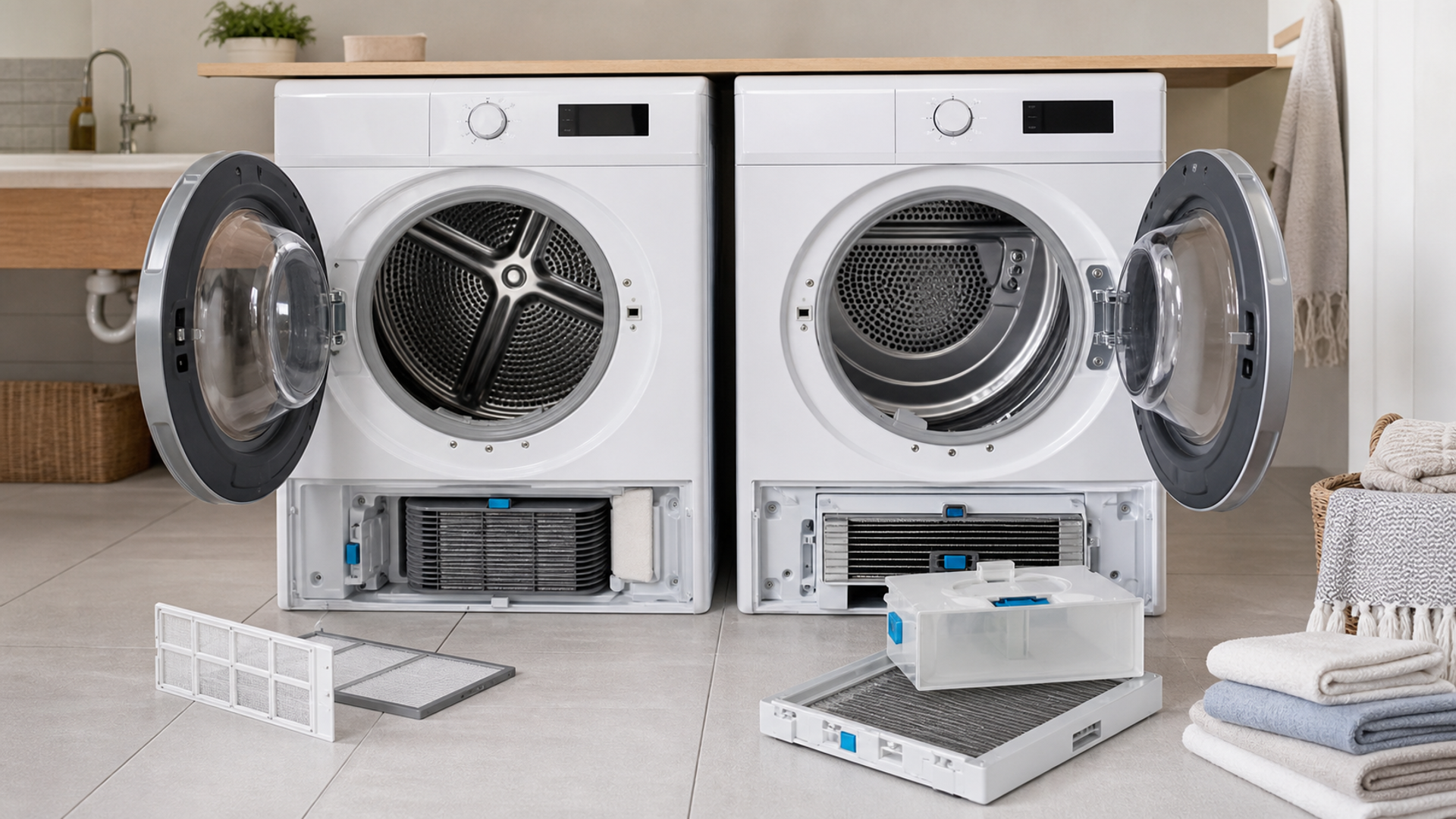
Heat-pump and conventional condenser dryers are both ventless categories, but they recycle and create heat differently. A heat-pump model usually recovers heat through a refrigerant circuit and dries at lower temperatures; a conventional condenser model commonly uses an electric heater and condenses moisture from warmer air. Cycle time, fabric care, room conditions and electricity use must be measured together.
Start with the laundry load
Choose a heat-pump dryer when lower energy use and gentler temperatures justify higher capital and longer cycles. Choose a conventional condenser dryer when purchase price, familiar servicing and faster high-heat cycles fit the household. Keep and optimise the current machine when filters, load size, washer spin or room ventilation is the real source of poor drying.
| Decision factor | Heat-pump dryer | Conventional condenser dryer | Keep and optimise the current dryer |
|---|---|---|---|
| Energy | Frequent loads make lower use valuable | Lower capital matters more than annual consumption | Measure the current machine before replacing it |
| Fabric care | Lower temperatures suit recurring delicate loads | Robust laundry tolerates warmer cycles | Air-dry only the sensitive items |
| Cycle time | Longer efficient cycles fit the schedule | Faster cycles solve a genuine bottleneck | Improve washer spin and load sorting first |
| Room | Heat and moisture management suit the installation | The condenser model fits clearances and drainage | Ventilation or drainage work comes first |
| Maintenance | Filters and heat exchanger access are manageable | Condenser and lint care are manageable | Clean the current airflow path |
| Service | Refrigerant-trained support and parts are available | Simpler local repair route is stronger | Keep the proven machine until support improves |
This heat pump dryer vs condenser dryer matrix is the article's working value object. Read the heat pump dryer vs condenser dryer rows together: the decisive failure mode depends on this topic's evidence, operating context and reader objective.
What closed-loop drying changes
Evidence 1. ENERGY STAR describes heat-pump dryers as recycling heated air and using a heat exchanger to remove moisture, reducing energy demand compared with conventional electric drying.
Evidence 2. The US Department of Energy advises that dryer energy also depends on washer extraction, load size, sensor use, lint maintenance and over-drying.
Evidence 3. Lower drying temperature can protect some textiles, but care labels and programme design still control whether an item belongs in a machine.
Evidence 4. Condenser tanks, drains, filters and heat-exchange surfaces require model-specific maintenance; ventless does not mean maintenance-free.
Reader-visible sources checked for this article:
energystar.gov — reader-visible current or official evidence
energystar.gov — reader-visible current or official evidence
For heat pump dryer vs condenser dryer, these sources establish only the claims inside their documented scope. Recheck every changeable specification, availability condition, price, policy or service term in the relevant market before acting.
Measure a complete wash week
The decision changes at energy. Choose the first path only if frequent loads make lower use valuable; move to the second when lower capital matters more than annual consumption; use the third when measure the current machine before replacing it. Save the downside that would make this row fail.
For fabric care, the first route works when lower temperatures suit recurring delicate loads; the second requires robust laundry tolerates warmer cycles. The control for the third is air-dry only the sensitive items. Verify this row against the exact product, property, account or environment before it can reverse the decision.
The cycle time row exposes a practical boundary. Route one assumes longer efficient cycles fit the schedule, while route two is defensible only when faster cycles solve a genuine bottleneck. Route three depends on improve washer spin and load sorting first. If that evidence is absent, keep the more reversible option.
Read room as a stop/go test: heat and moisture management suit the installation supports the first option; the condenser model fits clearances and drainage supports the second; and ventilation or drainage work comes first supports the third. Record which source proves the condition and when it was checked.
A buyer can resolve maintenance without starting from a brand preference. Ask whether filters and heat exchanger access are manageable; compare that with whether condenser and lint care are manageable; then use clean the current airflow path as the third route's safeguard. An unknown condition stays unknown.
On service, popularity is not enough. The evidence for option one is that refrigerant-trained support and parts are available. Option two means simpler local repair route is stronger. Option three is rational where keep the proven machine until support improves. Recheck any changeable term immediately before commitment.
Facts that would reverse the current choice
Reversal control 1 — Energy. Before choosing Heat-pump dryer, write down how the decision changes if “Frequent loads make lower use valuable” proves false. Do the same for Conventional condenser dryer and “Lower capital matters more than annual consumption”. Keep the Keep and optimise the current dryer route available until “Measure the current machine before replacing it” is verified. This control belongs to heat pump dryer vs condenser dryer; update it from the cited source or exact supplier rather than copying a generic checklist.
Reversal control 2 — Fabric care. Before choosing Heat-pump dryer, write down how the decision changes if “Lower temperatures suit recurring delicate loads” proves false. Do the same for Conventional condenser dryer and “Robust laundry tolerates warmer cycles”. Keep the Keep and optimise the current dryer route available until “Air-dry only the sensitive items” is verified. This control belongs to heat pump dryer vs condenser dryer; update it from the cited source or exact supplier rather than copying a generic checklist.
Reversal control 3 — Cycle time. Before choosing Heat-pump dryer, write down how the decision changes if “Longer efficient cycles fit the schedule” proves false. Do the same for Conventional condenser dryer and “Faster cycles solve a genuine bottleneck”. Keep the Keep and optimise the current dryer route available until “Improve washer spin and load sorting first” is verified. This control belongs to heat pump dryer vs condenser dryer; update it from the cited source or exact supplier rather than copying a generic checklist.
Reversal control 4 — Room. Before choosing Heat-pump dryer, write down how the decision changes if “Heat and moisture management suit the installation” proves false. Do the same for Conventional condenser dryer and “The condenser model fits clearances and drainage”. Keep the Keep and optimise the current dryer route available until “Ventilation or drainage work comes first” is verified. This control belongs to heat pump dryer vs condenser dryer; update it from the cited source or exact supplier rather than copying a generic checklist.
Reversal control 5 — Maintenance. Before choosing Heat-pump dryer, write down how the decision changes if “Filters and heat exchanger access are manageable” proves false. Do the same for Conventional condenser dryer and “Condenser and lint care are manageable”. Keep the Keep and optimise the current dryer route available until “Clean the current airflow path” is verified. This control belongs to heat pump dryer vs condenser dryer; update it from the cited source or exact supplier rather than copying a generic checklist.
Reversal control 6 — Service. Before choosing Heat-pump dryer, write down how the decision changes if “Refrigerant-trained support and parts are available” proves false. Do the same for Conventional condenser dryer and “Simpler local repair route is stronger”. Keep the Keep and optimise the current dryer route available until “Keep the proven machine until support improves” is verified. This control belongs to heat pump dryer vs condenser dryer; update it from the cited source or exact supplier rather than copying a generic checklist.
Audit one wash week
Weigh or count real loads, record washer spin, programme, start-to-cupboard time, electricity where measurable and any redrying. Separate towels, bedding and delicates.
Inspect the room
Measure doorway, stacking kit, clearances, drain, socket, ambient temperature and service access. Check whether heat released into the room causes a summer problem.
Price the ownership horizon
Use local electricity price and credible annual loads, then add purchase, installation, filters, service and expected replacement. Do not turn a lab label into a guaranteed bill.
Test maintenance access
Remove and clean every user-serviceable filter or condenser part on a showroom or manual walkthrough. If the task is awkward, assign who will actually do it and how often.
Three utility rooms
High-use family laundry
Heat pump can recover its premium through frequent loads when long cycles fit the household schedule. Define the fact that would reverse this recommendation before committing.
Low-use flat with limited capital
A conventional condenser dryer may remain rational when annual energy savings cannot offset purchase cost. Define the fact that would reverse this recommendation before committing.
Existing dryer suddenly performs poorly
Filter, condenser, sensor, washer spin and load diagnosis should precede replacement. Define the fact that would reverse this recommendation before committing.
Action checklist
Count weekly loads.
Record washer spin.
Measure real cycle time.
Read care labels.
Check room temperature.
Verify drain route.
Clean all filters.
Price local electricity.
Confirm refrigerant service.
Model five-year ownership.
Continue the decision
The linked VERTU articles expand adjacent parts of the heat pump dryer vs condenser dryer decision. They do not substitute for the external evidence above.
The heat-pump-condenser verdict
Choose a heat-pump dryer when lower energy use and gentler temperatures justify higher capital and longer cycles. Choose a conventional condenser dryer when purchase price, familiar servicing and faster high-heat cycles fit the household. Keep and optimise the current machine when filters, load size, washer spin or room ventilation is the real source of poor drying.
Keep the heat pump dryer vs condenser dryer decision reversible until its material cost, safety, access, privacy and compatibility facts are verified. Unknown evidence stays unknown; it is never silently scored as favourable.



![Top 10 Tourbillon Watches for Men [2026 Latest]](https://cdn.sanity.io/images/e0gp1l2g/production/8cb6bc45133cf9453382fc7d074465af588bb610-1800x1080.webp?w=800&h=450&q=82&auto=format&fit=crop)