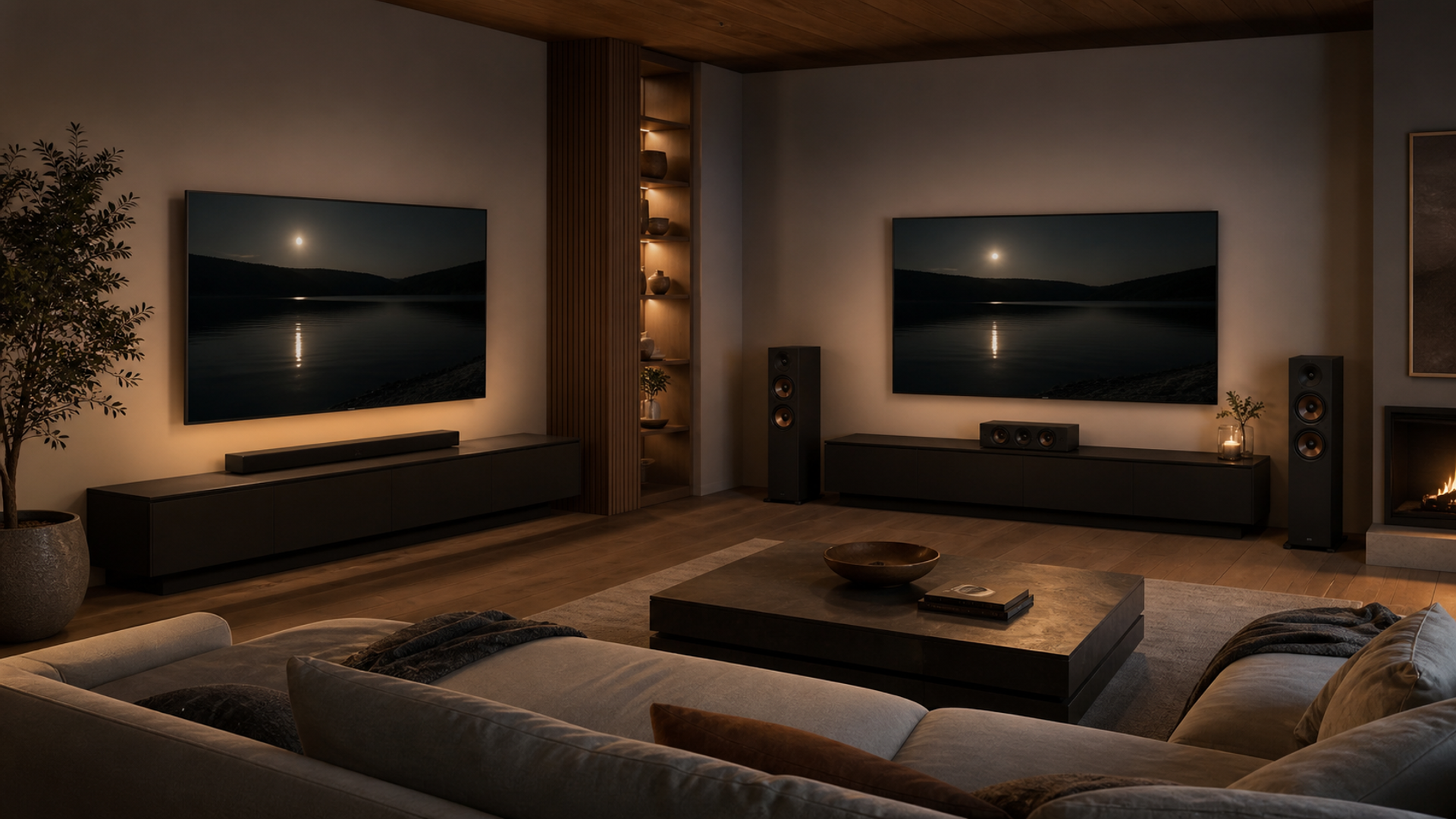
A soundbar and a separate-speaker system can both improve television sound, but they solve the room differently. A soundbar packages multiple drivers and processing into a narrow enclosure, reducing cables and setup. Separate speakers create physical spacing, a dedicated centre and a more flexible path to surround and bass. Channel numbers printed on packaging do not guarantee audible separation; room dimensions, seating, reflective surfaces, source format, placement and calibration determine whether the system delivers clear dialogue and convincing scale.
Start with the room and listening seat
Choose a soundbar when simplicity, limited furniture, shared-space aesthetics and clear dialogue lead. Choose separate speakers when physical stereo imaging, a dedicated centre, upgradeability and room-scale dynamics justify placement and wiring. Build in phases when a good front stage now and measured subwoofer or surround additions later will outperform an overfilled room.
| Decision factor | Soundbar | Separate speakers | Build in phases |
|---|---|---|---|
| Dialogue | Dedicated processing and centre focus simplify setup | Physical centre can anchor voices across seats | Fix placement and room noise first |
| Stereo image | Virtual width depends on room reflections | Physical left-right spacing creates a stable stage | Start with quality stereo |
| Surround | Reflective or wireless modules reduce wiring | Placed surrounds create controlled direction | Add only after front calibration |
| Bass | Compact bar may rely on a wireless sub | Subwoofer choice and placement are flexible | Measure room modes before adding bass |
| Connectivity | HDMI eARC and app integration can be simple | Receiver adds inputs and decoding flexibility | Audit sources and formats |
| Upgrade path | Usually ecosystem-bound | Components can be replaced separately | Design conduit and power now |
This soundbar vs speakers matrix is the article's working value object. Read the soundbar vs speakers rows together: the decisive failure mode depends on this topic's evidence, operating context and reader objective.
Packaging shapes the soundstage
Evidence 1. Dolby publishes placement guidance for speaker layouts because position and listener geometry are material to immersive playback.
Evidence 2. Bose distinguishes soundbars from conventional speakers by packaging, placement and system complexity rather than claiming one always sounds better.
Evidence 3. HDMI eARC, supported codecs and television pass-through behaviour must be verified across the exact source, display and audio device.
Evidence 4. Room reflections and bass modes can dominate perceived performance even when the electronics support the same format.
Reader-visible sources checked for this article:
dolby.com — reader-visible current or official evidence
bose.com — reader-visible current or official evidence
For soundbar vs speakers, these sources establish only the claims inside their documented scope. Recheck every changeable specification, availability condition, price, policy or service term in the relevant market before acting.
Calibrate before buying more boxes
For dialogue, the first route works when dedicated processing and centre focus simplify setup; the second requires physical centre can anchor voices across seats. The control for the third is fix placement and room noise first. Verify this row against the exact product, property, account or environment before it can reverse the decision.
The stereo image row exposes a practical boundary. Route one assumes virtual width depends on room reflections, while route two is defensible only when physical left-right spacing creates a stable stage. Route three depends on start with quality stereo. If that evidence is absent, keep the more reversible option.
Read surround as a stop/go test: reflective or wireless modules reduce wiring supports the first option; placed surrounds create controlled direction supports the second; and add only after front calibration supports the third. Record which source proves the condition and when it was checked.
A buyer can resolve bass without starting from a brand preference. Ask whether compact bar may rely on a wireless sub; compare that with whether subwoofer choice and placement are flexible; then use measure room modes before adding bass as the third route's safeguard. An unknown condition stays unknown.
On connectivity, popularity is not enough. The evidence for option one is that hDMI eARC and app integration can be simple. Option two means receiver adds inputs and decoding flexibility. Option three is rational where audit sources and formats. Recheck any changeable term immediately before commitment.
The decision changes at upgrade path. Choose the first path only if usually ecosystem-bound; move to the second when components can be replaced separately; use the third when design conduit and power now. Save the downside that would make this row fail.
Facts that would reverse the current choice
Reversal control 1 — Dialogue. Before choosing Soundbar, write down how the decision changes if “Dedicated processing and centre focus simplify setup” proves false. Do the same for Separate speakers and “Physical centre can anchor voices across seats”. Keep the Build in phases route available until “Fix placement and room noise first” is verified. This control belongs to soundbar vs speakers; update it from the cited source or exact supplier rather than copying a generic checklist.
Reversal control 2 — Stereo image. Before choosing Soundbar, write down how the decision changes if “Virtual width depends on room reflections” proves false. Do the same for Separate speakers and “Physical left-right spacing creates a stable stage”. Keep the Build in phases route available until “Start with quality stereo” is verified. This control belongs to soundbar vs speakers; update it from the cited source or exact supplier rather than copying a generic checklist.
Reversal control 3 — Surround. Before choosing Soundbar, write down how the decision changes if “Reflective or wireless modules reduce wiring” proves false. Do the same for Separate speakers and “Placed surrounds create controlled direction”. Keep the Build in phases route available until “Add only after front calibration” is verified. This control belongs to soundbar vs speakers; update it from the cited source or exact supplier rather than copying a generic checklist.
Reversal control 4 — Bass. Before choosing Soundbar, write down how the decision changes if “Compact bar may rely on a wireless sub” proves false. Do the same for Separate speakers and “Subwoofer choice and placement are flexible”. Keep the Build in phases route available until “Measure room modes before adding bass” is verified. This control belongs to soundbar vs speakers; update it from the cited source or exact supplier rather than copying a generic checklist.
Reversal control 5 — Connectivity. Before choosing Soundbar, write down how the decision changes if “HDMI eARC and app integration can be simple” proves false. Do the same for Separate speakers and “Receiver adds inputs and decoding flexibility”. Keep the Build in phases route available until “Audit sources and formats” is verified. This control belongs to soundbar vs speakers; update it from the cited source or exact supplier rather than copying a generic checklist.
Reversal control 6 — Upgrade path. Before choosing Soundbar, write down how the decision changes if “Usually ecosystem-bound” proves false. Do the same for Separate speakers and “Components can be replaced separately”. Keep the Build in phases route available until “Design conduit and power now” is verified. This control belongs to soundbar vs speakers; update it from the cited source or exact supplier rather than copying a generic checklist.
Map the room
Measure screen width, seating distance, ceiling, side walls, open doorways and acceptable cable routes. Mark every listening seat and obstruction before choosing channels or upward-firing drivers. Record the exact product, material, room, garment, vehicle, water report or operating condition and the time of the check. Separate observed behaviour from marketing language, and repeat the comparison in the intended setting rather than an ideal demonstration. If the room cannot support the advertised geometry, reduce channel ambition. Preserve the evidence that would reverse the choice: a change in fit, specification, maintenance, safety, price or environment must reopen the decision rather than inherit an old conclusion.
Run a dialogue test
Use familiar quiet speech, overlapping voices and low-volume evening scenes. Compare intelligibility across seats with enhancement modes off and on, at matched loudness. Record the exact product, material, room, garment, vehicle, water report or operating condition and the time of the check. Separate observed behaviour from marketing language, and repeat the comparison in the intended setting rather than an ideal demonstration. If dialogue improves only by harsh treble, placement or room noise may be the real problem. Preserve the evidence that would reverse the choice: a change in fit, specification, maintenance, safety, price or environment must reopen the decision rather than inherit an old conclusion.
Verify formats end to end
List streaming apps, discs, consoles and broadcast sources plus their actual audio outputs. Confirm television eARC, passthrough, receiver or bar decoding and cable support using status displays. Record the exact product, material, room, garment, vehicle, water report or operating condition and the time of the check. Separate observed behaviour from marketing language, and repeat the comparison in the intended setting rather than an ideal demonstration. If the source never outputs the promised format, do not pay for a channel label alone. Preserve the evidence that would reverse the choice: a change in fit, specification, maintenance, safety, price or environment must reopen the decision rather than inherit an old conclusion.
Calibrate the room
Level-match channels, set distance and crossover, test subwoofer positions and save a baseline. Use room correction as measured assistance, not permission for obstructed or asymmetrical placement. Record the exact product, material, room, garment, vehicle, water report or operating condition and the time of the check. Separate observed behaviour from marketing language, and repeat the comparison in the intended setting rather than an ideal demonstration. If treatment or furniture movement fixes the problem, that can reverse a hardware upgrade. Preserve the evidence that would reverse the choice: a change in fit, specification, maintenance, safety, price or environment must reopen the decision rather than inherit an old conclusion.
Three rooms, three answers
Apartment living room with one cabinet
A high-quality soundbar can deliver the cleanest complete system. Define the fact that would reverse this recommendation before committing.
Dedicated room with fixed seating
Separate speakers support stronger imaging and controlled surround. Define the fact that would reverse this recommendation before committing.
Premium room under renovation
A phased speaker system with conduit preserves future options. Define the fact that would reverse this recommendation before committing.
Action checklist
Measure room.
Mark seats.
Audit sources.
Verify eARC.
Test dialogue.
Level match.
Plan bass.
Check cables.
Respect neighbours.
Upgrade by measured need.
Continue the decision
The linked VERTU articles expand adjacent parts of the soundbar vs speakers decision. They do not substitute for the external evidence above.
The soundbar-versus-speakers verdict
Choose a soundbar when simplicity, limited furniture, shared-space aesthetics and clear dialogue lead. Choose separate speakers when physical stereo imaging, a dedicated centre, upgradeability and room-scale dynamics justify placement and wiring. Build in phases when a good front stage now and measured subwoofer or surround additions later will outperform an overfilled room.
Keep the soundbar vs speakers decision reversible until its material cost, safety, access, privacy and compatibility facts are verified. Unknown evidence stays unknown; it is never silently scored as favourable.