

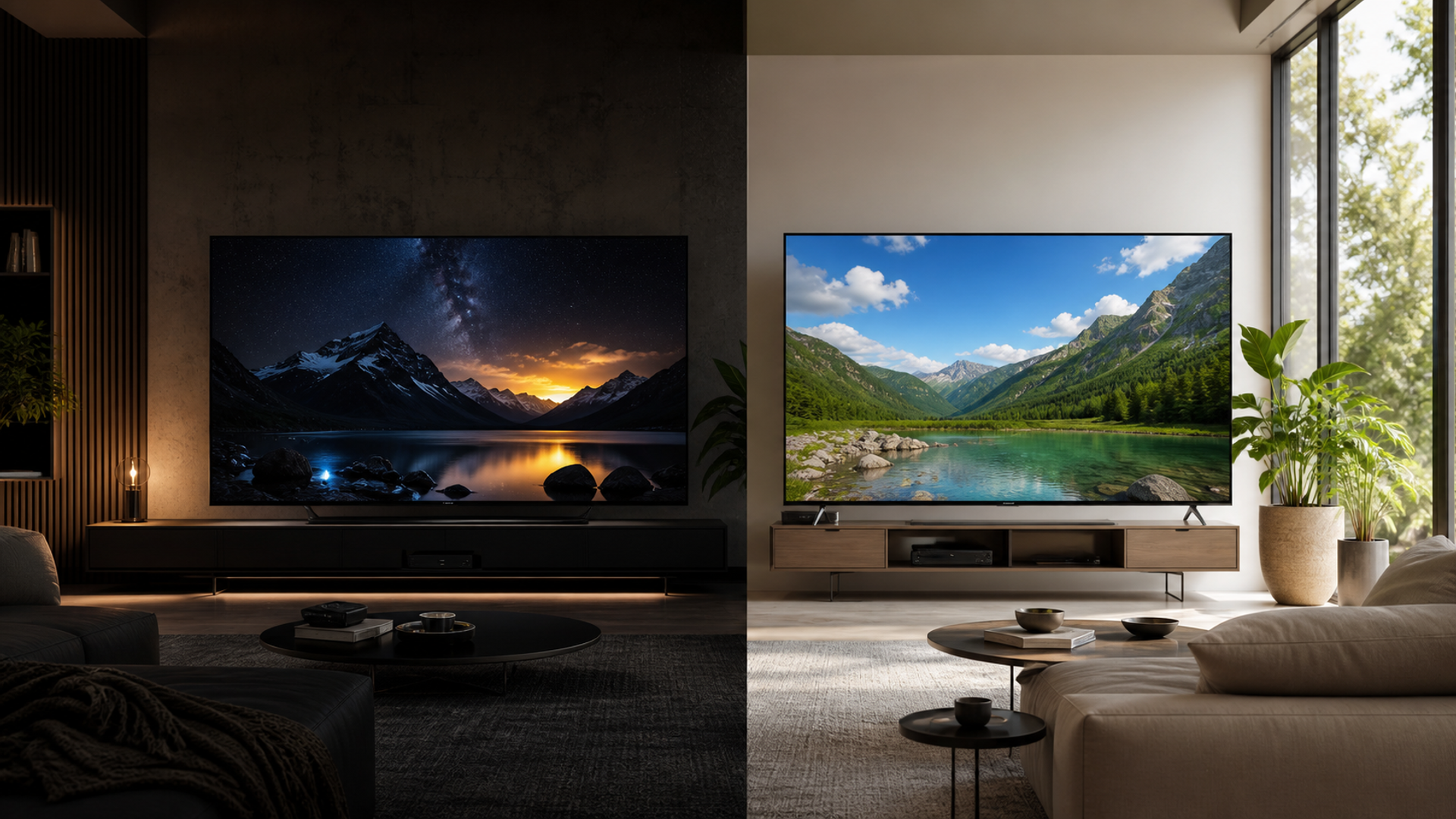
OLED and QLED describe different parts of a television's display system. OLED pixels emit their own light and can switch off individually; QLED televisions use an LCD panel, LED backlight and quantum-dot layer. That architecture influences black level, brightness and viewing angle, but panel generation, anti-reflection treatment, local dimming and processing can outweigh the family label.
Start with the room and content mix
Choose OLED when dark-room cinema, black level, viewing angle and fast pixel response dominate. Choose a strong QLED LCD when sustained brightness, bright-room sports and static-content use lead. Choose by exact model when room reflections, size, local dimming, gaming ports, warranty or price are more decisive than display architecture.
| Decision factor | OLED | QLED LCD | Choose by exact model |
|---|---|---|---|
| Room light | Controlled light supports OLED contrast | Bright daylight rewards sustained luminance | Anti-reflection is tested in the room |
| Black level | Per-pixel control is the priority | Local dimming is sufficient for the content | Exact scenes decide |
| Viewing angle | Wide seating needs stable off-axis image | Seats remain near the centre | The final installation is simulated |
| Content | Films and varied gaming dominate | Sports, news and bright television dominate | Mixed use is measured |
| Static elements | Usage and protection features are acceptable | Long static use favours LCD comfort | Warranty and habits decide |
| Installation | Thin panel and connections fit safely | Brightness and size fit the wall | Mount, sound and cable cost lead |
This oled vs qled matrix is the article's working value object. Read the oled vs qled rows together: the decisive failure mode depends on this topic's evidence, operating context and reader objective.
How OLED and QLED make the image
Evidence 1. LG describes OLED as self-emissive: individual pixels create light without a conventional backlight and can turn off for black.
Evidence 2. Samsung describes QLED televisions as LCD-based displays using a quantum-dot layer and LED backlight to expand colour and brightness.
Evidence 3. QLED is not one backlight system; edge lighting, full-array local dimming and Mini-LED implementations can perform differently.
Evidence 4. Burn-in risk, peak brightness, gaming support and warranty are model- and usage-specific, so architecture alone cannot settle the purchase.
Reader-visible sources checked for this article:
lg.com — reader-visible current or official evidence
samsung.com — reader-visible current or official evidence
For oled vs qled, these sources establish only the claims inside their documented scope. Recheck every changeable specification, availability condition, price, policy or service term in the relevant market before acting.
Compare exact models in realistic light
On room light, popularity is not enough. The evidence for option one is that controlled light supports OLED contrast. Option two means bright daylight rewards sustained luminance. Option three is rational where anti-reflection is tested in the room. Recheck any changeable term immediately before commitment.
The decision changes at black level. Choose the first path only if per-pixel control is the priority; move to the second when local dimming is sufficient for the content; use the third when exact scenes decide. Save the downside that would make this row fail.
For viewing angle, the first route works when wide seating needs stable off-axis image; the second requires seats remain near the centre. The control for the third is the final installation is simulated. Verify this row against the exact product, property, account or environment before it can reverse the decision.
The content row exposes a practical boundary. Route one assumes films and varied gaming dominate, while route two is defensible only when sports, news and bright television dominate. Route three depends on mixed use is measured. If that evidence is absent, keep the more reversible option.
Read static elements as a stop/go test: usage and protection features are acceptable supports the first option; long static use favours LCD comfort supports the second; and warranty and habits decide supports the third. Record which source proves the condition and when it was checked.
A buyer can resolve installation without starting from a brand preference. Ask whether thin panel and connections fit safely; compare that with whether brightness and size fit the wall; then use mount, sound and cable cost lead as the third route's safeguard. An unknown condition stays unknown.
Facts that would reverse the current choice
Reversal control 1 — Room light. Before choosing OLED, write down how the decision changes if “Controlled light supports OLED contrast” proves false. Do the same for QLED LCD and “Bright daylight rewards sustained luminance”. Keep the Choose by exact model route available until “Anti-reflection is tested in the room” is verified. This control belongs to oled vs qled; update it from the cited source or exact supplier rather than copying a generic checklist.
Reversal control 2 — Black level. Before choosing OLED, write down how the decision changes if “Per-pixel control is the priority” proves false. Do the same for QLED LCD and “Local dimming is sufficient for the content”. Keep the Choose by exact model route available until “Exact scenes decide” is verified. This control belongs to oled vs qled; update it from the cited source or exact supplier rather than copying a generic checklist.
Reversal control 3 — Viewing angle. Before choosing OLED, write down how the decision changes if “Wide seating needs stable off-axis image” proves false. Do the same for QLED LCD and “Seats remain near the centre”. Keep the Choose by exact model route available until “The final installation is simulated” is verified. This control belongs to oled vs qled; update it from the cited source or exact supplier rather than copying a generic checklist.
Reversal control 4 — Content. Before choosing OLED, write down how the decision changes if “Films and varied gaming dominate” proves false. Do the same for QLED LCD and “Sports, news and bright television dominate”. Keep the Choose by exact model route available until “Mixed use is measured” is verified. This control belongs to oled vs qled; update it from the cited source or exact supplier rather than copying a generic checklist.
Reversal control 5 — Static elements. Before choosing OLED, write down how the decision changes if “Usage and protection features are acceptable” proves false. Do the same for QLED LCD and “Long static use favours LCD comfort”. Keep the Choose by exact model route available until “Warranty and habits decide” is verified. This control belongs to oled vs qled; update it from the cited source or exact supplier rather than copying a generic checklist.
Reversal control 6 — Installation. Before choosing OLED, write down how the decision changes if “Thin panel and connections fit safely” proves false. Do the same for QLED LCD and “Brightness and size fit the wall”. Keep the Choose by exact model route available until “Mount, sound and cable cost lead” is verified. This control belongs to oled vs qled; update it from the cited source or exact supplier rather than copying a generic checklist.
Measure the room at viewing time
Record daylight, lamps, reflections, seating angles and viewing distance during the hours the television is actually used.
Bring a controlled scene set
Compare dark films, bright sports, subtitles, low-bitrate streaming and a game. Disable exaggerated retail modes before recording impressions.
Inspect model-level specifications
Verify panel, local dimming, anti-reflection layer, HDMI bandwidth, refresh modes, stand, wall mount and warranty for the exact size.
Price the complete cinema
Include mount, installation, sound, cables, furniture and light control. A less expensive panel can become the better room after the full system is counted.
Three viewing rooms
Dark dedicated film room
OLED can win when deep black and off-axis consistency define the experience. Define the fact that would reverse this recommendation before committing.
Sunlit family room with sport
A bright QLED LCD can be easier to live with when reflections and sustained luminance dominate. Define the fact that would reverse this recommendation before committing.
Mixed gaming and television
Exact input support, processing, static use and warranty should decide between specific models. Define the fact that would reverse this recommendation before committing.
Action checklist
Measure room light.
Map seating angles.
Test reflections.
Compare controlled scenes.
Verify local dimming.
Check HDMI ports.
Review static-content habits.
Read warranty terms.
Price installation.
Save exact model numbers.
Continue the decision
The linked VERTU articles expand adjacent parts of the oled vs qled decision. They do not substitute for the external evidence above.
The premium-TV verdict
Choose OLED when dark-room cinema, black level, viewing angle and fast pixel response dominate. Choose a strong QLED LCD when sustained brightness, bright-room sports and static-content use lead. Choose by exact model when room reflections, size, local dimming, gaming ports, warranty or price are more decisive than display architecture.
Keep the oled vs qled decision reversible until its material cost, safety, access, privacy and compatibility facts are verified. Unknown evidence stays unknown; it is never silently scored as favourable.
Final oled vs qled pre-commitment control
For oled vs qled, record the exact option and the one matrix row that actually decides the purchase. Repeat that topic's own test using the intended wrist, room, bag load, road, software, stone, garment or itinerary. Name the evidence that would reverse the oled vs qled conclusion, then date the manufacturer, programme, jeweller or maker source used for that evidence.
Save the specific oled vs qled configuration assessed, including its market, seller, warranty and return route. If a material dimension, movement, benefit, accessory, setting, construction detail or specification changes, reopen the comparison. The final log must explain why the rejected option lost on this reader's decisive constraint rather than on brand familiarity or one attractive image.
![How to Scan Receipts and Documents with Your Phone [Full Guide]](https://cdn.sanity.io/images/e0gp1l2g/production/0db13feec1d5e72b8a8a5f976d1f3e86619c9228-3840x1860.webp?w=180&h=180&q=78&auto=format&fit=crop)
![How to Scan Receipts and Documents with Your Phone [Full Guide]](https://cdn.sanity.io/images/e0gp1l2g/production/0db13feec1d5e72b8a8a5f976d1f3e86619c9228-3840x1860.webp?w=800&h=450&q=82&auto=format&fit=crop)
![Top 10 Two-Tone Carbon-Fibre Watches for Men [2026 List]](https://cdn.sanity.io/images/e0gp1l2g/production/18870799ba33fab0e038968359cd5772d7d7db30-1024x576.webp?w=800&h=450&q=82&auto=format&fit=crop)
![Top 10 Luxury Watches with Digital Complication Displays for Men [Latest]](https://cdn.sanity.io/images/e0gp1l2g/production/c4f6bf8c080f291c39f7cc85c7344ecff2fd3799-1024x553.webp?w=800&h=450&q=82&auto=format&fit=crop)