

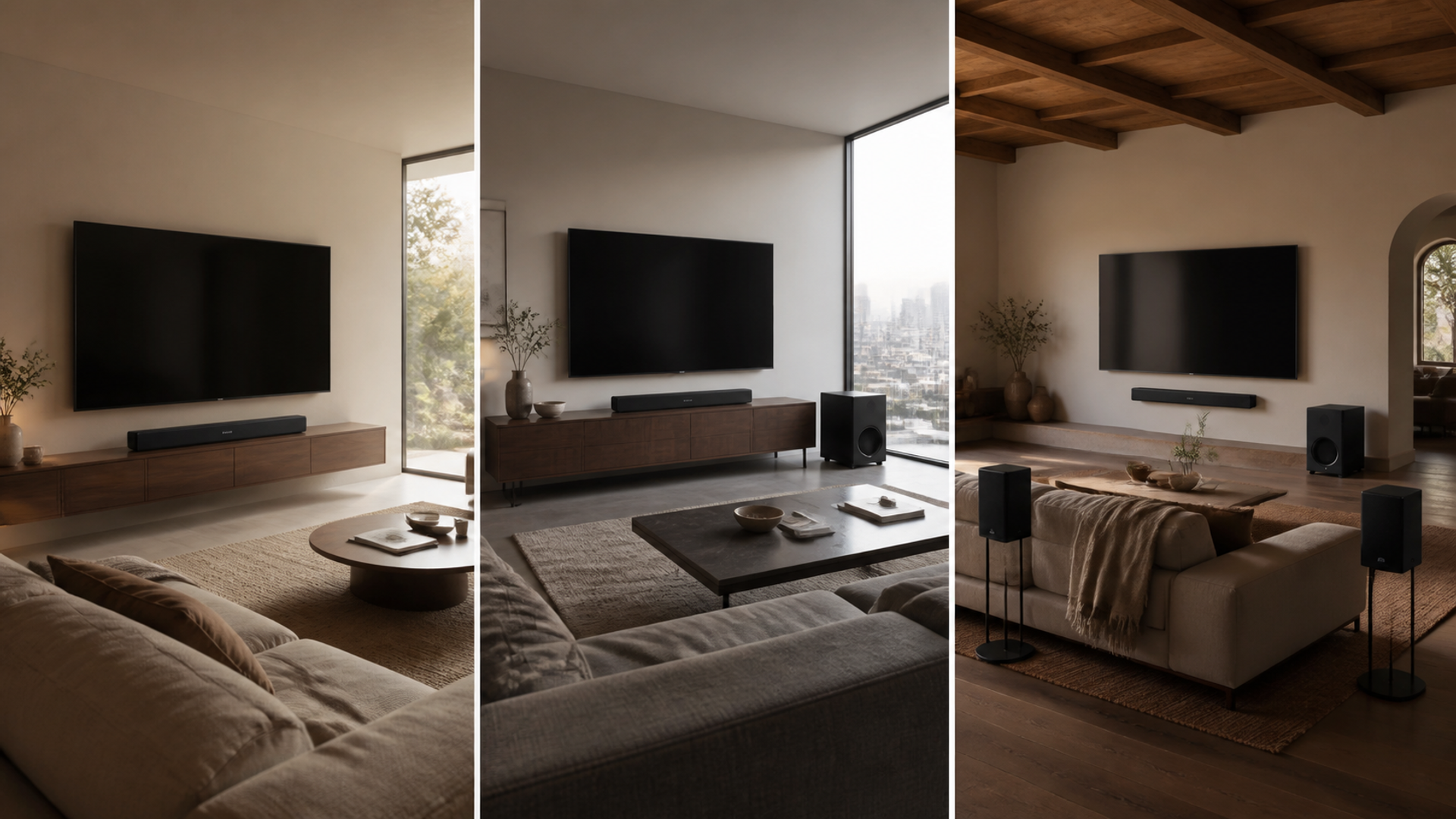
The best soundbar is the one that solves the room's real problem. For some homes that means clearer dialogue at moderate volume; for others it means convincing height effects without a full wired theatre. Channel numbers and format badges help, but wall distance, ceiling geometry, seating position, subwoofer placement and television connections determine what arrives at the sofa.
The short answer by room
Choose an all-in-one bar for clean installation and dialogue, a bar-plus-subwoofer system when controlled low bass matters, or a bar with physical rear speakers when surround envelopment is the objective and the room can support extra power and placement. Confirm HDMI eARC behaviour with the exact television and source devices before buying.
| Decision factor | All-in-one bar | Bar with subwoofer | Bar with rear speakers |
|---|---|---|---|
| Main objective | Dialogue and simplicity dominate | Low-frequency scale is wanted | Physical surround is the priority |
| Room geometry | Regular ceiling supports processing | Subwoofer position can be tested | Rear power and placement are available |
| Television link | ARC or eARC supports required formats | eARC and lip-sync are confirmed | Source routing supports the full system |
| Neighbour tolerance | Moderate bass and night mode matter | Bass can be contained and calibrated | Multiple speakers will not disturb adjacent rooms |
| Music use | Balanced stereo playback is acceptable | Bass integration suits music | Surround system can switch cleanly to music |
| Ownership complexity | One device and one cable are preferred | Wireless sub and app setup are acceptable | Updates, pairing and extra hardware are acceptable |
This best soundbars 2026 matrix is the article's working value object. Read the best soundbars 2026 rows together: the decisive failure mode depends on this topic's evidence, operating context and reader objective.
Read audio formats without being misled
Evidence 1. Dolby explains that Atmos carries object-based audio and height information, but playback results depend on the reproduction system and room rather than the badge alone.
Evidence 2. HDMI Licensing describes eARC as supporting higher-bandwidth audio and additional control features compared with earlier ARC implementations; both connected devices and cables must support the intended path.
Evidence 3. Samsung's current HW-Q990F specification identifies a soundbar package with subwoofer, rear components, HDMI ARC and immersive-format support, illustrating the hardware-heavy surround route.
Evidence 4. Sennheiser's AMBEO Soundbar Plus manual lists format support and shows that lossless immersive formats depend on an eARC-capable connection and compatible source chain.
Reader-visible sources checked for this article:
dolby.com — reader-visible current or official evidence
hdmi.org — reader-visible current or official evidence
images.samsung.com — reader-visible current or official evidence
cdn.sennheiser-hearing.com — reader-visible current or official evidence
For best soundbars 2026, these sources establish only the claims inside their documented scope. Recheck every changeable specification, availability condition, price, policy or service term in the relevant market before acting.
Map speakers, sockets and reflections first
Read main objective as a stop/go test: dialogue and simplicity dominate supports the first option; low-frequency scale is wanted supports the second; and physical surround is the priority supports the third. Record which source proves the condition and when it was checked.
A buyer can resolve room geometry without starting from a brand preference. Ask whether regular ceiling supports processing; compare that with whether subwoofer position can be tested; then use rear power and placement are available as the third route's safeguard. An unknown condition stays unknown.
On television link, popularity is not enough. The evidence for option one is that aRC or eARC supports required formats. Option two means eARC and lip-sync are confirmed. Option three is rational where source routing supports the full system. Recheck any changeable term immediately before commitment.
The decision changes at neighbour tolerance. Choose the first path only if moderate bass and night mode matter; move to the second when bass can be contained and calibrated; use the third when multiple speakers will not disturb adjacent rooms. Save the downside that would make this row fail.
For music use, the first route works when balanced stereo playback is acceptable; the second requires bass integration suits music. The control for the third is surround system can switch cleanly to music. Verify this row against the exact product, property, account or environment before it can reverse the decision.
The ownership complexity row exposes a practical boundary. Route one assumes one device and one cable are preferred, while route two is defensible only when wireless sub and app setup are acceptable. Route three depends on updates, pairing and extra hardware are acceptable. If that evidence is absent, keep the more reversible option.
Facts that would reverse the current choice
Reversal control 1 — Main objective. Before choosing All-in-one bar, write down how the decision changes if “Dialogue and simplicity dominate” proves false. Do the same for Bar with subwoofer and “Low-frequency scale is wanted”. Keep the Bar with rear speakers route available until “Physical surround is the priority” is verified. This control belongs to best soundbars 2026; update it from the cited source or exact supplier rather than copying a generic checklist.
Reversal control 2 — Room geometry. Before choosing All-in-one bar, write down how the decision changes if “Regular ceiling supports processing” proves false. Do the same for Bar with subwoofer and “Subwoofer position can be tested”. Keep the Bar with rear speakers route available until “Rear power and placement are available” is verified. This control belongs to best soundbars 2026; update it from the cited source or exact supplier rather than copying a generic checklist.
Reversal control 3 — Television link. Before choosing All-in-one bar, write down how the decision changes if “ARC or eARC supports required formats” proves false. Do the same for Bar with subwoofer and “eARC and lip-sync are confirmed”. Keep the Bar with rear speakers route available until “Source routing supports the full system” is verified. This control belongs to best soundbars 2026; update it from the cited source or exact supplier rather than copying a generic checklist.
Reversal control 4 — Neighbour tolerance. Before choosing All-in-one bar, write down how the decision changes if “Moderate bass and night mode matter” proves false. Do the same for Bar with subwoofer and “Bass can be contained and calibrated”. Keep the Bar with rear speakers route available until “Multiple speakers will not disturb adjacent rooms” is verified. This control belongs to best soundbars 2026; update it from the cited source or exact supplier rather than copying a generic checklist.
Reversal control 5 — Music use. Before choosing All-in-one bar, write down how the decision changes if “Balanced stereo playback is acceptable” proves false. Do the same for Bar with subwoofer and “Bass integration suits music”. Keep the Bar with rear speakers route available until “Surround system can switch cleanly to music” is verified. This control belongs to best soundbars 2026; update it from the cited source or exact supplier rather than copying a generic checklist.
Reversal control 6 — Ownership complexity. Before choosing All-in-one bar, write down how the decision changes if “One device and one cable are preferred” proves false. Do the same for Bar with subwoofer and “Wireless sub and app setup are acceptable”. Keep the Bar with rear speakers route available until “Updates, pairing and extra hardware are acceptable” is verified. This control belongs to best soundbars 2026; update it from the cited source or exact supplier rather than copying a generic checklist.
Start with dialogue at the real listening volume
Play a familiar drama at the volume used after dinner. Listen for consonants, centre-image stability and whether background music masks speech. Dialogue enhancement can help, but excessive processing may make voices unnatural. Compare the standard, voice and night modes, then ask whether the improvement survives several seats. A system that sounds spectacular in a short action demo may still fail the daily television test that justified the purchase.
Model the complete HDMI path
List every source: television apps, streaming box, disc player, console and music service. Record which device decodes each format, whether the television passes it, and how lip-sync behaves. Some systems provide extra HDMI inputs; others depend entirely on television eARC. Confirm control with the actual remote, standby behaviour and fallback when an update changes HDMI negotiation. Cable access should remain possible after cabinetry is finished.
Use room correction as a measurement, not magic
Calibration can compensate for level and timing, but it cannot create a missing rear speaker or fix a subwoofer trapped in a severe null. Measure bar height, distance from screen, ceiling shape and listening position. Keep upward-firing drivers clear of shelves. Test at least two subwoofer positions and avoid assuming the visually neat corner is acoustically best. Curtains, rugs and open-plan spaces change reflections and perceived clarity.
Plan the ownership experience
Check app account requirements, update policy, replacement remotes, warranty and service in the target market. Decide whether family members can use the system without a phone. Save calibration settings and photograph cable connections. If the television or room will change soon, favour a system that can be repositioned or expanded. The expensive system is not automatically the durable one if it depends on one fragile app or proprietary connection.
Three rooms that need different systems
The apartment living room
An all-in-one bar can deliver clearer dialogue and a clean installation where deep bass and rear speakers would create more problems than value. Define the fact that would reverse this recommendation before committing.
The open-plan cinema corner
A separate subwoofer is defensible when its position can be calibrated and the room needs scale without running speaker wire. Define the fact that would reverse this recommendation before committing.
The dedicated media room
Physical rears earn their complexity when seats, sockets and walls allow stable placement and immersive films are a genuine priority. Define the fact that would reverse this recommendation before committing.
Action checklist
Identify the room's main listening problem.
Measure television, shelf and ceiling clearance.
List source devices and required audio formats.
Confirm ARC or eARC on every link.
Test dialogue at normal volume.
Test two subwoofer positions.
Plan power for bar, sub and rears.
Check app-free daily control.
Verify warranty and local service.
Retain access to cables after installation.
Continue the decision
The linked VERTU articles expand adjacent parts of the best soundbars 2026 decision. They do not substitute for the external evidence above.
The soundbar verdict
Choose an all-in-one bar for clean installation and dialogue, a bar-plus-subwoofer system when controlled low bass matters, or a bar with physical rear speakers when surround envelopment is the objective and the room can support extra power and placement. Confirm HDMI eARC behaviour with the exact television and source devices before buying.
Keep the best soundbars 2026 decision reversible until its material cost, safety, access, privacy and compatibility facts are verified. Unknown evidence stays unknown; it is never silently scored as favourable.
![How to Scan Receipts and Documents with Your Phone [Full Guide]](https://cdn.sanity.io/images/e0gp1l2g/production/0db13feec1d5e72b8a8a5f976d1f3e86619c9228-3840x1860.webp?w=180&h=180&q=78&auto=format&fit=crop)
![How to Scan Receipts and Documents with Your Phone [Full Guide]](https://cdn.sanity.io/images/e0gp1l2g/production/0db13feec1d5e72b8a8a5f976d1f3e86619c9228-3840x1860.webp?w=800&h=450&q=82&auto=format&fit=crop)
![Top 10 Two-Tone Carbon-Fibre Watches for Men [2026 List]](https://cdn.sanity.io/images/e0gp1l2g/production/18870799ba33fab0e038968359cd5772d7d7db30-1024x576.webp?w=800&h=450&q=82&auto=format&fit=crop)
![Top 10 Luxury Watches with Digital Complication Displays for Men [Latest]](https://cdn.sanity.io/images/e0gp1l2g/production/c4f6bf8c080f291c39f7cc85c7344ecff2fd3799-1024x553.webp?w=800&h=450&q=82&auto=format&fit=crop)