

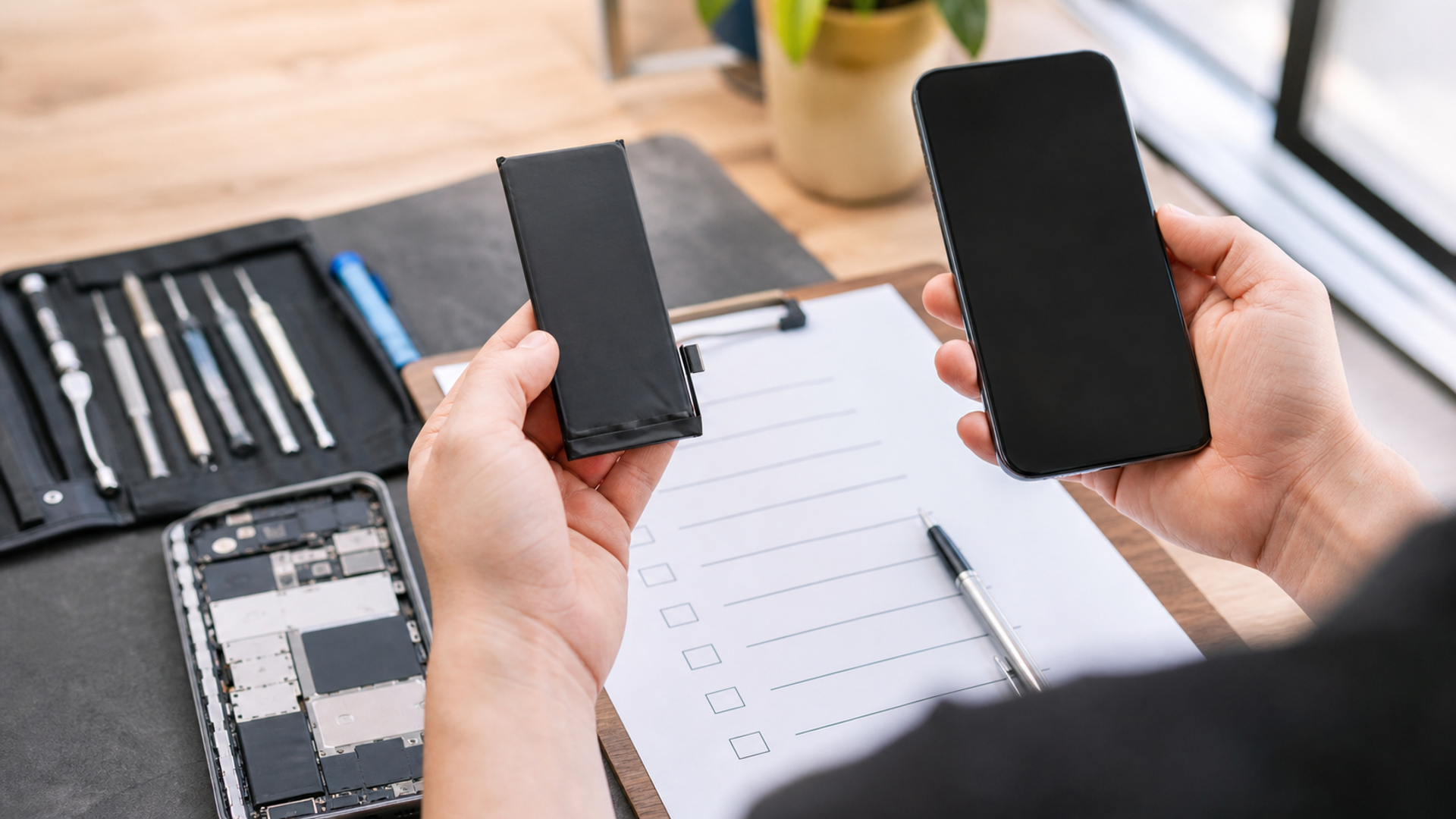
Replace the battery when battery life is the phone’s only serious problem, the device still receives the updates you need, the rest of the hardware is sound and a qualified repair route can restore sealing and reliability. Replace the phone when the weak battery is one item in a larger list: cracked frame, damaged display, unreliable port, insufficient storage, expired software support or downtime that costs more than the repair saves.
The decision is not simply “repair is cheaper”. A good battery replacement can extend a capable phone’s useful life. A poor or uneconomic repair can add risk to a device that already fails the owner’s needs. Work through the evidence in order.
Set a decision horizon before comparing quotes. If the repaired phone must remain dependable for another two years, evaluate two years of software support, storage and travel use. A low repair bill is not value when another predictable limitation forces replacement next quarter.
The decision matrix
| Condition | Battery replacement favoured | Phone replacement favoured |
|---|---|---|
| Battery | Short endurance, otherwise stable | Swelling, repeated shutdowns plus other faults |
| Software | Supported for your required period | Security or app support is ending |
| Hardware | Screen, frame, cameras and port are sound | Multiple damaged or unreliable components |
| Performance | Still adequate after restart and storage cleanup | Consistent workload limits remain |
| Storage | Enough free space for updates and work | Capacity cannot support current use |
| Repair route | Authorised or qualified, documented parts and warranty | Unclear part origin, no warranty or no calibration/sealing process |
| Downtime | Backup device and predictable turnaround | Lost access would disrupt travel or business |
| Data | Current verified backup and recovery credentials | Migration is already necessary for broader reasons |
This matrix intentionally separates battery symptoms from general ageing. A phone can feel old because its storage is nearly full, an app is misbehaving or the network is poor. None of those proves the battery needs replacing.
Confirm that the battery is the problem
Look for a consistent pattern: rapid percentage decline under ordinary use, unexpected shutdown at a repeatable charge level, severe performance reduction only when unplugged or a manufacturer battery-health warning. Compare several days, not one heavy travel day with navigation, camera use and weak signal.
Use the phone maker’s built-in battery-health and diagnostics where available. Apple explains battery service and recycling options, while Google provides Pixel battery help. The menus and thresholds vary by model, so do not import an internet percentage from a different device and treat it as a universal verdict.
Stop normal use and charging if the battery appears swollen, the display or back is lifting, the device becomes unusually hot or there is a chemical smell. Do not compress the casing to make it close. Arrange safe, qualified handling.
Calculate the full repair cost
The quoted battery price is only one line. Ask whether the service includes:
diagnosis before replacement;
genuine or documented compatible battery;
adhesives, seals and any required calibration;
post-repair charging and safety tests;
data-handling policy;
collection, shipping and insurance;
repair warranty;
taxes and likely additional findings.
Then add downtime. A travelling executive may need a loan device, secure migration, re-enrolment in corporate management and restoration of authenticators. Those tasks can exceed the physical repair time.
Check the remaining support life
A new battery cannot extend software support. Before repairing, confirm the manufacturer’s current update policy for the exact model and the minimum operating-system version required by banking, corporate, travel and authentication apps.
This is a personal decision, not a universal age limit. A phone used for calls and offline music has a different support burden from a device handling client files, payments and corporate identity. For the latter, an unsupported operating system can outweigh otherwise healthy hardware.
Inspect the rest of the phone as a system
Make one fault list before approving work:
display and touch response;
frame straightness and glass condition;
charging port and cable stability;
microphones, speakers and earpiece;
cameras and focus;
Wi-Fi, Bluetooth, cellular and NFC;
biometric authentication;
buttons and vibration;
storage capacity;
evidence of moisture or previous unauthorised repair.
If the battery is the sole defect, replacement has a strong case. If three other repairs are waiting, obtain a combined estimate. Piecemeal repairs can create repeated downtime and may exceed the value of starting with a supported device.
Preserve privacy during repair
The device may contain more value in data than in hardware. Back it up, verify the backup from another device, and document the accounts needed for recovery. Remove unnecessary sensitive files according to your organisation’s policy. Never hand over a corporate device without the required IT approval.
Ask the repairer whether a passcode is required and why. Some post-repair tests need access to functions; others can be performed without exposing personal content. Agree the process before collection, not across a counter after the phone has been opened.
For an executive device, consider a managed repair state: temporary account sign-out, revoked app sessions, mobile-device-management record, sealed handover and return checks. The right controls depend on the organisation and threat model.
When replacement wins
Replacement is rational when it resolves several constraints at once. Examples include a battery and cracked screen, insufficient storage for current work, no remaining security support, unreliable network bands in the regions you visit, or a repair route that cannot provide confidence in parts and sealing.
Do not replace solely because a new model exists. Define the failure the new phone must solve. Use the five-question business-phone guide to assess support, privacy, service and workflow, and the 256GB/512GB/1TB storage guide if capacity is part of the problem.
A five-step decision tree
Is there a safety sign? Swelling, separation, smoke or abnormal heat moves directly to qualified service.
Is the battery the only material fault? If no, price the whole device condition.
Does the phone have enough software and app-support life? If no, replacement is usually stronger.
Can a trustworthy repair restore the device with warranty and documented parts? If no, do not buy a false economy.
Is the data and downtime plan acceptable? If yes, battery replacement may be the best value; if no, plan a controlled migration.
After the repair
Check the invoice, warranty and stated parts. Test charging, touch, biometrics, cameras, microphones, speakers, cellular connection and any water-resistance claim the service explicitly provides. Do not assume the original resistance rating survives every repair; ask what was tested.
Keep the record with the device. Service history improves future diagnosis and helps a later buyer understand what changed. The best repair decision is one you can explain months later with evidence, not merely the cheapest number offered today.
A note on resale and handover
A documented battery replacement can make a later sale easier to evaluate, but do not advertise “new battery” without the date, provider and invoice. Reset the phone only after the new owner or trade-in process is confirmed, remove activation locks through the official account flow and keep a record that the device left your control. For corporate phones, follow the managed disposal process rather than a consumer trade-in shortcut.
Recycle removed batteries and retired devices through an approved local route. Do not place lithium batteries in household waste or ordinary recycling where local rules prohibit it; the repairer or manufacturer should explain the applicable collection channel.
![How to Scan Receipts and Documents with Your Phone [Full Guide]](https://cdn.sanity.io/images/e0gp1l2g/production/0db13feec1d5e72b8a8a5f976d1f3e86619c9228-3840x1860.webp?w=180&h=180&q=78&auto=format&fit=crop)
![How to Scan Receipts and Documents with Your Phone [Full Guide]](https://cdn.sanity.io/images/e0gp1l2g/production/0db13feec1d5e72b8a8a5f976d1f3e86619c9228-3840x1860.webp?w=800&h=450&q=82&auto=format&fit=crop)
![Top 10 Two-Tone Carbon-Fibre Watches for Men [2026 List]](https://cdn.sanity.io/images/e0gp1l2g/production/18870799ba33fab0e038968359cd5772d7d7db30-1024x576.webp?w=800&h=450&q=82&auto=format&fit=crop)
![Top 10 Luxury Watches with Digital Complication Displays for Men [Latest]](https://cdn.sanity.io/images/e0gp1l2g/production/c4f6bf8c080f291c39f7cc85c7344ecff2fd3799-1024x553.webp?w=800&h=450&q=82&auto=format&fit=crop)