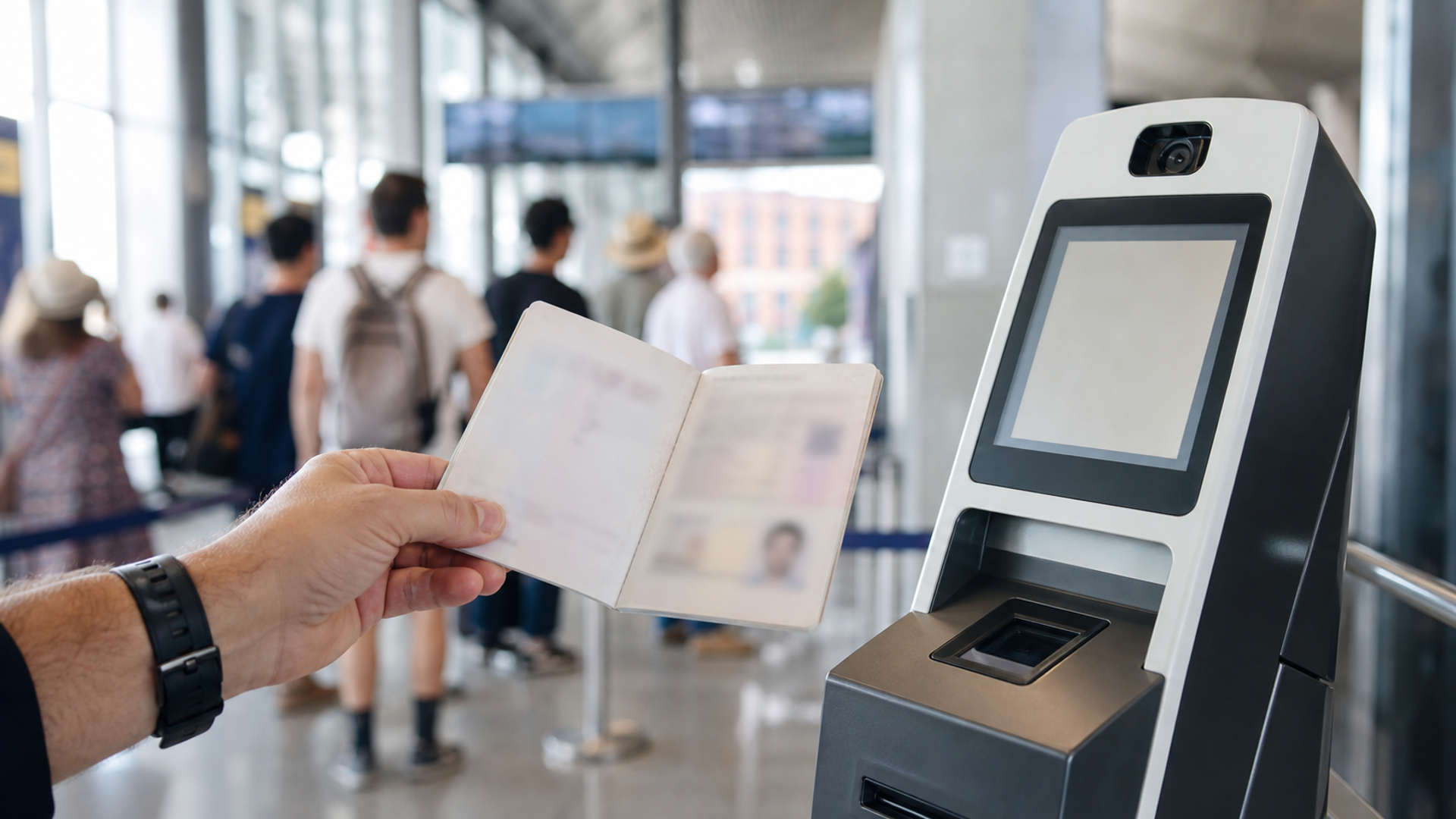
Europe's Entry/Exit System is now part of border control for many non-EU nationals making a short visit to the 29 European countries that use it. On a first EES journey, a traveller may need a facial image and, depending on age and visa status, fingerprints. On later journeys, border staff can verify the existing digital record. The exact sequence depends on who you are and where you cross, so there is no single queue-time promise or universal kiosk routine.
The issue is particularly visible for summer 2026. On 14 July, the UK Department for Transport said ministers were working with the European Commission on the operation of EES during the busy holiday period. Its official update points to additional infrastructure at Dover and continuing concern about passenger flows. It does not guarantee a particular waiting time at any border.
The practical answer is to stop treating “EES” as one extra form. It is a border record, a biometric process and an automated stay calculation. Your preparation should match your traveller type and route.
What EES is—and what it is not
EES electronically records entry, exit and refusal-of-entry information for relevant non-EU nationals travelling for a short stay, normally up to 90 days in any 180-day period. According to the European Union's official EES FAQ, it covers travellers who need a short-stay visa and those who are visa-exempt.
The system began a phased introduction on 12 October 2025 and became fully operational at the external border crossing points of participating countries on 10 April 2026. Ireland and Cyprus are outside the EES area. Several categories of traveller are exempt, including nationals of countries using EES and many holders of residence permits or long-stay visas; the EU publishes a fuller official exemptions list.
EES is not ETIAS. EES is the system used to register relevant border crossings. ETIAS is a separate, future travel-authorisation system for visa-exempt non-EU nationals. The current UK government EES guidance says ETIAS is expected to start operations from autumn 2026 and warns that no traveller action is required for it yet. Do not pay an unofficial site for an ETIAS application before the European Union opens the official service.
Traveller-type matrix: what happens to whom
Use this matrix as a preparation tool, not as a substitute for the decision of a border officer. Eligibility, exemptions and documents can depend on nationality, residence status and the purpose of travel.
| Traveller situation | What EES normally records | Biometric step | What to expect on a later crossing | Preparation priority |
|---|---|---|---|---|
| First EES crossing, visa-exempt non-EU short-stay traveller | Travel-document data, entry/exit details and a digital individual file | Facial image and four fingerprints are normally stored | Existing data can be checked and identity verified; an officer may still ask questions or request biometrics | Allow time for first registration; keep passport and itinerary ready; follow the operator's lane instructions |
| Repeat EES crossing, visa-exempt non-EU short-stay traveller | A new entry or exit is added to the existing record | Identity is verified against stored data; the exact device and sequence vary by border | The record is reused while valid, but it does not remove normal entry checks | Do not assume “registered once” means automatic admission or a fixed processing time |
| Short-stay visa holder | Travel-document and crossing data; facial image | EES stores the facial image; fingerprints already held in the Visa Information System are not stored again in EES | Subsequent crossings use the linked records and normal border checks | Carry the passport containing or linked to the visa and evidence relevant to the trip |
| Visa-free child under 12 | The child is still subject to EES unless another exemption applies | Facial image may be recorded; fingerprints are currently not scanned below age 12 | Identity and travel record can still be checked on later trips | Keep family documents organised; do not interpret the fingerprint exemption as an EES exemption |
| Residence-permit or long-stay-visa holder | Usually outside EES when the official exemption applies | Should present the document that proves exempt status rather than register as a short-stay visitor | Border staff may need to inspect the exemption document | Check the document's validity and carry the physical or officially accepted evidence specified for the route |
| Non-EU family member with free-movement rights | Treatment depends on the residence document, accompanying EU/EEA/Swiss family member and destination | Treatment is document- and circumstance-specific; consult the official EU exemption guidance before travel | Special retention and stay-calculation rules can apply | Read the EU family-member examples and present the relevant residence card or supporting relationship documents |
Two details are easy to miss. First, a short-stay visa holder and a visa-exempt traveller do not have the same EES fingerprint treatment. Second, children under 12 are exempt from fingerprint scanning, not automatically from the system itself.
Border-mode matrix: where registration happens
The same traveller can encounter a different physical process depending on the route. The UK government's operational guidance distinguishes juxtaposed controls in the UK from checks made on arrival in continental Europe.
| Journey mode | Where EES checks normally happen | Operational difference | What not to assume |
|---|---|---|---|
| Eurostar from London St Pancras | Before departure in the UK | Travellers may be directed to self-service pre-registration kiosks before border control | A kiosk result is not the final decision to admit the traveller |
| Eurotunnel Le Shuttle from Folkestone | Before departure in the UK | A purpose-built pre-registration area supports EES processing | The experience and timing will not necessarily match St Pancras or Dover |
| Ferry from the Port of Dover | Before departure in the UK | Checks use the Dover processing arrangements; vehicle and passenger flows affect operations | Government investment does not create a guaranteed maximum queue |
| Air travel from the UK | At the external border on arrival in the destination country | Airport equipment, lanes and staffing differ by location | The airline cannot complete the border officer's EES decision for you |
| Ferry from a UK port other than Dover | Normally on arrival at the destination border | The destination port runs registration and verification | Do not follow Dover-specific instructions for another port |
| Cruise beginning and ending outside the Schengen area | Day visits are usually exempt, but port authorities can require checks in some circumstances | Disembarking permanently, joining within Schengen or continuing by another mode can change the position | “Cruise passenger” is not a universal exemption for every itinerary |
Always follow the current instructions from the carrier, port and destination authority. Self-service equipment may collect or pre-register data, but the passport-control officer retains the border decision.
What data EES holds
The EU's EES data page says the system records travel-document details, the date and place of each entry and exit, facial image and fingerprints where applicable, and whether entry was refused. For short-stay visa holders, fingerprints already held in the Visa Information System are not stored again in EES.
The page also publishes retention periods. Entry, exit and refusal records are generally kept for three years. Individual files containing personal data are generally kept for three years and one day from the last exit or refusal; if no exit is recorded, the period can be five years from the expiry of the authorised stay. Special rules apply to certain family members exercising free-movement rights.
Those distinctions matter if a record is wrong. The EU page explains that travellers have data-protection rights, including routes to request access or correction and to complain to the relevant authorities. Keep enough evidence of your itinerary—boarding passes, tickets and dated accommodation records—to explain a missing or incorrect crossing if a problem appears. This is practical record-keeping, not a suggestion that every traveller should expect an error.
The 48-hour preparation checklist
There is no general EES form that a UK short-stay visitor must complete at home before travelling. Preparation is about documents, timing and route-specific instructions.
1. Confirm that EES applies to you
Check nationality, trip length, visa status and residence documents against the official EU eligibility and exemption pages. Do not rely on a travel companion's status. A British visitor on a short holiday, a British resident of France holding the correct residence document and a child travelling with an EU parent may have different treatment.
2. Check the passport used for the booking
Use the same valid travel document attached to your ticket and visa or residence record. A biometric passport may enable self-service equipment where available, but the EU says a non-biometric passport is not, by itself, a bar to crossing if it is otherwise valid and entry conditions are met. It may prevent use of an automated self-service route.
3. Build a route-specific time buffer
Follow the carrier's recommended arrival time and recheck it close to departure. Add a personal buffer for a first registration, a family group, mobility assistance or a complex itinerary, but do not invent a universal number of extra minutes. The 14 July UK statement describes preparation and infrastructure; it does not publish a guaranteed EES processing time.
For a disruption plan after the border, VERTU's guide to EU air-passenger rights in 2026 separates operational rebooking from compensation questions. If your itinerary is complex, the AI-agent and human-concierge travel disruption matrix helps decide which tasks can be automated and which need a person.
4. Keep essential records available offline
Store the booking reference, accommodation address, return or onward journey and insurance details in a form available without airport Wi-Fi. For multi-country travel, an eSIM, physical SIM or pocket-hotspot plan can help after arrival, but connectivity should not be the only place your border evidence exists.
5. Prepare children without promising a no-touch process
Explain that a camera may take a facial image and that a border officer may ask the family questions. Children under 12 are not currently fingerprinted for EES, but they may still be registered. Keep consent letters or custody documents where the destination or family circumstances require them.
6. Present exemption evidence before registration
The UK guidance tells exempt travellers to show the document proving their status rather than register for EES. If an EES record is created in error, it should be deleted through the relevant border or national authority process. Resolving that at the border may be easier than assuming the record will correct itself.
At the border: a calm sequence
When directed to EES processing:
Present the passport and, where relevant, visa, residence card or exemption evidence.
Use the designated kiosk or booth only as instructed.
Provide the facial image and fingerprints that apply to your traveller category.
Follow the equipment and border officer’s instructions; if displayed personal details appear incorrect, alert a member of staff before proceeding.
Answer the border officer's questions about the purpose, duration and arrangements of the trip.
Keep the travel document accessible again for boarding or onward controls.
Registration is not permission to enter. EES records information and supports border checks; the officer still applies the entry rules. Equally, a repeat traveller should not interpret a request for another photograph or fingerprint as proof that something is wrong. Equipment, data quality and verification needs can vary.
The sensible summer-travel conclusion
EES changes the mechanics of the border, not the fundamentals of a well-prepared journey. Know whether you are in scope, carry the document that proves your status, understand where your route performs the check and keep enough time for the process without relying on an invented queue forecast.
The most useful distinction is simple: EES registration belongs at the border; ETIAS, when officially launched, will be a separate pre-travel authorisation. Keeping those systems separate—and matching your checklist to your actual traveller type—will prevent more confusion than any promise of a “fast” lane.