

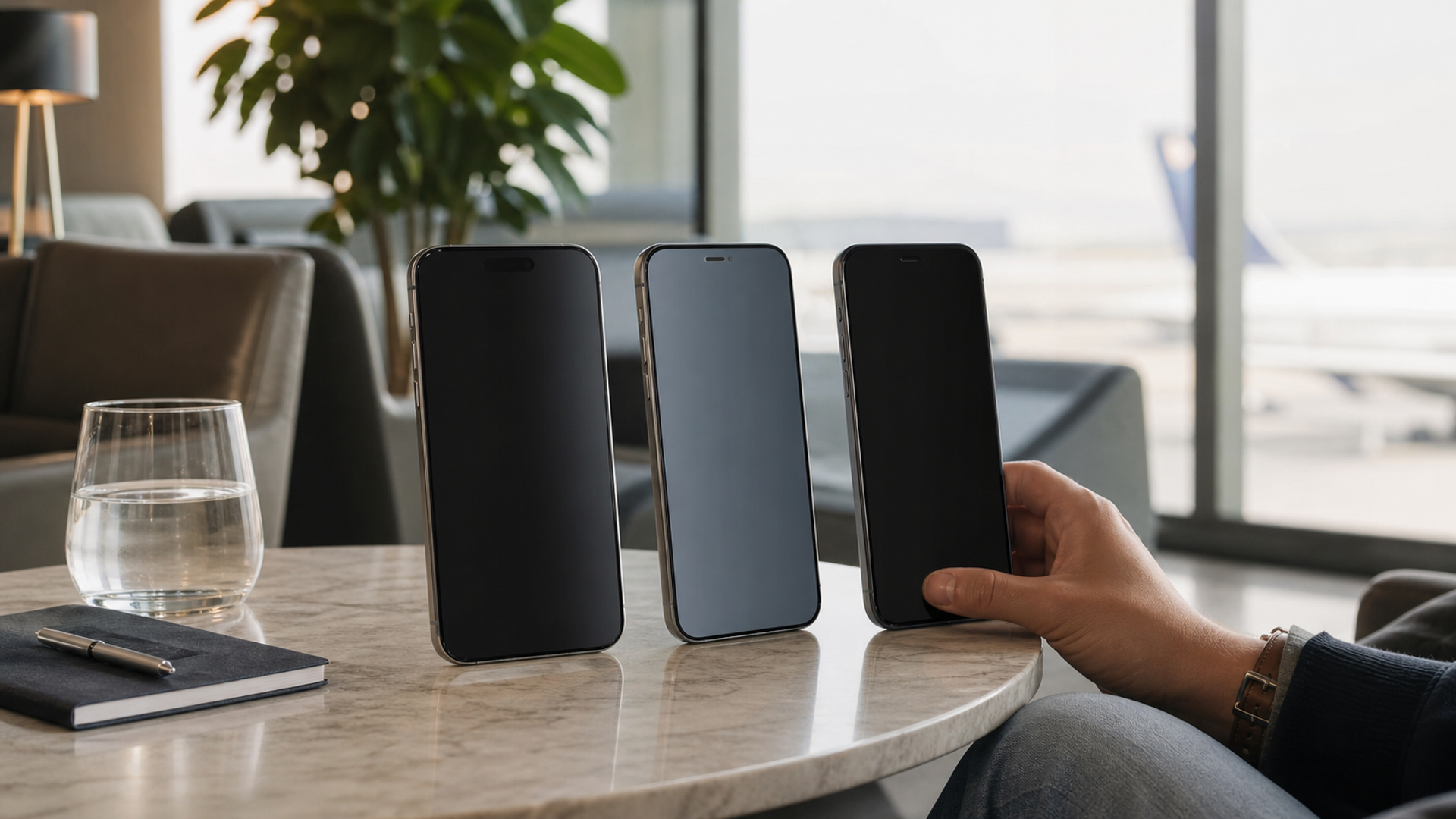
A privacy screen protector is useful when the real problem is someone viewing your display from the side. It is not a complete privacy system. Narrow-view filters trade brightness and viewing flexibility for a smaller readable angle; matte protectors prioritise glare and texture; clear protectors preserve the display most faithfully. The right choice depends on where you use the phone, what you show on it and which compromises you will actually tolerate.
That is the direct answer. The harder part is recognising that “privacy” is used to sell several different products. A darkened side view can reduce casual shoulder surfing, but it cannot stop a person directly behind you, a camera above you, a malicious app, a notification on the lock screen or an unlocked phone left on a table.
The decision matrix
| Type | Side-view reduction | Sharpness and colour | Glare | Shared viewing | Typical fit |
|---|---|---|---|---|---|
| Clear glass/film | Low | Best preservation | Usually reflective | Easy | Owners who mainly want scratch protection |
| Matte/anti-glare | Low to moderate, depending on product | Slight texture or reduced contrast possible | Best of the three | Easy | Bright offices, reading, frequent outdoor use |
| Two-way privacy | Stronger from left/right | May reduce brightness or alter colour off-axis | Product-dependent | Awkward | Commuting, aircraft seats, narrow desks |
| Four-way privacy | Stronger across more angles | Highest visual compromise is common | Product-dependent | Most restrictive | Brief viewing of sensitive data in crowded spaces |
These are category tendencies, not guarantees. Manufacturers use different optical layers and test methods. Ask for an actual viewing-angle specification, compatible model, material, thickness and biometric guidance rather than trusting the words “military”, “HD” or “anti-spy”.
Start with the threat, not the accessory
The US National Institute of Standards and Technology treats privacy as a system of safeguards, not a single film. Its mobile-device guidance emphasises configuration, access controls and organisational policy. A screen filter belongs at the physical-observation layer.
Use this short threat check:
Where is exposure happening? Train, aircraft, café, open office, conference registration desk or hotel lobby?
From which angle? Adjacent seat, standing behind, overhead camera or reflected glass?
What appears on screen? Calendar titles, client names, boarding documents, authentication prompts or full confidential files?
How long is it visible? A two-second notification and a 20-minute spreadsheet create different exposure.
Can the workflow change? Redact a document, use a private room, postpone the task or move it to a larger controlled screen?
If the sensitive content must be visible for a long time in a public place, the most effective decision may be not to open it there. The filter is a friction layer, not permission to ignore context.
Clear protectors: visual quality first
Choose clear protection when display fidelity, camera review, colour work and shared viewing matter more than side-angle reduction. Good clear glass can preserve the original feel and brightness, but fit is crucial. A protector that overlaps sensors, lifts at curved edges or interferes with a case can create more trouble than it prevents.
Check whether the phone maker has model-specific guidance. Google’s official touchscreen troubleshooting explicitly tells users to remove a case or screen protector when diagnosing poor response. That does not mean all protectors cause problems; it means the accessory is a variable worth testing.
Matte protectors: glare control, not secrecy
Matte surfaces diffuse reflections and can make text more comfortable under bright overhead lighting. Some users also prefer the texture for writing or scrolling. The trade-off is that diffusion can soften fine detail or add a subtle grain to light backgrounds.
Matte does not automatically mean private. Some products combine matte and narrow-view layers, but a conventional anti-glare film can remain readable from the side. If the product page does not state a restricted viewing angle, assume it is primarily about reflection and feel.
For travellers, matte can be valuable when glare—not people—is the main obstacle. It may be the better choice for outdoor navigation and long reading sessions where shared viewing is still needed.
Two-way privacy: the practical commuting choice
A two-way filter limits readability primarily from the left and right while keeping the frontal view usable. This aligns with adjacent-seat exposure on trains and aircraft. It also creates the most common frustration: showing a boarding pass, photograph or map to another person becomes awkward.
Brightness may need to increase to compensate for the optical layer, which can affect battery use. Colour and contrast may shift when the phone is even slightly off-axis. Test at the brightness you normally use rather than under a shop’s maximum-brightness display.
Two-way privacy does little against someone looking over your shoulder from directly behind. Combine it with seating awareness, short screen-on time and hidden lock-screen previews.
Four-way privacy: narrower use, larger compromise
Four-way products attempt to restrict viewing above and below as well as left and right. They can suit a person who briefly reviews sensitive text while standing in a queue. They can also make face-level alignment more demanding and interfere with landscape viewing.
For driving navigation, photography, collaborative work and accessibility, the restrictions may be unacceptable. A privacy product that users constantly remove or disable is not a durable control.
Five compatibility checks before buying
1. Fingerprint reader
Under-display optical or ultrasonic readers may require a compatible thickness, installation method or re-enrolment. Follow the phone and protector maker’s instructions. Do not reduce lock security simply to compensate for a poor accessory.
2. Face unlock and proximity sensors
The cut-outs must match the exact model. A generic protector can cover sensors or front-camera elements. Confirm the full model number, not just the marketing family.
3. Case fit
Edge-to-edge glass may lift when a case lip presses against it. A case-compatible protector leaves a controlled gap. Test the final combination, because each part can work alone and fail together.
4. Screen shape
Curved, folding and unusually proportioned displays need model-specific materials and adhesive behaviour. Do not apply a rigid protector to a surface for which it was not designed.
5. Polarised eyewear
Some optical films look unusually dark or show colour effects through polarised sunglasses, especially at a rotated angle. Test portrait and landscape use before a trip.
A better executive privacy stack
| Exposure | Primary control | Supporting control |
|---|---|---|
| Adjacent passenger | Two-way filter | Angle the phone and shorten viewing time |
| Lock-screen messages | Hide sensitive notification content | Use neutral calendar/event naming |
| Unattended phone | Strong screen lock and short auto-lock | Keep the device physically controlled |
| Sensitive document | Redaction or secure workspace | Avoid public viewing where possible |
| Account takeover | Passkeys, authenticator or hardware key | Recovery plan and device inventory |
| Lost device | Find/lock/erase readiness | Carrier and corporate incident contacts |
For authentication choices, see the executive travel security plan. For broader mobile confidentiality, the screen-privacy AI-phone guide explains why software and hardware controls must work together.
What to buy
Choose clear if display quality is the priority and the environment is controlled. Choose matte if glare and tactile comfort are the actual problems. Choose two-way privacy for adjacent-seat exposure. Choose four-way only when the narrower cone solves a frequent, specific risk and you have tested accessibility, biometrics and landscape use.
Then verify the filter under real conditions: normal brightness, your case, your sunglasses, your authentication method and the seat angle you actually encounter. Privacy that exists only in packaging copy is not a control.
![How to Scan Receipts and Documents with Your Phone [Full Guide]](https://cdn.sanity.io/images/e0gp1l2g/production/0db13feec1d5e72b8a8a5f976d1f3e86619c9228-3840x1860.webp?w=180&h=180&q=78&auto=format&fit=crop)
![How to Scan Receipts and Documents with Your Phone [Full Guide]](https://cdn.sanity.io/images/e0gp1l2g/production/0db13feec1d5e72b8a8a5f976d1f3e86619c9228-3840x1860.webp?w=800&h=450&q=82&auto=format&fit=crop)
![Top 10 Two-Tone Carbon-Fibre Watches for Men [2026 List]](https://cdn.sanity.io/images/e0gp1l2g/production/18870799ba33fab0e038968359cd5772d7d7db30-1024x576.webp?w=800&h=450&q=82&auto=format&fit=crop)
![Top 10 Luxury Watches with Digital Complication Displays for Men [Latest]](https://cdn.sanity.io/images/e0gp1l2g/production/c4f6bf8c080f291c39f7cc85c7344ecff2fd3799-1024x553.webp?w=800&h=450&q=82&auto=format&fit=crop)