


Key takeaways
The figure most people quote in 2026 is ~$48.5 million, tied to the Falcon Supernova iPhone 6 Pink Diamond—but public sale verification is limited.
In the ultra-luxury tier, “price” can mean maker list price, insured value, private-sale number, or a public auction result. Those are not interchangeable.
Materials matter, but so do the quiet multipliers: craftsmanship, provenance, aftercare, security posture, and service logistics.
If you’re buying in the US, your protection comes from lab reports + appraisal standards + chain-of-custody discipline, not headlines.
Introduction
You want the clearest answer on the price of the most expensive phone in the world in 2026.
Most sources cite ~$48.5M for the Falcon Supernova iPhone 6 Pink Diamond, but sale verification is lacking.
Most coverage repeats the figure as a reported price without showing a public transaction record—see the Indian Express write-up on the “reported $48.5 million” device.
Prices vary at this level because you’re not buying “a phone” in the conventional sense. You’re buying a composite object: gemstones, precious metals, craftsmanship, provenance, services, and scarcity.
This guide explains today’s record context, value drivers, and a practical buyer checklist for US readers.
Current record and market context: price of the most expensive phone in the world in 2026
The $48.5M “most expensive phone” claim
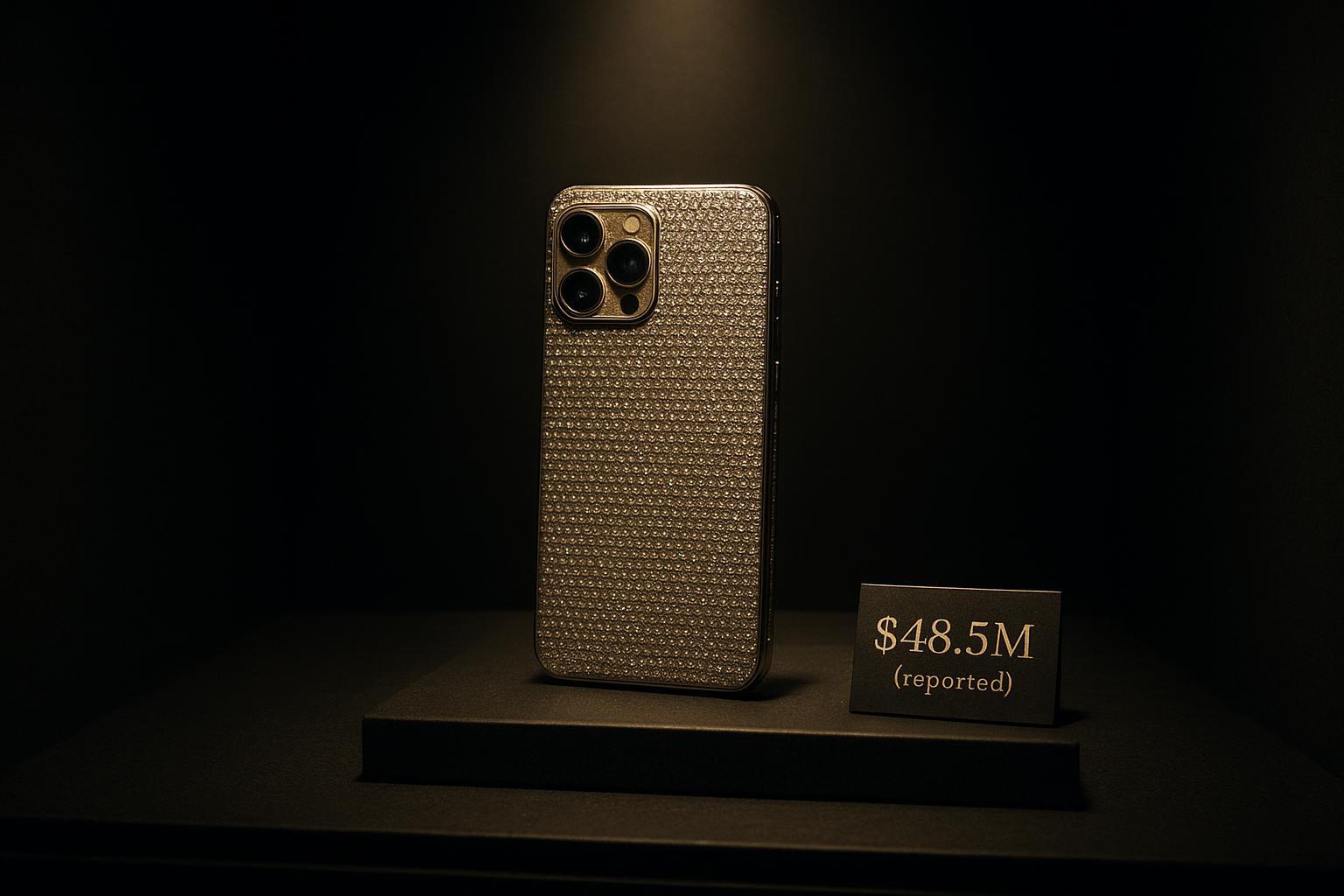
The most repeated number you’ll see attached to the phrase “most expensive phone in the world” is $48.5 million, usually attributed to a customized iPhone described as the Falcon Supernova iPhone 6 Pink Diamond.
What matters in 2026 isn’t whether the object exists—it likely does—but what the price actually represents.
In most coverage, $48.5M appears as a reported figure, paired with descriptions of a pink diamond and precious-metal casing. For example, Indian Express describes the phone and repeats the $48.5M figure, but does not provide an auction result, bill of sale, or other public transaction evidence (Indian Express, 2025).
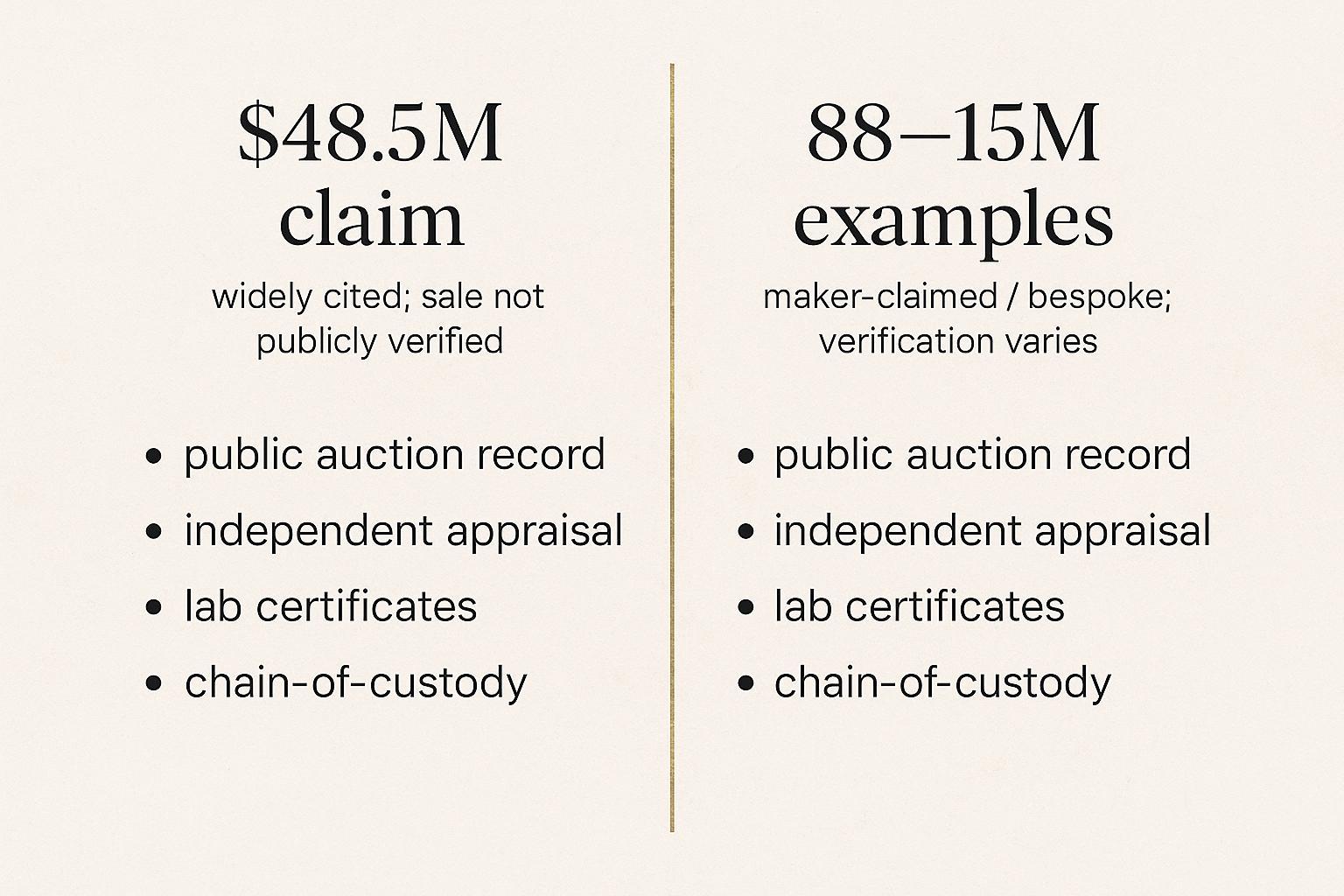
So the clean way to hold the record claim in your head is:
“Widely cited” does not automatically mean “publicly verified.”
A headline number can be a maker’s stated price, a press-friendly valuation, or a private transaction value that never becomes public.
Key Takeaway: In 2026, the ~$48.5M figure is best treated as a reported valuation/list price, not a confirmed public sale price.
Verifiable high-value examples and their limits
If you want verification, your benchmark is simple: Can you point to a documented transaction or a credible paper trail?
In the luxury-object world, “verifiable” usually means one (or more) of the following:
a public auction record (with lot details, condition report, and final price)
independent lab documents for stones (diamond/gem reports)
a professional appraisal with stated purpose and methodology
a chain-of-custody story you can audit (seller → intermediary → you)
The catch: many ultra-high-value phones are commissioned pieces, not catalog products. That makes their “market price” inherently blurry. Even when documentation exists, it may confirm materials and craftsmanship more readily than it confirms the exact number paid.
This is why you’ll often see a second tier of “multi-million” phone examples presented with ranges. In practice, those ranges frequently reflect:
maker-claimed pricing
insured replacement values
one-off private deals that aren’t disclosed
The limit is structural: privacy is part of the product. You can’t expect perfect transparency, but you can demand enough documentation to protect yourself.
How to interpret unverified prices in 2026
When you see a record-price claim in 2026, translate it into the four most likely meanings:
List price (maker-stated)
Useful as an anchor, but not proof of what someone paid.
Insured replacement value
Often higher than what the secondary market would pay.
Private-sale price
Real, but usually undisclosed.
Public-auction price
The cleanest public verification standard—when it exists.
If you’re a buyer, you don’t need the internet to agree on a single number. You need a framework that makes it difficult for someone to sell you a story.
What drives ultra-high prices
Gemstones and precious metals fundamentals
At the top end, the “phone” is the chassis; the value is the stone and the metalwork.
A useful mental model is to separate:
intrinsic value (gold weight, stone quality)
execution value (how well it’s set, finished, and protected)
narrative value (provenance, scarcity, who commissioned it)
For gemstones, certification is the line between “rare” and “allegedly rare.”
GIA’s consumer guidance is explicit: “For added security, you can verify a GIA grading report using the online Report Check tool, which will confirm that the information on the report matches the GIA database” (GIA 4Cs, Tips for Online Diamond Buying).
For precious metals, you’re looking at:
the metal itself (gold/platinum)
hallmarks (a baseline, not a guarantee)
construction quality (edges, seams, tolerances)
The practical point: at record-level pricing, you’re not “paying for sparkle.” You’re paying for verifiable rarity.
Craftsmanship, scarcity, and provenance
Two phones can contain similar materials and still be priced worlds apart. The multiplier is craftsmanship and scarcity.
Look for signs of serious build integrity:
precision in stone setting (uniform pavé, clean prongs, no uneven spacing)
finishing consistency (no soft edges where hard edges should be)
integration (stones and metalwork designed as one object, not a retrofit)
Scarcity is often presented as “only X pieces.” Your job is to turn that into evidence.
Ask for:
production documentation (limited-edition numbering, maker letter)
original packaging and service documentation
repair/service history (yes, even for a phone)
Provenance is where value becomes real.
A serious appraisal will document identifying details—marks, signatures, condition, and provenance—and state what the number means (fair market vs replacement value). That distinction becomes crucial when a seller is quoting an “insurance number” as if it were a market clearing price.
Services, privacy, and lifetime support
At the ultra-luxury level, services aren’t a bonus. They are part of the valuation logic.
What you’re effectively buying is a support perimeter:
secure provisioning and setup
authenticated repairs and parts
confidentiality in logistics
long-term support when mainstream devices age out
This is also where the phone category splits in two:
jewelry-first objects (the device is almost incidental)
tool-first luxury devices (the device is intended for real daily use, with privacy and support layered on top)
Either way, “lifetime support” should be treated like provenance: ask what’s included, what’s excluded, and what is documented.
Buyer’s guide: US due diligence
Authenticate gems and metals (GIA/IGI, hallmarks)
Start with a simple rule: no lab report, no confidence.
For diamonds and many gemstones:
GIA’s “get rich quick” warning is blunt: “Insist on a world-recognized, independent, grading report like GIA’s for any gemstone purchase.” (GIA, Gem Buyers Beware: Get Rich Quick Scams)
For IGI reports, IGI provides a public verification workflow (report number / QR / upload) via its own portal (IGI, Verify Your Report). Treat any lab report as one layer of verification—not the entire due-diligence stack.
For metals:
inspect hallmarks and compare them to known standards
verify weight and construction (a jeweler with the right tools can help)
treat “plating” versus solid precious metal as a different category entirely
How to verify: Match the physical item to the paperwork. Report numbers, measurements, inscriptions, and photographs should all agree.
Appraisals, insurance, taxes, and resale reality
A phone at this tier behaves like jewelry and art.
Chubb’s collector guidance is a clean baseline for US buyers: appraisals should comply with USPAP, and a comprehensive report should specify purpose, valuation method, assumptions, and include a firm statement of value (Chubb, A collector’s guide to appraisals).
Two numbers matter, and they are not the same:
Fair Market Value (FMV): what a willing buyer and seller would transact at.
Replacement Value (RV): what it would cost to replace in an appropriate market—often higher.
Insurance decisions and storage decisions follow from which number you’re optimizing for.
Taxes are situational. The practical takeaway is that high-value objects create documentation obligations. Plan for qualified counsel—especially if the item crosses borders or is acquired through entities.
Resale is rarely as liquid as the headline suggests. Treat resale as uncertain unless you have one of two things:
comparable public sales
a broker/auction path willing to underwrite a realistic range
Security posture and concierge coordination
Even if the phone is primarily a collectible, the moment it holds accounts, messages, or identity, you have a security problem—one you can’t solve with a single setting.
A practical US buyer security posture looks like this:
decide whether the device will be daily-used or vault-stored
separate identities: dedicated accounts, dedicated SIM/eSIM strategy, dedicated recovery methods
maintain chain-of-custody discipline (who handled the device, when, and where)
treat repair and servicing as a risk surface
This is also where discreet service models matter. For example, VERTU positions concierge support as a coordination layer alongside a privacy-first device workflow—useful when you need setup, travel continuity, and vetted servicing arranged without turning your purchase into a public event. If you want a reference point for what “24/7 concierge” should include (scope, discretion, and red flags), see VERTU’s guide to a luxury phone with 24/7 concierge service.
To keep the assessment grounded (and non-promotional), ask any provider the same three questions:
What is documented, and what is verbal?
Who touches the device during setup/repair?
What is the plan for long-term support when hardware or software ages?
Conclusion
In 2026, the widely cited record is ~$48.5M but remains unverified; treat with caution.
Focus on certification, provenance, insurance, taxes, security, and trusted channels to buy confidently.
Disclosure: This article references VERTU pages. Editorial judgment remains the priority.

![Top 10 Tourbillon Watches for Men [2026 Latest]](https://cdn.sanity.io/images/e0gp1l2g/production/8cb6bc45133cf9453382fc7d074465af588bb610-1800x1080.webp?w=800&h=450&q=82&auto=format&fit=crop)