

Introduction
In 2026, “the most luxurious mobile phone in the world” isn’t a single model. It’s a standard.
At the top end of the market, luxury isn’t defined by a benchmark score or a camera spec sheet. It’s defined by what stays true after the first week: materials you can feel, craftsmanship you can inspect, provenance you can verify, service that protects your time, and technology that keeps pace with your daily life.
This guide gives you a framework to evaluate contenders without relying on marketing adjectives.
How to evaluate (the five pillars)
- Materialswhat the chassis and touchpoints are actually made of (and where those materials are used).
- Craftsmanshiphow it’s assembled, finished, and serviced over time.
- Exclusivitylimited production, bespoke options, and documentation that proves what you own.
- Servicesconcierge, warranty, and aftercare that reduce friction when life changes.
- Technology paritythe baseline for modern daily use (connectivity, security, updates).
This is for high-net-worth buyers and collectors in the US who want a phone that functions as both a daily tool and a lasting object.
Prices and availability in this segment are often private, regional, and time-sensitive. Treat any figure you see online as indicative. Confirm details directly with the maker or an authorized channel.
Defining luxury in 2026 (what “most luxurious” means)
Materials and craft
In luxury watches, you can tell the truth with your fingertips. Luxury phones are moving in the same direction.
Start with two questions:
What materials are structural, and what materials are decorative? “Gold accents” and “titanium frame” can mean anything. Ask what grade, where it’s used, and why it matters for durability and feel.
Is the finish built to age well? You’re paying for the surface you’ll touch thousands of times. Look for consistent edges, tight tolerances around buttons and ports, and a finish that’s meant to resist micro-scratches and oils.
A practical buyer’s mindset here is simple: if a brand can’t explain materials plainly (metal type, grade, where it’s used), you’re not buying certainty. You’re buying a story.
Collector’s note: Luxury phones often borrow their value logic from jewelry and horology: the casework can outlast the electronics, but only if aftercare and refurbishment are real, not aspirational.
Exclusivity and provenance
Exclusivity is only meaningful when it’s verifiable.
In 2026, provenance has three layers:
- Edition realitylimited runs, unique identifiers, and clear documentation of what “limited” means.
- Transaction clarityan invoice or proof of purchase that matches the device identifiers.
- Service historya repair/maintenance trail that preserves value.
If you’re buying through any channel other than directly from the maker, treat documentation as non-negotiable. A luxury phone that can’t be authenticated with confidence is a liability, not an asset.
Technology parity
Even the most ornate device must clear a modern baseline.
Technology parity in 2026 means:
- Reliable connectivity in the USVoLTE is essential, and band support determines whether you get real coverage.
- Security posture you can understandwhat’s protected, what’s encrypted, what’s optional.
- Update and support realitya clear stance on security patches and long-term service.
A fast, practical check for US compatibility is to validate your exact model’s bands in Kimovil’s Frequency Checker and then confirm VoLTE and eSIM readiness using Simology’s VoLTE and band checklist.
2026 shortlist: the contenders
Heritage and bespoke houses
This category is about craft first.
You’re paying for:
Materials that behave like luxury goods (weight, finish, scratch resistance).
Hand-assembly and tight quality control.
Personalization that feels designed, not bolted-on.
Where these pieces can fall short is not in the casework, but in the boring details: update cadence, network compatibility by region, and whether aftercare works when you’re not near a flagship boutique.
Customized 2026 flagships
This category is about technology first, wrapped in luxury.
You’re paying for:
The newest mainstream hardware platform (performance, cameras, app ecosystem).
Custom exterior materials or limited-edition finishes.
A luxury look with mass-market reliability.
The trade-off is provenance. Many “custom” builds look impressive but lack the documentation standards collectors expect. If you care about resale or inheritance value, insist on serial-level documentation and a clear service pathway.
Collector art pieces (archival)
This category is about rarity first.
Archival pieces and art editions can sit at the extreme end of price and scarcity, sometimes with jewel-setting, historic references, or one-off commissions.
Two cautions matter in 2026:
- Usabilitysome pieces are closer to sculpture than daily phone.
- Supportabilityif the underlying electronics age out, the maker’s refurbishment and parts strategy determines whether the piece remains usable.
Services, security, aftercare
Concierge and warranty
At this price level, service is not a “perk.” It’s part of the product.
Evaluate concierge and warranty like you’d evaluate a private banking relationship:
- Scopewhat’s included, what’s excluded, and what requires escalation.
- Coveragecountries supported for service delivery and repairs.
- Response realityhow fast you get a capable human, and how follow-through is handled.
A helpful framing is: concierge should protect your time, not create more coordination.
If you want a reference point for what concierge means in practice, start with VERTU Concierge and compare it to the service promises of any other contender you’re considering.
Authentication and logistics
Most buyer regret in this category has nothing to do with the phone. It comes from the purchase process.
Treat authentication and logistics as a single workflow:
Confirm identifiers (IMEI/serial) match documentation.
Use an insured, tracked shipping method with clear liability.
Document the packaging and handover.
Record the unboxing like it’s an insurance claim waiting to happen.
The reason to be methodical is simple: according to Cahoot’s guide on high-value shipping insurance, claims often hinge on documentation assembled before the shipment leaves the sender, not after there’s a problem. For a quick overview of what insurers typically ask for, see Pitney Bowes’ shipping insurance claims documentation.
Privacy, updates, compliance
Luxury buyers in 2026 tend to care about security in a very practical way: not as an ideology, but as risk management.
Ask these questions before you commit:
- Privacy posturewhat exactly is protected, and by what mechanism?
- Updateswho is accountable for security patches, and what’s the cadence?
- Compliance and travel realityif you travel with sensitive information, what does the brand recommend for storage, backup, and cross-border use?
A neutral example of how some luxury makers approach this is VERTU’s blend of human-led concierge access, bespoke personalization, and a security posture that includes Web3-oriented capabilities and AI-assisted workflows. If you want to benchmark the questions you should ask any brand about service scope and privacy mechanisms, this guide to a luxury phone with 24/7 concierge service is a useful starting point.
Conclusion
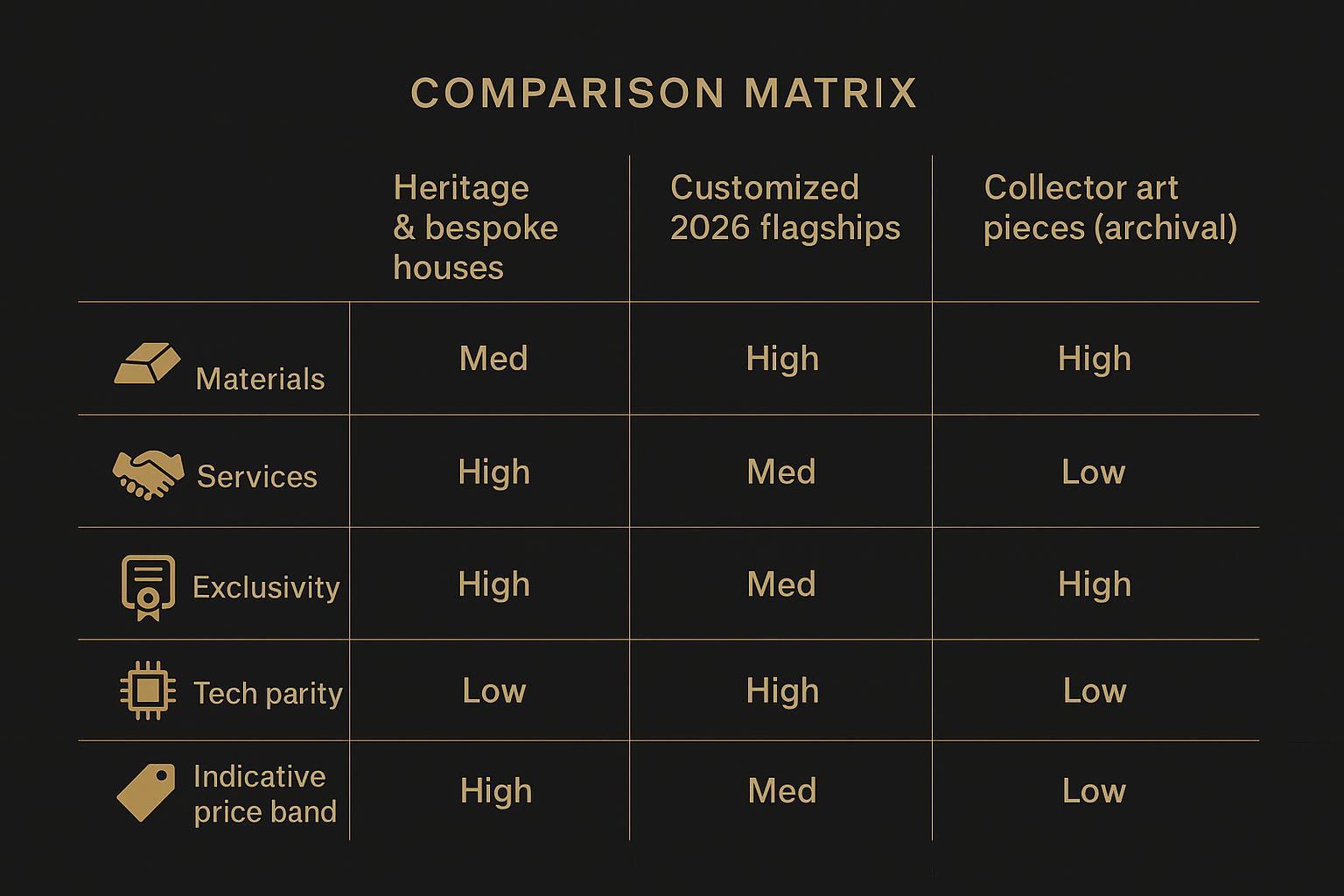
Start with your priorities. If materials and provenance matter most, lean toward heritage and bespoke houses. If day-to-day reliability and ecosystem integration matter most, customized flagships may be the cleaner fit. If you’re buying for collectibility above all, treat archival art pieces like you’d treat any collectible: verify everything, and accept the usability trade-offs.
Before you pay, verify authenticity, warranty terms, lead times, and US 5G support. Use Kimovil’s Frequency Checker to sanity-check bands, and confirm VoLTE/eSIM readiness with Simology’s checklist.
Use insured logistics. Document packing and unboxing for claims, and keep all packaging until you’re certain there’s nothing to dispute.
Choose the piece that elevates your lifestyle without sacrificing daily usability.
Disclosure: This article references VERTU pages. Editorial judgment remains the priority.
![Top 10 Tourbillon Watches for Men [2026 Latest]](https://cdn.sanity.io/images/e0gp1l2g/production/8cb6bc45133cf9453382fc7d074465af588bb610-1800x1080.webp?w=800&h=450&q=82&auto=format&fit=crop)