

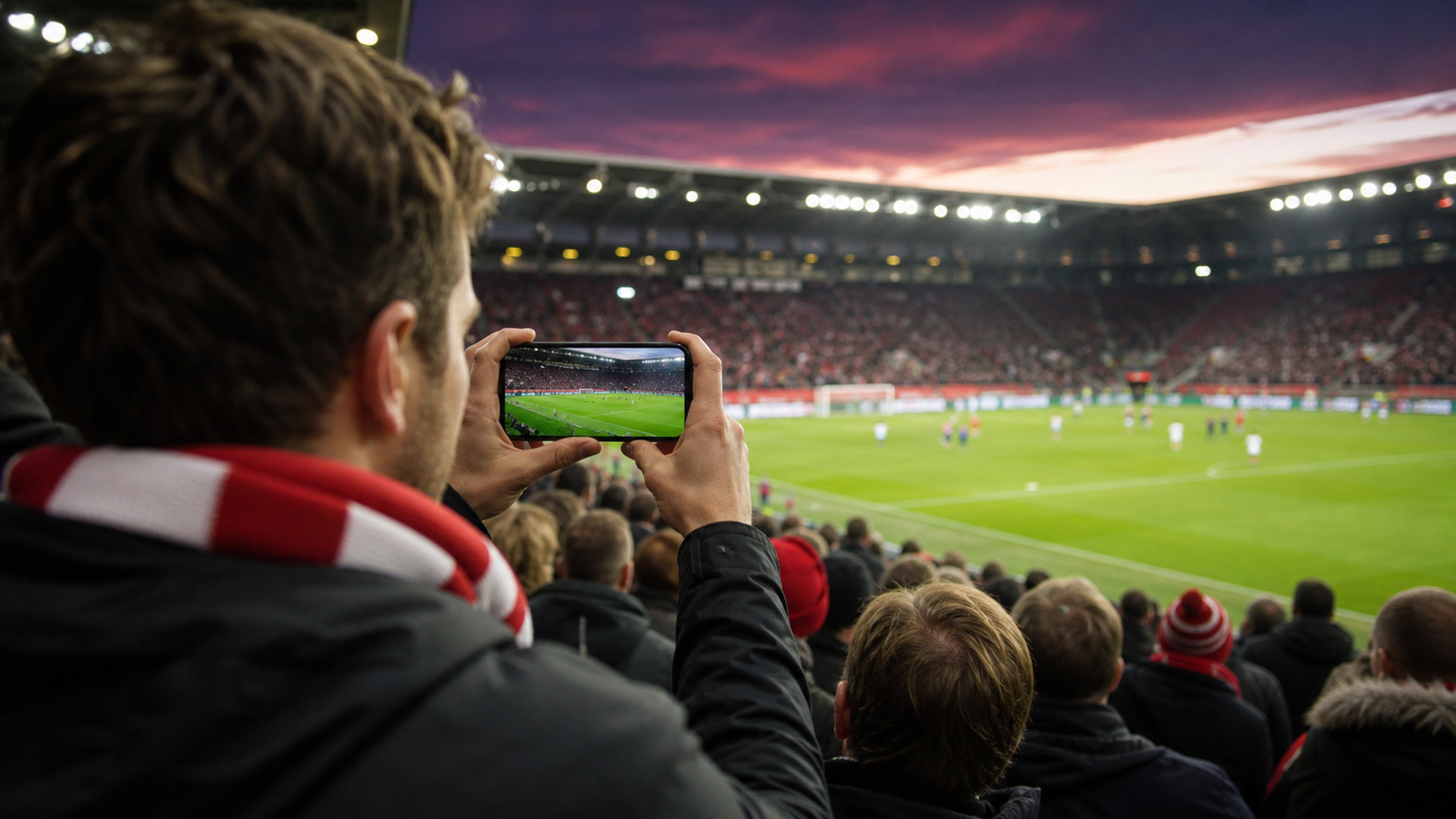
The 2026 World Cup final put millions of phones in the stands, but a large zoom number still does not guarantee a usable football photograph. Distance, light, shutter timing, sensor size and stadium policy matter more than marketing shorthand.
The short answer: Use the longest native optical focal length that still gives a stable, bright image; treat extra digital zoom as a crop, not free reach.
The question is more useful when it is converted into checks a reader can repeat. The matrix below separates what can be verified now from what still depends on a seller, service provider, venue or changing software policy. Details that vary by model, market, condition or account should be confirmed on the current source before money, access or irreplaceable evidence changes hands.
Decision matrix
| Decision point | Why it matters | Practical action |
|---|---|---|
| Start with stadium rules | A technically superior accessory is useless if security will not admit it | Check the venue policy before choosing equipment and carry the smallest compliant setup |
| Separate optical reach from a crop | The image can change sensor, aperture and stabilisation as you move through zoom levels | Test 1x, the native telephoto step and one modest crop before the match |
| Protect shutter speed | A bright but blurred player is harder to rescue than a slightly noisy sharp frame | Use burst or action mode, brace the phone and avoid extreme zoom when light falls |
| Compose for the next action | Anticipation creates more keepers than maximum resolution | Frame space ahead of the runner and follow likely passes rather than chasing the ball |
| Choose stills or video deliberately | A mixed plan preserves decisive stills without filling the phone before the final whistle | Record short clips for entrances and celebrations, then return to stills for play |
| Edit with restraint | They cannot recreate a face or ball that was never resolved | Select the sharpest frame first, crop once and keep the original file |
Use the table as a sequence rather than a scorecard. A strong result in one row does not cancel a serious failure elsewhere: excellent hardware cannot repair a missing return route, a convincing story cannot replace provenance, and a convenient service does not justify unlimited data access.
For a buyer, the order of checks matters. Start with eligibility, condition or authorisation; then test the feature under realistic conditions; only then compare price. This prevents a low price or impressive specification from anchoring the decision before the largest downside is understood. Where the seller cannot support a material claim, treat that as information about the offer rather than an invitation to fill the gap with optimism.
Specifications still have a role, but only after the disqualifying checks. Compare the exact configuration, software state and service region rather than a product-family headline. Where performance is subjective, define the task in advance and save a result you can compare. Where condition or authorisation is involved, use official diagnostics or regulator records. The aim is not to remove every uncertainty; it is to discover whether the remaining uncertainty is small enough for the price and the intended use.
1. Start with stadium rules
Large detachable lenses, tripods and selfie sticks may be restricted even when phones are allowed. That matters because a technically superior accessory is useless if security will not admit it.
Check the venue policy before choosing equipment and carry the smallest compliant setup. Record the result while the evidence is visible and repeat the check under the conditions in which the device, object or service will actually be used.
Do not infer one stadium's policy from another event or from a social post. If uncertainty remains, protect the decision with a return right, service allowance or a lower price rather than assuming the best case.
2. Separate optical reach from a crop
The image can change sensor, aperture and stabilisation as you move through zoom levels. The useful evidence is observable: a phone switches between physical cameras at its labelled native focal lengths.
The practical move is to test 1x, the native telephoto step and one modest crop before the match. Keep the answer with its date and source, especially where a model, account, venue or regional policy can change.
A smooth on-screen zoom animation does not prove continuous optical magnification. If uncertainty remains, protect the decision with a return right, service allowance or a lower price rather than assuming the best case.
3. Protect shutter speed
Start with the behaviour, not the label. Footballers move quickly and floodlights do not freeze motion by themselves, so a bright but blurred player is harder to rescue than a slightly noisy sharp frame.
Use burst or action mode, brace the phone and avoid extreme zoom when light falls. The test should be clear enough for a partner, support adviser, specialist or future buyer to repeat without relying on your memory.
Night mode can merge time and create ghosted limbs during fast play. If uncertainty remains, protect the decision with a return right, service allowance or a lower price rather than assuming the best case.
4. Compose for the next action
The ball usually moves faster than a phone can refocus after a frantic pan. Read that alongside the practical consequence: anticipation creates more keepers than maximum resolution.
A defensible response is to frame space ahead of the runner and follow likely passes rather than chasing the ball. If the seller or provider supplies the evidence, verify both its origin and its relevance to the exact item or account.
Pinching the zoom during every attack increases shake and missed moments. If uncertainty remains, protect the decision with a return right, service allowance or a lower price rather than assuming the best case.
5. Choose stills or video deliberately
The decision turns on a simple fact: high-resolution video can capture a sequence but consumes storage and battery. As a result, a mixed plan preserves decisive stills without filling the phone before the final whistle.
Record short clips for entrances and celebrations, then return to stills for play. Then test the result once outside the ideal demonstration: different light, a longer session, an interrupted connection or another ordinary use condition.
Continuous 4K or 8K recording can heat the device and exhaust storage. If uncertainty remains, protect the decision with a return right, service allowance or a lower price rather than assuming the best case.
6. Edit with restraint
They cannot recreate a face or ball that was never resolved. A buyer can test the premise because cropping and computational sharpening can clarify a good source frame.
Use this as the next action: select the sharpest frame first, crop once and keep the original file. Preserve the controlling page, result and date without saving secrets or publishing personal identifiers.
Aggressive AI enhancement can invent texture and weaken documentary credibility. If uncertainty remains, protect the decision with a return right, service allowance or a lower price rather than assuming the best case.
A realistic scenario
You are seated high behind the corner flag at an evening match. Warm-ups happen in daylight, the match begins at dusk and the trophy moment is under floodlights. Your goal is a sequence that includes atmosphere, recognisable action and one clean celebration image without spending the entire match looking at a screen.
Apply the matrix to the actual situation, not an ideal showroom version of it. Identify the exact item, account, venue or service; preserve the current evidence; run the least destructive test first; and calculate the downside if the claim fails. A lower offer, narrower permission, service appointment, different product or decision to wait can all be successful outcomes.
The pre-decision checklist
Before proceeding, make sure you can do each of the following:
Check the venue policy before choosing equipment and carry the smallest compliant setup.
Test 1x, the native telephoto step and one modest crop before the match.
Use burst or action mode, brace the phone and avoid extreme zoom when light falls.
Frame space ahead of the runner and follow likely passes rather than chasing the ball.
Record short clips for entrances and celebrations, then return to stills for play.
Select the sharpest frame first, crop once and keep the original file.
This list is deliberately practical. It should be possible to complete it without handing a seller unnecessary personal data or accepting a verbal promise that cannot be checked later. If one missing answer controls safety, privacy, repair cost or authenticity, resolve that answer before optimising secondary features.
Build a record you can use later
Create a compact evidence folder for this decision. Save the controlling official page, receipt or reference, non-secret screenshots, the result and the date. Add software versions where behaviour can change, or condition photographs where physical value matters. Keep serials, identity data and account-recovery details private.
The record should let a support team, specialist, insurer or future buyer understand why the decision was reasonable at the time. A short, labelled chain is more credible than a large folder of unexplained screenshots. It also gives you a baseline if a hinge changes, an algorithm is updated, a ticket account closes, a service entitlement differs or a collector later questions provenance.
For adjacent decisions, see the VERTU guides on camera phone versus compact camera guide and phone storage decision for travellers. These links answer the next practical question; they do not replace the primary evidence for this topic.
Sources and verification
The cited pages control the key rule, product context or official claim and may change after publication. Recheck availability, regulatory status, event controls, service entitlement and regional terms before acting. Where health, safety, legal or financial consequences are involved, this article offers general decision support rather than professional advice.
Final decision
Use the longest native optical focal length that still gives a stable, bright image; treat extra digital zoom as a crop, not free reach. Revisit the conclusion when the source, physical condition, permission boundary or support route changes. A decision remains strong when another person can understand the evidence, reproduce the important check and see what would make you stop.
![How to Scan Receipts and Documents with Your Phone [Full Guide]](https://cdn.sanity.io/images/e0gp1l2g/production/0db13feec1d5e72b8a8a5f976d1f3e86619c9228-3840x1860.webp?w=180&h=180&q=78&auto=format&fit=crop)
![How to Scan Receipts and Documents with Your Phone [Full Guide]](https://cdn.sanity.io/images/e0gp1l2g/production/0db13feec1d5e72b8a8a5f976d1f3e86619c9228-3840x1860.webp?w=800&h=450&q=82&auto=format&fit=crop)
![Top 10 Two-Tone Carbon-Fibre Watches for Men [2026 List]](https://cdn.sanity.io/images/e0gp1l2g/production/18870799ba33fab0e038968359cd5772d7d7db30-1024x576.webp?w=800&h=450&q=82&auto=format&fit=crop)
![Top 10 Luxury Watches with Digital Complication Displays for Men [Latest]](https://cdn.sanity.io/images/e0gp1l2g/production/c4f6bf8c080f291c39f7cc85c7344ecff2fd3799-1024x553.webp?w=800&h=450&q=82&auto=format&fit=crop)