

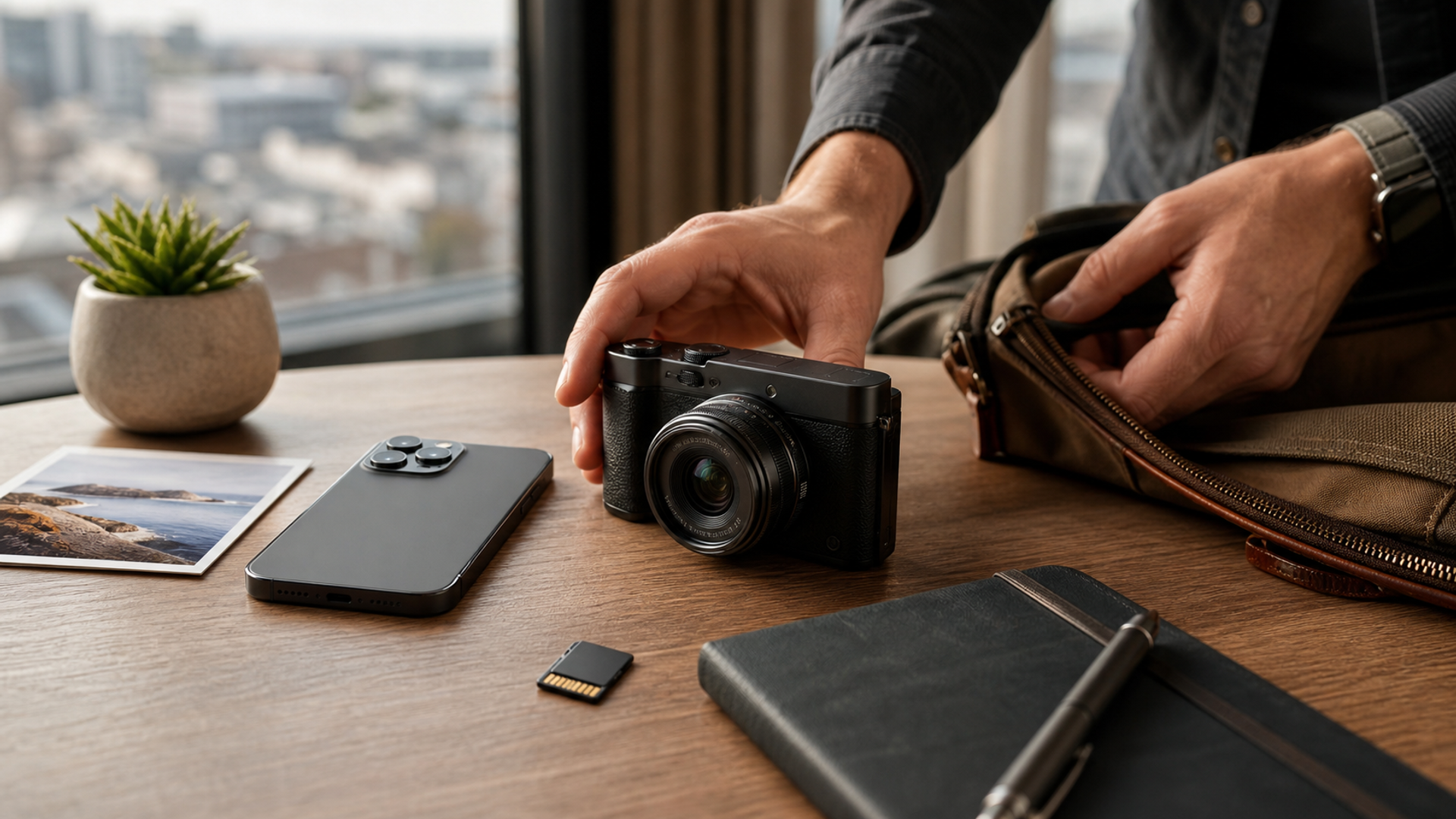
A flagship camera phone is the better travel camera for most people because it is always available, edits and shares immediately, records location automatically and covers several focal lengths without a separate battery or memory card. A premium compact camera earns its place when the trip is partly about photography: deliberate composition, cleaner raw files, more predictable controls and a lens with a recognisable visual character.
The decision is not settled by megapixels. It depends on whether the photograph is a quick record of the journey or one of the reasons for making the journey.
Quick verdict by traveller
| Traveller | Better choice | Why | What to accept |
|---|---|---|---|
| One-bag city traveller | Camera phone | No extra weight; instant maps, notes and sharing | Less physical control and smaller sensors |
| Family trip | Camera phone | Fast switching between stills, video and group photos | Computational processing may look inconsistent |
| Photography-led holiday | Premium compact | Dedicated controls, raw workflow and purposeful lens | Extra 700–800g, charger and storage workflow |
| Discreet business traveller | Phone | Familiar object and fewer valuables to manage | Notifications can interrupt shooting |
| Print-minded photographer | Compact camera | Larger sensor and more editing latitude | Files need culling, backup and processing |
What current camera phones do exceptionally well
Modern phones solve the gap between seeing and saving. Apple's iPhone 17 Pro specifications list three 48MP rear cameras, optical-quality focal-length options, ProRAW and stabilised 4K video. The important advantage is the integrated system: capture, edit, caption, locate, back up and send from one object. This analysis is supported by Apple ProRAW support guidance.
Computational photography combines exposures, controls noise and recognises scenes before the traveller has considered a setting. That is valuable in difficult travel moments—children moving through a station, a sudden view from a car or a dinner where a larger camera would alter the atmosphere. Phones also switch from ultra-wide architecture to portraits and video with almost no setup.
Their weakness is that some decisions are made for the photographer. Sharpening, local contrast, colour and night processing may vary between lenses or scenes. Touch controls are less certain with gloves or wet hands. Long digital zoom remains a crop, however persuasive the preview looks. The small device is brilliant at producing a finished result quickly, but not always at producing a neutral file for later interpretation.
What a premium compact camera changes
The Leica Q3 43, for example, pairs a full-frame 60.3MP effective sensor with a fixed 43mm lens and weighs about 772g with battery. Those facts describe a very different proposition from a phone. The camera asks the photographer to work within one principal field of view, while giving direct control over aperture, shutter speed, focus and raw capture.
A fixed-lens compact can make a trip visually coherent. The same perspective returns across streets, people, interiors and details. A larger sensor can provide more latitude in difficult light and more natural separation between subject and background. Physical controls let the photographer prepare exposure before raising the camera.
Yet the compact is not automatically superior. A fixed lens can be too tight for interiors or too wide for distant details. Autofocus and stabilisation must be judged by the specific model, not by price. The camera becomes another high-value object to insure, charge, carry and protect from rain. Its files need a backup plan beyond the single card.
The seven-scene test
Before buying, score both options against the trip you actually take:
Airport and transit: the phone wins when one hand holds luggage and the other needs a boarding pass.
Architecture: a phone's ultra-wide lens fits tight streets; a compact may render edges and detail more naturally.
People at dinner: the phone is less disruptive, but aggressive night processing can change skin and ambience.
Portraits: a larger sensor and physical aperture can create optical depth; the phone offers instant, adjustable portrait processing.
Distant subjects: compare real optical reach rather than advertised digital zoom.
Video: phones integrate stabilisation, microphones and sharing; compacts may offer stronger codecs but require a workflow.
Printing: inspect raw files at the intended print size instead of judging only a bright phone screen.
Give each scene a weight from one to five. A serious photography trip may give printing and low light five points; a weekend break may give transit and sharing five. The result is more useful than a universal ranking.
Hidden costs and practical friction
A compact camera requires at least one spare battery, a fast memory card, reader or cable, protective case and backup destination. Add those to the carried weight. A phone may need cloud storage, a power bank and enough free local capacity for video. Both can fail when storage fills; only the phone is also responsible for maps, payment and communication.
Security matters. Carrying one device concentrates risk but reduces the number of valuables. Carrying two provides redundancy: if the phone is unavailable, the camera still records; if the camera fails, the phone remains capable. Keep serial numbers, enable device tracking where supported and avoid editing irreplaceable files without a second copy.
A rational two-device workflow
Travellers who carry both should assign roles rather than choosing randomly. Use the compact for planned walks, portraits and images intended for a portfolio or print. Use the phone for transit, context, video snippets, documents and immediate communication. At the end of each day, copy selected camera files to a second destination, but do not erase the card until another verified copy exists. For the adjacent decision, see our phone storage decision for travellers.
This division also protects attention. Put the phone into a focused mode during a photography walk so messages do not interrupt seeing. When the camera stays at the hotel, accept the phone's speed instead of regretting the missing kit.
Final choice
Choose the camera phone if photography supports the trip. Choose the premium compact if photography structures the trip. Buy neither on headline specifications alone: rent or borrow a compact for one full day, process its raw files and notice whether carrying it changed what you saw—or merely added weight.
The pre-trip setup that matters more than another lens
Whichever device wins, prepare it before departure. Set the correct date and time zone, clear enough storage for the longest day, save an offline editing route and test transfer to the backup destination. On a phone, decide whether location data should remain in exported images and create a camera-focused home screen. On a compact, format cards in-camera only after verifying backups, synchronise the clock with the phone and photograph contact details as the first frame on each card. A disciplined setup protects more photographs than a marginal specification advantage.
![How to Scan Receipts and Documents with Your Phone [Full Guide]](https://cdn.sanity.io/images/e0gp1l2g/production/0db13feec1d5e72b8a8a5f976d1f3e86619c9228-3840x1860.webp?w=180&h=180&q=78&auto=format&fit=crop)
![How to Scan Receipts and Documents with Your Phone [Full Guide]](https://cdn.sanity.io/images/e0gp1l2g/production/0db13feec1d5e72b8a8a5f976d1f3e86619c9228-3840x1860.webp?w=800&h=450&q=82&auto=format&fit=crop)
![Top 10 Two-Tone Carbon-Fibre Watches for Men [2026 List]](https://cdn.sanity.io/images/e0gp1l2g/production/18870799ba33fab0e038968359cd5772d7d7db30-1024x576.webp?w=800&h=450&q=82&auto=format&fit=crop)
![Top 10 Luxury Watches with Digital Complication Displays for Men [Latest]](https://cdn.sanity.io/images/e0gp1l2g/production/c4f6bf8c080f291c39f7cc85c7344ecff2fd3799-1024x553.webp?w=800&h=450&q=82&auto=format&fit=crop)