

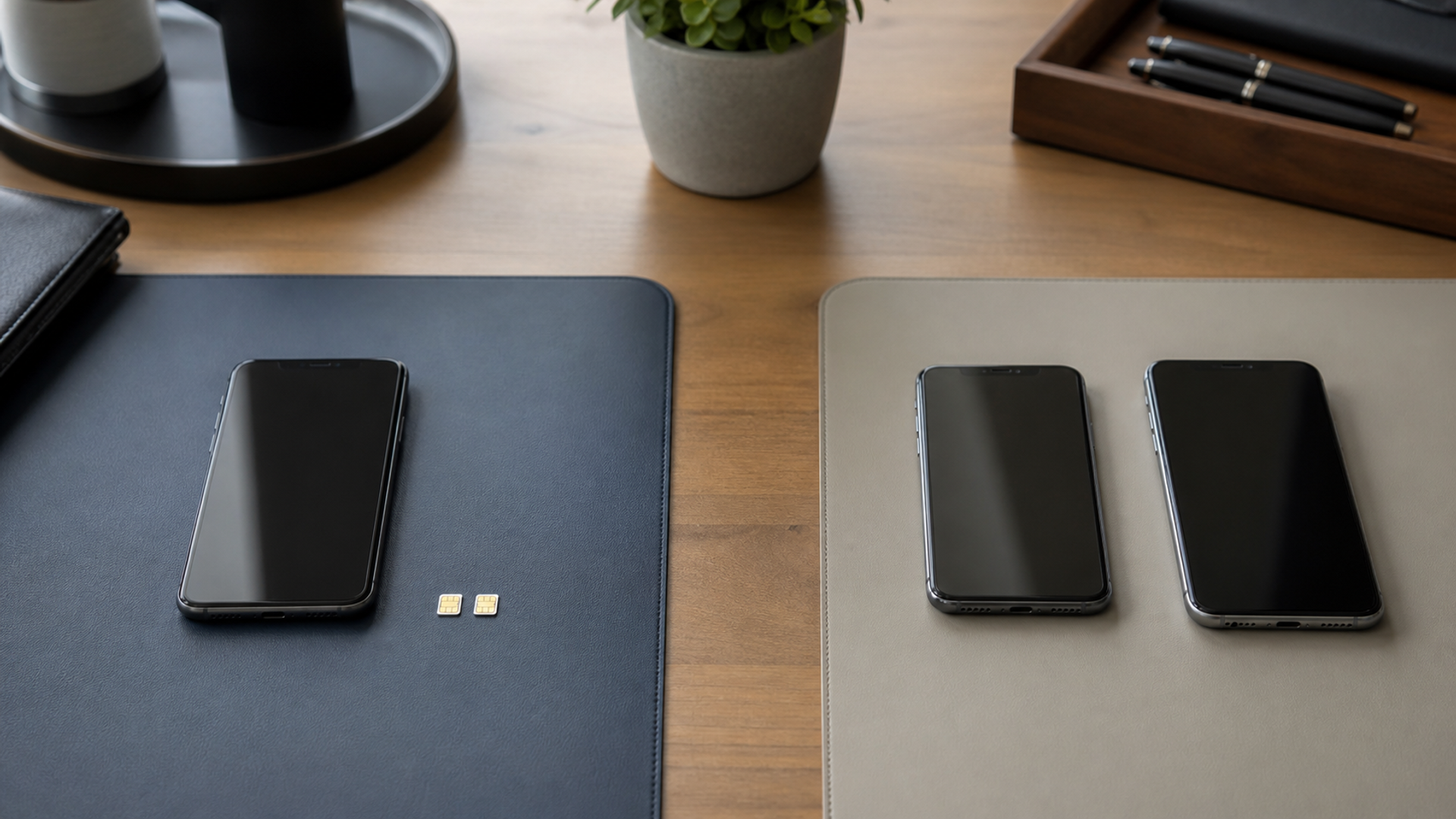
Using one phone for work and personal life can be elegant until a legal hold, mobile-device-management policy, border inspection, lost handset or midnight notification reveals that two phone numbers are not the same as two security boundaries. Dual SIM separates lines and billing. It does not automatically separate apps, photographs, browser sessions, backups, employer control or account recovery.
Two phones create a physical boundary, but they also double charging, patching, travel and loss risk. A managed Android Work Profile creates a meaningful container on one device when the employer supports it. An iPhone can use separate business and personal lines, Focus modes and managed apps, yet the exact management model still depends on the organisation. The right design begins with the boundary you need, not the number of devices you prefer to carry.
> The short answer: Use Dual SIM when the main problem is telephone identity or tariffs. Use a managed work profile when policy-backed app and data separation is required. Use two phones when physical custody, availability or high-consequence account separation matters more than convenience.
What is confirmed, and what is not
Apple documents Dual SIM as a way to use one number for business and another for personal calls, or to separate voice and data plans. It also notes that one cellular data network is used at a time and that carrier and regional support vary. Google describes Android Work Profile as a self-contained profile for work apps and data, managed by the organisation while personal apps and usage remain separate. Those capabilities are not interchangeable.
The matrix below evaluates five boundaries: number, data, administrator, availability and recovery. A setup can be strong on one and weak on another. An executive with two SIMs but one cloud account still has a single point of account failure; an employee with two phones but forwarded notifications can still leak work data onto the personal screen.
five-boundary separation matrix
| Check | Evidence or current signal | Decision use |
|---|---|---|
| Telephone identity | Separate numbers, caller ID, voicemail and messaging routes | Dual SIM may be enough |
| Work-data container | Corporate apps, files, credentials and sharing controls are managed separately | Require a real profile |
| Administrator visibility | A written notice explains what the employer can view, configure and erase | Read before enrolment |
| Availability boundary | One device can fail, be surrendered or run flat without silencing both identities | Two devices win |
| Attention boundary | Work can be paused without disabling personal safety and family access | Profiles or two devices |
| Account recovery | Each critical identity can recover without the other phone or line | Avoid circular dependency |
| Exit and legal events | Offboarding, legal hold, repair and device sale have defined data paths | Plan the end |
A strong score in one row cannot cancel a hard failure in identity, safety, permission or recovery. Date every fact that can change and keep market, account, device or object configuration attached to the evidence.
Telephone identity
If the only requirement is presenting a business number and keeping a personal number private, Dual SIM can solve much of the problem with less equipment. Verify which line each contact uses, the default for new calls, voicemail behaviour and what happens to iMessage, RCS or other messaging when a line changes. Test roaming and local eSIM use before travel. A number boundary does not control screenshots, contacts, cloud photo backup or shared application sessions.
Decision use: Dual SIM may be enough. Evidence to keep: Separate numbers, caller ID, voicemail and messaging routes.
Work-data container
On supported Android deployments, Work Profile can separate managed apps and data and let the organisation enforce policies inside that profile. Confirm what your EMM supports and which cross-profile connections are allowed. A second app icon or a manually created folder is not a security container. On any platform, ask IT to describe the actual management mode, data-removal capability and backup destination rather than relying on a consumer setting with a similar name.
Decision use: Require a real profile. Evidence to keep: Corporate apps, files, credentials and sharing controls are managed separately.
Administrator visibility
Ownership changes the control surface. On a personally owned device, a work container may limit the organisation to managed data; on a company-owned device, wider policies can apply. Record whether IT can see device identifiers, installed work apps, network activity, location from work apps or overall device settings. If the answer affects personal privacy, use the organisation’s policy and enrolment disclosure, not a colleague’s recollection.
Decision use: Read before enrolment. Evidence to keep: A written notice explains what the employer can view, configure and erase.
Availability boundary
A second phone is valuable when business continuity matters: one carrier may fail, one battery may drain or one handset may be held for inspection or repair. The benefit exists only if accounts, chargers and networks are genuinely independent. Two phones on the same cloud account, in the same bag, with the same carrier and no spare authentication route are less resilient than they appear. Define which device is primary during an incident.
Decision use: Two devices win. Evidence to keep: One device can fail, be surrendered or run flat without silencing both identities.
Attention boundary
Separate Focus modes, notification schedules and a pausable Work Profile can reduce intrusion, but test exceptions. Emergency contacts, authentication prompts and travel changes may need to cross the boundary. Do not connect work and personal calendar, messaging or search apps merely for convenience without understanding what data crosses. A good setup has a deliberate emergency bridge and a normal closed state.
Decision use: Profiles or two devices. Evidence to keep: Work can be paused without disabling personal safety and family access.
Account recovery
Map email, password manager, authenticator, carrier and bank recovery. A common failure is placing every backup code on the work phone while the personal number is the only recovery factor—or the reverse. Store a controlled offline route and ensure the employer can remove work data without deleting the owner’s only personal recovery record. Test after changing employer, carrier or number.
Decision use: Avoid circular dependency. Evidence to keep: Each critical identity can recover without the other phone or line.
Exit and legal events
Ask what happens when employment ends, a device is repaired, or a company phone must be returned immediately. Work Profile removal can delete local managed data; company-owned devices may be factory-reset. Two-phone users need a process to transfer personal material off a company device before it becomes mixed. Keep business records in authorised systems rather than personal messaging or photo libraries so separation survives the hardware lifecycle.
Decision use: Plan the end. Evidence to keep: Offboarding, legal hold, repair and device sale have defined data paths.
Put the framework into a real decision
Start with three columns: one unmanaged phone with Dual SIM, one personally owned phone with a managed work profile, and two physically separate phones. Add rows for number, app data, admin control, carrier, battery, location, backup, border or legal custody, offboarding and after-hours attention. Mark each boundary that is required by policy or consequence.
For a consultant whose work consists of calls and a separate billing line, Dual SIM may be sufficient. For an employee accessing managed files, a supported Work Profile or company-managed environment is more defensible. For a principal handling high-consequence approvals while travelling, two devices on different carriers may provide continuity—but only with independent recovery and carefully limited data duplication. Review the matrix with IT and legal where regulated information or employer monitoring is involved.
A decision record another person can audit
Create a dated record containing the exact object, device, system or route; the source URL and access time; the person responsible for verification; and the condition that would change the recommendation. Preserve earlier observations instead of overwriting them when facts move. For product, policy and service claims, record the market and configuration. For private identifiers, store a redacted public copy and a controlled private copy.
End with one of four outcomes: proceed, wait, request evidence or decline. State the reason in one sentence, list the unresolved risk and name the next review date. This makes later performance review more honest: an editor can see what was knowable at publication rather than judging the decision with hindsight.
Action checklist
Name the boundary: number, data, administrator, availability or recovery.
Ask IT for the exact management mode.
Test default line and messaging behaviour.
List data allowed to cross profiles or devices.
Create an emergency communication bridge.
Use independent recovery for critical accounts.
Document offboarding and remote-wipe effects.
Recheck after a carrier, employer or device change.
Related VERTU reading
These links cover adjacent decisions. They do not replace the current primary source or the exact configuration under review.
Sources and verification
Sources were accessed on 21 July 2026. Product availability, software features, laws, official alerts, policies, prices and service terms can change. Recheck the live source before acting. Legal, financial, insurance, health, travel-security and conservation references are general information rather than individual professional advice.
Final view
One line versus two lines is a telecoms choice. One profile versus two profiles is a data-governance choice. One phone versus two phones is an availability and custody choice. Keep those questions separate, then select the lightest setup that satisfies the strongest required boundary. Convenience should be the final optimisation, not the assumption that defines the architecture.
![How to Scan Receipts and Documents with Your Phone [Full Guide]](https://cdn.sanity.io/images/e0gp1l2g/production/0db13feec1d5e72b8a8a5f976d1f3e86619c9228-3840x1860.webp?w=180&h=180&q=78&auto=format&fit=crop)
![How to Scan Receipts and Documents with Your Phone [Full Guide]](https://cdn.sanity.io/images/e0gp1l2g/production/0db13feec1d5e72b8a8a5f976d1f3e86619c9228-3840x1860.webp?w=800&h=450&q=82&auto=format&fit=crop)
![Top 10 Two-Tone Carbon-Fibre Watches for Men [2026 List]](https://cdn.sanity.io/images/e0gp1l2g/production/18870799ba33fab0e038968359cd5772d7d7db30-1024x576.webp?w=800&h=450&q=82&auto=format&fit=crop)
![Top 10 Luxury Watches with Digital Complication Displays for Men [Latest]](https://cdn.sanity.io/images/e0gp1l2g/production/c4f6bf8c080f291c39f7cc85c7344ecff2fd3799-1024x553.webp?w=800&h=450&q=82&auto=format&fit=crop)