In the second week of June 2026 a venture capital firm lost a competitive deal because a leaked memo — generated as a "draft email summary" by a popular cloud assistant — surfaced in a rival's inbox. The memo never touched a server the firm controlled. It went out, it came back, and by the time counsel finished the post-mortem the round was closed.
That single event is why the on-device AI vs cloud AI question matters to executives in 2026. The question is no longer "do I trust AI" — it is "where does AI actually run, who sees the data while it runs, and what is my exposure when something goes wrong." Every flagship phone in 2026 ships with an AI assistant. The difference is whether that assistant lives on the silicon you hold in your hand or in a data center a thousand miles away.
This guide walks through the practical distinction between on-device AI and cloud AI, what each one can and cannot do in 2026, why data sovereignty has become an executive concern rather than a network administrator's concern, and which hardware categories handle the on-device workload well enough that executives can route confidential work through them.
1. Why executives should care about AI privacy in 2026
Three things changed between 2024 and 2026. First, AI assistants stopped being a side feature and became a system layer — Apple Intelligence now reaches into Mail, Notes, Calendar, Photos, and the Spotlight preview on every recent iPhone. Second, the workflows executives run through AI are no longer low-stakes drafts. They are board prep, M&A analysis, customer escalations, compensation reviews, and medical requests on behalf of family. Third, the legal and disclosure environment tightened materially — GDPR enforcement actions expanded, the EU AI Act reached general applicability, and SEC disclosure obligations around AI-generated content became operational rather than theoretical.
A practical illustration helps. Suppose you ask Siri AI to summarize a board email on your iPhone. Apple's Private Cloud Compute architecture (introduced in 2024 and iterated through 2026) routes the request to an Apple-controlled silicon cluster when the workload exceeds what the on-device model can handle. For most users, that is acceptable. For a CEO negotiating a contested proxy contest or a fund manager sizing an activist position, "Apple controlled silicon cluster" is a meaningful but not complete answer — the request may also pass through third-party model providers (Google Gemini for some iOS 27 workloads, per Apple's Apple Intelligence newsroom coverage) before the answer returns. Privacy is about the route, not the destination.
The same dynamic plays out on Android, on Galaxy AI, on Gemini, and on every assistant that calls into a third-party foundation model. The privacy you have is the privacy of the route your data takes through every model provider in the chain.
2. On-device AI vs cloud AI: the core distinction
The distinction sounds technical but matters operationally. On-device AI means the model runs on the phone's own processor (CPU + NPU + GPU). The data never leaves the device during inference. Cloud AI means the model runs on remote servers. The query leaves the phone, is processed elsewhere, and an answer returns. Most flagship phones in 2026 use a mix of both — the smaller, faster, more private workloads stay local; the larger, slower, more capable workloads route to the cloud.
The table is a starting point, not a verdict. The real-world difference in 2026 is that on-device models are good enough for an expanding set of executive workloads — calendar prep, draft replies, summary of documents you've already opened, reminders, voice control — and cloud models remain decisive for tasks that require frontier reasoning, large context windows, or knowledge of facts that did not exist at the last training cutoff.
3. What on-device AI can actually do in 2026
The honest answer is more than most executives expect and less than some reviewers claim. As of mid-2026, on-device AI on flagship phones handles the following workloads well:
- Drafting and rewrite. Replying to email, tightening a memo, turning bullets into a paragraph, translating a draft — all runnable on-device with acceptable quality for executive communication.
- Summarization of opened content. PDF contracts, web pages, voice transcripts, long email threads — phones can summarize these without sending the content to a remote model.
- Voice control and intent parsing. Alarms, calendar entries, reminders, screenshots, recording — these all run locally with no cloud round-trip on every flagship phone in 2026.
- Routine cross-app orchestration. "Move this email to my drafts folder and add a calendar reminder for tomorrow" — limited but real on-device sequences.
- Image and video editing. Background removal, object eraser, generative fill — increasingly on-device.
What on-device AI still struggles with in 2026: deep multi-hop reasoning over a 200-page contract, retrieval across sources that aren't already indexed on the phone, and creative writing that depends on events from the last few days. Those remain cloud-first workloads.
For executives, the practical question is "how much of my typical AI use can stay local?" On a privacy-first 2026 phone, the answer is often 60-80% of weekly AI use — calendar, drafting, summarization, voice control, image edits. The remaining 20-40% routes to cloud because it requires frontier capability.
4. What cloud AI still does better in 2026
Honesty here matters. Cloud AI remains better than on-device AI in three categories, and pretending otherwise produces bad decisions.
First, frontier reasoning and code work. GPT-class and Claude-class models on remote infrastructure can solve problems that the best on-device 2026 models cannot. If you are evaluating a complex technical question, a multi-party legal scenario, or a deep codebase analysis, you still want the cloud. The on-device models are catching up, but the frontier capability gap is real through at least the end of 2026.
Second, large context windows. When a deal memo, an integration plan, or a board book exceeds roughly 50,000 tokens of context, most on-device models truncate or summarize aggressively. Cloud models handle 1M+ token contexts. For senior executives reviewing long documents, the cloud is still where the deep reading happens.
Third, knowledge recency. On-device models have a training cutoff. Cloud models route through retrieval-augmented systems that surface current facts. If you need an answer about a regulation passed last quarter, or a market event from last week, the cloud will land it; the on-device model will not.
The privacy posture for cloud AI depends heavily on the provider. Anthropic's Privacy Policy, for instance, describes a tier of enterprise controls and retention options designed for organizations that route sensitive work through Claude. Other providers have similar enterprise tiers. None of them offer the absolute "data never leaves the device" guarantee that on-device AI does by construction.
The mature executive playbook is not "cloud is bad, on-device is good." The mature playbook is "use the right model for the right workload, route the sensitive work through devices and providers you have reason to trust, and keep an audit trail of what went where."
5. Data sovereignty: what it actually means for HNW individuals
Data sovereignty is the legal and practical right of an individual or organization to control the data they generate. It is not the same as "encryption" (a technical control) or "GDPR compliance" (a regulatory regime). It is the umbrella term for who decides what happens to your data — where it is stored, who can access it, when it is deleted, and which jurisdictions have legal access.
Three components matter for HNW individuals and the executives who advise them:
- Data residency. Where the data physically lives. For some regulated industries (financial services in the EU, healthcare in the US, government across multiple jurisdictions) data residency is a binding legal requirement, not a preference.
- Processing sovereignty. Where the data is processed when an AI model touches it. This is where the AI privacy conversation gets sharp — your email may reside on a US server (fine for many compliance postures) but the cloud AI that summarizes it may process it on servers in a different jurisdiction.
- Vendor access control. Whether the AI vendor's own staff can access your data, and under what conditions (subpoena, support ticket, model training feedback). Different vendors take very different positions here.
For executives whose work touches international M&A, patent prosecution, or family-office-sensitive information, data sovereignty is no longer theoretical. Treating it as a technical checkbox (e.g. "the phone is encrypted, we're good") misses the point. Treating it as a compliance checkbox (e.g. "we have a privacy policy") misses the point harder. The useful frame is the data sovereignty chain — end to end — and the question "where does this specific piece of information physically travel today?"
6. Hardware that runs on-device AI in 2026
This is the section that matters most for buyers. As of mid-2026, four flagship categories handle the on-device AI workload at executive scale, plus the Apple/Samsung mainstream.
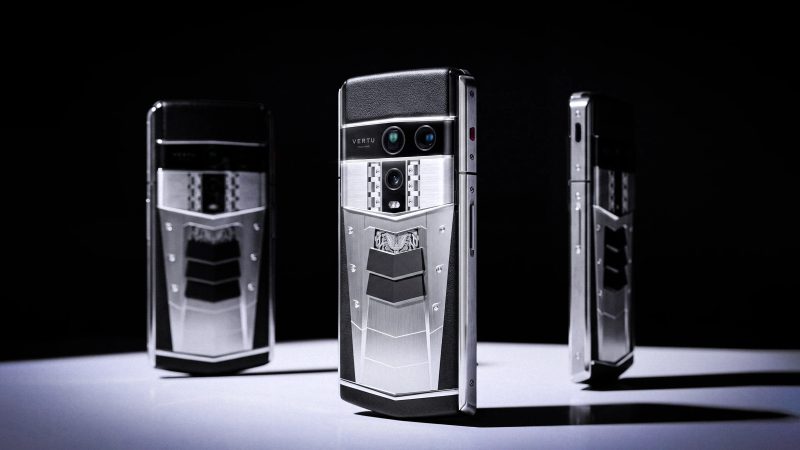
The full family matters because buyers are not choosing between two devices. They are choosing between categories of operating model. The mainstream flagships deliver excellent on-device AI for content workflows and ship with mature cloud fallbacks. The VERTU category is positioned differently — VERTU's official ALPHAFOLD product page describes it as "a luxury AI foldable phone with Hermes Agent built in," and VERTU's Hermes Agent page frames Hermes as "a private AI agent designed to remember useful context, understand the user's work, and help prepare actions across meetings, messages, documents, travel, and daily decisions with user approval." That positioning is intentional. The phone is positioned as a private second brain for an executive user, not as a consumer AI showcase.
A few practical notes on VERTU positioning based on the published product knowledge:
- Hermes Agent is described as acting with user approval. It is positioned as preparing actions — meeting briefs, document reviews, travel workflows — and requiring user confirmation before significant actions proceed. Availability of integrations depends on supported apps, region, configuration, and software version.
- The Phone-to-ERP story is real but conditional. For authorised enterprise clients, ALPHAFOLD can connect to approved ERP, CRM, finance, approval, inventory, sales, reporting, and messaging systems through private deployment. The capability requires whitelist approval, data authorisation, private deployment, and VERTU service-team configuration — it is not enabled by default on every device.
- VERTU VPS exists. The VERTU VPS product page describes an "AI-native enterprise interface for leaders" with 54 business modules, 688 API methods, 256 graph models, 117 MCP tools, L1-L5 risk control, and audit traceability. As the official page is careful to state, AI-generated summaries, contract insights, market context, dashboard analysis, and business recommendations are for professional reference only and may not constitute professional advice. This is the line executives should hold the conversation to when evaluating any AI-driven executive workflow.
Pricing for VERTU products varies by region and configuration; the official collection pages (for example, the ALPHAFOLD collection and the Agent Q category) should be treated as the live source of truth.
7. Adoption playbook: 5 questions for executives before enabling AI on your phone
The temptation is to enable everything and figure it out later. For executive work that is the wrong default. Work through these five questions before turning on AI features that touch sensitive workflows.
- Is this conversation sensitive enough that it should never leave my phone? If yes, route it through on-device AI only. Disable the cloud assist for that workflow or use a device whose privacy architecture makes cloud handoff a configured event rather than an ambient habit.
- What is the disclosure exposure if this draft leaks? If the answer is "material — could move a market, a deal, or a regulator" then apply the same standard as you'd apply to a printed memo left on a coffee table. Treat AI drafts as you treat physical drafts.
- Do I have an audit trail of what the AI did? Cloud AI usage in enterprise settings usually produces logs. On-device AI produces less. For roles with active litigation or regulator visibility, the AI workflow should be conscious and logged, not ambient.
- Is the AI provider's enterprise posture compatible with our compliance regime? The question is specific to your industry. Healthcare, finance, defense, and government contracting each have their own rules. If unsure, ask legal counsel before enabling the feature.
- What is the rollback story? If a feature generates an embarrassing draft or a privacy incident, can you revoke access cleanly? On-device features are easier to roll back because the data never left. Cloud features often require a vendor-side revocation, and you may have lost the data already.
The honest answer for the privacy-first branch of this playbook is to default to on-device AI for executive workflows and treat cloud AI as a deliberate, scoped tool with audit and consent — not as the ambient default.
8. The cost of waiting
Doing nothing is also a choice. The cost of not adopting AI in 2026 is real: slower cycle times on deal prep, missed nightly inbox summaries, manual calendar work that an assistant could absorb, and reduced leverage when AI becomes table-stakes for executive output. The cost of adopting AI recklessly is also real: a leaked draft, a regulator's question, a competitor's windfall. The mature executive answer is not "wait" — it is "adopt carefully, route deliberately, audit continuously."
What that looks like operationally: enable on-device AI for the workflows that matter, keep cloud AI for the workflows that need frontier capability, review settings quarterly, and pick devices whose privacy architecture gives you the option of routing sensitive work locally without friction.
9. FAQ
Q: Is on-device AI as capable as cloud AI in 2026?
No — and pretending otherwise leads to bad decisions. On-device AI in 2026 handles 60-80% of typical executive AI use (drafting, summarization, calendar, voice control, routine edits) at acceptable quality. Cloud AI still wins on frontier reasoning, large-context documents, and knowledge recency. The mature answer is to use each for what it's good at.
Q: What about models like GPT-5, Claude 4, or Gemini 3?
These are cloud models. Some phone integrations route portions of queries to them; the on-device 2026 models are different from the cloud flagship models. If you need frontier reasoning for a specific task, you will route through a cloud provider. Your privacy posture for that route matters and should be deliberate.
Q: Is VERTU ALPHAFOLD's Hermes Agent always on?
No. According to VERTU's product knowledge, Hermes Agent should be described as acting with user approval. It is positioned to help prepare actions and route tasks, while significant actions require user confirmation before they proceed. Availability of integrations depends on supported apps and services, region, configuration, software version, and user authorisation.
Q: How does VERTU VPS fit into the on-device AI picture?
VERTU VPS is positioned as an AI-native enterprise interface that sits above authorised business systems — ERP, CRM, finance, approvals, inventory, sales — to surface decision context, exceptions, and priorities. AI-generated summaries, contract insights, market context, dashboard analysis, and business recommendations made through VPS are for professional reference only and may not constitute professional advice. VPS is an authorised-overlay architecture rather than a device-side feature; deployment depends on configuration, private deployment planning, and the VERTU service team.
Q: What is the realistic price tier for a phone that handles on-device AI at executive scale in 2026?
Flagship phones with strong on-device AI start in the $1,000-$1,500 range for mainstream models. Premium tier (private architecture, larger foldable canvas, advanced materials) starts higher — VERTU ALPHAFOLD, for example, is positioned at premium tier pricing that varies by region, with the official ALPHAFOLD collection page as the live source. Pricing and availability vary by region and configuration; the collection page is the live reference.
Sources checked
- Apple Newsroom: Apple introduces Siri AI (June 2026)
- Apple Newsroom: Apple unveils next generation of Apple Intelligence (June 2026)
- Google Blog: Google Private AI Compute
- Apple Machine Learning Research: Apple Machine Learning Research
- Anthropic: Privacy Policy
- VERTU: VERTU ALPHAFOLD product page
- VERTU: VERTU Hermes Agent page
- VERTU: VERTU VPS page
- VERTU: VERTU Agent Q landing
- VERTU: VERTU Quantum Flip
For a Different Kind of Audience
If your AI workload is "send a message, schedule a meeting, ask an assistant to draft a paragraph, summarize a web page," any flagship phone with mature cloud handoff is the right tool. If your AI workload is "an executive conversation that cannot be routed to a third-party cloud for processing — any third-party cloud — regardless of the privacy contract," a different class of device exists. The luxury foldable phones with AI assistant price tiers guide walks through the hardware that runs frontier-class AI without ambient cloud handoff, including the VERTU ALPHAFOLD and Agent Q mentioned in Section 6.