

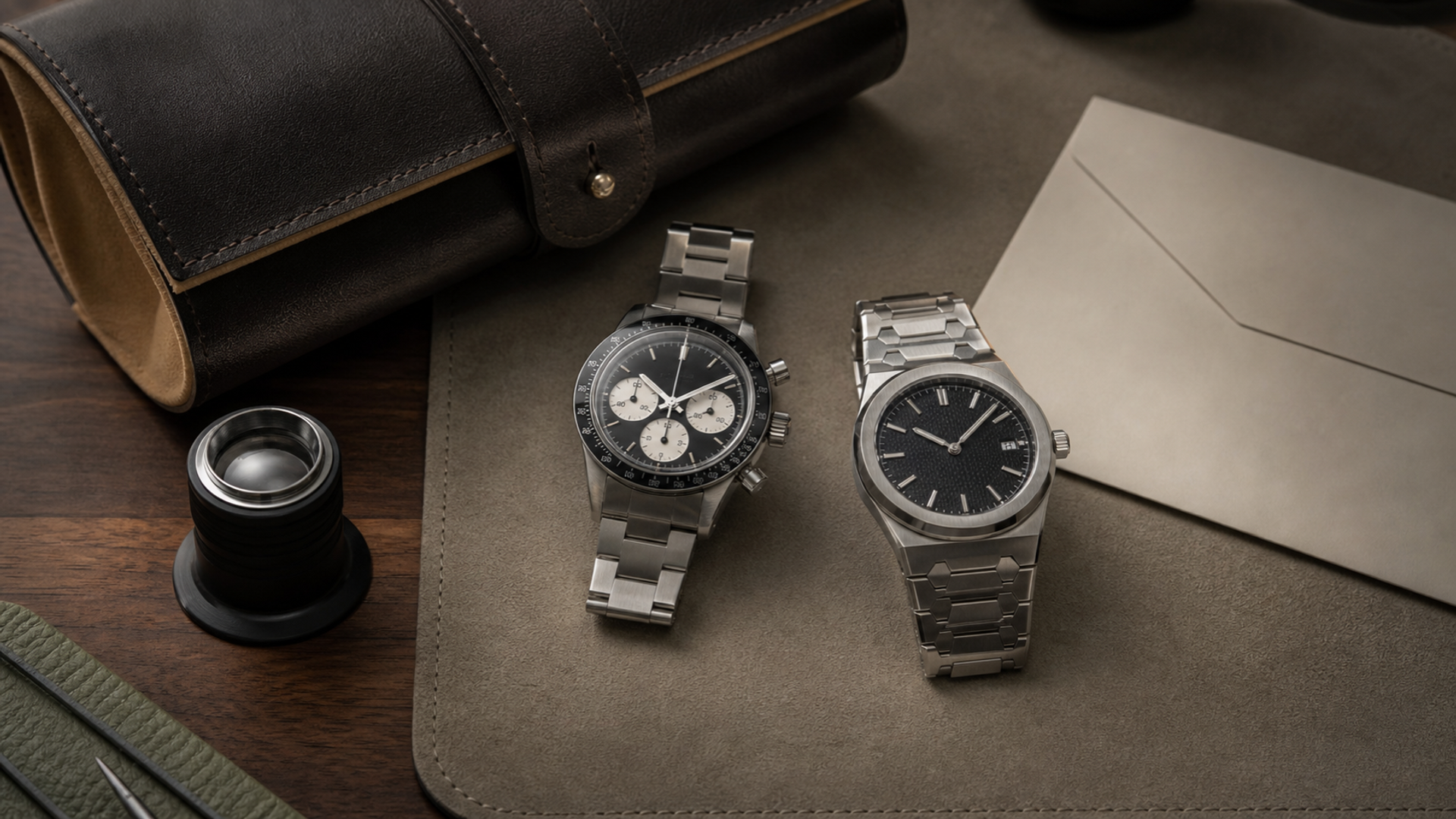
Rolex is often the stronger choice for a buyer who wants a compact, highly recognisable collection, durable everyday design and a broad global service story. Omega is often better for someone who values technical variety, more open retail access and a wider range of complications, materials and historic design references. The correct choice is not a league-table result; it is a match between the watch, your wrist and how you intend to own it.
This Omega vs Rolex comparison focuses on modern ownership rather than speculative investment. It looks at design breadth, movements, availability, service, resale and the practical question of what you will wear on an ordinary Tuesday.
Omega vs Rolex at a glance
| Ownership factor | Omega | Rolex | Decision implication |
|---|---|---|---|
| Collection breadth | Broad range of sport, dress, space and diving references | Tighter, highly coherent Oyster and classic families | Choose variety or concentrated identity |
| Movement story | Strong emphasis on Co-Axial and Master Chronometer programmes | Strong emphasis on in-house durability and Superlative Chronometer standard | Compare the exact calibre, not slogans |
| Retail access | Many references are comparatively straightforward to view | Some popular references may be difficult to obtain at retail | Access can decide the real shortlist |
| Design recognition | Several iconic families with varied visual language | Very high recognition across core models | Decide how visible you want the watch to be |
| Service | Global brand network; intervention depends on calibre and condition | Global service network with model-specific assessment | Ask about lead time before purchase |
| Secondary market | Model-dependent; some references trade below retail | Strong for selected references, but not uniformly | Never treat a watch as guaranteed profit |
| Best fit | Technical variety and informed choice | Coherent everyday ownership and recognition | Buy for repeated wear |
Begin with the collection, not the brand argument
Rolex’s current watch catalogue covers professional and classic families with a controlled design language. The result is easy to understand: many models share a recognisable case, bracelet and dial discipline while serving distinct uses. That coherence can make a one-watch purchase feel settled.
Omega offers a broader visual and technical spread. Speedmaster, Seamaster, Constellation and De Ville families can feel like different worlds. The advantage is choice; the risk is spending too much time comparing references that do not serve the same job. Define the job first: daily sports watch, formal watch, travel watch, diver or chronograph.
The old “which brand is better?” question hides the useful one: which exact reference remains comfortable, legible and appropriate across most of your real week? A watch that wins on specifications but stays in a safe is a weak purchase.
Movement and certification: read the evidence carefully
Omega’s Master Chronometer certification explanation describes testing that goes beyond a single uncased movement and includes resistance to strong magnetic fields. That matters for a buyer who spends time around laptops, speakers, travel hardware or other magnetic sources. The benefit is practical, but only if the exact watch carries the certification.
Rolex communicates precision through its Superlative Chronometer standard and designs movements for robust daily use. Its case, crown and bracelet systems are part of the ownership proposition, not merely the calibre. Again, check the exact reference: water resistance, power reserve and clasp vary across families and generations.
Do not reduce either brand to one technical feature. Accuracy on the wrist depends on regulation, condition, position and use. A well-serviced watch from either maker can be an excellent timekeeper; a neglected example with unknown history can be expensive regardless of the logo.
Design, visibility and social context
Rolex is more immediately recognised by a broad audience. That can be desirable if the watch is intended to mark an achievement or maintain a classic professional vocabulary. It can be undesirable when discretion, travel security or low visibility matters. Dial colour and metal can change that signal, but they do not erase it.
Omega can be more legible to enthusiasts than to the general public. A Speedmaster communicates a different story from a Seamaster or a restrained De Ville. That range helps a collector express taste without repeating one silhouette. It also means resale and recognition vary more widely by reference.
Try each watch in the contexts that matter. View it under daylight, office light and a shirt cuff. Photograph it at arm’s length rather than only in a close-up. Check whether the bracelet pulls hair, whether the clasp centres on the wrist and whether the crown presses into the hand.
The three-watch collection framework can help if this purchase must complement existing pieces. Buyers concerned about authenticity should also use a structured Rolex authentication checklist and an authorised inspection rather than relying on visual shortcuts.
Availability changes the economics
The theoretical retail price is irrelevant when the desired reference is unavailable, bundled with unwanted purchases or offered only after an uncertain wait. Rolex demand can make access a material part of the decision. Do not pay for a story about future allocation; buy only through a channel and at a price you can verify.
Omega’s broader availability often lets a buyer compare dial, bracelet and size side by side. That can produce a better fit and reduce the risk of buying unseen. Discounts, regional prices and boutique editions complicate the picture, so compare the delivered cost and after-sales relationship rather than the list price alone.
On the secondary market, condition, completeness, reference, dial and service history dominate. A popular model can retain value well, but market prices move and transaction costs are real. Treat resale as optional downside protection, not the reason to buy.
Service and ten-year ownership
Both brands maintain substantial service networks. Rolex’s watch care and service information explains that a watch is assessed before work and that servicing involves more than movement lubrication. Omega publishes service intervention information, though actual work depends on country, model and condition.
Before buying, ask three questions: where the watch will be serviced, whether refinishing is optional, and what happens to replaced components. Collectors may wish to preserve case geometry and original parts; daily wearers may prefer restoration. Put those preferences in writing when the watch is booked in.
Budget for ownership rather than only acquisition. Insurance, pressure testing, straps, bracelet links and periodic service all matter. A complex chronograph or unusual material may cost more to maintain than a simpler three-hand steel watch.
A practical wearer-profile matrix
Choose Omega when you want to compare several technical solutions in person, value magnetic resistance, prefer lower general recognition or want a specific narrative such as diving or chronograph heritage. It is also compelling when the exact watch is available at an authorised seller with a strong fit and clear service path.
Choose Rolex when you want a highly coherent everyday watch, value immediate design recognition, prefer a concentrated collection or expect the broad service network to support frequent international use. It is compelling only when access and price remain sensible.
Choose neither when the watch is uncomfortable, the seller cannot establish provenance, the purchase depends on promised appreciation, or the model duplicates a watch you already avoid wearing.
The showroom test
Spend at least twenty minutes with the final two references. Set the bracelet correctly, use the crown, operate the clasp and inspect legibility at an angle. Ask for the total delivered price, included links, warranty activation and expected service route.
Then leave without purchasing. If one watch remains clearly more appropriate after the initial excitement fades, the answer is becoming reliable. If your preference flips with every social-media image, the shortlist is not yet mature.
First luxury watch versus next collection watch
For a first luxury watch, versatility and service clarity should receive extra weight. A neutral steel watch with strong water resistance, an easily sized bracelet and a clear authorised service route can cover work, weekends and travel. In that role, a Rolex Oyster-family reference or an Omega Aqua Terra or Seamaster may make more sense than a highly specialised chronograph or precious-metal piece.
For a second or third watch, duplication becomes the risk. If the collection already contains a recognised steel sports watch, another may add less pleasure than a dress reference, chronograph or discreet travel watch. Omega’s broader catalogue can make that next role easier to define; Rolex’s concentrated range can strengthen consistency for a collector who deliberately wants one design language.
Write the collection roles on paper and count expected wrist days. If two candidates compete for the same days, choose the one with the better fit or replace the shortlist. Collection logic is more durable than online enthusiasm around a launch or scarce dial.
Final decision
Omega wins for breadth, technical variety and the freedom to make a highly specific choice. Rolex wins for coherence, recognition and a strong everyday ownership proposition. Neither advantage is universal.
The best luxury watch brand is the one that gives you the right reference, fit, provenance and service relationship at a price that does not require a resale prediction. Choose the watch you will use, then care for it as a long-term object rather than a short-term trade.
Sources
Rolex, Official Watch Collection, accessed 1 August 2026.
Rolex, Watch Care and Service, accessed 1 August 2026.
Omega, Master Chronometer Certification, accessed 1 August 2026.
Omega, Service Interventions and Prices, accessed 1 August 2026.
![How to Scan Receipts and Documents with Your Phone [Full Guide]](https://cdn.sanity.io/images/e0gp1l2g/production/0db13feec1d5e72b8a8a5f976d1f3e86619c9228-3840x1860.webp?w=180&h=180&q=78&auto=format&fit=crop)
![How to Scan Receipts and Documents with Your Phone [Full Guide]](https://cdn.sanity.io/images/e0gp1l2g/production/0db13feec1d5e72b8a8a5f976d1f3e86619c9228-3840x1860.webp?w=800&h=450&q=82&auto=format&fit=crop)
![Top 10 Two-Tone Carbon-Fibre Watches for Men [2026 List]](https://cdn.sanity.io/images/e0gp1l2g/production/18870799ba33fab0e038968359cd5772d7d7db30-1024x576.webp?w=800&h=450&q=82&auto=format&fit=crop)
![Top 10 Luxury Watches with Digital Complication Displays for Men [Latest]](https://cdn.sanity.io/images/e0gp1l2g/production/c4f6bf8c080f291c39f7cc85c7344ecff2fd3799-1024x553.webp?w=800&h=450&q=82&auto=format&fit=crop)