

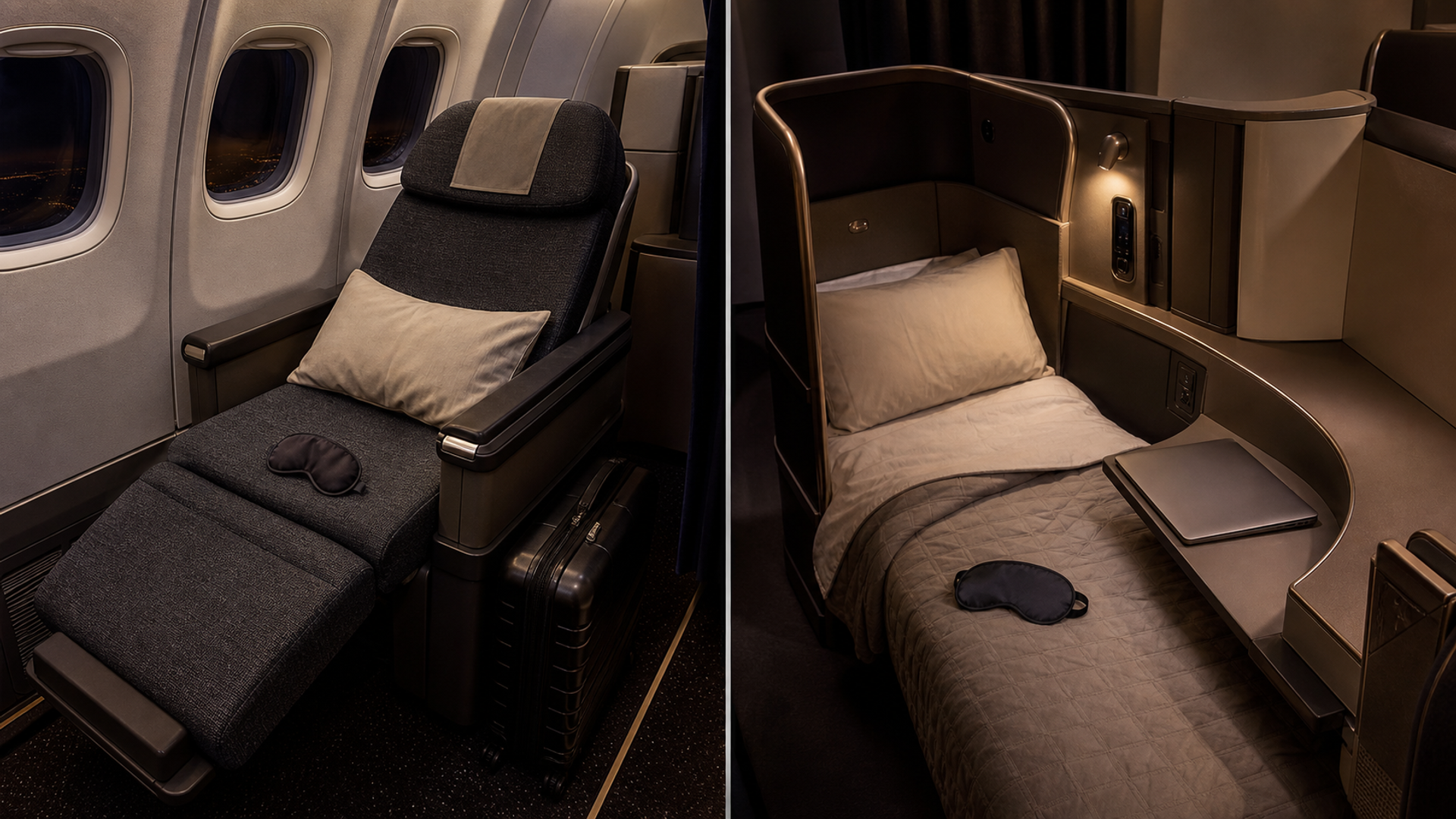
United Premium Plus is usually the better-value upgrade when you want a wider recliner, more legroom and a smaller cabin but can arrive without a full night’s sleep. United Polaris is the materially different product: on eligible long-haul flights it adds a lie-flat seat, direct aisle access, stronger airport benefits and a service designed around sleeping. The right answer depends on the exact aircraft, the direction of travel and what you must do after landing.
This United Premium Plus vs Polaris guide treats the fare gap as a purchase decision, not a status decision. Prices move by route and date, so the useful question is: what outcome does the higher cabin protect that the lower one cannot?
Quick verdict
Choose United Premium Plus for daytime flights, leisure arrivals, couples travelling together and large fare gaps. Choose United Polaris for overnight sectors, immediate meetings, travellers who need direct aisle access, and itineraries where a useful Polaris Lounge interval changes the whole journey.
Do not pay for Polaris from a generic cabin photograph. Confirm that the flight is United-operated, that the segment is sold with the relevant cabin, and that the seat map shows the aircraft you expect. A schedule or equipment change can alter privacy, seat location and lounge eligibility.
United Premium Plus vs Polaris decision matrix
| Factor | United Premium Plus | United Polaris | Verify before paying |
|---|---|---|---|
| Seat category | Wide premium-economy recliner with leg support | Lie-flat business-class seat | Exact aircraft and seat map |
| Sleep | Better than Economy, but still seated | Horizontal sleep is possible | Realistic sleep window and seat location |
| Aisle access | Window passenger may cross a neighbour | Direct aisle access on the long-haul Polaris product | Operating aircraft and configuration |
| Airport | Priority treatment varies by ticket and status | Eligible itinerary can include Polaris Lounge access | Airport, same-day itinerary and access rules |
| Dining | Upgraded meal and presentation | More elaborate premium service | Flight duration and departure time |
| Baggage | Premium-economy allowance for the ticketed route | Business allowance for the ticketed route | Itinerary-specific bag calculator |
| Best use | Comfort without buying a bed | Sleep, privacy and protected arrival performance | Total fare gap, not cabin label |
The seat difference changes the category of travel
Premium Plus is not simply Economy with a better meal. Its dedicated recliner, greater pitch, wider personal space and leg support can make a long daytime sector substantially easier. It is especially useful for travellers who work in short bursts, watch films, read or sleep tolerably while seated. A smaller cabin can also feel calmer than the main economy cabin.
Polaris changes the geometry. The seat is designed to become a flat sleeping surface, and direct aisle access removes the need to coordinate with a neighbour. That matters when you wake frequently, want to stand during the night, need uninterrupted privacy or must control your own sleep schedule. United’s official Premium Plus overview and Polaris overview describe the products, but the aircraft seat map remains the final pre-purchase check.
A bed is not automatically valuable on every flight. On a seven-hour eastbound service, meal service and descent may leave only four realistic hours for sleep. On a twelve-hour overnight flight, the usable window can be much longer. Evaluate the hours you can actually protect, not the published flight duration.
Use an arrival-performance calculation
The most disciplined upgrade test starts after landing. Write down the first event that cannot be moved: a board meeting, wedding, family responsibility, onward drive or hotel check-in. Then compare the likely recovery time in each cabin.
Use this simple calculation:
Estimate the realistic sleep window after take-off, meal service and pre-landing activity.
Estimate how much sleep you personally get in a recliner versus a flat bed.
Add any useful ground time from lounge access, priority treatment or easier baggage handling only when confirmed.
Divide the fare difference by the extra protected hours.
Compare that cost with the value of the arrival day.
If Polaris costs an extra $1,200 and you expect four additional useful hours across the journey, the premium is $300 per protected hour. That may be rational before a high-stakes workday and wasteful before a quiet resort afternoon. If the difference drops to $500, the same seat becomes a different proposition without any hardware change.
Polaris Lounge value is itinerary-specific
United Polaris Lounge access can be a meaningful part of the business-class proposition, but it is not a universal feature attached to every seat with the word “business”. Eligibility depends on the same-day itinerary, operating airline, cabin and airport. United’s lounge access information should be checked for the exact trip.
A three-hour connection can turn a lounge into a practical workspace, shower stop and meal before sleep. A 50-minute connection gives it almost no usable value. The airport also matters: a benefit at the origin does not compensate for a difficult arrival transfer, and a lounge in another terminal can be impractical.
Ground benefits are most valuable during disruption. A quiet place with power and food can reduce the cost of a delayed connection, but it cannot make the airline operate a cancelled flight. Keep responsibility clear: United controls the ticket, rebooking and airport product; any third-party assistance operates around those decisions.
Eligible VERTU clients may use human Concierge support to help coordinate flights, airport assistance, ground transport, hotels or dining where available and subject to service terms. That support cannot guarantee a Polaris seat, lounge admission, upgrade, schedule or recovery result, and material bookings still require user authorisation. Its natural role is continuity between suppliers, not replacing United’s operational channels.
Food and service should not distract from sleep
Premium Plus normally offers a more deliberate meal and amenity experience than Economy. Polaris adds more space, premium dining and more individual service pacing. On a daytime flight, those improvements may contribute meaningfully to comfort. On an overnight flight, a long dinner can work against the main reason to upgrade.
Decide before boarding whether you will eat fully, eat quickly or sleep immediately. If the lounge provides a suitable meal, an early sleeper may choose to minimise onboard service. If you plan to remain awake, the workspace, power and privacy can carry more value than the bed.
Menus change and availability varies. Never assign hundreds of dollars of upgrade value to a specific dish, amenity kit or wine that may be replaced. The durable differences are seat category, access, privacy and the ability to control your time.
Baggage and priority: check the whole ticket
Premium Plus and Polaris can include stronger checked-bag treatment than standard Economy, but the applicable allowance depends on route, ticket, status and the complete itinerary. Partner-operated segments can introduce different rules. Use United’s current baggage tools for the booking rather than repeating a generic allowance.
Priority check-in, boarding and baggage delivery can reduce friction, yet their value is uneven. Priority boarding is valuable when overhead space and working time matter; it is less valuable when you prefer to spend the last possible minute in the lounge. Priority baggage is useful only if it works at the destination, and no delivery order is certain enough to support a tight self-connection.
Aircraft swaps are the biggest residual risk
Cabin names survive aircraft changes. Seat experience may not. Recheck the flight at booking, after schedule notifications and again before the cancellation deadline. Look at seat width, row position, galley and lavatory proximity, window alignment and whether your chosen seat remains assigned.
If a specific Polaris configuration is essential, buy a fare with acceptable change and cancellation terms. Do not build the trip around a seat-selection screenshot alone. Operational substitutions are a normal airline risk, not evidence that the cabin never has value.
For comparison with other carriers, the Singapore Airlines Premium Economy vs Business Class guide shows how a similar decision changes with a different fleet. The Emirates Premium Economy vs Business Class guide is useful when the journey routes through Dubai.
Who should book Premium Plus?
Premium Plus is usually the smarter buy for a traveller on a daytime flight, a couple who wants to sit together, someone with an easy arrival day, or a buyer whose Polaris premium would fund several hotel nights. It also makes sense when you sleep reasonably well in a recliner and the connection is too short for lounge value.
It becomes weaker when the flight is overnight, you need frequent aisle access, you cannot sleep seated or your first day contains a demanding commitment. A bargain is not good value when it fails the journey’s main requirement.
Who should book Polaris?
Polaris is usually worth considering for an overnight flight before work, a solo traveller who values direct aisle access, a passenger who needs privacy, or a journey with a long eligible lounge interval. It can also make sense when a sale or corporate fare compresses the gap.
It becomes weaker when the flight is short, daylight, lightly loaded, or followed by generous recovery time. It is also difficult to justify when the operating segment is not the long-haul product the buyer expects.
Final decision
United Premium Plus wins when the journey needs better sitting, not a bed. Polaris wins when horizontal sleep, aisle independence, airport access and arrival performance have measurable value. Confirm the aircraft, price the useful hours, verify the lounge and baggage rules, and choose the fare whose benefits survive a less-than-perfect travel day.
Sources
United Airlines, United Premium Plus, accessed 2 August 2026.
United Airlines, United Polaris, accessed 2 August 2026.
United Airlines, Airport lounge access, accessed 2 August 2026.


![Top 10 Luxury Smartwatches for Business Travel [2026]](https://cdn.sanity.io/images/e0gp1l2g/production/8b5e5b21db42a1c5f040e828bd041857353a8eb2-2560x1382.webp?w=800&h=450&q=82&auto=format&fit=crop)