

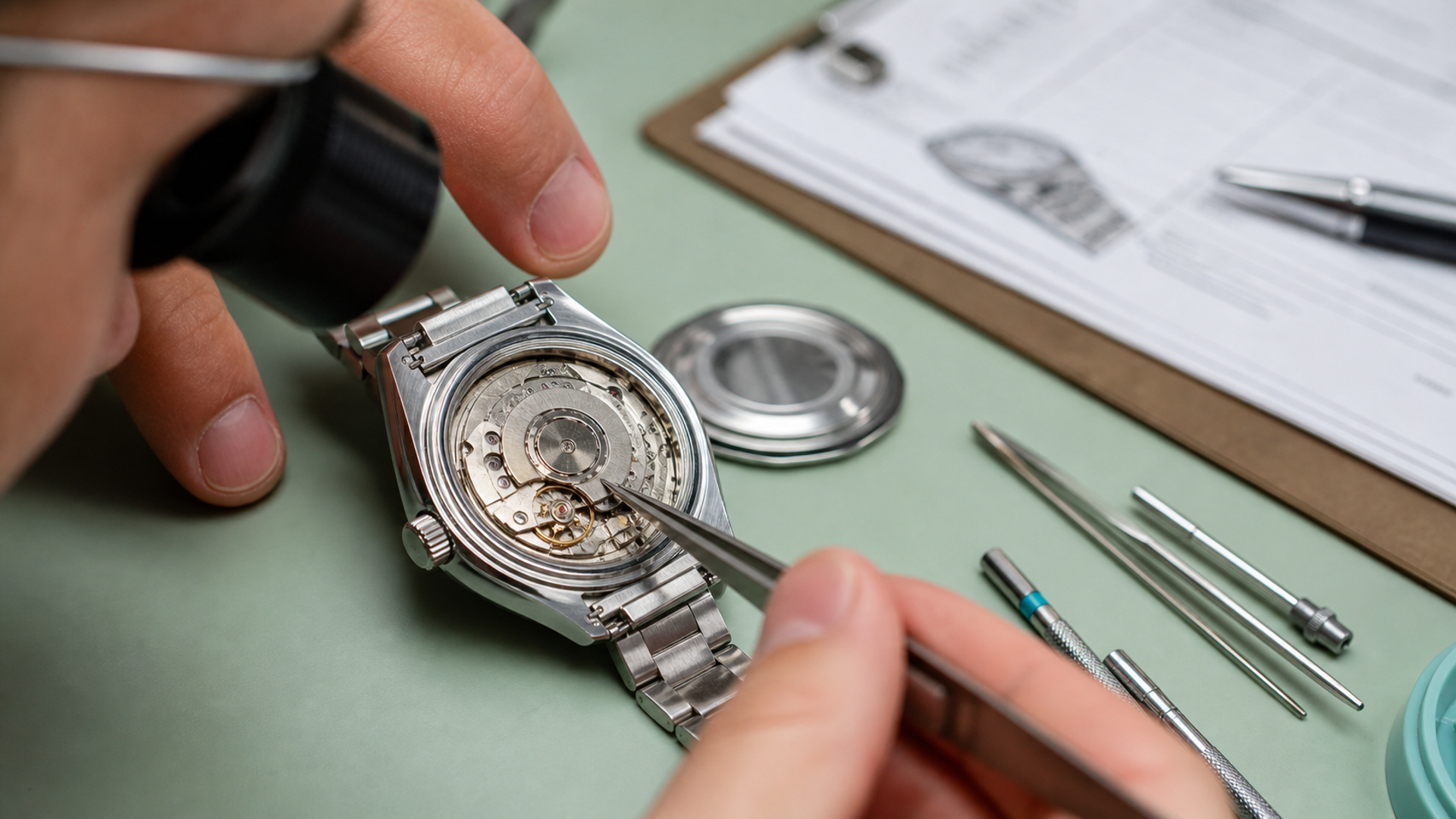
You cannot reliably authenticate every Rolex from photographs or a single “tell”. The safest buying route is an authorised Rolex retailer or a watch sold through the official Rolex Certified Pre-Owned programme. For any secondary-market purchase, verify the seller, the watch, the documents and the money trail independently—and make the transaction conditional on inspection by a qualified watchmaker or recognised authentication service.
Modern counterfeits can combine convincing cases, cloned movements, genuine components and fabricated paperwork. At the same time, genuine watches can have service parts, replaced bracelets, refinished cases or missing documents. The question is not only “Is it fake?” It is also “Is this watch correctly represented, in acceptable condition, legally owned and priced for its originality?”
Risk-tier authentication checklist
| Check | Low-risk evidence | Warning sign | What to do |
|---|---|---|---|
| Selling route | Authorised retailer or official Rolex CPO retailer | Anonymous seller, pressure to move off-platform | Stop or require independent escrow and inspection |
| Seller identity | Verifiable business, address, history and written terms | Newly created profile, copied images, changing story | Verify independently, not through seller-provided links |
| Reference and serial | Consistent with model, era and paperwork | Mismatched format, altered engraving, number reused online | Have the watch opened and records assessed by an expert |
| Dial and hands | Correct for reference and production period | Inconsistent fonts, spacing, lume or handset | Compare with authoritative reference material; avoid photo-only verdicts |
| Movement | Correct calibre and construction, professionally inspected | Decorated generic movement or inconsistent components | Require internal inspection |
| Case and bracelet | Appropriate dimensions, finishing and codes | Soft overpolished edges, wrong clasp or mixed parts undisclosed | Price originality and condition separately |
| Papers and accessories | Details match the watch and seller | Blank, altered or “full set” documents with errors | Treat boxes and cards as supporting, never conclusive, evidence |
| Payment | Traceable invoice, buyer protection, inspection window | Crypto-only, wire to unrelated name, no returns | Do not send funds |
Start with the seller, not the watch
A flawless-looking watch from an unverifiable seller is still a high-risk transaction. Confirm the legal business name, physical location, company registration where relevant, public history and after-sales terms. Call the business through a number found independently. Search the exact phone number, email, photographs and listing text for reuse in other identities.
Ask who owns the watch and whether it is being sold on consignment. The invoice should identify the seller, buyer, reference, serial or properly redacted identifying details, declared condition, included accessories, price, tax and return terms. If the person receiving payment is unrelated to the named seller, stop until the discrepancy is resolved.
Reputation is useful but not sufficient. Reviews can be bought and established accounts can be taken over. The strongest seller evidence is a transaction structure that remains safe when something goes wrong: inspection period, written authenticity warranty, clear jurisdiction, traceable payment and a practical remedy.
Make the reference the centre of the investigation
Rolex models evolve. Dial printing, bracelets, clasps, movements, bezels and serial-number placement vary by reference and era. A generic checklist saying that every genuine Rolex has one font, one magnifier behaviour or one hand motion creates false confidence. Identify the precise reference and approximate production period before comparing details.
The reference should align with case dimensions, metal, bezel, dial family, movement and bracelet options. An unusual configuration is not automatically counterfeit—Rolex service parts and legitimate variation exist—but it requires stronger documentation. Ask the seller to disclose replaced parts, service dials, reluming, refinishing and aftermarket additions.
Do not post the complete serial publicly. Fraudsters can copy it into counterfeit documentation. Provide sensitive identifiers only to the chosen professional and insurer through a secure channel.
Dial inspection: consistency matters more than one trick
Look at the dial under neutral light and magnification. Printing should be clean, aligned and appropriate to the reference, but tiny variations exist across suppliers and years. Check the coronet, minute track, date aperture, lume plots, depth-rating text and spacing as one coherent system. A counterfeiter may reproduce one famous feature while missing the relationship between several.
Hands should match the model and era in length, finish and lume appearance. Luminous material that differs sharply between dial and hands can indicate replacement, ageing or fabrication. That difference needs explanation, not an instant verdict.
Date magnification is frequently promoted as a decisive test. It is not. Crystal type, viewing angle, service replacement and counterfeit quality can affect appearance. Use the Cyclops, rehaut and laser-etched coronet only as supporting observations tied to the exact generation.
Case, bezel and finishing
Rolex case geometry is difficult to reproduce well but can also be damaged by polishing. Examine lug shape, crown guards, chamfers where applicable, brushing direction and the transitions between polished and brushed surfaces. Soft, rounded edges may indicate heavy refinishing rather than counterfeiting. That still affects collector value and future service options.
Test bezel action only with permission and without forcing it. Alignment, click feel and insert details should fit the reference. Ceramic and aluminium bezels age differently. Aftermarket inserts can look attractive but make the watch less original than the listing implies.
The winding crown should screw down smoothly on models designed for it, but tactile feel is not enough to authenticate a watch. Dirt, wear and service condition change resistance. Never perform a water test on an unknown watch; a failed seal can cause expensive damage.
Bracelet and clasp
Bracelets are commonly swapped, stretched, repaired or partly replaced. Check end-link fit, reference codes, clasp construction, finishing and the relationship between bracelet age and watch age. A genuine head on an aftermarket bracelet is not a counterfeit watch, but it is not an original complete example either.
Excessive stretch can reflect wear in pins and links. Inspect for sharp burrs, uneven screws and poor welds. Counterfeit clasps may feel light or show crude machining, while high-grade copies can be convincing. A professional should assess the metal, construction and codes in context.
Bracelet condition is also a safety issue. A weak clasp or damaged spring bar can turn a genuine watch into a lost watch. Include repair cost in the purchase decision.
The movement requires professional inspection
The movement is among the strongest evidence, but it should be inspected by someone who knows the relevant calibre. Opening the case without proper tools can scratch the watch, damage seals and create contamination. Arrange inspection through a qualified independent watchmaker, authorised retailer or the official route appropriate to the transaction.
The examiner should confirm calibre architecture, markings, finishing and component consistency, then assess corrosion, lubricant condition, amplitude and service need. “Swiss movement” does not mean Rolex movement. Some counterfeits use movements decorated to resemble genuine calibres, and some altered watches combine authentic and non-authentic parts.
Ask for a written inspection result, not only “looks good”. Define whether the opinion covers authenticity, originality, condition and water resistance; those are separate questions.
Papers, boxes and service history
Boxes and cards can be purchased separately or counterfeited. Their presence does not authenticate the watch; their absence does not make a genuine watch fake. Match document details to the reference, serial, selling retailer and date, and inspect for alteration.
Service history can be more useful because it shows a chain of custody and previous work. Yet an old service receipt does not prove the watch has remained unchanged. Verify the issuer independently and ask what parts were replaced.
The official Rolex Certified Pre-Owned programme provides a Rolex-supervised route for eligible watches sold through participating official retailers, with authenticity certification and a two-year international guarantee under programme terms. It is a risk-reduction route, not evidence that every non-CPO Rolex is counterfeit.
Price, urgency and impossible bargains
A price meaningfully below the market requires an explanation: condition, missing tax, urgent liquidity, service need, disputed provenance or fraud. Compare the same reference, year range, dial, bracelet, condition and completeness. Asking prices are not realised prices, and an inexpensive listing can be designed to create urgency rather than complete a transaction.
Walk away from artificial deadlines, secrecy, refusal of inspection, overpayment stories and requests to use irreversible payment. A genuine watch will be offered again; money sent to the wrong party may not return.
For cross-border transactions, include duty, VAT, shipping insurance, sanctions compliance and the difficulty of enforcing a return. A slightly higher local price can be cheaper than an international dispute.
Safe transaction design
Meet at a secure professional location, not a car park or hotel lobby. Have the watch inspected before funds become irreversible. Use a payment method and escrow arrangement whose terms you have verified directly. Photograph the condition and included items at handover.
Confirm that the watch is not reported lost or stolen through appropriate services and documentation. No private database is complete, so provenance still matters. Ask the insurer what evidence is required and whether cover begins during shipment or only after inspection.
Keep identity documents and complete serial numbers out of casual messages. Fraud prevention should not create a new identity-theft risk.
Where VERTU Concierge fits—and where it does not
For eligible users, VERTU Concierge may help coordinate supported appointments, travel logistics or contact with an appropriate retailer where available. It does not authenticate a Rolex, create authorised inventory, guarantee a purchase or replace Rolex and qualified watch professionals. Any reservation, payment or external action requires user authorisation.
The relevant value is coordination around a high-stakes purchase: arranging a secure appointment or integrating it with a trip. The authenticity verdict must remain with the competent examiner and documented selling route.
Buyer’s final checklist
Verify the seller through independent contact details.
Identify the exact reference and production context.
Obtain high-resolution, current photographs with a unique timestamp request.
Confirm the case, dial, hands, bezel, bracelet and clasp are coherent.
Ask for full disclosure of service, replacement and aftermarket parts.
Treat papers and boxes as supporting evidence only.
Arrange professional internal inspection before irreversible payment.
Check provenance and lost-or-stolen records where possible.
Use a written invoice, inspection window and protected payment route.
Insure the watch based on verified identity and condition.
Verdict
The safest way to spot a fake Rolex is to stop expecting one visual trick to do the work. Authenticate the transaction in layers: seller, reference, external details, movement, provenance and payment. When the value is meaningful, pay for competent inspection and make the purchase conditional on it. Confidence should come from independent evidence and a remedy—not from a convincing photograph.
Related VERTU reading
After establishing authenticity, compare collection roles in Rolex Submariner versus GMT-Master II. New collectors can use our guide to men’s luxury watch brands to place Rolex in a wider market context.
![How to Scan Receipts and Documents with Your Phone [Full Guide]](https://cdn.sanity.io/images/e0gp1l2g/production/0db13feec1d5e72b8a8a5f976d1f3e86619c9228-3840x1860.webp?w=180&h=180&q=78&auto=format&fit=crop)
![How to Scan Receipts and Documents with Your Phone [Full Guide]](https://cdn.sanity.io/images/e0gp1l2g/production/0db13feec1d5e72b8a8a5f976d1f3e86619c9228-3840x1860.webp?w=800&h=450&q=82&auto=format&fit=crop)
![Top 10 Two-Tone Carbon-Fibre Watches for Men [2026 List]](https://cdn.sanity.io/images/e0gp1l2g/production/18870799ba33fab0e038968359cd5772d7d7db30-1024x576.webp?w=800&h=450&q=82&auto=format&fit=crop)
![Top 10 Luxury Watches with Digital Complication Displays for Men [Latest]](https://cdn.sanity.io/images/e0gp1l2g/production/c4f6bf8c080f291c39f7cc85c7344ecff2fd3799-1024x553.webp?w=800&h=450&q=82&auto=format&fit=crop)