Air France Premium—still widely searched as Premium Economy—is the sensible choice when you want more space, a quieter cabin and a better meal without paying for a bed. Business becomes worth the upgrade when the flight contains a meaningful overnight sector, when arriving rested has a financial or personal value, or when lounge access, priority handling and direct aisle access remove friction from a tightly timed trip. The decision should be made for the exact aircraft and itinerary, not from the cabin name alone.
The short answer
For a daytime Atlantic crossing, many travellers will get most of the usable benefit from Premium. For an overnight flight into Paris followed by meetings, a connection or a same-day event, Business can buy back several hours that would otherwise be lost to poor sleep and airport recovery. The biggest dividing line is not food or champagne. It is whether the seat becomes a fully flat bed and whether every passenger can reach the aisle without negotiating with a neighbour.
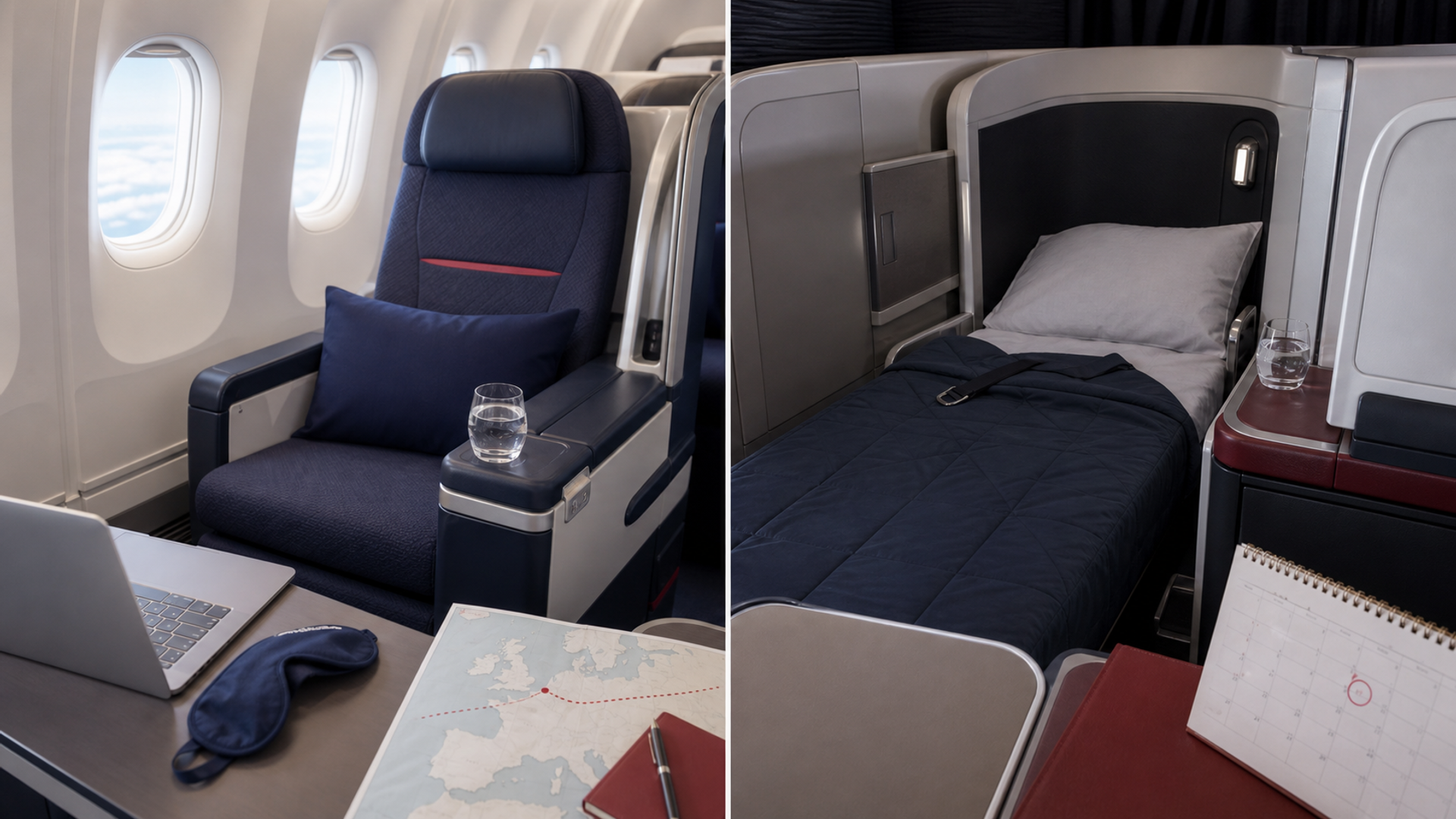
Air France describes its current long-haul Business standard through three ideas: full flat, full access and full privacy. Its latest Premium seat is a recliner with approximately 94–97 cm of legroom depending on aircraft, an adjustable footrest and a backrest that reclines up to 124 degrees. Those are materially different products, but neither label guarantees the newest seat on every flight. Aircraft assignment remains the first thing to verify.
Air France Premium vs Business decision matrix
| Decision factor | Premium | Business | Who should pay more? |
|---|---|---|---|
| Primary seat function | Upright comfort and deeper recline | Fully flat bed on long-haul fleet | Overnight travellers who need real sleep |
| Aisle access | Depends on row and seat | Direct access on the newest standard; verify aircraft | Solo travellers who dislike climbing over others |
| Privacy | Smaller cabin and wider seat than Economy | Enclosed or semi-enclosed personal space on newer seats | Confidential work and light-sensitive sleepers |
| Airport experience | Priority benefits vary by fare and status | Lounge, priority check-in, boarding and baggage usually included | Tight connections and high-friction airports |
| Dining | Upgraded French-style service | More elaborate service and wider choice | Travellers who value pacing and flexibility |
| Best value pattern | Day flight, leisure trip, modest fare gap | Night flight, important arrival, large recovery cost | Choose by arrival consequence, not aspiration |
| Main risk | Paying extra but still not sleeping | Paying a very large premium for a short or daytime flight | Check schedule, aircraft and fare rules |
Start with the aircraft, not the marketing page
Air France operates several long-haul configurations. Its current travel-cabin overview says all long-haul Business cabins have fully flat beds, while the latest door-equipped Business seats and newest Premium recliners appear on selected aircraft. The airline’s Airbus A350 cabin announcement gives a useful example: a nearly two-metre Business bed with a sliding door, while Premium has a recliner, 94 cm of legroom and a 48 cm seat pan in that configuration.
This makes the flight number only a starting point. Before paying, check the seat map in Manage My Booking and compare it with the aircraft shown for your date. Then check again in the final week because equipment can change. A good decision survives a swap: if you would regret the fare with an older but still fully flat Business seat, the price is probably too high.
Premium also has configuration differences. Air France’s 2024 Premium update says its newest recliner was being expanded across selected Boeing 777 and Airbus A350 aircraft and explicitly notes that measurements vary by aircraft type. Some older Premium seats use a fixed-shell design. That shell limits the way the passenger ahead intrudes into your space, but some travellers prefer the body angle and cushioning of the newer recliner. Seat reviews are therefore most useful when they match the route, aircraft and date—not merely the airline.
What the seat difference means over eight to twelve hours
Premium gives you a larger personal zone. The seat is wider than Economy, the legroom is meaningfully greater, and the footrest changes how long you can remain comfortable while reading, watching a film or working. A smaller cabin may also feel calmer. Those improvements are real even if you never sleep.
Business changes the geometry of the night. A flat surface allows side sleeping, removes much of the load from the lower back and makes it possible to build a normal sleep sequence. Air France says its newest Business seats follow the “full flat, full access, full privacy” standard; its updated A330 documentation describes a two-metre-long bed. The exact width, storage and privacy hardware vary by aircraft, but the decisive capability is consistent: it is a bed rather than a recliner.
Do not assume that flat automatically means eight hours of sleep. Meal timing, turbulence, cabin temperature and an eastbound flight’s short night can reduce the useful sleep window. On a late departure, eat in the lounge or before the airport if that helps you sleep sooner. On a flight leaving Paris in the afternoon, the bed may be less valuable than the extra space and uninterrupted work time.
Put a price on the arrival, not only the ticket
The cleanest way to compare the cabins is to calculate the cost per protected arrival hour:
Business premium ÷ useful hours recovered = cost per protected hour
Suppose Business costs £1,200 more than Premium and you believe the bed, priority path and lounge will preserve four productive or enjoyable hours after landing. The cost is £300 per protected hour. If the trip is a holiday with a flexible first day, that may be unattractive. If the arrival is followed by a board meeting, wedding, product launch or complex onward connection, the same number can be reasonable.
Use conservative estimates. Do not count every hour spent in the lounge as “saved,” and do not assume perfect sleep. The framework is most useful because it forces the upgrade to compete against an alternative: a better hotel, an extra night at the destination, a daytime flight, airport transfer, or simply keeping the money.
Ground experience: where Business quietly widens the gap
Business is not only an onboard product. On an itinerary beginning at Paris-Charles de Gaulle or another major station, lounge access, a priority check-in channel, earlier boarding and priority baggage can make the trip more predictable. This matters most when the airport is busy, the departure is delayed or the traveller needs a quiet place for a call.
Premium’s ground benefits depend more heavily on the fare, Flying Blue status and airport. Do not infer lounge access from the cabin. Read the fare conditions and the airport-specific entitlement. If you already have lounge access through status or a payment card, part of Business’s incremental value disappears.
The same logic applies to baggage. A traveller with only a cabin bag may value priority handling less than a family checking several cases. A passenger connecting onto a separate ticket may value it more, although priority tags never guarantee that a bag appears first.
Food, service and the ability to control time
Air France has deliberately moved Premium above a simple larger-seat proposition. Its Premium materials describe champagne, a comfort kit, upgraded tableware and menus developed with a Michelin-starred chef. Business adds a more elaborate dining sequence and greater personalisation.
Yet the practical Business advantage is control. A long, formal meal can be enjoyable on a daytime flight, but a passenger trying to sleep should ask the crew about a faster service. In Premium, the meal arrives on a more fixed cabin rhythm. Neither is inherently better; the question is whether you want ceremony or time.
Travellers with allergies or dietary requirements should request the appropriate special meal before the airline’s deadline and verify the request in the booking. Cabin class does not remove the need for that check.
Which cabin fits each trip?
Choose Premium when:
the long sector is mainly during your waking day;
the fare gap would fund an extra hotel night or a better overall itinerary;
you can tolerate a recliner and are not relying on sleep;
you already have status-based priority services or independent lounge access;
you are travelling as a couple and prefer to sit together without suite walls;
the newest Premium seat is confirmed on the aircraft.
Choose Business when:
the sector is overnight and the next day has a fixed commitment;
a flat bed has proven value for your body and sleep pattern;
direct aisle access matters for a solo traveller;
you need a quieter, more private work and rest environment;
priority processing reduces the risk around a tight or complex itinerary;
the fare difference is modest after comparing change rules, baggage and inclusions.
Treat either option cautiously when:
the aircraft type is uncertain or the route frequently sees swaps;
the fare is non-refundable and your schedule may change;
a short feeder segment is being priced as though it were the long-haul experience;
the connection is so poor that a different schedule would help more than a better seat.
A five-minute booking check
Identify every operating carrier and aircraft on the itinerary.
Open the seat map and look for the actual Business and Premium layout.
Confirm whether the long sector is predominantly day or night in your body clock.
Compare total fare conditions: changes, refunds, baggage, lounge and seat selection.
Price an extra hotel night and a better-timed flight as alternatives.
Check the arrival calendar for the first six hours after landing.
Recheck the aircraft and seat assignment before departure.
This checklist prevents the most common mistake: buying an abstract cabin category while ignoring the specific journey.
Where VERTU Concierge can be relevant
For eligible VERTU clients, VERTU Concierge may assist with high-touch travel planning, premium ground transport, dining requests and disruption coordination, subject to availability and the terms of the service. It cannot guarantee inventory, replace the airline’s obligations or make a weak flight schedule good. Its value is coordination: keeping the air, hotel, transfer and arrival plan connected when several moving parts matter.
For a broader route-first benchmark, compare Air France with our guide to the best business-class airlines by route, seat and ground time. If the question is specifically how much a premium-economy cabin can substitute for Business, the Emirates Premium Economy vs Business comparison shows the same decision framework on a different network.
Verdict
Air France Premium is the rational default for travellers buying space and calm. Business is the stronger purchase when the itinerary demands sleep, privacy and a controlled arrival. The upgrade is worth it only when those benefits solve a real problem on the exact flight. Confirm the aircraft, calculate the value of the arrival and buy the cabin that protects the trip—not the one with the more impressive name.