

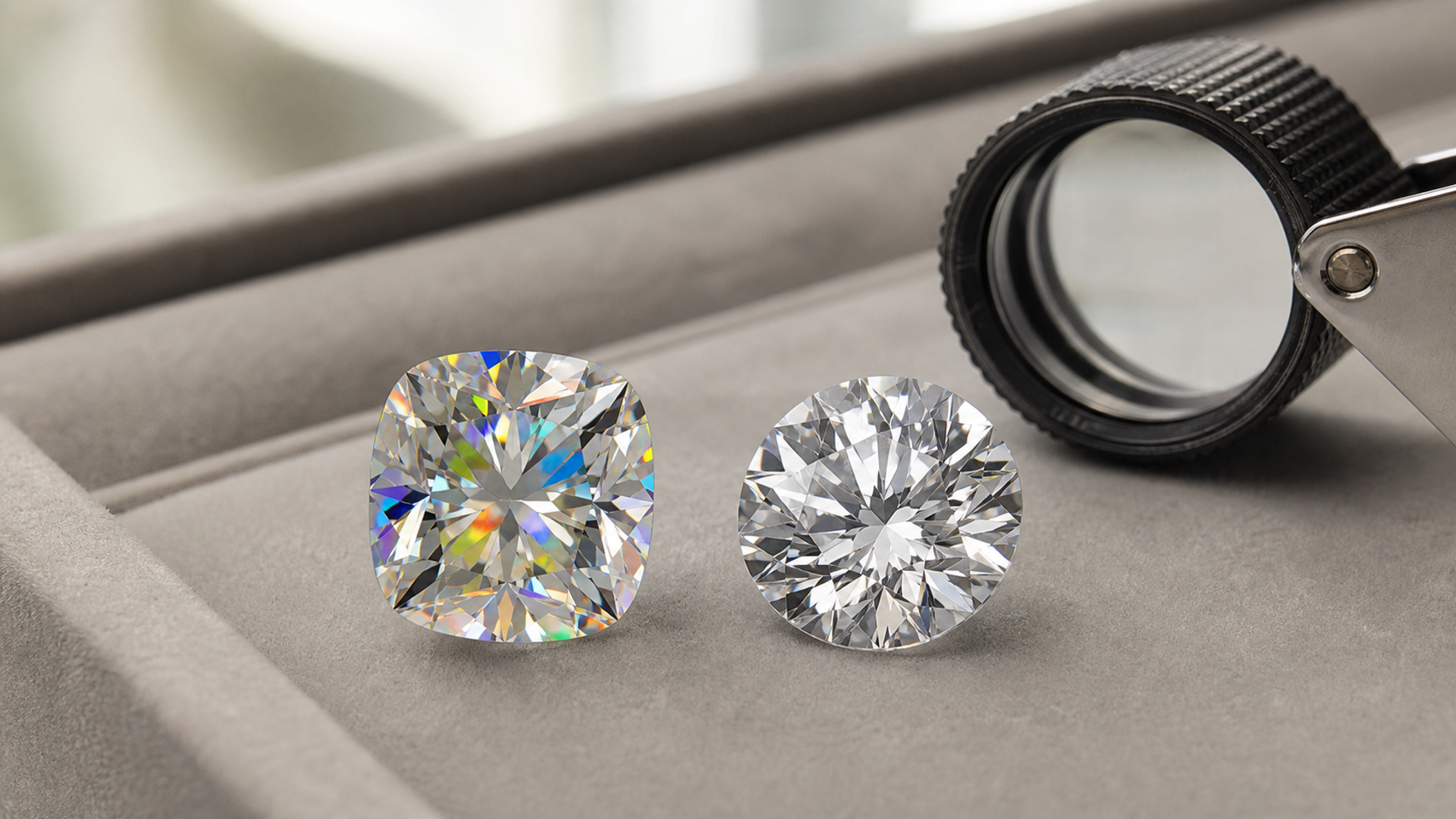
Moissanite is the better choice when size, daily durability and a controlled budget matter most. Diamond is the stronger choice when the buyer values rarity, a familiar grading language, broad resale recognition and the particular optical character of diamond. Neither stone is a universally superior purchase. They solve different versions of the same problem, and the expensive mistake is buying one while expecting it to behave—financially or visually—like the other.
The distinction also needs to be made correctly. Moissanite is not a laboratory-grown diamond. It is silicon carbide, a different material with its own refractive properties, hardness and identification characteristics. A laboratory-grown diamond, by contrast, has essentially the same chemical composition and crystal structure as a mined diamond. The Gemological Institute of America treats these as separate categories, and a reputable seller should do the same.
The decision in one table
| Decision factor | Moissanite | Diamond | What the buyer should verify |
|---|---|---|---|
| Visual character | Strong fire, often with conspicuous rainbow flashes | More familiar balance of brilliance, fire and contrast | Compare loose stones in daylight and ordinary indoor light |
| Size for budget | Usually permits a larger face-up look at the same spend | Price rises sharply with size and quality | Compare millimetre dimensions, not only carat labels |
| Hardness | About 9.25 on the Mohs scale | 10 on the Mohs scale | Hardness resists scratching; it does not make a setting indestructible |
| Toughness in wear | Suitable for daily jewellery | Suitable for daily jewellery | Inspect prongs, girdle exposure and setting protection |
| Grading language | Seller and laboratory descriptions vary | Widely understood 4Cs framework | Ask who graded the stone and what the report actually guarantees |
| Rarity narrative | Commercial stones are laboratory-created | Available as mined or laboratory-grown diamond | Decide whether origin and scarcity are part of the emotional value |
| Resale recognition | Smaller and less established secondary market | Broader recognition, but retail price is never assured on resale | Obtain realistic trade-in or resale terms in writing |
| Ethical inquiry | Laboratory production avoids mining but still uses energy and supply chains | Origin, mining practice and laboratory production all require scrutiny | Ask for traceable, specific evidence rather than a generic “ethical” label |
Start with the look, not the label
The most useful comparison happens before a salesperson tells you which stone is “better”. Put similarly sized round stones beside each other and move them through several lighting conditions. Moissanite can return intense spectral colour—small rainbow flashes that some buyers love and others find too lively. Diamond usually presents a different mixture of white brightness, coloured fire and dark-light contrast. Photography can exaggerate or suppress both effects, so a social-media video is weak purchase evidence.
Cut quality and shape change the result. An elongated moissanite, an antique-style cut and a modern round brilliant will not display light in the same way. Likewise, a poorly cut diamond will not automatically look more compelling because it is diamond. Compare the actual stones, face-up, at normal viewing distance. If the jewellery is a surprise gift, learn whether the recipient wants “diamond” as part of the object’s meaning; visual similarity cannot replace that preference.
Cost: compare complete rings, not stone headlines
Moissanite’s clearest advantage is the amount of visible stone available for a given budget. That does not mean every moissanite ring is inexpensive. Precious-metal weight, design complexity, hand finishing, brand, setting labour and aftercare can cost more than the centre stone. A large low-cost stone in a weak setting can be worse value than a smaller stone secured and finished properly.
Diamond pricing is more complicated because carat, colour, clarity and cut interact. Two one-carat diamonds can have materially different prices and appearances. The 4Cs are useful, but they should guide a visual decision rather than replace one. A buyer who cannot see the difference between two clarity grades in normal wear may prefer to spend on cut, setting or insurance. A buyer choosing moissanite should similarly avoid paying for marketing grades that do not produce a visible benefit.
Ask for an itemised quotation showing the centre stone, side stones, metal, labour, taxes, resizing and warranty. That makes the comparison honest. It also reveals whether the apparent saving is being consumed by a heavier or more elaborate setting that the buyer did not initially intend to purchase.
Durability: hard is not the same as damage-proof
Diamond is the hardest natural material used in jewellery and ranks 10 on the Mohs hardness scale. Moissanite is also exceptionally hard, commonly stated at about 9.25, which makes it practical for frequent wear. Mohs hardness describes resistance to scratching; it is not a promise that a stone cannot chip, fracture or be lost. A sharp impact in the wrong direction, a bent prong or a worn setting can defeat either choice.
Ring architecture matters more than many online comparisons admit. High-set stones catch on clothing and furniture. Exposed girdles receive more impact. Fine pavé can lose small stones even when the centre remains perfect. For a person who works with tools, lifts weights, gardens or travels with heavy luggage, a lower protective setting and sensible removal routine may add more usable durability than choosing one centre stone over the other.
Plan maintenance at purchase. Ask how often the setting should be inspected, who pays for routine tightening, whether replacement stones will match and what activities void the warranty. Photograph the finished piece and retain the invoice and grading documents separately. Durability is partly material science and partly ownership discipline.
Size and “carat” can mislead
Diamond carat is a unit of weight. Moissanite is less dense, so a moissanite with the same millimetre dimensions as a one-carat round diamond will not weigh one carat. Retailers therefore often use “diamond equivalent weight” or a size comparison. That language can be useful, but only if the actual dimensions are also disclosed.
Compare diameter, depth and face-up spread. A stone that carries too much weight below the setting can appear smaller than another stone of the same nominal carat. Extremely shallow proportions may spread wider but compromise optical performance or durability. The practical question is not “How many carats?” but “How large does this exact stone look, and how well does it return light?”
For earrings or a three-stone ring, matching also matters. Ask whether the stones are matched for dimensions, colour and optical character. A pair that looks equal under showroom spotlights may reveal a visible mismatch in daylight.
Colour, clarity and documentation
Diamond has an established international vocabulary around colour, clarity, cut and carat weight. Independent reports can make comparison easier, provided the buyer understands what the laboratory assessed and verifies that the report number matches the stone. A report is not an appraisal, a warranty or proof of future resale value.
Moissanite sellers may use terms such as colourless, near-colourless, premium or forever. These descriptions are not automatically equivalent across brands and laboratories. Older or lower-quality material can show warm, grey or greenish tones, particularly in larger sizes and certain lighting. Examine the stone from the side and against a neutral background, not only face-up beneath jewellery lights.
The US Federal Trade Commission’s jewellery guidance emphasises truthful representation of jewellery products. The buyer’s practical safeguard is a receipt that names the material plainly: “moissanite”, “laboratory-grown diamond” or “mined diamond”, along with treatments and metal fineness. Ambiguous language such as “diamond alternative” should never be allowed to blur the actual identity of the stone.
Long-term value has three meanings
“Value” can mean resale price, years of wear or emotional significance. These should not be collapsed into one number. Diamond has a more developed secondary market, yet most retail diamond jewellery does not resell for its original purchase price. Brand, documentation, condition, desirability and the buyer’s route to market all affect the outcome. A vague promise that a diamond is an investment is not a resale plan.
Moissanite usually has lower acquisition cost and weaker resale recognition. That can still be excellent lifetime value when the wearer obtains the desired look, uses the piece frequently and does not tie up capital in a feature they do not value. Its financial downside may be smaller in absolute terms even if its percentage resale recovery is poor.
Emotional value is personal but real. A mined diamond may represent geological rarity; a laboratory-grown diamond may represent technological precision; moissanite may represent visual impact without a large centre-stone budget. The correct choice is the story the owner actually wants, documented honestly.
Ethical and environmental claims require evidence
No category earns an automatic ethical halo. Laboratory production uses energy and industrial inputs. Mining has environmental and social impacts but also supports formal employment and local economies under very different governance conditions. Supply chains, energy sources, traceability and labour practice matter more than a one-word label.
Ask a narrow question: what can the seller prove about this stone’s origin and processing? Look for specific chain-of-custody information, producer identity, audit standards or energy disclosures. “Conflict-free”, “sustainable” and “eco” should be treated as claims that need scope and evidence, not as decorative adjectives.
If values are central to the purchase, record them in the brief before shopping. Otherwise they are easy to trade away when presented with a visually attractive stone.
A practical buying sequence
Set the complete jewellery budget, including tax, resizing and insurance.
Decide whether the word “diamond” is emotionally important.
Select the preferred face-up size in millimetres.
Compare actual stones in daylight, warm indoor light and low light.
Check the setting for height, prong security and ease of maintenance.
Read the report and invoice; confirm the material and any treatment.
Ask for return, resizing, replacement and warranty terms in writing.
Obtain a realistic insurance valuation rather than assuming the sales price is recoverable.
Keep photographs, report numbers and receipts outside the jewellery box.
Reinspect the setting after the first months of wear and at intervals advised by the jeweller.
Verdict
Choose moissanite when a larger visual presence, strong daily-wear performance and lower capital commitment are the priorities—and when its colourful fire is genuinely appealing. Choose diamond when the buyer wants diamond’s optical character, grading ecosystem, cultural meaning and broader secondary-market recognition. The best purchase is not the stone that wins an abstract comparison. It is the stone whose identity, appearance, setting and total cost remain satisfying after the showroom lighting and sales narrative disappear.
Related VERTU reading
For a different application of gemstones and precious materials, read the VERTU diamond phone buyer’s guide. The broader 2026 luxury watches and jewellery trends guide covers neighbouring collector and ownership decisions without changing this article’s gemstone comparison.
![How to Scan Receipts and Documents with Your Phone [Full Guide]](https://cdn.sanity.io/images/e0gp1l2g/production/0db13feec1d5e72b8a8a5f976d1f3e86619c9228-3840x1860.webp?w=180&h=180&q=78&auto=format&fit=crop)
![How to Scan Receipts and Documents with Your Phone [Full Guide]](https://cdn.sanity.io/images/e0gp1l2g/production/0db13feec1d5e72b8a8a5f976d1f3e86619c9228-3840x1860.webp?w=800&h=450&q=82&auto=format&fit=crop)
![Top 10 Two-Tone Carbon-Fibre Watches for Men [2026 List]](https://cdn.sanity.io/images/e0gp1l2g/production/18870799ba33fab0e038968359cd5772d7d7db30-1024x576.webp?w=800&h=450&q=82&auto=format&fit=crop)
![Top 10 Luxury Watches with Digital Complication Displays for Men [Latest]](https://cdn.sanity.io/images/e0gp1l2g/production/c4f6bf8c080f291c39f7cc85c7344ecff2fd3799-1024x553.webp?w=800&h=450&q=82&auto=format&fit=crop)