Key TakeawayIn 2026, enterprise adoption of Web3 wearable technology has evolved from speculative experiments into a core strategic driver. By unifying hardware secure enclaves, on-device AI, and W3C-standardized decentralized identity, smart glasses and rings offer US enterprises tamper-proof authentication, automated compliance logging, and verifiable physical-to-digital provenance.
Introduction
As enterprise tech stacks adapt to distributed workforces, autonomous AI agents, and heightened regulatory scrutiny, hardware form factors are undergoing a fundamental transformation. In 2026, wearable devices are no longer viewed simply as biometric trackers or smartphone accessories. When equipped with Web3 architecture—specifically decentralized identifiers (DIDs), verifiable credentials (VCs), and zero-knowledge proofs (ZKPs)—wearables act as cryptographically secure physical trust anchors for the enterprise.
This shift creates a direct bridge between an executive's physical presence and digital authorization. Chief Information Security Officers (CISOs), product leaders, compliance leads, and institutional investors across the United States are prioritizing this convergence. The imperative is clear: replace vulnerable passwords, centralized OAuth friction, and unverified data feeds with hardware-backed, self-sovereign cryptographic credentials.
This article examines the 2026 enterprise landscape for Web3 wearables. It details verified market momentum, operational use cases across identity and luxury fashion, a rigorous security and compliance blueprint, and a strategic 90–180 day deployment model.
2026 reality check
What’s real vs hype
The early wave of Web3 wearables suffered from over-promising and technical friction. Clunky head-mounted displays, high battery drain, required manual token management, and slow blockchain settlement created unacceptable barriers for enterprise IT deployment.
In 2026, the market reality has matured around three key technological breakthroughs:
- Invisible CryptographyComplex wallet keys and gas fees are fully abstracted away through smart account standards. The end user interacts naturally with hardware sensors without managing private seed phrases.
- On-Device ProcessingMachine learning models and cryptographic signatures are executed directly within localized hardware secure enclaves, avoiding constant cloud latency and data leakage.
- Purpose-Built Form FactorsSleek, high-comfort smart rings and ergonomic, display-less AI glasses have superseded heavy VR/AR helmets for daily enterprise workflows.
Conversely, speculative consumer metaverse wearables and pure token-gated novelty devices have largely subsided. Enterprise value in 2026 is driven exclusively by utility: identity assurance, automated audit trails, zero-trust physical-logical access, and frictionless compliance.
Where Web3 enhances utility
Web3 architecture solves three persistent operational challenges in modern enterprise mobility:
- Zero-Trust AuthenticationInstead of relying on vulnerable SMS TOTP or centralized push notifications, a wearable uses biometric sensors paired with a localized private key to sign identity claims instantly.
- Verifiable Data ProvenanceSensor readings (e.g., location, temperature, biometric verification) are signed at the hardware level, creating immutable, audit-ready event logs that prove real-world physical events.
- Data Sovereignty & Selective DisclosureUtilizing W3C Verifiable Credentials and Zero-Knowledge Proofs, employees and VIP clients can prove their authorization, clearance level, or age without revealing underlying personal data to third-party verifiers.
Market momentum and data
AI glasses outlook (shipments, drivers)
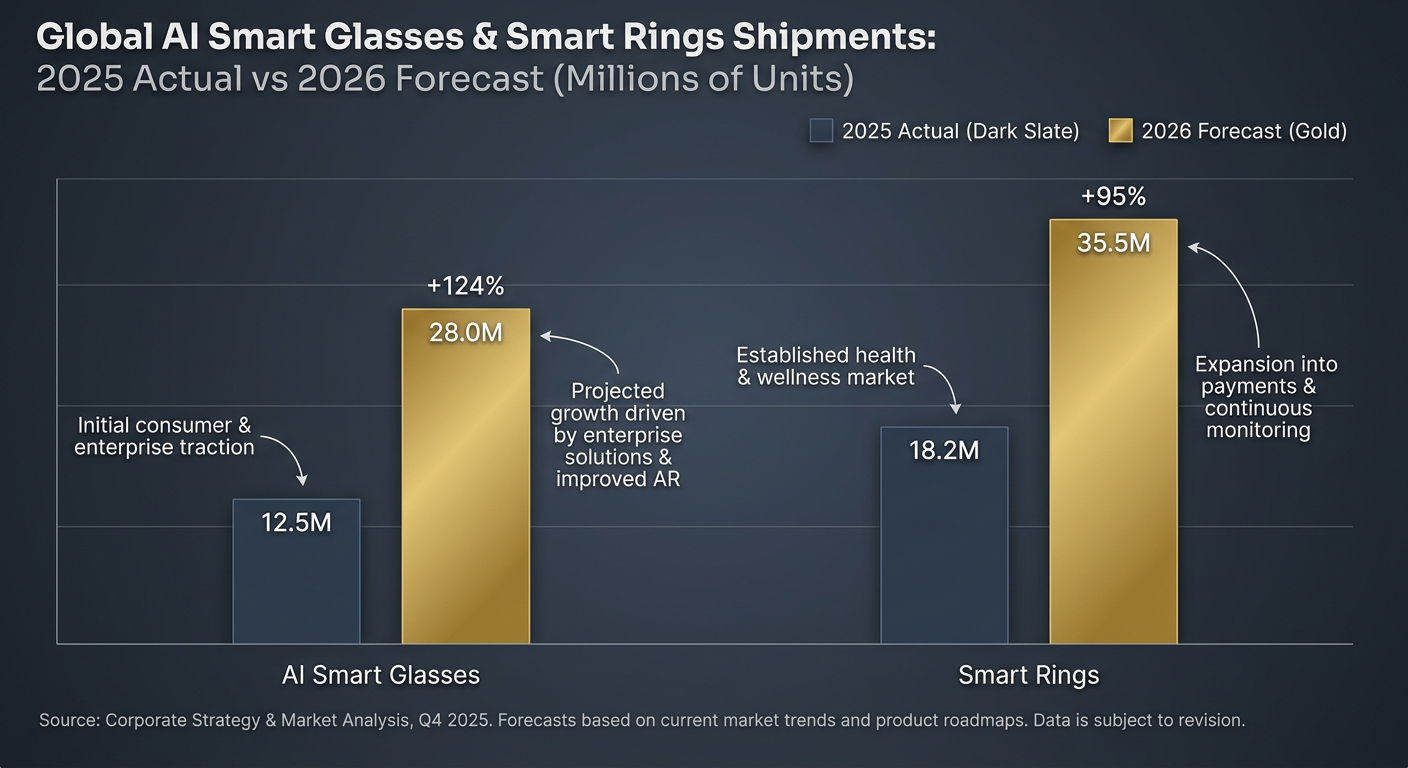
The enterprise adoption of smart eyewear reached an inflection point entering 2026. According to Omdia's 2026 Global AI Glasses Market Report, global AI glasses shipments reached 8.7 million units in 2025 (a 322% year-over-year surge) and are projected to surpass 15 million units in 2026.
Primary enterprise drivers include hands-free field operations, real-time contextual AI assistance, and biometric session continuity. By embedding micro-secure enclaves into display-less smart frames, organizations enable field engineers, healthcare professionals, and executive teams to authenticate workflows using spatial voice commands and glance-based attestation.
Smart rings outlook (adoption vectors)
Smart rings represent the fastest-growing form factor for continuous enterprise identity and biometric health monitoring. Based on market data from Grand View Research's 2026 Smart Rings Market Analysis, the global smart ring sector expanded to $417.5 million in 2025 and is tracking toward $518.9 million in 2026, driven by a projected 22.5% CAGR through 2033.
Enterprise adoption vectors for smart rings center on:
- Discreet NFC / BLE AccessTap-to-enter access control for high-security facilities, data centers, and executive suites.
- Continuous Biometric IdentityReal-time heart-rate frequency and skin-conductance matching that locks enterprise sessions immediately if the ring is removed from the authorized user's finger.
- Executive Wellness & Stress TrackingCorporate wellness initiatives leveraging private, local biometric aggregation without centralized data surveillance.
Adoption barriers to watch
Despite rapid expansion, CISOs and procurement teams must evaluate four ongoing hardware and operational constraints:
- Battery & Thermal LimitsContinuous cryptographic signing and BLE radio usage constrain active battery life to 24–48 hours in smart rings and 8–12 hours in AI glasses.
- Biometric Template PrivacyState-level regulations require explicit user consent and local-only hardware storage for biometric reference data.
- Interoperability GapsHeterogeneous enterprise systems require standardized middleware to verify W3C credentials across legacy active directory environments.
Enterprise-grade use cases
Provenance and authenticated digital fashion
In high-luxury retail, corporate gifting, and bespoke client engagement, physical objects are increasingly paired with digital twins on-chain to combat counterfeiting and establish verifiable ownership.
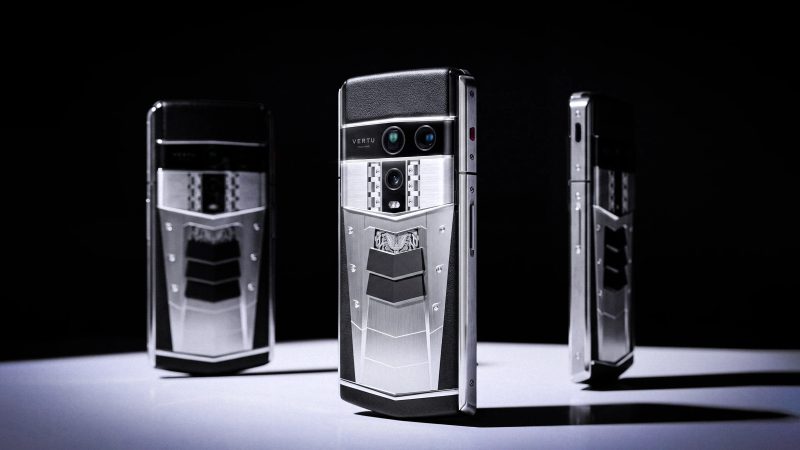
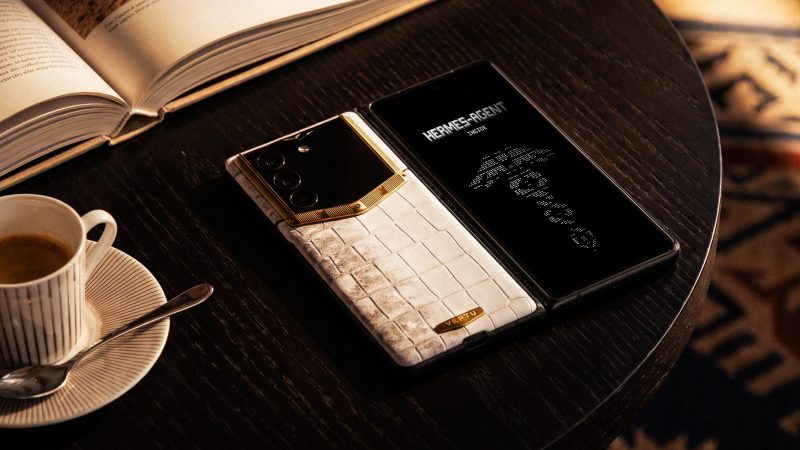
A prominent example of this synthesis is found in VERTU's concierge-integrated ecosystem. Known for combining handcrafted luxury materials with Web3 security vaults, VERTU illustrates how high-net-worth clients receive verifiable digital identity passes bound directly to their physical devices. Through an integrated Web3 hardware infrastructure, a client wearing an authenticated piece or holding a secure device can seamlessly access 24/7 global VIP concierge services, private event check-ins, and tailored personal assistance. The underlying blockchain registry proves authenticity and client status instantly without exposing personal identity records to third-party staff.
Identity, access, and compliance credentials (DID/VC)
Traditional identity systems rely on vulnerable centralized databases. Web3 wearables leverage the W3C Decentralized Identifiers (DID) Architecture Specification to grant employees self-sovereign digital credentials.
When an employee presents their wearable to an enterprise access point:
The reader issues a challenge request to the wearable's DID.
The wearable retrieves a locally stored Verifiable Credential issued by the company's HR authority.
The device signs the response inside its secure hardware enclave, proving valid clearance, active employment, or facility access rights.
Zero personal identifiers (such as Social Security Numbers or home addresses) leave the device.
Loyalty and tokenized engagement
Enterprise customer experience (CX) programs utilize wearables to automate tokenized engagement. In hospitality, aviation, and financial services, smart rings and glasses serve as non-custodial loyalty keys:
- Automated Airport Lounge & VIP AccessSmart rings instantly verify tokenized membership passes at terminal gates.
- Programmable PerksSmart contracts distribute tokenized rewards based on verified physical attendance at corporate summits or sponsor activations.
- Frictionless Micro-TransactionsNFC-enabled smart rings conduct tokenized payments within pre-approved spending limits set by corporate expense policies.
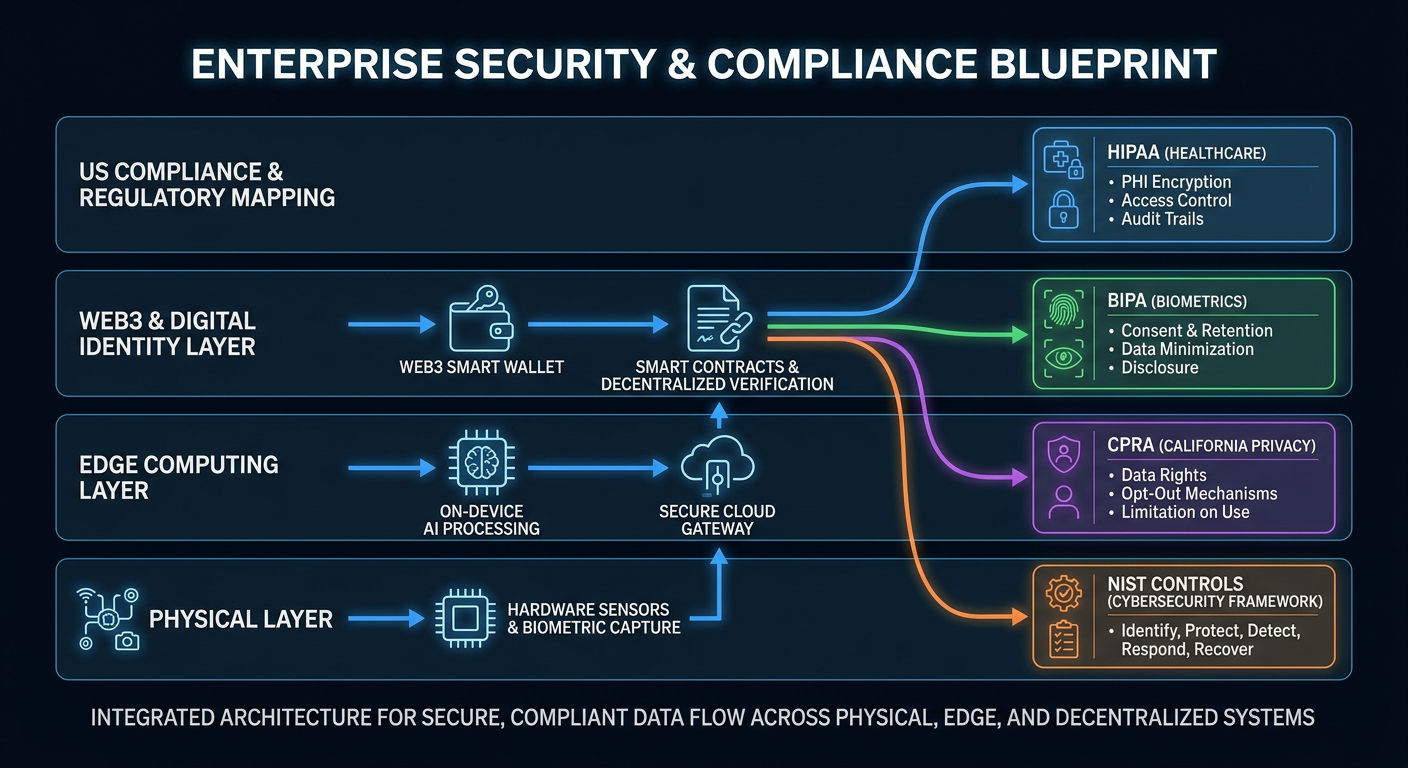
Security and compliance blueprint
Regulatory scope (HIPAA, HBNR, CPRA/Colorado/Virginia, BIPA, FDA)
Enterprise deployment of Web3 wearables in the United States requires navigating a strict multi-jurisdictional compliance matrix:
Regulation | Compliance Mandate | Web3 Wearable Architectural Mitigation |
|---|---|---|
HIPAA & HBNR | Protects Protected Health Information (PHI) and mandates breach notifications for non-covered health entities. | Health metrics remain on-device. Only Zero-Knowledge attestations are transmitted off-device. |
CPRA / CCPA / VCDPA | Enforces data minimization, right to delete, and strict limits on personal data sharing. | Self-sovereign DID keys allow users to revoke access credentials instantly without central data residue. |
Illinois BIPA | Strict requirements for written consent and local storage of biometric identifiers. | Biometric matching occurs exclusively inside the device's Secure Enclave; raw templates never hit the cloud or blockchain. |
FDA (Software as Medical Device) | Regulates wellness vs. diagnostic clinical claims. | Enterprise wellness apps maintain clear boundary controls, framing sensor outputs as lifestyle/wellness indicators. |
Threat model across device→AI→cloud→Web3
A comprehensive CISO risk assessment must evaluate four vulnerability layers:
[ Wearable Sensors ] ──(BLE/NFC)──> [ Mobile/Edge AI ] ──(TLS 1.3)──> [ Enterprise Cloud ] ──(RPC)──> [ Web3 Smart Contracts ]
- Device LayerPhysical tampering, side-channel analysis, and Bluetooth signal spoofing.
- AI LayerPrompt injection into ambient voice models on smart glasses and localized model poisoning.
- Cloud GatewayMan-in-the-middle attacks between localized edge nodes and corporate databases.
- Web3 Contract LayerRe-entrancy vulnerabilities, compromised admin keys, and malicious smart contract upgrades.
Mitigations and controls (NIST AI RMF, NISTIR 8259, ISO 27001/27701, SOC 2)
To neutralize these threat vectors, enterprises must mandate specific security controls mapped to recognized standards:
- NISTIR 8259 (IoT Cybersecurity Baseline)Mandates secure device identification, encrypted data storage, and over-the-air (OTA) cryptographic firmware signing.
- NIST AI Risk Management Framework (AI RMF)Establishes governance controls around ambient AI voice parsing to prevent unintended authorization execution.
- ISO 27001 / ISO 27701 & SOC 2 Type IIEnsures enterprise cloud relay nodes maintain rigorous privacy controls, continuous audit logging, and strict data segregation.
Reference architecture and rollout
Data governance and on-device AI
An enterprise-ready wearable deployment follows a strict local-first data architecture. Raw sensor streams—such as microphone audio, camera feeds, and heart-rate intervals—are processed inside the device's localized Neural Processing Unit (NPU).
+-------------------------------------------------------------------+
|                        WEARABLE HARDWARE                          |
|  +-------------------+   +-------------------------------------+  |
|  | Hardware Sensors  | ->| Local NPU (Zero-Retention AI Model) |  |
|  +-------------------+   +-------------------------------------+  |
|                                     |                             |
|                                     v                             |
|  +-------------------------------------------------------------+  |
|  | Secure Enclave / Hardware Root of Trust (Private Key Storage)|  |
|  +-------------------------------------------------------------+  |
+-------------------------------------------------------------------+
                                      |
                     Cryptographic Proof (ZKP / DID)
                                      v
+-------------------------------------------------------------------+
|                     ENTERPRISE GATEWAY & WEB3                     |
|  +-----------------------+       +-----------------------------+  |
|  | ERC-4337 Smart Account| <---> | Enterprise IAM / SOC 2 Logs |  |
|  +-----------------------+       +-----------------------------+  |
+-------------------------------------------------------------------+
Only transformed, cryptographically signed summaries or Zero-Knowledge Proofs leave the hardware buffer. The underlying raw data is immediately purged from volatile RAM, ensuring zero persistent footprint for attackers.
Wallets, keys, and account abstraction
Managing raw seed phrases is unviable for corporate employees. Web3 wearables overcome this bottleneck by implementing Ethereum's ERC-4337 Account Abstraction Standard.
Under this model:
The wearable's hardware Secure Enclave stores an unexportable signing key.
The user's corporate wallet is a smart contract on-chain, not an externally owned account (EOA).
- Session KeysExecutives can authorize temporary, scoped session keys for a 12-hour shift, allowing the smart ring to sign routine door-access transactions automatically.
- Social & Corporate RecoveryIf a wearable ring or glass frame is lost, corporate IT administrators and pre-approved guardians can execute a multi-signature recovery script to transfer wallet authority to a replacement device instantly.
Operating model and vendor due diligence
Before approving wearable vendors, enterprise IT procurement teams should conduct strict vendor due diligence using the following checklist:
- Hardware Security AssessmentDoes the device utilize a certified Secure Enclave (e.g., EAL6+ rated chip)?
- Firmware IntegrityAre firmware updates cryptographically signed and verifiable over-the-air?
- Cryptographic AuditHas the device's Web3 library and account abstraction smart contract undergone an independent third-party security audit?
- Privacy AttestationDoes the vendor provide SOC 2 Type II and ISO 27701 privacy compliance certifications?
Conclusion
Executive takeaways and prioritized next steps
Web3 wearable technology in 2026 has crossed the threshold from experimental gadgetry to enterprise infrastructure. By combining the physical convenience of smart eyewear and rings with the immutable security of decentralized identity, organizations can eliminate authentication friction, strengthen physical-logical security, and ensure seamless regulatory compliance.
To capitalize on this shift, executive leadership should execute three immediate steps:
- Cross-Functional AlignmentEstablish a joint task force comprising the CISO, Chief Risk Officer, and Product leads to identify high-friction identity workflows.
- Vendor Risk ScrutinyAudit potential wearable vendors against the NISTIR 8259 cybersecurity baseline and EAL6+ hardware enclave requirements.
- Scoped Pilot DefinitionLaunch a focused, high-value pilot targeting executive access control or high-value asset tracking before expanding across broader corporate divisions.
Metrics and checkpoints for 90–180 day pilots
Enterprise product and security teams should structure 90–180 day implementation pilots using the following clear operational checkpoints:
[ Day 1–30: Architecture & Vendor Vetting ] ──> [ Day 31–90: High-Value User Pilot ] ──> [ Day 91–180: Enterprise Rollout & Audit ]
- Days 1–30 (Architecture & Compliance Readiness)Complete CISO threat modeling, verify W3C DID/VC compatibility, and confirm BIPA/CPRA consent workflows.
- Days 31–90 (Controlled User Pilot)Deploy smart rings or AI glasses to a trial cohort of 50 executive or field service users. Measure authentication latency reduction (target: <500ms) and user sign-in friction score.
- Days 91–180 (Enterprise Assessment & Audit)Evaluate zero-trust security incident logs, confirm zero raw biometric cloud leakage, and benchmark administrative cost savings against legacy MFA systems.
Disclosure: This article references VERTU pages. Editorial judgment remains the priority.