

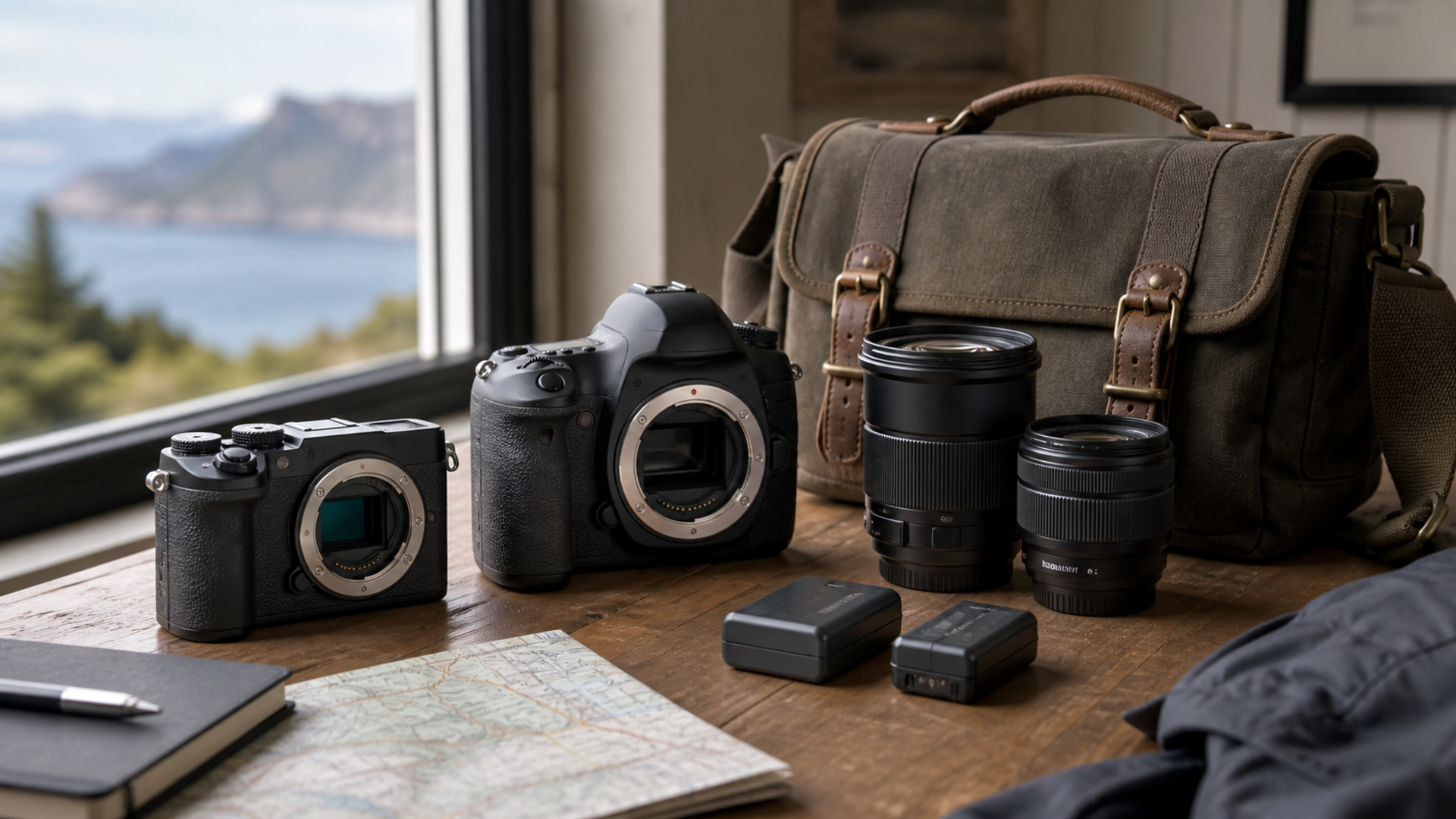
Mirrorless versus DSLR camera is mainly a system and workflow decision. A DSLR uses a mirror and optical viewfinder; a mirrorless camera keeps the sensor active and presents a live electronic view. Mirrorless can offer compact bodies, exposure preview and advanced autofocus, while a DSLR can preserve familiar handling, optical-viewfinder endurance and an established lens kit. Assignments and switching cost should decide.
Begin with photographs, not categories
Choose mirrorless when electronic preview, subject autofocus, video and a native lens roadmap improve real work. Choose DSLR when existing bodies and lenses remain reliable and optical viewing fits. Keep the current system when technique, lighting, support or one lens is the real limitation.
| Decision factor | Mirrorless system | DSLR system | Keep the current system |
|---|---|---|---|
| Viewfinder | Electronic preview improves decisions | Optical viewing fits the work | Use live view or monitor |
| Autofocus | Subject recognition matters | Existing focus meets subjects | Improve settings |
| Lenses | Native lenses cover work and budget | Owned DSLR glass remains strong | Adapt or rent |
| Battery | Spare workflow is acceptable | Long optical endurance matters | Add power |
| Video | Monitoring and stabilisation improve output | Stills dominate | Use dedicated video |
| Cost | Benefits repay migration | Switching strands useful gear | Upgrade one bottleneck |
This mirrorless vs dslr camera matrix is the article's working value object. Read the mirrorless vs dslr camera rows together: the decisive failure mode depends on this topic's evidence, operating context and reader objective.
What removing the mirror changes
Evidence 1. Nikon defines mirrorless as a camera whose active sensor feeds the display or electronic viewfinder.
Evidence 2. Removing the moving mirror changes how the scene is viewed and processed.
Evidence 3. Electronic preview and autofocus depend on processing, display and battery.
Evidence 4. Lens ecosystem, ergonomics and service can outweigh body-category claims.
Reader-visible sources checked for this article:
nikonusa.com — reader-visible current or official evidence
nikonusa.com — reader-visible current or official evidence
For mirrorless vs dslr camera, these sources establish only the claims inside their documented scope. Recheck every changeable specification, availability condition, price, policy or service term in the relevant market before acting.
Audit lenses and switching cost
A buyer can resolve viewfinder without starting from a brand preference. Ask whether electronic preview improves decisions; compare that with whether optical viewing fits the work; then use use live view or monitor as the third route's safeguard. An unknown condition stays unknown.
On autofocus, popularity is not enough. The evidence for option one is that subject recognition matters. Option two means existing focus meets subjects. Option three is rational where improve settings. Recheck any changeable term immediately before commitment.
The decision changes at lenses. Choose the first path only if native lenses cover work and budget; move to the second when owned DSLR glass remains strong; use the third when adapt or rent. Save the downside that would make this row fail.
For battery, the first route works when spare workflow is acceptable; the second requires long optical endurance matters. The control for the third is add power. Verify this row against the exact product, property, account or environment before it can reverse the decision.
The video row exposes a practical boundary. Route one assumes monitoring and stabilisation improve output, while route two is defensible only when stills dominate. Route three depends on use dedicated video. If that evidence is absent, keep the more reversible option.
Read cost as a stop/go test: benefits repay migration supports the first option; switching strands useful gear supports the second; and upgrade one bottleneck supports the third. Record which source proves the condition and when it was checked.
Facts that would reverse the current choice
Reversal control 1 — Viewfinder. Before choosing Mirrorless system, write down how the decision changes if “Electronic preview improves decisions” proves false. Do the same for DSLR system and “Optical viewing fits the work”. Keep the Keep the current system route available until “Use live view or monitor” is verified. This control belongs to mirrorless vs dslr camera; update it from the cited source or exact supplier rather than copying a generic checklist.
Reversal control 2 — Autofocus. Before choosing Mirrorless system, write down how the decision changes if “Subject recognition matters” proves false. Do the same for DSLR system and “Existing focus meets subjects”. Keep the Keep the current system route available until “Improve settings” is verified. This control belongs to mirrorless vs dslr camera; update it from the cited source or exact supplier rather than copying a generic checklist.
Reversal control 3 — Lenses. Before choosing Mirrorless system, write down how the decision changes if “Native lenses cover work and budget” proves false. Do the same for DSLR system and “Owned DSLR glass remains strong”. Keep the Keep the current system route available until “Adapt or rent” is verified. This control belongs to mirrorless vs dslr camera; update it from the cited source or exact supplier rather than copying a generic checklist.
Reversal control 4 — Battery. Before choosing Mirrorless system, write down how the decision changes if “Spare workflow is acceptable” proves false. Do the same for DSLR system and “Long optical endurance matters”. Keep the Keep the current system route available until “Add power” is verified. This control belongs to mirrorless vs dslr camera; update it from the cited source or exact supplier rather than copying a generic checklist.
Reversal control 5 — Video. Before choosing Mirrorless system, write down how the decision changes if “Monitoring and stabilisation improve output” proves false. Do the same for DSLR system and “Stills dominate”. Keep the Keep the current system route available until “Use dedicated video” is verified. This control belongs to mirrorless vs dslr camera; update it from the cited source or exact supplier rather than copying a generic checklist.
Reversal control 6 — Cost. Before choosing Mirrorless system, write down how the decision changes if “Benefits repay migration” proves false. Do the same for DSLR system and “Switching strands useful gear”. Keep the Keep the current system route available until “Upgrade one bottleneck” is verified. This control belongs to mirrorless vs dslr camera; update it from the cited source or exact supplier rather than copying a generic checklist.
Mine the archive
Review successful and missed images by subject, lens, shutter, aperture and focus mode. Separate autofocus, blackout, weight and video limits from lighting, position and technique. Record the exact model, material, room, recipe or operating condition and the time of the check. Keep the observation separate from a marketing promise, and repeat the test under the intended use rather than an ideal showroom condition. If one lens explains the misses, do not replace the mount. Save the result and the evidence that would reverse it, because a change in fit, specification, service, price or environment must reopen this decision rather than inherit an old conclusion.
Test an assignment
Rent exact body, adapter and lens for the real event or trip. Compare keeper rate, focus, buffer, viewfinder, colour workflow and fatigue after configuring controls first. Record the exact model, material, room, recipe or operating condition and the time of the check. Keep the observation separate from a marketing promise, and repeat the test under the intended use rather than an ideal showroom condition. If the system has not survived pressure, do not sell the proven backup. Save the result and the evidence that would reverse it, because a change in fit, specification, service, price or environment must reopen this decision rather than inherit an old conclusion.
Price migration
List bodies, lenses, flashes, triggers, batteries, chargers, cards, software, service and resale. Verify adapted autofocus, stabilisation and correction and weigh the complete bag rather than body alone. Record the exact model, material, room, recipe or operating condition and the time of the check. Keep the observation separate from a marketing promise, and repeat the test under the intended use rather than an ideal showroom condition. If benefits do not repay stranded gear, stage the change. Save the result and the evidence that would reverse it, because a change in fit, specification, service, price or environment must reopen this decision rather than inherit an old conclusion.
Plan continuity
Confirm file compatibility, tethering, firmware, cleaning, repair and loan equipment. Save settings and maintain a backup through transition, including travel chargers and battery rules. Record the exact model, material, room, recipe or operating condition and the time of the check. Keep the observation separate from a marketing promise, and repeat the test under the intended use rather than an ideal showroom condition. If support is weaker than the existing system, specification gains lose weight. Save the result and the evidence that would reverse it, because a change in fit, specification, service, price or environment must reopen this decision rather than inherit an old conclusion.
Three photographers, three answers
Hybrid photo-video work
Mirrorless can justify migration when paid output improves. Define the fact that would reverse this recommendation before committing.
Proven DSLR event kit
Keeping it can protect reliability and capital. Define the fact that would reverse this recommendation before committing.
Heavy travel bag
Audit lenses before changing mounts. Define the fact that would reverse this recommendation before committing.
Action checklist
Review misses.
List lenses.
Define video.
Rent candidates.
Test focus.
Measure battery.
Weigh bag.
Price adapters.
Verify service.
Keep backup.
Continue the decision
The linked VERTU articles expand adjacent parts of the mirrorless vs dslr camera decision. They do not substitute for the external evidence above.
The camera-system verdict
Choose mirrorless when electronic preview, subject autofocus, video and a native lens roadmap improve real work. Choose DSLR when existing bodies and lenses remain reliable and optical viewing fits. Keep the current system when technique, lighting, support or one lens is the real limitation.
Keep the mirrorless vs dslr camera decision reversible until its material cost, safety, access, privacy and compatibility facts are verified. Unknown evidence stays unknown; it is never silently scored as favourable.
![How to Scan Receipts and Documents with Your Phone [Full Guide]](https://cdn.sanity.io/images/e0gp1l2g/production/0db13feec1d5e72b8a8a5f976d1f3e86619c9228-3840x1860.webp?w=180&h=180&q=78&auto=format&fit=crop)
![How to Scan Receipts and Documents with Your Phone [Full Guide]](https://cdn.sanity.io/images/e0gp1l2g/production/0db13feec1d5e72b8a8a5f976d1f3e86619c9228-3840x1860.webp?w=800&h=450&q=82&auto=format&fit=crop)
![Top 10 Two-Tone Carbon-Fibre Watches for Men [2026 List]](https://cdn.sanity.io/images/e0gp1l2g/production/18870799ba33fab0e038968359cd5772d7d7db30-1024x576.webp?w=800&h=450&q=82&auto=format&fit=crop)
![Top 10 Luxury Watches with Digital Complication Displays for Men [Latest]](https://cdn.sanity.io/images/e0gp1l2g/production/c4f6bf8c080f291c39f7cc85c7344ecff2fd3799-1024x553.webp?w=800&h=450&q=82&auto=format&fit=crop)