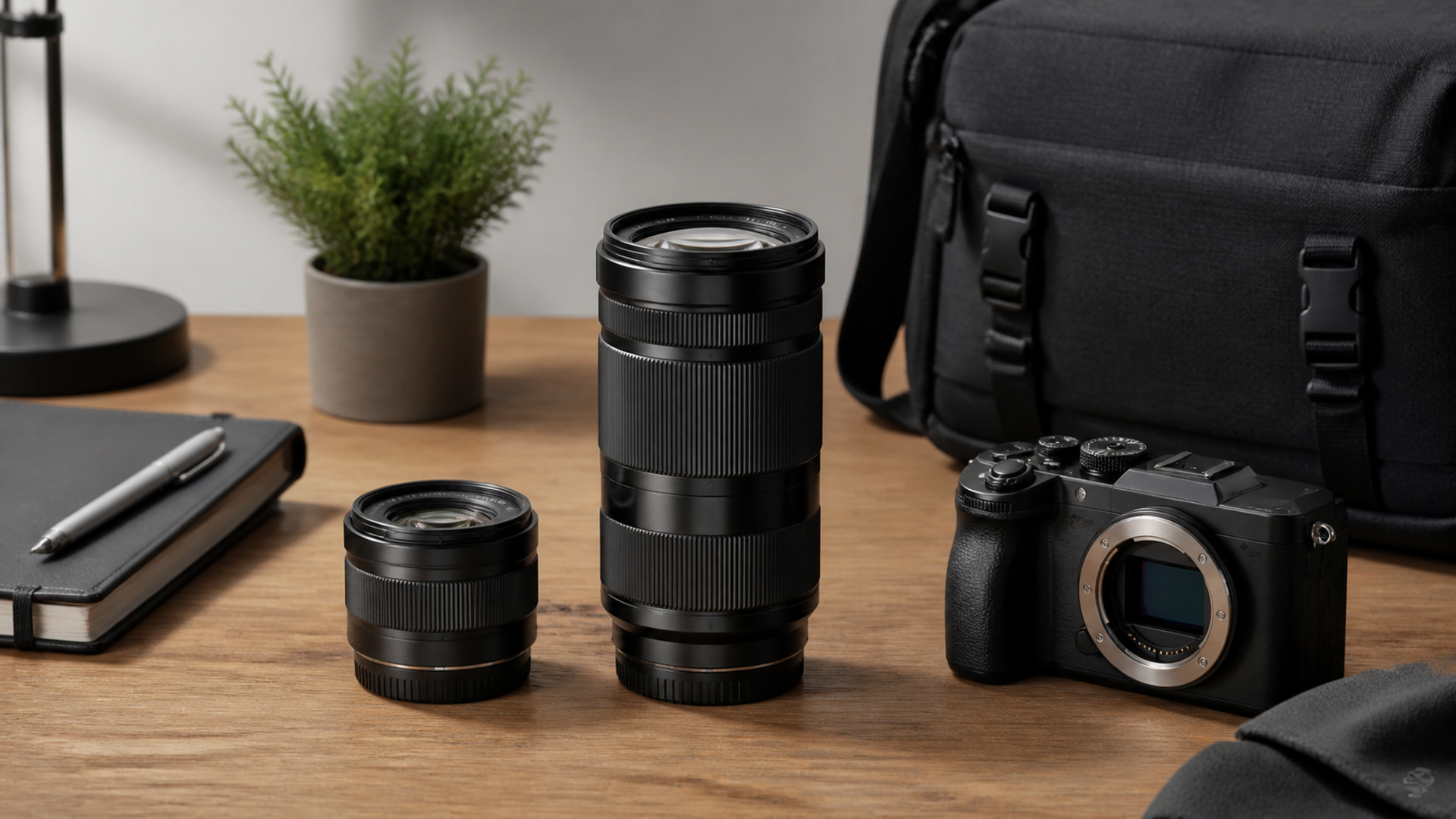
A prime lens has one focal length; a zoom covers a range. That difference affects framing speed, aperture, size, weight, optical design and how a photographer moves. Modern examples in either category can be excellent, so the decision should begin with repeated subjects, working distance, light, output and the number of lenses actually carried.
Begin with the shot list
Choose a prime when a useful focal length, faster aperture, compact size or deliberate way of seeing outweighs framing flexibility. Choose a zoom when changing distance or subjects demand rapid composition and fewer lens swaps. Keep the current lens when lighting, position, focus technique or support is the true limitation.
| Decision factor | Prime lens | Zoom lens | Keep the current lens |
|---|---|---|---|
| Framing | Photographer can move or anticipate | Variable distance requires reframing | Rehearse position and crop |
| Light | Wide aperture improves shutter or isolation | Stabilisation and high ISO cover assignment | Add light or support |
| Image quality | Exact prime is strong where used | Exact zoom is strong across used range | Compare final output |
| Weight | One compact prime stays mounted | One zoom replaces several lenses | Remove unused glass |
| Weather | Sealed construction fits conditions | Fewer changes reduce exposure | Improve change technique |
| Cost | One focal length earns repeated use | Range replaces purchases | Rent specialty lenses |
This prime lens vs zoom lens matrix is the article's working value object. Read the prime lens vs zoom lens rows together: the decisive failure mode depends on this topic's evidence, operating context and reader objective.
What fixed and variable focal length change
Evidence 1. Prime means fixed focal length, while zoom means variable focal length; neither term alone specifies aperture, sharpness or build.
Evidence 2. A wider maximum aperture can admit more light and reduce depth of field, but focus accuracy becomes more demanding.
Evidence 3. Zooms can reduce lens changes, while a set of primes may be heavier and costlier than one zoom.
Evidence 4. Performance varies by focal length, focus distance, aperture and body correction, so exact-model testing matters.
Reader-visible sources checked for this article:
nikonusa.com — reader-visible current or official evidence
usa.canon.com — reader-visible current or official evidence
For prime lens vs zoom lens, these sources establish only the claims inside their documented scope. Recheck every changeable specification, availability condition, price, policy or service term in the relevant market before acting.
Test the lens in the assignment
A buyer can resolve framing without starting from a brand preference. Ask whether photographer can move or anticipate; compare that with whether variable distance requires reframing; then use rehearse position and crop as the third route's safeguard. An unknown condition stays unknown.
On light, popularity is not enough. The evidence for option one is that wide aperture improves shutter or isolation. Option two means stabilisation and high ISO cover assignment. Option three is rational where add light or support. Recheck any changeable term immediately before commitment.
The decision changes at image quality. Choose the first path only if exact prime is strong where used; move to the second when exact zoom is strong across used range; use the third when compare final output. Save the downside that would make this row fail.
For weight, the first route works when one compact prime stays mounted; the second requires one zoom replaces several lenses. The control for the third is remove unused glass. Verify this row against the exact product, property, account or environment before it can reverse the decision.
The weather row exposes a practical boundary. Route one assumes sealed construction fits conditions, while route two is defensible only when fewer changes reduce exposure. Route three depends on improve change technique. If that evidence is absent, keep the more reversible option.
Read cost as a stop/go test: one focal length earns repeated use supports the first option; range replaces purchases supports the second; and rent specialty lenses supports the third. Record which source proves the condition and when it was checked.
Facts that would reverse the current choice
Reversal control 1 — Framing. Before choosing Prime lens, write down how the decision changes if “Photographer can move or anticipate” proves false. Do the same for Zoom lens and “Variable distance requires reframing”. Keep the Keep the current lens route available until “Rehearse position and crop” is verified. This control belongs to prime lens vs zoom lens; update it from the cited source or exact supplier rather than copying a generic checklist.
Reversal control 2 — Light. Before choosing Prime lens, write down how the decision changes if “Wide aperture improves shutter or isolation” proves false. Do the same for Zoom lens and “Stabilisation and high ISO cover assignment”. Keep the Keep the current lens route available until “Add light or support” is verified. This control belongs to prime lens vs zoom lens; update it from the cited source or exact supplier rather than copying a generic checklist.
Reversal control 3 — Image quality. Before choosing Prime lens, write down how the decision changes if “Exact prime is strong where used” proves false. Do the same for Zoom lens and “Exact zoom is strong across used range”. Keep the Keep the current lens route available until “Compare final output” is verified. This control belongs to prime lens vs zoom lens; update it from the cited source or exact supplier rather than copying a generic checklist.
Reversal control 4 — Weight. Before choosing Prime lens, write down how the decision changes if “One compact prime stays mounted” proves false. Do the same for Zoom lens and “One zoom replaces several lenses”. Keep the Keep the current lens route available until “Remove unused glass” is verified. This control belongs to prime lens vs zoom lens; update it from the cited source or exact supplier rather than copying a generic checklist.
Reversal control 5 — Weather. Before choosing Prime lens, write down how the decision changes if “Sealed construction fits conditions” proves false. Do the same for Zoom lens and “Fewer changes reduce exposure”. Keep the Keep the current lens route available until “Improve change technique” is verified. This control belongs to prime lens vs zoom lens; update it from the cited source or exact supplier rather than copying a generic checklist.
Reversal control 6 — Cost. Before choosing Prime lens, write down how the decision changes if “One focal length earns repeated use” proves false. Do the same for Zoom lens and “Range replaces purchases”. Keep the Keep the current lens route available until “Rent specialty lenses” is verified. This control belongs to prime lens vs zoom lens; update it from the cited source or exact supplier rather than copying a generic checklist.
Mine existing focal-length data
Review successful and missed images by focal length, subject and location. Note whether the zoom stayed near one position or whether its range prevented missed moments. Separate framing preference from kit-lens limitations. This record can reveal a natural prime focal length, a need for a wider zoom, or no equipment problem.
Create an assignment test
Photograph a real event, walk, portrait session or trip with rented candidates. Match final output and inspect focus consistency, flare, corners, close focus and handling. Do not compare a prime at its best aperture with a zoom wide open unless those are the settings the assignment requires.
Model movement and safety
Mark where the photographer can move and where barriers, crowds or ceremony rules prevent it. Perspective changes with camera position, not focal length alone, so stepping closer is not equivalent to zooming from one location. A prime can sharpen discipline but cannot create access.
Pack the complete system
Include hood, filters, support and backup. One heavy zoom may balance worse than two small primes, while three fast primes can occupy more space and invite changes. Check weather sealing and repair support. The right lens reaches the subject and returns usable files without exhausting the photographer.
Three camera bags
Controlled portraits
A fast prime can reward consistent distance and intentional depth. Define the fact that would reverse this recommendation before committing.
Unrepeatable event
A professional zoom protects framing when movement is constrained. Define the fact that would reverse this recommendation before committing.
Overloaded travel bag
Removing redundant lenses may solve the problem without a purchase. Define the fact that would reverse this recommendation before committing.
Action checklist
Define shot list.
Analyse focal lengths.
Map distances.
Set low-light need.
Compare apertures.
Test autofocus.
Inspect flare.
Weigh bag.
Check service.
Rent for assignment.
Continue the decision
The linked VERTU articles expand adjacent parts of the prime lens vs zoom lens decision. They do not substitute for the external evidence above.
The prime-zoom verdict
Choose a prime when a useful focal length, faster aperture, compact size or deliberate way of seeing outweighs framing flexibility. Choose a zoom when changing distance or subjects demand rapid composition and fewer lens swaps. Keep the current lens when lighting, position, focus technique or support is the true limitation.
Keep the prime lens vs zoom lens decision reversible until its material cost, safety, access, privacy and compatibility facts are verified. Unknown evidence stays unknown; it is never silently scored as favourable.